


No products in the cart.
Peptide Price Differences: 9 Powerful Reasons the “Same” Peptide Can Cost 10× More
Peptide price differences can be confusing.
You search for a specific research peptide and find one supplier selling a vial for $30 (€30) while another asks $300 (€300). Both products appear to have the same peptide name, the same sequence, the same stated milligram amount, and perhaps even the same “99% purity” claim.
So why is one ten times more expensive?
Is the expensive supplier simply adding an enormous markup?
Is the inexpensive supplier selling an inferior product?
Or are you actually comparing two materials that only appear identical on a product page?
After years of working around peptide sourcing, synthesis, quality documentation, analytical testing, and researcher requirements, I have learned that peptide price differences are rarely explained by one factor alone.
The real explanation is usually found in what the buyer cannot see from the product photograph or headline price.
The synthesis itself is only one part of the total cost. Purification, analytical testing, net peptide content, salt or counter-ion composition, manufacturing controls, documentation, packaging, storage, logistics, and batch consistency can all affect the final price.
This guide explains those hidden variables so researchers can compare peptide suppliers based on actual value rather than vial price alone.
Important: Research peptides are laboratory materials. Product specifications, testing requirements, and suitability depend on the intended research application. Analytical specifications should always be verified against the actual lot documentation rather than assumed from a supplier’s marketing description.
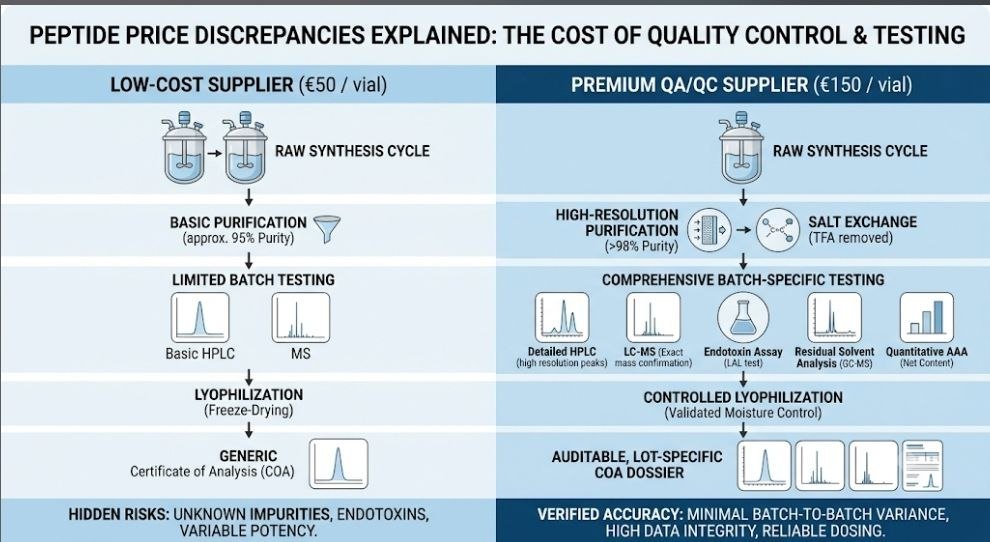
Table of Contents
Why Do Two Companies Sell the Same Peptide at Different Prices?
https://pubmed.ncbi.nlm.nih.gov/
The first thing to understand about peptide price differences is that a product listing does not tell you everything about the material inside the vial.
Two suppliers may use exactly the same peptide name but operate with completely different specifications.
For example:
- Supplier A: $30 (€30)
- Supplier B: $300 (€300)
At first glance, Supplier A appears to offer a 90% saving.
But suppose Supplier B provides lot-specific analytical testing, verified identity, documented purity, quantitative content information, controlled manufacturing, detailed traceability, and additional contaminant testing.
The comparison is no longer simply:
$30 vs. $300.
It becomes:
What exactly is included in the $30 material compared with the $300 material?
That distinction is at the heart of peptide price differences.
The peptide sequence is only one part of the product
A peptide has a defined amino acid sequence, but the finished research material can differ in several other ways.
Two products with the same sequence can differ in:
- Purity specification
- Analytical method
- Identity confirmation
- Counter-ion or salt composition
- Residual solvent profile
- Moisture content
- Net peptide content
- Endotoxin level
- Packaging
- Storage conditions
- Batch consistency
- Documentation
- Manufacturing controls
- Testing frequency
- Lot traceability
This is why experienced researchers do not evaluate peptide suppliers by price alone.
They evaluate price relative to evidence.
The Biggest Reason for Peptide Price Differences: Quality Control
One of the largest contributors to peptide price differences is quality assurance and quality control.
Peptide synthesis can produce a mixture containing the desired sequence along with truncated sequences, deletion products, side products, protecting-group remnants, and other related impurities.
Purification removes unwanted components.
Analytical testing then helps determine what was actually produced.
That second part can become expensive.
Why analytical verification costs money
A serious quality-control program may involve several analytical techniques, depending on the peptide and intended research specification.
These can include:
- Reverse-phase HPLC
- LC-MS or mass spectrometry
- Endotoxin testing
- Residual solvent analysis
- Heavy-metal analysis
- Water or moisture testing
- Quantitative peptide-content analysis
- Counter-ion analysis
- Other specialized characterization methods
Every additional test requires laboratory time, equipment, qualified personnel, consumables, standards, data review, and documentation.
Consequently, peptide price differences can reflect differences in how much analytical evidence accompanies the material.
A supplier offering a basic certificate may have a very different cost structure from one commissioning extensive lot-specific testing.
Generic COA vs. lot-specific COA
This is one of the first questions I recommend asking.
Is the COA specific to the lot you are purchasing?
A useful lot-specific COA should normally contain identifying information that connects the analytical report to the actual production batch.
Look for:
- Product name
- Lot or batch number
- Manufacturing information
- Testing date
- Specification
- Analytical result
- Testing method
- Laboratory identification
- Relevant chromatograms or spectra
- Appropriate report or sample identifiers
A generic document that could theoretically accompany every batch provides much less information than a report tied to the exact lot.
That difference contributes to peptide price differences.
Purity Is Not the Same as Identity
One of the most important lessons when comparing peptide suppliers is this:
Purity and identity answer different questions.
HPLC asks: “How much chromatographically detectable material behaves like the target under this method?”
Mass spectrometry asks: “Does the observed molecular mass correspond to the expected molecule?”
These are complementary measurements.
A supplier may advertise:
“≥99% HPLC purity.”
That sounds impressive.
But the number needs context.
Which HPLC method was used?
What was the gradient?
What column was used?
What wavelength was monitored?
What peaks were integrated?
Was the method capable of resolving the relevant impurities?
Was identity separately confirmed?
This is why a single percentage should never be treated as the complete quality story.
Why the number “99%” can be misleading without context
An HPLC purity percentage is dependent on the analytical method.
Closely related compounds can sometimes be difficult to separate chromatographically.
For certain peptides, impurities may have very similar retention behavior to the desired sequence.
Therefore, the correct question is not simply:
“Is it 99%?”
The better question is:
“99% according to which validated or appropriately developed method, and what independent evidence confirms identity?”
That distinction can explain substantial peptide price differences.
What Mass Spectrometry Adds
Mass spectrometry provides information that HPLC alone does not provide.
For peptide identity confirmation, the laboratory can compare observed mass-to-charge information with the expected molecular mass.
The precise acceptance criteria depend on:
- Instrument type
- Calibration
- Peptide molecular weight
- Ionization mode
- Mass analyzer
- Analytical method
- Whether monoisotopic or average mass is being considered
For this reason, there is no universal “one-number” tolerance that applies to every peptide and every instrument.
The important principle is that the analytical result should be consistent with the expected molecular identity within the laboratory’s appropriate analytical criteria.
That is a much stronger statement than simply claiming a high HPLC percentage.
Why Higher Purity Can Increase Peptide Cost
Another major contributor to peptide price differences is purification.
The crude product obtained after synthesis is not necessarily the final research-grade material.
Purification separates the desired peptide from related impurities.
As the required purity specification becomes more demanding, purification can become increasingly difficult.
The economics of purification
Imagine a synthesis produces a crude mixture containing the desired peptide plus numerous related compounds.
A purification process may recover a certain amount of target material.
However, every purification step can result in additional material loss.
When a specification moves from a moderate purity level to a much higher purity level, the manufacturer may need:
- Additional chromatographic purification
- More analytical monitoring
- More fractions
- Additional pooling decisions
- More solvent
- More processing time
- Greater yield loss
The final amount of usable peptide can therefore become much smaller.
That increases the manufacturing cost per finished milligram.
Why long and complicated peptides can be especially challenging
Peptide synthesis becomes more demanding as sequence length and complexity increase.
Potential problems can include:
- Incomplete coupling
- Deletion sequences
- Side reactions
- Aggregation during synthesis
- Difficult purification
- Oxidation-sensitive residues
- Deamidation
- Disulfide-related issues
- Stereochemical impurities
- Difficult folding or structural behavior
The exact challenges depend heavily on the peptide sequence.
Therefore, two suppliers may quote very different prices even when their product pages display the same peptide name.
Salt Form and Counter-Ions Can Change the Price
Another frequently overlooked contributor to peptide price differences is counter-ion composition.
Many synthetic peptides are initially isolated in a salt form associated with the reagents and purification process.
Trifluoroacetate (TFA) is commonly encountered in peptide chemistry.
The finished material may therefore require additional processing depending on the desired specification and application.
Why counter-ion information matters
The counter-ion contributes to the total mass of the isolated material.
Consequently, the mass of a lyophilized cake is not necessarily identical to the mass of the peptide sequence itself.
Depending on the product specification, researchers may need information about:
- Counter-ion identity
- Counter-ion content
- Residual TFA
- Moisture
- Other formulation components
A supplier that performs additional counter-ion exchange may incur extra:
- Processing time
- Solvent use
- Labor
- Analytical testing
- Yield loss
That can increase the final price.
Does TFA automatically mean a peptide is bad?
No.
This is an important correction to simplistic peptide marketing.
The presence of TFA does not automatically make a research peptide unsuitable for every experiment.
Its significance depends on:
- Concentration
- Peptide
- Research model
- Buffer system
- Cell type
- Experimental conditions
- Required specification
The scientifically responsible approach is to know what counter-ion is present and whether it is compatible with the intended research application.
That is much more useful than saying that one salt form is universally good and another is universally bad.
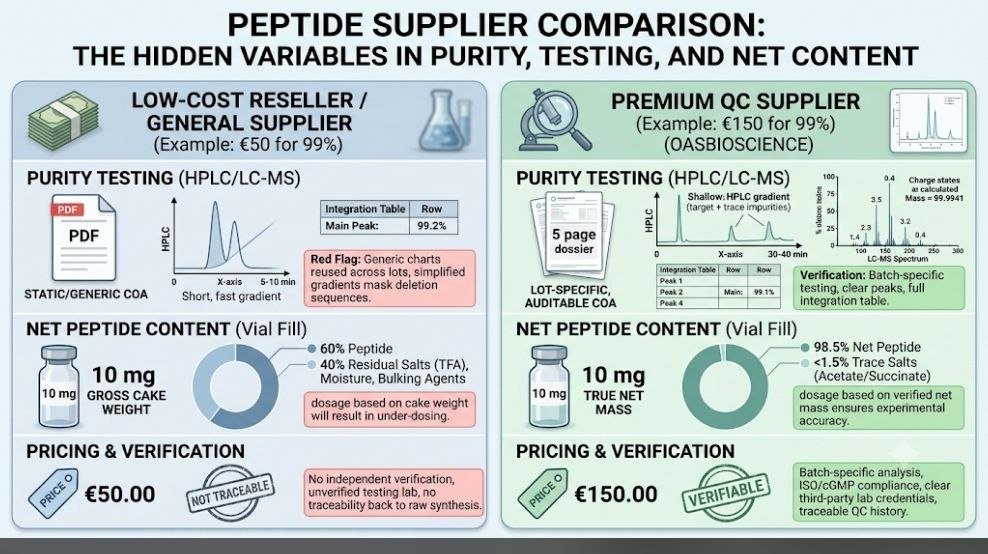
Net Peptide Content vs. Gross Lyophilized Weight
This is one of the most important areas where peptide price differences can become misleading.
Suppose two suppliers both advertise:
10 mg peptide
That statement requires clarification.
Does “10 mg” mean:
- 10 mg of total lyophilized material?
or
- 10 mg of quantified peptide content?
Those are not necessarily equivalent.
What can contribute to lyophilized mass?
Depending on formulation and processing, a dried peptide preparation can contain:
- Target peptide
- Counter-ions
- Bound or residual water
- Other formulation components
- Potential residual processing materials
Therefore, the actual peptide content can differ from the gross mass of the lyophilized product.
This is why buyers should ask:
“Is the stated milligram quantity based on gross fill weight or quantified net peptide content?”
That single question can reveal significant differences between apparently similar products.
An Illustrative $50 vs. $150 Example
Consider two hypothetical 10 mg products.
Supplier A
Price: $50 (€50)
Suppose analytical characterization determines that the preparation contains 60% target peptide by mass.
Illustrative active peptide:
6 mg
Effective price:
$50 ÷ 6 mg = $8.33 per mg
Supplier B
Price: $150 (€150)
Suppose the preparation contains 95% target peptide by mass.
Illustrative active peptide:
9.5 mg
Effective price:
$150 ÷ 9.5 mg = $15.79 per mg
Supplier B is still more expensive.
But the apparent three-fold price difference does not tell the whole story.
This example is illustrative rather than a claim about typical market percentages.
The lesson is simply that researchers should compare verified content and specification, not just the number printed on the front of a vial.
Testing Costs Behind Peptide Price Differences
Testing is another major reason for peptide price differences.
Different laboratories may choose different analytical packages.
A basic research material might have a limited analytical specification.
A more comprehensively characterized lot may have several independent assays.
1. RP-HPLC
Reverse-phase HPLC is widely used to assess peptide purity.
Researchers should examine the actual chromatogram when available.
Look for:
- Clearly labeled axes
- Retention time
- Run duration
- Main peak
- Integration information
- Additional peaks
- Appropriate method information
The percentage alone is less informative without seeing how it was generated.
2. LC-MS
LC-MS can provide evidence supporting molecular identity.
The observed mass should be consistent with the expected peptide under the analytical method used.
It can also provide evidence of additional molecular species that warrant investigation.
3. Endotoxin Testing
Endotoxin testing can be important for biological research applications where endotoxin contamination could interfere with experimental results.
The result should be reported quantitatively when appropriate, rather than merely saying:
“Passed.”
The acceptable specification depends on the intended application.
There is no single universal endotoxin threshold for every experiment.
That distinction is critical.
4. Residual Solvent Testing
Peptide synthesis and purification can involve organic solvents.
Depending on the manufacturing process, examples can include:
- DMF
- Dichloromethane
- Acetonitrile
- Other process solvents
Residual solvent testing can help determine whether relevant residues remain within the applicable specification.
5. Heavy Metal Testing
Depending on the manufacturing route and application, laboratories may also investigate trace metals.
ICP-MS can be used for highly sensitive elemental analysis.
Again, whether this is required depends on the product specification and intended use.
6. Quantitative Peptide Content
A purity percentage does not automatically tell you how much peptide is physically present in the vial.
A separate quantitative assay may therefore be useful.
Potential approaches include:
- Amino acid analysis
- Quantitative UV methods
- Other validated analytical approaches
The appropriate method depends on the peptide and laboratory requirements.
This is another area where peptide price differences can reflect the analytical work behind the product.
Why Manufacturing and Supply Chain Matter
The manufacturing environment is another source of peptide price differences.
A supplier’s position in the supply chain affects the final price.
A company may:
- Manufacture directly
- Work with a contracted manufacturer
- Purchase from a wholesaler
- Act as a distributor
- Purchase bulk material and repackage it
- Commission custom synthesis
Each model has different overhead and quality-control responsibilities.
Facility costs matter
A highly controlled manufacturing operation can involve significant costs associated with:
- Facility maintenance
- Equipment qualification
- Calibration
- Environmental controls
- Documentation
- Personnel
- Cleaning
- Validation
- Batch records
- Quality systems
- Traceability
These costs ultimately affect pricing.
However, an important principle is:
A higher price does not automatically prove higher quality.
Likewise:
A lower price does not automatically prove poor quality.
Price is evidence of cost structure—not proof of quality.
The documentation must support the quality claim.
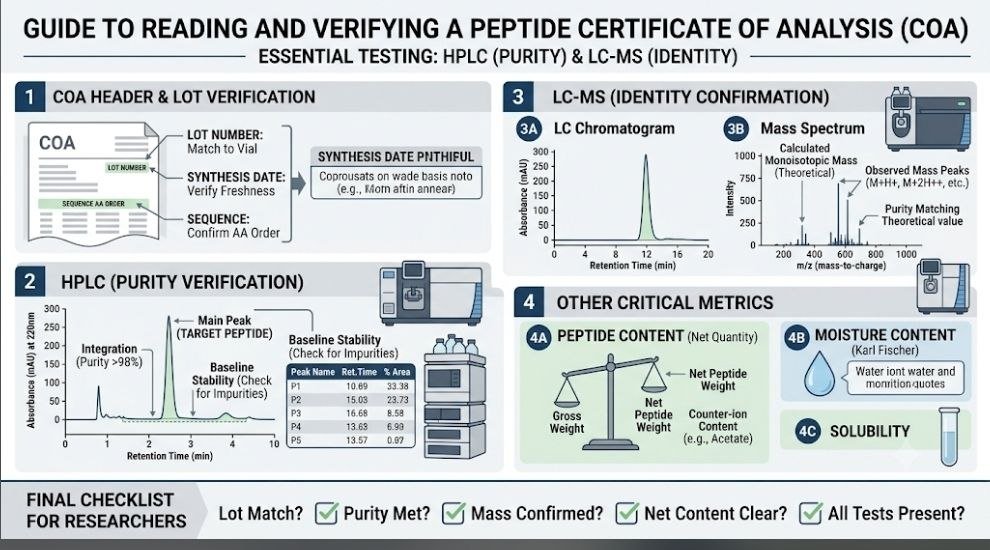
How to Read a Peptide COA
A Certificate of Analysis should be treated as an analytical claim that needs verification, not as a marketing certificate.
This is one of the most valuable skills a researcher can develop when evaluating peptide price differences.
Step 1: Check the lot number
The lot number on the vial should correspond to the lot number on the COA.
If they do not match, stop and investigate.
Step 2: Check the testing date
Look at:
- Manufacturing date
- Testing date
- Expiration or retest information where applicable
A document that appears unchanged across multiple batches deserves additional scrutiny.
Step 3: Examine the HPLC chromatogram
Don’t look only at the percentage.
Inspect:
- X-axis
- Y-axis
- Retention time
- Integration table
- Main peak
- Secondary peaks
- Baseline
- Method conditions where provided
A chromatogram should be interpretable.
Step 4: Examine the MS data
Ask whether the reported molecular mass supports the claimed identity.
If the supplier provides only a purity percentage but no meaningful identity evidence, the documentation is incomplete from an identity-verification perspective.
Step 5: Look for quantitative endotoxin information when relevant
“Negative” or “Pass” is less informative than a quantitative result when quantitative endotoxin testing is applicable.
The specification should correspond to the intended research use.
Step 6: Determine how the milligram quantity was established
Ask:
“Is this gross lyophilized mass or quantified peptide content?”
This can have a major effect on the true economics of the purchase.
Red Flags When Comparing Peptide Suppliers
The following warning signs deserve attention.
Red Flag #1: Every batch has exactly the same chromatogram
If several supposedly independent lots have indistinguishable chromatograms—including identical peak shapes and noise patterns—ask whether the documentation is genuinely lot-specific.
Red Flag #2: “100.00% purity”
Absolute purity claims deserve scrutiny.
Analytical purity is method-dependent, and trace-level impurities can be difficult to characterize.
A claim of exactly 100.00% should therefore prompt questions about the method and reporting convention.
Red Flag #3: No identity data
A purity percentage alone does not establish molecular identity.
Look for appropriate identity confirmation.
Red Flag #4: Unclear testing laboratory
If a third-party laboratory is claimed, the report should contain enough information to establish that the test is attributable to that laboratory and the relevant sample.
Red Flag #5: No lot number
A COA that cannot be connected to a specific batch provides limited assurance.
Red Flag #6: No information about content basis
If a product says “10 mg” but never explains whether that is gross or quantified peptide content, ask.
Red Flag #7: Marketing focuses entirely on price
A supplier that talks endlessly about being the cheapest but provides little technical documentation may be asking customers to compare the wrong variable.
Three Anonymized Case Studies
The following examples are presented as anonymized/composite research scenarios based on the types of quality problems that can arise when analytical characterization is limited. They should not be interpreted as claims about a particular competitor.
Case Study 1: Same HPLC Purity, Different Endotoxin Results
A research laboratory purchased two preparations of a custom peptide.
Both suppliers advertised approximately 98–99% HPLC purity.
On paper, the products appeared comparable.
However, additional analysis revealed a major difference in endotoxin burden.
One material showed a very low quantitative endotoxin result.
The other showed a substantially higher result.
The lesson was straightforward:
HPLC purity does not measure endotoxin.
A peptide can have a strong chromatographic purity result while still requiring separate evaluation for contaminants that the HPLC method does not measure.
For biological experiments, that distinction can matter enormously.
Case Study 2: Same “10 mg” Label, Different Content
Two suppliers sold a peptide as a 10 mg vial.
Both advertised high HPLC purity.
Additional quantitative analysis showed that the amount of target peptide relative to total dry mass was different between the two preparations.
One material had substantially higher quantified peptide content.
The second contained a larger contribution from non-peptide mass.
The researchers had initially compared:
10 mg vs. 10 mg.
After characterization, they realized they were not necessarily comparing identical quantities of target peptide.
The lesson:
Always clarify what the milligram specification actually represents.
Case Study 3: A Clean Main Peak Requires More Investigation
A longer peptide was purchased from two suppliers.
Both provided chromatograms showing a dominant primary peak.
Additional analytical work was performed on the materials.
The results indicated that one material required further investigation because structurally related species were not completely resolved under the initial chromatographic method.
This demonstrates why analytical method development matters.
A single clean-looking peak does not automatically mean that every possible structurally related impurity has been excluded.
The lesson is not that HPLC is unreliable.
The lesson is that analytical methods have limitations, and sophisticated research sometimes requires complementary techniques.
The Hidden Cost of a Cheap Peptide
This is where the economics of peptide price differences become particularly important.
Suppose a researcher purchases a peptide for:
$50 (€50).
It looks like a bargain.
But then imagine that the material produces unexpected experimental variability.
The laboratory spends:
- $1,000 (€1,000) on assay materials
- Three weeks of researcher time
- Additional cell culture costs
- Repeat analytical testing
- Additional reagents
- Instrument time
The original $50 purchase is no longer the meaningful number.
The actual cost is the cost of the material plus the consequences of uncertainty.
This does not mean expensive products never fail.
They can.
It means that researchers should consider the cost of uncertainty when evaluating suppliers.
A $50 vs. $150 Peptide Example
Let’s consider a hypothetical comparison.
Budget supplier
$50 / €50 per vial
Documentation:
- Basic COA
- Limited analytical information
- Unclear net content
- Limited contaminant data
Higher-tier supplier
$150 / €150 per vial
Documentation:
- Lot-specific HPLC
- Identity confirmation
- Quantitative endotoxin result where applicable
- Content specification
- Counter-ion information
- Detailed traceability
The second supplier costs three times more.
But the correct question is not:
“Why is Supplier B charging three times as much?”
Instead ask:
“What additional manufacturing, testing, documentation and material specifications account for the difference?”
If the additional $100/€100 buys meaningful evidence and reduces uncertainty, the premium may have a rational economic explanation.
If there is no meaningful difference in specifications or documentation, then the higher price may simply represent a higher commercial margin.
This is the correct way to think about peptide price differences.
A Practical Peptide Supplier Comparison Checklist
Before purchasing, compare suppliers using the following checklist.
| Factor | Question to Ask |
|---|---|
| Identity | Is molecular identity independently confirmed? |
| HPLC | Is the chromatogram lot-specific? |
| Purity | What analytical method generated the percentage? |
| Content | Is the mg value gross or quantified peptide content? |
| Counter-ion | What salt/counter-ion form is supplied? |
| Endotoxin | Is quantitative testing available when relevant? |
| Solvents | Are residual solvents characterized when required? |
| Metals | Is elemental analysis available when relevant? |
| COA | Does the COA match the physical lot? |
| Laboratory | Is the testing laboratory identifiable and verifiable? |
| Traceability | Can the lot be traced through the supply chain? |
| Consistency | Is there evidence of batch-to-batch control? |
| Storage | Are storage and handling specifications documented? |
| Price | What exactly does the price include? |
This checklist makes peptide price differences much easier to understand.
What Researchers Should Ask Before Ordering
If you are comparing two peptide suppliers, ask these questions directly.
Question 1: Is the COA specific to my lot?
If the answer is unclear, investigate further.
Question 2: How was purity determined?
Ask for the analytical method and chromatogram where available.
Question 3: How was identity confirmed?
Look for appropriate mass-spectrometric or other identity evidence.
Question 4: What does the stated milligram amount represent?
Is it gross lyophilized material or quantified peptide content?
Question 5: What is the counter-ion or salt form?
This can matter for certain experimental systems.
Question 6: Is endotoxin testing available?
For biological research where endotoxin could influence results, this can be an important specification.
Question 7: Can the laboratory verify the analytical report?
If a third-party test is claimed, ask for sufficient information to authenticate it.
Question 8: What happens if the material fails specification?
Understand the supplier’s quality and replacement policy before ordering.
How OasBioScience Approaches Peptide Quality
At OasBioScience, our philosophy is simple:
Researchers should not have to evaluate peptide quality using price alone.
The goal is to provide information that helps customers understand what they are purchasing and why specifications matter.
Our approach emphasizes the principles that experienced researchers should expect from a serious peptide supplier:
Transparency
We believe analytical information should be presented clearly rather than hidden behind marketing language.
Lot traceability
The ability to connect material to its corresponding batch documentation is fundamental to quality assurance.
Analytical evidence
HPLC purity is valuable, but it should be considered alongside appropriate identity and quality information.
Researcher education
A supplier should not simply say:
“Our peptide is 99% pure.”
A responsible supplier should help customers understand what that statement actually means.
Value rather than artificial cheapness
Our objective is not to win a race to the lowest sticker price.
The objective is to provide research materials supported by appropriate specifications and documentation.
You can learn more about OasBioScience and its peptide research products at OasBioScience.
Continue Learning: If you found this guide helpful, you may also want to read our previous peptide education articles covering the following topics
• Does adding more diluent make peptides weaker?
• Peptide vendor documents explained
• Explore 9 evidence-based facts about BPC-157
• How long should a weight loss cycle last?
• Can GLP-1 muscle loss be prevented?
• Discover the best peptide for obesity research.
• Which peptide suppresses appetite the most?
• Discover 9 powerful fixes for peptide foaming
• Learn how to read peptide Certificates of Analysis step by step.
• How Should Peptides Be Stored?
• Learn the correct peptide reconstitution process 2026
- Does adding more diluent make peptides weaker?
- Learn 7 powerful reasons why, how HPLC methods affect results
- Peptides warmed in transit are not automatically ruined
- How long can peptides stay unrefrigerated during shipping?
- Learn the complete peptide synthesis and manufacturing process
- HPLC vs Mass Spectrometry explained
- Can I use sterile water instead of bacteriostatic water?
- A 99% HPLC result can look impressive—but what does it really tell you?
- Why won’t my peptide dissolve?
Scientific Reference: For additional peer-reviewed information on peptide stability, sterile preparation, and pharmaceutical reconstitution practices, visit
European Medicines Agency (EMA)
National Center for Biotechnology Information (NCBI)
Why Peptide Price Differences Should Never Be Judged by Price Alone
When researchers see a $30 (€30) peptide next to a $300 (€300) peptide, it is tempting to assume one supplier is simply overcharging.
Sometimes that may be true.
But sometimes the price difference reflects genuine differences in:
- Purification
- Analytical testing
- Manufacturing controls
- Net content
- Salt form
- Documentation
- Traceability
- Packaging
- Batch consistency
- Quality assurance
The reverse is also true.
A high price does not automatically guarantee a high-quality peptide.
That is why the best purchasing decision comes from comparing evidence, specifications and total research value.
Frequently Asked Questions
1. Why are peptide prices so different between suppliers?
Peptide price differences can result from purification requirements, synthesis complexity, testing, manufacturing overhead, net peptide content, salt form, packaging, supply-chain structure, documentation, and quality-control requirements.
The same peptide name does not necessarily mean identical specifications.
2. Is a more expensive peptide always better?
No.
Price is not proof of quality.
A higher-priced peptide may have more comprehensive testing and documentation, but researchers should verify those claims through lot-specific analytical evidence.
The best approach is to compare specifications rather than assuming that expensive means better.
3. Does 99% HPLC purity mean the peptide is 99% pure?
Not necessarily in the broad sense people sometimes assume.
It means that, under the specified HPLC method and integration conditions, the reported chromatographic purity reaches that value.
It does not automatically quantify every possible contaminant, establish molecular identity, determine endotoxin content, or tell you the exact net peptide mass.
That is why HPLC should be interpreted in context.
4. What is the difference between HPLC and LC-MS for peptides?
HPLC is commonly used to separate components and estimate chromatographic purity.
Mass spectrometry provides molecular-mass information that helps support identity.
The two techniques answer different analytical questions and are often complementary.
5. Why should I care about the peptide’s salt or counter-ion form?
Counter-ions contribute to the total mass of a preparation and can influence formulation characteristics.
For some research applications, the counter-ion may also be relevant to experimental conditions.
Researchers should therefore know what form they are purchasing rather than assuming all preparations are chemically identical apart from the peptide sequence.
6. Does a 10 mg vial always contain 10 mg of peptide?
Not necessarily.
The answer depends on how the supplier defines and verifies the stated quantity.
Ask whether the specification refers to gross lyophilized mass or quantified peptide content.
This distinction can significantly affect comparisons between suppliers.
7. How can I tell whether a peptide COA is legitimate?
Start by checking whether the lot number on the COA matches the product.
Then examine the testing date, analytical methods, chromatograms, mass data, laboratory identification, and report identifiers.
If a third-party laboratory is named, the report should be independently verifiable where applicable.
8. Is the cheapest peptide always a bad choice?
No.
A lower price can result from legitimate economies of scale, larger production volumes, efficient manufacturing, lower overhead, or different testing specifications.
The problem is not necessarily the low price.
The problem is buying based on low price without understanding what the specification includes.
9. Why can longer peptides cost more?
Longer or more complex sequences can present greater synthesis and purification challenges.
The probability of synthesis-related impurities can increase with sequence complexity, and purification may become more difficult.
More difficult manufacturing can increase processing time and reduce final yield.
10. What should I compare besides peptide price?
Compare:
- Identity
- Purity method
- Lot-specific COA
- Net peptide content
- Counter-ion
- Endotoxin specification where relevant
- Residual solvents where relevant
- Traceability
- Batch consistency
- Testing laboratory
- Storage requirements
- Supplier quality documentation
The goal is to determine what you actually receive for the price.
The Researcher’s Rule: Compare Evidence, Not Stickers
The most important lesson from peptide price differences is simple:
Price is what you pay. Verified specifications and data integrity are what you are actually buying.
A $30 (€30) vial may be an excellent value.
A $300 (€300) vial may be overpriced.
Or the $300 (€300) product may contain substantially more quality assurance and analytical evidence than the $30 (€30) alternative.
You cannot determine that from the price tag alone.
You have to investigate.
Ask for the lot-specific COA.
Check the HPLC data.
Verify identity.
Understand the content specification.
Ask about counter-ions.
Consider endotoxin testing when relevant.
Understand what testing is actually included.
And most importantly, compare products on the basis of defined specifications rather than marketing percentages.
Final Takeaway: What Really Explains Peptide Price Differences?
The biggest mistake a researcher can make is assuming:
Same peptide name = same product.
In reality, the peptide sequence is only one part of the equation.
Two suppliers can offer the same sequence while differing substantially in:
Synthesis → Purification → Testing → Content → Formulation → Documentation → Traceability → Price
That is why peptide price differences can be so dramatic.
The responsible way to compare suppliers is not to automatically choose the cheapest or most expensive option.
Instead, ask:
1. What exactly is being supplied?
2. How was identity confirmed?
3. How was purity measured?
4. Is the COA specific to the actual lot?
5. Does the stated milligram amount represent gross mass or quantified peptide content?
6. What counter-ion or salt form is present?
7. What additional quality tests are available?
8. Can the analytical documentation be verified?
9. What evidence exists for batch consistency?
10. What does the price actually include?
Once you start asking these questions, the mystery behind peptide price differences becomes much easier to understand.
The goal should never be to pay the highest price simply because it sounds premium.
The goal is to obtain appropriate quality, appropriate documentation, and appropriate analytical evidence for the intended research application at a rational total cost.
That is the standard researchers should expect from the modern peptide supply industry.
And that is the philosophy behind OasBioScience: technical transparency, responsible quality documentation, and helping researchers make informed purchasing decisions rather than asking them to trust a number printed on a vial.
For more information about OasBioScience and our research peptide offerings, visit oasbioscience.com.

