
How Long Can Peptides Stay Unrefrigerated During Shipping? 7 Critical Facts You Need to Know In 2026

How Long Can Peptides Stay Unrefrigerated During Shipping?
How long can peptides stay unrefrigerated during shipping? There is no single number that applies to every peptide.
That is the most important answer.
A dry, lyophilized (freeze-dried) peptide is fundamentally different from a peptide that has already been reconstituted into a liquid. Temperature, humidity, formulation, sequence, packaging and duration of exposure can all influence stability.
For many properly manufactured and sealed lyophilized research peptides, a normal shipping excursion at approximately room temperature for several days is not automatically a reason to assume the material has been ruined. Published analytical work has even found that a lyophilized mixture containing 125 peptides maintained its analytical performance during room-temperature storage for up to 20 days under the study conditions, including successful transport without dry ice when sufficient desiccant was used.
But that does not mean every peptide can safely remain unrefrigerated for 20 days.
That distinction is critical.
A peptide’s actual stability must be considered in the context of its formulation and intended storage conditions. Regulatory stability guidance for biological products emphasizes that temperature, oxidation, light, ionic conditions and other environmental factors can affect proteins and polypeptides, while FDA guidance also stresses that temperature excursions should be evaluated using actual time-and-temperature exposure and product-specific stability information.
After more than two decades of working with peptides, including international shipping and third-party laboratory testing, one of the most common misconceptions I encounter is the idea that “refrigerated” automatically means “any unrefrigerated exposure is damaging.”
It is much more complicated than that.
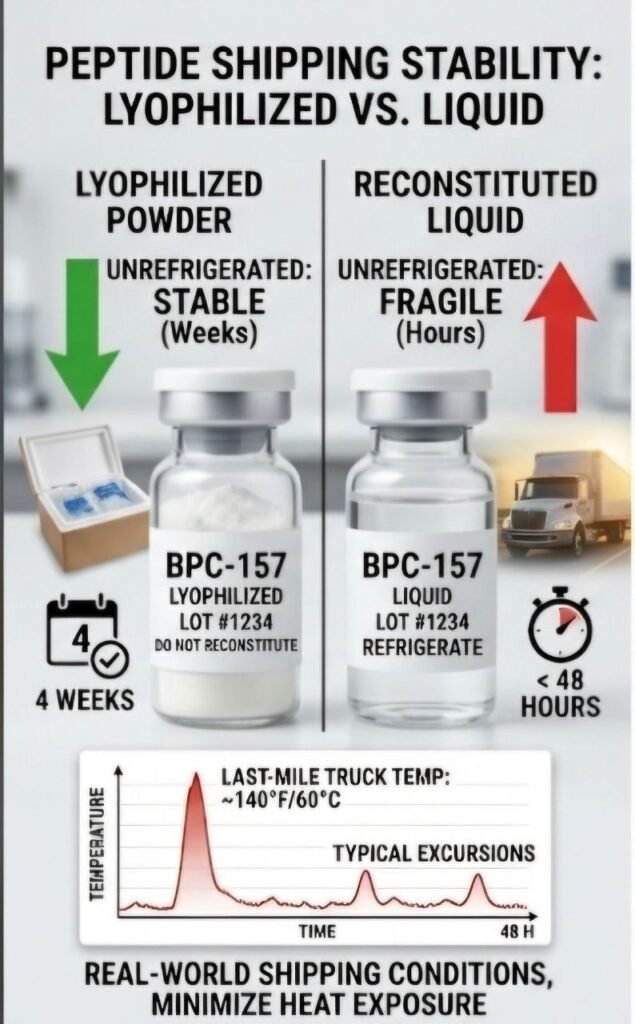
Table of Contents
Table of Contents
What Happens to a Peptide During Shipping?
A peptide does not suddenly become chemically unstable simply because it spends several hours outside a refrigerator.
Stability is a function of time, temperature, formulation and molecular structure.
Think of shipping exposure as a combination of stresses rather than a simple refrigerator-versus-room-temperature decision.
The five major variables are:
- Temperature
- Duration
- Physical state
- Moisture
- Peptide sequence and formulation
A package traveling internationally might experience 20–25°C during normal indoor transportation, significantly higher temperatures inside a vehicle or warehouse, or even freezing temperatures during winter transport.
The same peptide can therefore experience several different environments during one shipment.
This is why asking only, “Was it refrigerated?” does not provide enough information to determine whether the material remains suitable.
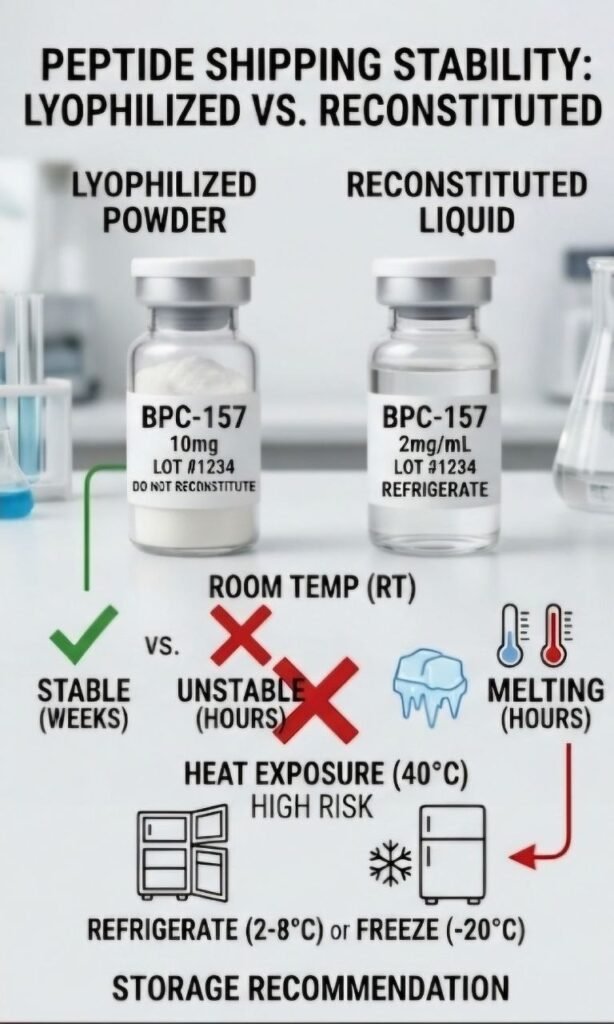
Lyophilized vs. Reconstituted Peptides
This is the most important distinction in understanding how long peptides can stay unrefrigerated during shipping.
Lyophilized Peptides
Lyophilization removes most of the water from the formulation.
The resulting dry material generally has considerably different stability characteristics from the same peptide dissolved in an aqueous solution.
Removing water can reduce several degradation pathways associated with the liquid state. Research on protein and peptide formulations has shown why the solid state is often preferred for storage, although lyophilization itself can also introduce physical stresses and does not make every molecule automatically stable.
This is why a properly sealed dry vial can sometimes tolerate a period of ambient transportation that would be inappropriate for a liquid formulation.
Reconstituted Peptides
Once a peptide is dissolved, the stability equation changes.
Water provides an environment in which chemical reactions and physical processes can occur more readily.
Depending on the peptide and formulation, these may include:
- Hydrolysis
- Deamidation
- Oxidation
- Aggregation
- Adsorption to surfaces
- Conformational changes
- Loss of biological activity
A published study of lyophilized PTH(1-34) illustrates this important point: stability after reconstitution varied substantially with concentration and temperature, and precipitation occurred in some samples during storage.
Therefore:
A dry peptide surviving a shipping excursion does not mean the same peptide will have the same tolerance after reconstitution.
How Long Can Lyophilized Peptides Stay Unrefrigerated?
For properly manufactured, dry, sealed lyophilized research peptides, several days at normal ambient temperature during shipping may be compatible with stability.
However, there is no scientifically responsible universal statement such as:
“Every peptide is safe for exactly 7 days unrefrigerated.”
That would be misleading.
The better approach is to divide shipping exposure into practical categories.
0–48 Hours at Normal Room Temperature
For many dry lyophilized peptides, a short excursion around normal room temperature is generally much less concerning than prolonged exposure to heat and humidity.
A shipment spending one or two days at approximately 20–25°C should not automatically be considered compromised solely because it was not refrigerated.
The exact conclusion, however, depends on the product’s validated storage requirements.
3–7 Days at Normal Ambient Temperature
This is a realistic international shipping window.
For many dry peptide preparations, several days of ambient transit may be tolerated when the vial remains dry, sealed and protected from excessive heat.
Published research provides a useful example: a lyophilized mixture containing 125 peptides showed no significant change in quantitative analytical performance during room-temperature testing for up to 20 days under the study conditions. The researchers also transported a lyophilized peptide mixture internationally without dry ice and found no significant difference in analytical performance.
That is useful evidence—but it should not be interpreted as a universal stability guarantee.
1–2 Weeks
At this point, the question becomes more formulation-specific.
A dry peptide that remains sealed and dry may tolerate an extended shipping period, but the actual temperature history becomes increasingly important.
A shipment traveling for 10 days at 20–25°C is very different from one sitting at 40°C in a warehouse.
Several Weeks
Long delays require considerably more caution.
A product should not be assumed to retain its original quality merely because it remains visually intact.
For high-value material, laboratory testing can provide a much stronger answer than visual inspection.
How Temperature Changes the Risk
Temperature is not simply “good” or “bad.”
The combination of temperature and time determines the exposure.
A few hours at 30°C is not equivalent to several weeks at 30°C.
Likewise, a brief temperature spike during transportation does not necessarily have the same impact as continuous storage at that temperature.
FDA stability guidance recognizes the importance of monitoring actual storage conditions and assessing the effect of excursions rather than treating every deviation identically.
Normal Room Temperature: Approximately 20–25°C
This is generally the least concerning shipping scenario for a dry, properly sealed lyophilized peptide.
The important question is whether the product’s specific storage specification permits the excursion.
Warm Conditions: Approximately 25–30°C
Risk begins to increase depending on duration and formulation.
This is particularly important for peptides with known chemical liabilities or formulations that are sensitive to moisture.
Hot Conditions: Approximately 30–35°C
Longer exposure deserves greater scrutiny.
The degradation rate of lyophilized materials can be temperature-dependent, and published stability literature emphasizes that degradation rates in lyophiles can change substantially with temperature.
Extreme Heat: Above 35°C
This is where shipping conditions become much more concerning.
A delivery truck or warehouse can become significantly hotter than the outdoor temperature.
A package exposed repeatedly to high heat for days should not be evaluated using the same assumptions as a package that spent three days at 22°C.
Why Moisture Can Matter More Than a Short Temperature Excursion
One of the most overlooked aspects of peptide shipping is moisture.
A dry lyophilized cake is not the same thing as a damp lyophilized cake.
Residual moisture, humidity and container-closure integrity can influence chemical stability.
Potential degradation pathways include:
Deamidation
Asparagine and glutamine residues can undergo deamidation under suitable environmental conditions.
The resulting chemical modification can alter chromatographic behavior and potentially affect biological properties.
Oxidation
Methionine and cysteine-containing sequences can be susceptible to oxidation.
Oxygen exposure, temperature and formulation can all contribute to oxidative degradation.
Hydrolysis
Water can participate in hydrolytic reactions.
This is one reason the transition from a dry powder to an aqueous solution is so important.
Aggregation
Some peptides and proteins can associate into larger species.
Temperature, concentration, formulation, pH and interfaces can all influence aggregation. Research reviews identify these factors as important contributors to peptide physical stability.
Therefore, when evaluating a warm shipment, don’t ask only:
“How hot did it get?”
Also ask:
“Was the peptide still completely dry?”
Which Peptides Are More Sensitive?
Not every peptide behaves the same way.
Sequence length is one factor, but it is not the only factor.
The more useful question is:
What chemical and structural vulnerabilities does this particular peptide have in its particular formulation?
Short Linear Peptides
Some relatively short linear peptides may have fewer structural complications than larger polypeptides.
However, short does not automatically mean indestructible.
A peptide’s specific residues, formulation, purity, moisture content and storage environment still matter.
Longer Peptides
Longer sequences can have additional sites for chemical modification and may possess more complex conformational behavior.
As molecular complexity increases, stability evaluation becomes more important.
Peptides Containing Oxidation-Prone Residues
Sequences containing methionine or cysteine can require additional consideration because oxidation can produce measurable chemical modifications.
Peptides Containing Deamidation-Prone Residues
Asparagine and glutamine can be susceptible to deamidation under appropriate conditions.
This is particularly relevant when temperature and moisture increase.
Peptides and Proteins With Complex Higher-Order Structure
Larger biological molecules can be particularly sensitive to temperature, agitation, oxidation and other environmental factors.
FDA’s ICH Q5C guidance specifically notes that proteins and polypeptides depend on molecular conformation and can be sensitive to temperature changes, oxidation, light, ionic conditions and shear.
What Happens During Hot International Shipping?
International shipping presents a unique problem.
A package does not experience one temperature from departure to delivery.
Instead, it may pass through:
Laboratory → warehouse → airport → aircraft → customs → distribution center → delivery vehicle → customer’s location
At each stage, conditions can change.
A customs delay can therefore create a much longer exposure than the original shipping estimate.
Summer Shipping
During hot weather, delivery vehicles and warehouses can become significantly warmer than the surrounding environment.
For this reason, responsible shipping protocols should focus on reducing temperature extremes rather than assuming that every package will remain at a fixed temperature.
Winter Shipping
Cold exposure is another consideration.
Freezing can be harmful to some formulations, particularly aqueous biological products.
This is another reason why “cold is always good” is not a scientifically adequate shipping philosophy.
The correct temperature range depends on the product.
How Peptide Shipping Packaging Protects Stability
Good packaging does more than keep a vial from breaking.
It controls the environment around the product.
1. Primary Vial
A properly selected glass vial and compatible closure provide the first barrier against environmental exposure.
2. Secondary Moisture Protection
For lyophilized material, protection from humidity is important.
A properly sealed secondary pouch and appropriate desiccant can reduce environmental moisture exposure.
3. Physical Protection
Foam inserts, vial holders and appropriate secondary packaging reduce the risk of breakage during transportation.
4. Thermal Protection
Insulated liners can slow the rate at which external temperature changes reach the product.
This does not necessarily mean that every dry peptide requires an active cold chain.
It means the packaging should be matched to the product’s stability requirements.
5. Temperature Monitoring
For sensitive or high-value shipments, temperature indicators or data loggers can provide valuable evidence of what happened during transportation.
That is far better than guessing from how warm the package felt when it arrived.
How to Tell Whether a Peptide Has Been Damaged
Visual inspection is useful, but it has limitations.
A vial can look normal while containing chemical degradation that cannot be seen with the naked eye.
Conversely, a lyophilized cake can look cosmetically different without necessarily demonstrating significant chemical loss.
Inspect the Vial
Check:
- Container integrity
- Stopper condition
- Aluminum seal
- Evidence of moisture
- Unusual discoloration
- Physical condition of the lyophilized cake
- Evidence of leakage or contamination
Inspect the Lyophilized Cake
A dry cake or powder that remains physically intact is generally more reassuring than a material that has become visibly wet, sticky or partially dissolved.
But appearance alone cannot establish purity.
Important warning
Do not assume:
“It looks white, therefore it is 100% intact.”
That is not an analytical conclusion.
HPLC and LC-MS: The Best Way to Verify Quality
When the stakes are high, analytical testing is more informative than appearance.
HPLC
Reverse-phase HPLC can help determine whether the primary peptide peak remains intact and whether additional peaks have appeared.
A simplified interpretation might look like:
Intact peptide → dominant main peak
versus
Degraded material → reduced main peak + additional degradation peaks
The exact interpretation depends on the validated analytical method.
LC-MS
Mass spectrometry can help determine molecular identity and detect certain modifications.
For example, an oxidation event may produce a mass shift consistent with addition of oxygen.
Deamidation can also produce characteristic mass and chromatographic changes.
However, these analytical observations should be interpreted by qualified laboratory personnel using an appropriate method.
Why One Test Is Not Always Enough
Peptide degradation can involve multiple mechanisms.
HPLC may identify chemical purity changes.
Mass spectrometry may provide molecular identity and modification information.
Other techniques may be required to investigate aggregation or particles.
Scientific literature emphasizes that peptide stability involves both chemical and physical processes, and different analytical techniques may be necessary to characterize them.
Real-World Shipping Case Study: A Severe Temperature Excursion
The following case study illustrates how a shipment can experience a serious temperature excursion without automatically proving complete product failure.
Important: This case should be presented as an anonymized/illustrative stability case unless the underlying laboratory report is available for publication.
The Scenario
A lyophilized peptide shipment was delayed internationally during summer conditions.
The shipment experienced approximately two weeks of transportation and customs delay.
Temperature monitoring indicated periods of significant heat exposure.
The package eventually arrived with the cooling material exhausted.
Initial Inspection
The vial remained sealed.
The lyophilized material showed some physical change but did not appear wet or contaminated.
That observation raised a question:
Was the peptide actually chemically degraded, or had the appearance changed without major loss of purity?
The correct answer required analytical testing.
HPLC Comparison
A control sample maintained under its intended storage conditions was compared with the temperature-exposed sample.
The analysis showed a reduction in the principal peak accompanied by an increase in minor secondary peaks.
That pattern would be consistent with some degree of chemical degradation rather than simply a cosmetic change.
LC-MS
Mass spectrometry can then help investigate whether the additional peaks correspond to specific chemical modifications, such as oxidation or deamidation.
The Lesson
The important lesson is not that a particular peptide can universally survive two weeks of extreme heat.
It is this:
A shipping excursion should be evaluated according to actual exposure and analytical evidence rather than an arbitrary number of unrefrigerated hours.
That principle is consistent with modern stability practice, where temperature excursions are assessed according to time, temperature and product-specific stability information.
What Researchers Should Do When a Shipment Arrives Warm
This is one of the most important sections for customers.
Step 1: Don’t Panic
A warm package does not automatically mean the peptide is ruined.
First determine:
- How long was the shipment in transit?
- Was the material lyophilized or liquid?
- Was there visible moisture?
- Was the package exposed to extreme heat?
- Was the container closure intact?
- Is temperature-monitoring information available?
Step 2: Inspect Before Reconstitution
Look at the vial and lyophilized material before adding anything.
Document unusual appearance with photographs.
Step 3: Follow the Product’s Specified Storage Conditions
Once received, place the material into the storage environment specified by the supplier or product documentation.
Do not invent a new storage protocol simply because the shipment arrived warm.
Step 4: Do Not Force a Conclusion From Appearance
A normal-looking cake is reassuring but does not prove analytical purity.
Likewise, a slightly altered cake does not automatically prove complete molecular destruction.
Step 5: Contact the Supplier
Provide:
- Order information
- Delivery date
- Transit duration
- Temperature information if available
- Photographs
- Packaging condition
- Any evidence of leakage or moisture
A responsible supplier should help determine the appropriate next step.
Step 6: Consider Analytical Testing
For valuable research materials or disputed shipments, laboratory analysis may be appropriate.
HPLC and LC-MS can provide substantially more information than visual inspection.
Common Shipping Mistakes to Avoid
Mistake #1: Assuming Every Peptide Requires Identical Cold-Chain Conditions
Different peptides and formulations have different stability profiles.
Mistake #2: Treating Room Temperature as a Single Temperature
20°C and 40°C are both technically “above refrigeration,” but they represent very different thermal exposures.
Mistake #3: Ignoring Moisture
Humidity and container-closure integrity can be critical for lyophilized materials.
Mistake #4: Assuming a Cold Pack Solves Everything
A gel pack inside an inadequately insulated package may provide little meaningful protection during prolonged transportation.
Insulation and thermal design matter.
Mistake #5: Judging Purity by Appearance Alone
A beautiful white cake is not an HPLC chromatogram.
Mistake #6: Assuming Refrigeration Can Reverse Degradation
Returning a degraded peptide to a refrigerator does not reverse chemical modification.
Refrigeration is a storage strategy—not a molecular repair mechanism.
Mistake #7: Applying Stability Data From One Peptide to Another
Published stability data for one formulation cannot automatically be transferred to another peptide.
Even the behavior of the same peptide can change with formulation, concentration and temperature.
Temperature × Time × Formulation Decision Matrix
The most useful way to think about how long peptides can stay unrefrigerated during shipping is to evaluate three variables simultaneously.
| Peptide condition | Temperature exposure | Duration | Practical interpretation |
|---|---|---|---|
| Lyophilized, sealed | ~20–25°C | 24–48 hours | Often a relatively low-risk shipping excursion |
| Lyophilized, sealed | ~20–25°C | 3–7 days | Common transit scenario; product-specific stability still applies |
| Lyophilized, sealed | ~25–30°C | 1–2 weeks | Increasingly formulation-dependent |
| Lyophilized, sealed | >35°C | Several days | Greater concern; evaluate actual exposure and stability data |
| Lyophilized, sealed | Extreme heat | Prolonged exposure | Analytical verification may be appropriate |
| Reconstituted liquid | ~20–25°C | Short excursion | Product-specific; stability may decline faster than dry material |
| Reconstituted liquid | Elevated temperature | Extended exposure | Higher risk; follow product-specific stability information |
| Protein/complex biologic | Outside specified range | Any significant excursion | Follow validated excursion data or manufacturer guidance |
This table is a risk framework, not a universal guarantee of purity or potency.
Frequently Asked Questions
FAQ 1: How long can peptides stay unrefrigerated during shipping?
There is no universal number.
For many properly sealed lyophilized peptides, several days at normal room temperature during transportation may not automatically cause significant degradation. However, stability depends on the peptide, formulation, moisture content, packaging and actual temperature exposure.
FAQ 2: Will 24 hours at room temperature ruin a lyophilized peptide?
Usually, a short room-temperature shipping excursion should not automatically be interpreted as product failure for a properly sealed lyophilized peptide.
However, the manufacturer’s or supplier’s specified storage conditions should always take priority.
FAQ 3: Can lyophilized peptides survive several days without refrigeration?
Many lyophilized preparations can tolerate short ambient shipping periods, and published research has demonstrated room-temperature stability for certain lyophilized peptide mixtures over periods of weeks under controlled study conditions.
That evidence should not be generalized to every peptide or formulation.
FAQ 4: Is a reconstituted peptide more sensitive to heat?
Generally, introducing water changes the stability environment and can accelerate certain chemical and physical degradation pathways.
The exact stability depends on the peptide, concentration, buffer, excipients, pH and storage temperature.
FAQ 5: What happens if peptides get hot during shipping?
The answer depends on how hot, how long, and what formulation was exposed.
Short exposure to moderate warmth may have little measurable effect in some dry formulations, while prolonged high-temperature exposure can accelerate oxidation, deamidation, hydrolysis or aggregation.
FAQ 6: How can I tell if a peptide was damaged during shipping?
Start with the container and physical appearance, but don’t rely on appearance alone.
For definitive quality assessment, appropriate laboratory methods such as HPLC and LC-MS can provide evidence of chemical purity, molecular identity and certain degradation products.
FAQ 7: Does freezing protect every peptide?
No.
Some products are designed for frozen storage, while others can be damaged by freezing or repeated freeze-thaw cycles.
The correct storage temperature is product-specific.
FAQ 8: Can refrigeration restore a peptide that was damaged by heat?
No.
Refrigeration can slow future degradation but does not reverse chemical modifications that have already occurred.
FAQ 9: Why is moisture important for lyophilized peptides?
Lyophilization removes water to produce a dry formulation, and moisture exposure can change the physical and chemical environment of the peptide.
For this reason, container-closure integrity and protection from humidity are important during shipping and storage.
FAQ 10: Should I discard a peptide simply because it arrived warm?
Not necessarily.
First determine the form of the peptide, duration and severity of the temperature excursion, packaging condition and product-specific storage requirements.
If quality is uncertain, contact the supplier and consider analytical testing rather than making a conclusion based solely on how warm the package felt.
Final Takeaway: Don’t Measure Peptide Stability With a Stopwatch Alone
So, how long can peptides stay unrefrigerated during shipping?
The best answer is:
There is no universal number.
For many dry, properly sealed lyophilized research peptides, ordinary room-temperature exposure during several days of transportation is not automatically catastrophic. Published research supports the idea that certain lyophilized peptide preparations can remain analytically stable at room temperature for extended periods under defined conditions.
But extreme heat, prolonged exposure, moisture ingress and formulation-specific vulnerabilities can change the outcome.
And once a peptide is reconstituted, the stability equation changes again.
The most reliable framework is:
FORM → TEMPERATURE → TIME → MOISTURE → FORMULATION → ANALYTICAL VERIFICATION
That is the approach I have found most useful throughout my experience supplying and working with peptides since 2003.
A shipping delay is not automatically a failed batch.
A warm package is not automatically a degraded peptide.
And refrigeration is not a magical reset button.
The scientifically responsible approach is to understand the material, document the excursion and use appropriate analytical evidence when the answer matters
A Note From OasBioScience
At OasBioScience, our approach to peptide quality goes beyond simply putting a vial in a package and hoping it arrives in good condition.
We emphasize proper handling, appropriate packaging, documentation and analytical quality assessment. For researchers evaluating peptide material, understanding the difference between lyophilized stability, reconstituted stability, shipping excursions and verified analytical purity is essential.
If you are researching peptide quality, documentation, HPLC results, LC-MS characterization or proper peptide handling, explore the educational resources and laboratory-quality information available through OasBioScience.
The goal should never be to tell a customer that a peptide is “fine” simply because it looks fine.
The goal is to understand why it should be considered stable—and, when necessary, demonstrate that conclusion analytically.
Continue Learning: If you found this guide helpful, you may also want to read our previous peptide education articles covering the following topics
• Does adding more diluent make peptides weaker?
• Peptide vendor documents explained
• Explore 9 evidence-based facts about BPC-157
• How long should a weight loss cycle last?
• Can GLP-1 muscle loss be prevented?
• Discover the best peptide for obesity research.
• Which peptide suppresses appetite the most?
• Discover 9 powerful fixes for peptide foaming
• Learn how to read peptide Certificates of Analysis step by step.
• How Should Peptides Be Stored?
• Learn the correct peptide reconstitution process 2026
- Does adding more diluent make peptides weaker?
- Learn 7 powerful reasons why, how HPLC methods affect results
Scientific Reference: For additional peer-reviewed information on peptide stability, sterile preparation, and pharmaceutical reconstitution practices, visit
