
How Long Should a Weight Loss Cycle Last? 7 Powerful Rules for Safe, Sustainable Results

Table of Contents
- How Long Should a Weight Loss Cycle Last?
- What Is a Weight Loss Cycle?
- Why There Is No Universal Weight Loss Cycle Length
- How Long Should a Weight Loss Cycle Last for Different Goals?
- The 7 Most Important Factors That Determine Weight Loss Cycle Length
- How to Know When Your Weight Loss Cycle Should End
- Weight Loss Plateaus: When to Continue and When to Reassess
- Weight Loss Cycles and GLP-1 Medications
- Why Weight Regain Happens After a Weight Loss Cycle
- Three Realistic Weight Loss Cycle Case Studies
- The Maintenance Phase: The Part Most People Ignore
- Common Weight Loss Cycle Mistakes
- A Practical Weight Loss Cycle Framework
- Frequently Asked Questions
- Final Takeaway
How Long Should a Weight Loss Cycle Last?
https://pubchem.ncbi.nlm.nih.gov
How long should a weight loss cycle last? There is no single number of weeks that works for everyone.
A weight loss cycle should last long enough to produce meaningful progress while preserving muscle, maintaining reasonable energy and performance, and improving the person’s ability to maintain the result afterward.
For one person, a structured weight loss cycle may last only four weeks.
For another, it may involve several months of progressive weight loss separated by maintenance or diet-break periods.
For someone using an FDA-approved medication for chronic weight management, the concept can be different altogether. Medications such as semaglutide and tirzepatide are not necessarily intended to be treated like a short bodybuilding-style “cycle.” Current FDA labeling describes approved weight-management use as supporting reduction of excess body weight and long-term maintenance of weight reduction.
That distinction is extremely important.
The biggest mistake I see is treating weight loss as a race with an arbitrary finish date.
After working in education, research-related supply, nutrition and weight-management discussions, and peptide-related education since 2003, and having worked with more than 10,000 people, I have repeatedly seen that the best outcomes rarely come from simply asking:
“How quickly can I lose the weight?”
A better question is:
“How long can I pursue meaningful fat loss while protecting my health, muscle, performance, and ability to maintain the result?”
That is the real question behind how long should a weight loss cycle last.
What Is a Weight Loss Cycle?
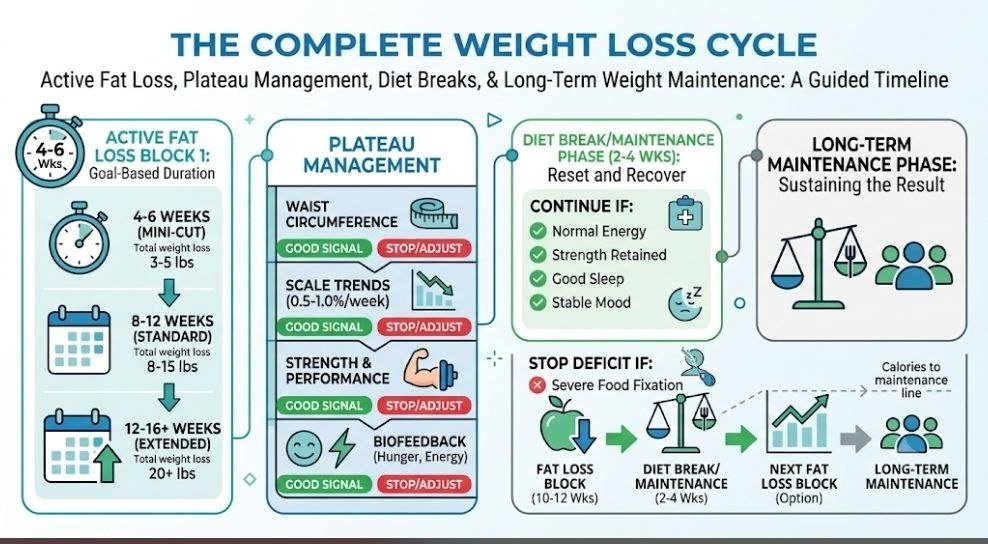
A weight loss cycle is the broader period beginning when someone intentionally starts losing excess body weight and ending when they transition into a sustainable maintenance phase.
It can contain several stages:
Planning → Active Weight Loss → Adjustment → Plateau Management → Maintenance Transition → Long-Term Maintenance
This is different from thinking of weight loss as simply “diet for 12 weeks and stop.”
A successful weight loss cycle should have an endpoint.
But the endpoint should be based on the person’s response rather than an arbitrary calendar date.
Weight Loss Cycle vs. Maintenance
This distinction is essential.
During active weight loss, the objective is generally to create a sustainable energy deficit.
During maintenance, the objective changes.
You are no longer primarily trying to make the scale go down.
Instead, you are trying to stabilize body weight, preserve lean mass, maintain activity, establish sustainable eating patterns, and determine whether the new body weight can actually be maintained.
This means the end of a weight loss cycle is not the end of the weight-management process.
It is the beginning of a different phase.
Why There Is No Universal Weight Loss Cycle Length
If you search online for how long should a weight loss cycle last, you will find recommendations ranging from four weeks to several months.
The problem is that many of these recommendations remove the individual from the equation.
Two people can start at exactly the same body weight and require completely different strategies.
Consider two individuals weighing 200 pounds.
Person A may have relatively low body fat, excellent training performance, and only wants to lose 8–10 pounds.
Person B may have obesity, significant metabolic risk factors, poor sleep, limited physical activity, and wants to lose 40–50 pounds.
It would make little sense to prescribe exactly the same weight loss cycle to both people.
Individual Response Matters
The appropriate duration depends on factors including:
- Starting body weight
- Body-fat level
- Weight-loss goal
- Rate of weight loss
- Muscle mass
- Training experience
- Nutrition quality
- Sleep
- Stress
- Appetite
- Physical activity
- Health markers
- Medication use
- Psychological response
- Ability to maintain the deficit
- Progress over time
This is why the best answer to how long should a weight loss cycle last is not simply “8 weeks,” “12 weeks,” or “16 weeks.”
The better answer is:
Long enough to achieve meaningful progress without allowing the costs of continued restriction to outweigh the benefits.
How Long Should a Weight Loss Cycle Last for Different Goals?
Different goals require different timelines.
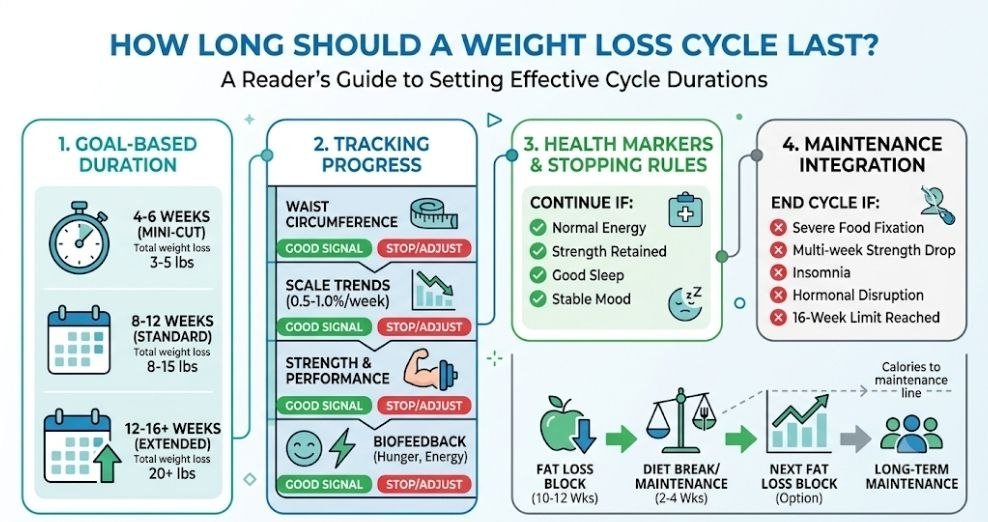
Short Weight Loss Cycle: Approximately 4–6 Weeks
A short cycle can make sense for someone who has a relatively small amount of fat to lose and already has a solid nutritional and training foundation.
This is sometimes called a mini-cut in fitness environments.
The objective is not massive weight loss.
The objective is a controlled reduction in excess fat followed by a return to maintenance.
A short cycle may be appropriate when:
- The amount of fat to lose is relatively small.
- Training performance is strong.
- Protein intake is adequate.
- Sleep is good.
- The person is already relatively lean.
- There is a clear reason for the short-term goal.
However, aggressive short-term approaches should not automatically be considered superior.
Rapid weight loss can increase fatigue and make adherence more difficult.
Moderate Weight Loss Cycle: Approximately 8–16 Weeks
This range is often more practical for a structured fat-loss phase.
An individual may spend several weeks in a moderate calorie deficit while monitoring:
- Weekly weight trends
- Waist circumference
- Training performance
- Hunger
- Sleep
- Energy
- Recovery
- Body composition
At the end of the phase, the person may transition into maintenance.
Importantly, 8–16 weeks should not be treated as a universal medical rule.
It is better understood as a useful planning framework for many structured dieting phases.
Longer Weight Loss Journey: Several Months or More
Someone with substantial excess weight may require a much longer overall journey.
That does not necessarily mean remaining in an aggressive calorie deficit continuously.
A better structure may look like:
Weight Loss Block → Maintenance/Diet Break → Weight Loss Block → Maintenance → Further Weight Loss if Appropriate
This approach can be more sustainable than trying to force one uninterrupted deficit.
For people using prescription anti-obesity medication, the overall treatment period may be considerably longer than a conventional dieting “cycle.” For example, FDA labeling for semaglutide and tirzepatide includes long-term weight reduction/maintenance rather than defining treatment as a fixed short cycle.
The 7 Most Important Factors That Determine Weight Loss Cycle Length
1. Your Starting Point
Starting body composition strongly influences how long weight loss can reasonably continue.
Someone carrying considerable excess body fat generally has more available energy reserves than someone already relatively lean.
That does not mean people with obesity should pursue unlimited aggressive dieting.
It means the appropriate strategy can be different.
2. Your Rate of Weight Loss
The scale should not be expected to fall at exactly the same speed every week.
Early weight loss can include substantial changes in:
- Glycogen
- Water
- Food volume
- Sodium
- Fat mass
Later, the rate may slow.
A slower rate does not automatically mean the weight loss cycle has failed.
The important question is whether the underlying trend is still moving in the desired direction.
3. Muscle Retention
A successful weight loss cycle should not be judged exclusively by the number on the scale.
If someone loses 20 pounds but sacrifices a substantial amount of lean tissue, the result may be considerably less desirable than losing 15 pounds while retaining muscle.
Resistance training and adequate protein can help support lean-mass retention during weight loss.
This is particularly important for people who plan to maintain their results for years rather than simply looking lighter temporarily.
4. Energy, Sleep and Recovery
A calorie deficit is a physiological stressor.
That does not make dieting inherently harmful.
But excessive restriction combined with poor sleep, high life stress and intense training can create a situation where continuing the weight loss cycle becomes counterproductive.
Warning signs can include:
- Persistent fatigue
- Poor sleep
- Significant decline in training performance
- Constant food preoccupation
- Irritability
- Reduced recovery
- Excessive hunger
- Reduced motivation
These signs should not simply be ignored because “the diet isn’t finished yet.”
5. Health Markers
For someone pursuing weight loss because of metabolic health concerns, body weight is only one measurement.
Depending on the individual and their clinician’s recommendations, relevant markers can include:
- Blood pressure
- Blood glucose
- HbA1c
- Lipid profile
- Waist circumference
- Sleep quality
- Physical activity
- Cardiometabolic risk factors
A person’s target should therefore be broader than a number on the bathroom scale.
6. Psychological Sustainability
This is one of the most overlooked factors in determining how long should a weight loss cycle last.
A strategy can be mathematically effective but practically unsustainable.
If someone is constantly thinking about food, unable to participate in normal social situations, exhausted from restriction, or repeatedly losing control around food, continuing the same approach indefinitely is unlikely to produce a durable result.
The goal is not merely to finish the deficit.
The goal is to reach maintenance successfully.
7. Your Ability to Maintain the Result
This may be the most important factor of all.
Suppose someone reaches their target weight after 16 weeks.
If they immediately return to the eating pattern, activity level and environment that caused the original weight gain, the weight loss cycle has not really solved the long-term problem.
The weight loss phase must therefore be connected to maintenance.
Weight loss is the intervention. Maintenance is the test of sustainability.
How to Know When Your Weight Loss Cycle Should End
Instead of relying on one number, I recommend thinking about three levels of stopping criteria.
Tier 1: Red Flags
These are signals that the current deficit may need to stop or be reassessed regardless of whether the original weight goal has been achieved.
Examples include:
Significant Performance Decline
If strength and training performance decline substantially and remain suppressed, the person may need to reassess energy intake, recovery and training load.
Severe Food Preoccupation
Constantly thinking about food, planning meals obsessively or experiencing intense cravings can indicate that the current strategy is becoming difficult to sustain.
Persistent Sleep Problems
Poor sleep can make hunger regulation, recovery and adherence more difficult.
Severe Fatigue
If normal daily activities become unusually difficult, the strategy deserves reassessment.
Significant Psychological Distress
Weight loss should not come at the expense of serious psychological deterioration.
Tier 2: Planned Endpoints
A weight loss cycle can also end because the original objective has been achieved.
Potential endpoints include:
- Target weight reached
- Meaningful waist reduction
- Desired body-composition improvement
- Health markers improved
- Sustainable eating habits established
- Training performance remains acceptable
- Appetite is manageable
- The person is ready to maintain
The scale is useful.
But it should not be the only measurement.
Tier 3: Diminishing Returns
Eventually, the benefit of continuing a calorie deficit may become smaller than the cost.
For example, imagine someone has lost substantial weight and is now losing only a small amount despite increasing fatigue, declining performance and worsening hunger.
At that point, the correct answer may not be:
“Make the deficit even more aggressive.”
It may be:
“Transition to maintenance, recover, reassess and decide whether another phase is actually necessary.”
Weight Loss Plateaus: When to Continue and When to Reassess
A plateau does not automatically mean that a weight loss cycle has failed.
This is one of the biggest misconceptions in weight management.
A Short Plateau Can Be Normal
Scale weight can temporarily remain unchanged because of:
- Water retention
- Increased training stress
- Sodium changes
- Menstrual-cycle fluctuations
- Constipation
- Increased glycogen
- Poor sleep
- Acute stress
Fat loss can sometimes continue while scale weight temporarily stays flat.
This is why looking at a single weigh-in can be misleading.
When a Plateau Deserves Investigation
A plateau becomes more interesting when:
- Several weeks pass with no meaningful downward trend.
- Waist measurements also stop changing.
- Dietary adherence has changed.
- Activity has decreased.
- Appetite has increased substantially.
- Medication response has changed.
- Energy expenditure has fallen.
- The original calorie target is no longer appropriate.
The answer is not automatically to slash calories.
First determine why the plateau occurred.
What to Do During a Weight Loss Plateau
A useful troubleshooting sequence is:
Step 1: Examine the multi-week weight trend.
Step 2: Check waist circumference.
Step 3: Review actual food intake rather than estimated intake.
Step 4: Review daily steps and general movement.
Step 5: Evaluate sleep and stress.
Step 6: Check resistance-training performance.
Step 7: Consider whether a maintenance period is appropriate.
Step 8: If medication is involved, discuss the response and treatment plan with the prescribing healthcare professional.
A plateau is information.
It is not automatically an instruction to eat less.
Weight Loss Cycles and GLP-1 Medications
This is where the question how long should a weight loss cycle last becomes especially important.
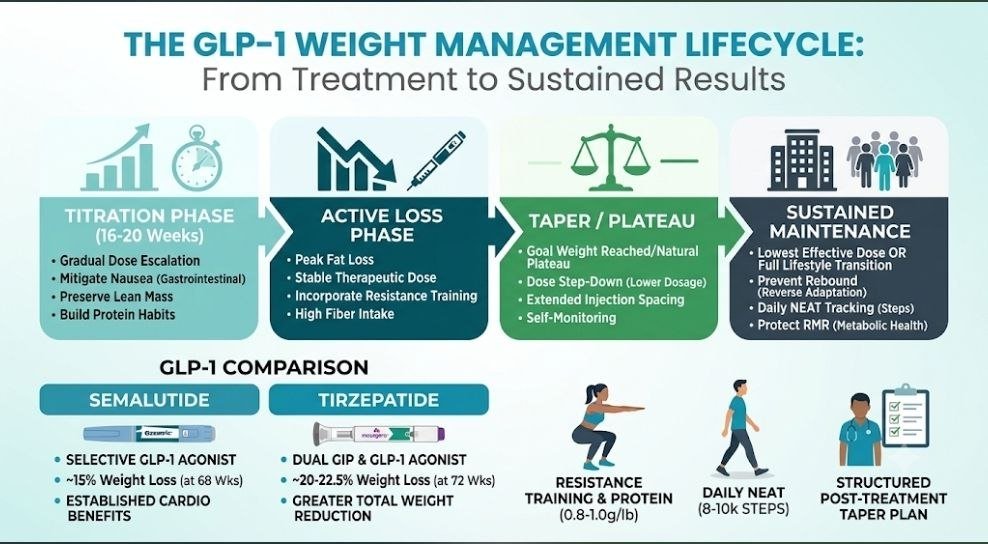
People often use the word “cycle” when discussing semaglutide, tirzepatide and other weight-management compounds.
But prescription anti-obesity medications should not automatically be treated like short-term bodybuilding cycles.
For example, FDA labeling describes Wegovy (semaglutide) for reducing excess body weight and maintaining weight reduction long term in indicated populations.
Similarly, Zepbound (tirzepatide) is indicated alongside reduced-calorie diet and increased physical activity to reduce excess body weight and maintain weight reduction long term in appropriate adults.
That means someone using one of these medications should not decide:
“I have completed 12 weeks, so I must stop.”
The correct treatment duration should be determined with a qualified healthcare professional based on factors such as:
- Response
- Tolerability
- Health status
- Treatment goals
- Weight trajectory
- Other medications
- Medical history
- Long-term maintenance needs
GLP-1 Treatment Is Not Simply a Short Weight Loss Cycle
The clinical evidence also demonstrates why maintenance matters.
In the STEP 1 extension, participants who discontinued semaglutide after the treatment period regained a substantial portion of their previous weight loss during the following year. The researchers concluded that obesity’s chronic nature can mean ongoing treatment is needed to maintain improvements for some patients.
This does not mean everyone must remain on medication forever.
It means that stopping effective treatment should be considered a clinical decision rather than an arbitrary deadline.
Why Weight Regain Happens After a Weight Loss Cycle
Weight regain is not simply a failure of willpower.
After significant weight loss, the body can respond through biological and behavioral mechanisms that make maintenance more difficult.
These can include:
- Increased appetite
- Changes in hunger and satiety signaling
- Lower energy expenditure because body mass has decreased
- Reduced spontaneous activity
- Return to previous eating environments
- Loss of dietary structure
- Loss of muscle mass
- Psychological fatigue
- Discontinuation of effective treatment
This is why the maintenance phase deserves as much attention as the active weight loss cycle.
What Happens When Semaglutide Is Stopped?
The STEP 1 extension provides an important example.
Participants who had received semaglutide and then stopped treatment regained a substantial amount of their prior weight loss during the following year. At week 120, approximately two-thirds of the weight lost during treatment had been regained on average.
This does not mean that weight regain is inevitable for every individual.
It demonstrates something more important:
Successful weight loss does not automatically create permanent biological protection against regain.
A maintenance strategy matters.
Three Realistic Weight Loss Cycle Case Studies
The following examples illustrate different ways a weight loss cycle can be structured.
They are illustrative case studies based on realistic patterns, not clinical trials or guarantees of individual results.
Case Study 1: The Moderate Single-Phase Cut
Starting Point
- Weight: 198 lb
- BMI: approximately 28.4
- Body fat: approximately 23%
- Goal: Lose 12–15 lb while preserving lean mass
- Duration: 10 weeks
Approach
The individual used approximately a 22% reduction in calorie intake, high protein intake, moderate carbohydrates around training and low-to-moderate dietary fat.
Training consisted of four weekly resistance-training sessions and approximately 8,000–10,000 steps per day.
Progress
During the first four weeks, body weight fell approximately 6 pounds.
Some of this early reduction represented water and glycogen changes in addition to fat loss.
During weeks five through seven, weight loss slowed to approximately 1–1.2 pounds per week.
During week eight, the scale remained unchanged for approximately 10 days.
Instead of immediately cutting calories further, activity was increased and a maintenance-calorie, carbohydrate-focused day was incorporated.
Final Result
The individual reached approximately 185 pounds, representing a 13-pound total reduction.
The individual then transitioned toward maintenance rather than continuing the deficit indefinitely.
Lesson
The important lesson isn’t that everyone should use a 10-week weight loss cycle.
The lesson is that the correct response to a short plateau is not always greater restriction.
Case Study 2: The Two-Block Weight Loss Cycle
Starting Point
- Weight: 245 lb
- BMI: approximately 35.1
- Body fat: approximately 34%
- Goal: Lose 35–40 lb
- Total period: 26 weeks
Instead of one uninterrupted deficit, the approach consisted of:
12-week weight loss block → 3-week maintenance/diet break → 11-week weight loss block
First Block
The individual used a conservative calorie deficit, high protein intake, high-fiber whole foods, three resistance-training sessions and low-impact cardiovascular activity.
Approximately 18 pounds were lost during the first 12 weeks.
However, by the end of the block, food preoccupation, sleep difficulty and fatigue had increased.
Diet Break
Calories were brought toward estimated maintenance.
Scale weight initially increased by approximately two pounds before stabilizing.
This did not necessarily represent two pounds of newly gained fat.
Changes in glycogen, food volume and water can produce rapid scale changes when calories and carbohydrate intake increase.
Second Block
The second deficit was established from the individual’s new body weight and estimated energy requirements.
Another 16 pounds were lost over approximately 11 weeks.
Final Result
Final weight: approximately 209 pounds.
Total weight loss: approximately 36 pounds.
The individual then entered an extended maintenance phase lasting approximately 3–4 months.
Lesson
This example demonstrates why how long should a weight loss cycle last cannot be answered without considering the amount of weight that needs to be lost.
For substantial fat loss, multiple phases can make more sense than trying to force one continuous deficit.
Case Study 3: The Mini-Cut
Starting Point
- Weight: 172 lb
- BMI: approximately 24
- Body fat: approximately 14%
- Goal: Lose approximately 4–6 lb
- Duration: 4 weeks
This individual had gained a small amount of excess fat during an extended muscle-building period.
The objective was not major weight reduction.
It was a short correction before returning to maintenance or a controlled muscle-building phase.
Progress
Approximately 3.5 pounds were lost during the first two weeks.
Another 1.5 pounds were lost during weeks three and four.
Final weight: approximately 167 pounds.
Lesson
A short weight loss cycle can make sense when the amount of fat to lose is small.
But the same strategy should not automatically be applied to someone with a much larger amount of excess weight.
The Maintenance Phase: The Part Most People Ignore
The biggest mistake in weight management is treating maintenance as an afterthought.
Many people spend months asking:
“How long should a weight loss cycle last?”
Then they reach their goal and have no plan for the next day.
That is backwards.
Maintenance should be considered before the weight loss cycle begins.
What Should Maintenance Include?
A good maintenance phase may involve:
- Establishing a sustainable calorie intake
- Continuing resistance training
- Maintaining adequate protein
- Maintaining regular physical activity
- Monitoring body weight
- Monitoring waist circumference
- Maintaining healthy food patterns
- Managing sleep
- Managing stress
- Creating a realistic social strategy
The goal isn’t to maintain a perfect scale number every morning.
The goal is to establish a sustainable range.
Why the Scale Can Increase After a Diet
Suppose someone finishes a diet and increases carbohydrate intake.
Their scale weight rises by 1–3 pounds.
That does not automatically mean they gained several pounds of body fat.
Glycogen storage is associated with water storage.
Food volume also increases.
Sodium intake can change.
Bowel contents change.
Therefore, the scale can rise quickly without representing equivalent fat gain.
This is one reason why people should not panic during the first several days of a maintenance transition.
Common Weight Loss Cycle Mistakes
Mistake 1: Choosing an Arbitrary End Date
“I’ll diet for exactly 12 weeks.”
Why?
If there is no physiological or practical reason for that deadline, the number itself doesn’t tell you whether the cycle was successful.
Mistake 2: Chasing Rapid Weight Loss
Faster is not automatically better.
Aggressive restriction can increase fatigue, hunger and the risk of losing lean tissue.
The best rate is one that produces meaningful progress while remaining sustainable.
Mistake 3: Cutting Calories Every Time the Scale Stops
A plateau may be water.
It may be reduced activity.
It may be tracking error.
It may be stress.
It may be a genuine reduction in energy expenditure.
Diagnose first.
Adjust second.
Mistake 4: Ignoring Muscle
A smaller scale number isn’t necessarily a better body-composition result.
Resistance training and adequate protein deserve a central place in many weight-loss strategies.
Mistake 5: Treating GLP-1 Medication Like a Short Cycle
Semaglutide and tirzepatide have approved indications for chronic weight management and long-term maintenance in appropriate patients.
Medication duration should therefore be discussed with the prescribing clinician rather than determined by an internet “cycle length.”
Mistake 6: Having No Maintenance Plan
This is arguably the biggest mistake.
A person can successfully lose 30 pounds and still fail at long-term weight management if they have no strategy for maintaining the new weight.
A Practical Weight Loss Cycle Framework
Here is a simple framework I recommend using when thinking about how long should a weight loss cycle last.
Phase 1: Establish the Baseline
Measure:
- Starting weight
- Waist circumference
- Relevant body-composition information
- Activity
- Nutrition
- Sleep
- Training
- Relevant health markers
Do not rely on weight alone.
Phase 2: Establish the Objective
Ask:
What exactly are we trying to accomplish?
Possible objectives include:
- Reduce excess body fat
- Improve waist circumference
- Improve metabolic health
- Reach a healthier body-weight range
- Improve physical function
- Prepare for a specific fitness event
Phase 3: Begin the Weight Loss Phase
Use a sustainable approach rather than immediately choosing the most aggressive deficit possible.
Phase 4: Monitor the Response
Review the trend rather than individual weigh-ins.
Track:
- Weight
- Waist
- Hunger
- Sleep
- Energy
- Strength
- Activity
- Adherence
Phase 5: Reassess Plateaus
If progress slows, determine why.
Don’t automatically make the deficit more aggressive.
Phase 6: Decide Whether to Continue
Continue if:
- Progress remains meaningful.
- Energy is manageable.
- Sleep is acceptable.
- Performance is reasonably preserved.
- Hunger is manageable.
- The strategy remains sustainable.
Consider a maintenance transition if:
- The goal has been achieved.
- Fatigue has become significant.
- Performance is deteriorating.
- Food preoccupation is becoming excessive.
- Progress has stalled despite appropriate adherence.
- Continuing provides little additional benefit.
Phase 7: Transition to Maintenance
This is where the weight loss cycle becomes long-term weight management.
How Long Should a Weight Loss Cycle Last? A Simple Decision Table
| Situation | Potential Approach |
|---|---|
| Small amount of fat to lose | Short, focused phase |
| Moderate fat-loss goal | Several weeks to a few months |
| Significant weight-loss goal | Multiple phases may be appropriate |
| Good progress and good biofeedback | Continue while appropriate |
| Temporary scale plateau | Monitor before making major changes |
| Multi-week plateau | Reassess nutrition, activity and recovery |
| Severe fatigue or performance decline | Consider ending or modifying the deficit |
| Goal achieved | Transition to maintenance |
| GLP-1 medication involved | Follow an individualized clinical treatment plan |
| Weight regained after previous dieting | Reassess maintenance strategy rather than simply starting another extreme diet |
Frequently Asked Questions
1. How long should a weight loss cycle last?
There is no universal duration. A weight loss cycle should be individualized according to starting weight, body composition, goal, rate of progress, health markers, muscle retention, energy, appetite, performance and long-term sustainability.
Short phases may last several weeks, while substantial weight-loss journeys may require several months or multiple weight-loss blocks separated by maintenance periods.
2. Is 12 weeks long enough for a weight loss cycle?
Twelve weeks can be a useful timeframe for a structured fat-loss phase, but it is not a universal rule.
Some people may reach their objective sooner.
Others may require multiple phases.
People using prescription anti-obesity medications should not assume that treatment must stop after 12 weeks because medications such as semaglutide and tirzepatide are used for chronic weight management and long-term maintenance in appropriate patients.
3. Should I take a break after a weight loss cycle?
A maintenance or diet-break period can be useful depending on the individual’s response, fatigue, adherence and goals.
A maintenance phase can also help someone practice the skills required to maintain the new body weight before attempting another weight-loss phase.
However, the ideal timing and duration should be individualized.
4. How do I know if my weight loss cycle is too long?
Warning signs include persistent fatigue, worsening sleep, significant performance deterioration, excessive food preoccupation, poor recovery, declining adherence and a lack of meaningful progress despite sustained effort.
If the costs of continuing the deficit are becoming greater than the benefits, it may be time to reassess the strategy.
5. Is a weight loss plateau a reason to end the cycle?
Not necessarily.
A short plateau can result from water retention, glycogen changes, digestive changes, stress or other temporary factors.
A prolonged plateau should prompt a systematic review of nutrition, activity, adherence, sleep, recovery and the overall strategy.
6. How long should I use semaglutide for weight loss?
There is no universal “semaglutide cycle” length.
FDA-approved Wegovy labeling includes reducing excess body weight and maintaining weight reduction long term in appropriate patients.
Whether an individual should continue, adjust or discontinue treatment is a decision for the prescribing healthcare professional based on response, tolerability, medical history and treatment goals.
7. How long should I use tirzepatide for weight loss?
Tirzepatide marketed as Zepbound is indicated for chronic weight management in appropriate adults and includes long-term maintenance of weight reduction.
Therefore, it should not automatically be treated as a fixed 8-, 12- or 16-week cycle.
The treatment plan should be individualized by the prescribing clinician.
8. Why do people regain weight after a weight loss cycle?
Weight regain can occur because of biological adaptations to weight loss, increased appetite, reduced energy expenditure, reduced activity, loss of dietary structure and return to previous eating patterns.
Weight regain after stopping effective anti-obesity medication has also been documented. In the STEP 1 extension, participants regained a substantial portion of previous weight loss after semaglutide withdrawal.
9. Can I start another weight loss cycle after reaching maintenance?
Potentially, yes, depending on your goals and health status.
For someone with substantial weight to lose, multiple weight-loss and maintenance phases may be more practical than one prolonged deficit.
The decision should be based on the individual’s response rather than a predetermined calendar.
10. What is more important than the length of a weight loss cycle?
The quality and sustainability of the result.
A successful weight loss cycle should ideally produce meaningful fat loss while protecting lean mass, maintaining reasonable physical and psychological function, and preparing the person to maintain the result.
Continue Learning: If you found this guide helpful, you may also want to read our previous peptide education articles covering the following topics
- Discover 9 powerful fixes for peptide foaming
- Learn about which peptide suppresses appetite the most
- Discover How Much Weight Can You Lose on Tirzepatide
- Discover why you are not losing weight on semaglutide
- Tirzepatide Side Effects: 15 Powerful Facts, Warning Signs & Safe Management
- Discover the foods to avoid on GLP-1 medications
- Discover the best peptide for obesity research.
- Can GLP-1 muscle loss be prevented?
Final Takeaway: Stop Asking for One Magic Number
So, how long should a weight loss cycle last?
The honest answer is that there is no magic number.
Four weeks may be appropriate for one person.
Ten weeks may work for another.
A larger weight-loss journey may require several months and multiple phases.
And someone using an approved anti-obesity medication may require an individualized long-term treatment strategy rather than a conventional short “cycle.”
The most useful way to determine the duration is to monitor the entire picture:
Weight trend + waist circumference + body composition + appetite + sleep + energy + strength + activity + health markers + sustainability.
A weight loss cycle should end when the objective has been achieved, when continuing creates diminishing returns, or when the person’s physiological or psychological response indicates that a change is needed.
Most importantly, don’t confuse the end of active weight loss with the end of weight management.
The real goal isn’t simply to lose weight.
It is to lose excess weight in a way that gives you the best possible chance of keeping it off.
That is why maintenance should be planned before the weight loss cycle even begins.
About OasBioScience
At OasBioScience, our educational approach is centered on helping people better understand peptides, weight-management research, product quality, laboratory documentation and the science surrounding emerging research compounds.
With experience dating back to 2003 and work involving more than 10,000 people across education, research-related supply and weight-management discussions, our goal is to make complicated scientific topics easier to understand.
For educational resources, peptide research information and laboratory-focused content, visit OasBioScience.
Important: Information on this page is educational and should not be interpreted as medical advice, a diagnosis, or a personalized treatment plan. Prescription medications such as semaglutide and tirzepatide should be used under the supervision of an appropriately qualified healthcare professional. Research compounds are not automatically approved medicines, and readers should verify the regulatory status and intended use of any compound in their jurisdiction.
Sources and Further Reading
- The FDA prescribing information for Wegovy describes semaglutide’s role in reducing excess body weight and maintaining weight reduction long term in indicated populations.
- FDA prescribing information for Zepbound describes tirzepatide for chronic weight management and maintenance of weight reduction in appropriate adults.
- The STEP 1 extension examined weight and cardiometabolic changes after semaglutide withdrawal and documented substantial weight regain after treatment discontinuation.
- The FDA announced approval of Zepbound for chronic weight management in adults with obesity or overweight plus at least one weight-related condition.
U.S. Food and Drug Administration (FDA)
