
Can GLP-1 Muscle Loss Be Prevented? 7 Powerful Strategies to Protect Lean Mass

Table of Contents
- Can GLP-1 Muscle Loss Really Happen?
- The Most Important Difference: Lean Mass vs. Muscle
- Why GLP-1 Muscle Loss Can Occur During Weight Loss
- How Much Lean Mass Can Be Lost With GLP-1 Therapy?
- Semaglutide and Muscle Loss
- Tirzepatide and Muscle Loss
- Retatrutide, Liraglutide and Cagrilintide
- 7 Powerful Strategies to Prevent GLP-1 Muscle Loss
- How Much Protein Should You Eat on a GLP-1?
- Why Resistance Training Is Essential
- How Fast Should You Lose Weight?
- How to Monitor Muscle While Losing Weight
- Two Representative GLP-1 Muscle-Loss Profiles
- Two Profiles Showing Better Muscle Preservation
- Common Mistakes That Increase GLP-1 Muscle Loss
- Frequently Asked Questions
- Final Takeaway
Can GLP-1 Muscle Loss Really Happen?
https://pubmed.ncbi.nlm.nih.gov
GLP-1 muscle loss is a legitimate concern during substantial weight loss, but the phrase needs an important qualification.
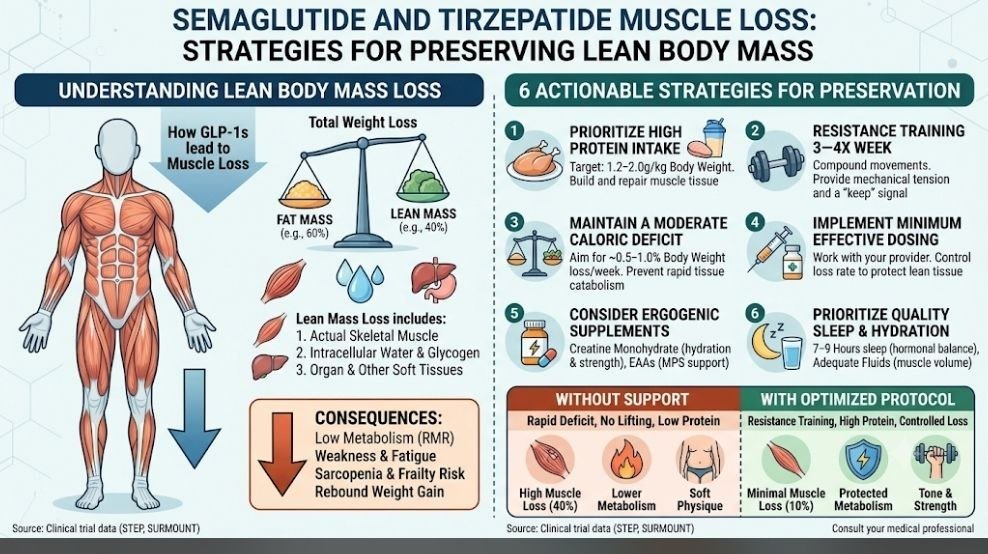
GLP-1-based therapies do not simply “eat away” at skeletal muscle. When a person loses a significant amount of body weight—whether through dietary calorie restriction, bariatric surgery, or incretin-based medication—the weight lost can include both fat mass and lean mass.
The crucial question is therefore not simply:
“Does GLP-1 therapy cause muscle loss?”
A better question is:
“How much of the weight being lost is fat, how much is lean tissue, and how can skeletal muscle be protected?”
That distinction changes the entire conversation.
Recent evidence shows that incretin-based therapies can produce substantial reductions in body weight while preferentially reducing fat mass. At the same time, measurable reductions in lean mass can occur. A 2026 systematic review and meta-analysis of 20 randomized controlled trials involving 15,782 participants estimated that lean mass represented approximately 25%–39% of total weight lost with incretin therapies, although the proportions varied between agents and studies.
This does not mean that 25%–39% of the weight lost was pure skeletal muscle.
That is one of the most important facts readers need to understand.
Lean mass measurements can include skeletal muscle as well as body water and other non-fat tissues. Therefore, a decrease in DXA-derived lean mass or BIA-derived fat-free mass should not automatically be interpreted as equivalent to losing the same amount of contractile skeletal muscle. Recent reviews specifically emphasize this distinction.
After working with GLP-1-related compounds and peptide education since 2003 as a supplier and educator, one of the most important lessons I would emphasize is this:
Successful weight loss should not be judged by the scale alone. The quality of the weight lost matters.
A person can lose 40 pounds and dramatically improve metabolic health while preserving most of their muscle.
Another person can lose a similar amount of weight while eating too little protein, performing no resistance training, and becoming significantly weaker.
The scale may look equally impressive.
The physiology is not.

The Most Important Difference: Lean Mass vs. Muscle
Before discussing GLP-1 muscle loss, we need to define what researchers actually measure.
What Is Lean Body Mass?
Lean body mass is broadly everything that is not classified as fat mass.
Depending on the measurement method, it can include:
- Skeletal muscle
- Body water
- Glycogen-associated water
- Organs
- Connective tissue
- Blood and other fluid compartments
- Other non-fat soft tissue
- In some definitions, bone-related components are treated separately
This means:
Lean mass ≠ muscle mass.
That distinction is essential.
Imagine a person begins a GLP-1-based weight-loss program and substantially reduces food intake.
Their glycogen stores may change.
Their associated water may change.
Their gastrointestinal contents change.
Their fat mass declines.
Their lean tissue may also decline.
A DXA or BIA measurement may therefore show a reduction in “lean mass” without proving that the entire reduction represents skeletal muscle fibers.
Recent research specifically warns against treating DXA lean mass and BIA fat-free mass as interchangeable with skeletal muscle.
Why This Matters for GLP-1 Muscle Loss
This is why a headline such as:
“GLP-1 drugs destroy muscle”
is scientifically too simplistic.
The available evidence is more nuanced.
Some studies show reductions in lean mass during treatment. Other research finds that fat mass decreases substantially more than lean mass, while strength and functional measurements can remain stable or improve.
The goal should therefore be fat loss with preservation of muscle quantity and function, rather than simply trying to make the number on the scale fall as quickly as possible.
Why GLP-1 Muscle Loss Can Occur During Weight Loss
GLP-1 Therapy Changes Appetite
GLP-1 receptor agonists and related incretin therapies can substantially reduce appetite and food intake.
For someone carrying excess body fat, this can be extremely beneficial.
But there is a potential nutritional tradeoff.
When appetite falls dramatically, people may not simply eat fewer desserts or processed foods.
They may also eat:
- Less protein
- Fewer total calories
- Smaller meals
- Fewer complete meals
- Less food variety
- Fewer micronutrient-rich foods
For some people, gastrointestinal symptoms make this even more difficult.
If the body is consistently receiving less energy and less protein while physical activity is also low, maintaining existing muscle becomes more challenging.
Rapid Weight Loss Changes the Equation
Weight loss itself requires an energy deficit.
The body does not magically know that you want to lose only fat.
During substantial energy restriction, tissue turnover and substrate utilization change.
This is why GLP-1 muscle loss is better understood in the context of weight loss physiology rather than as direct muscle toxicity.
A 2024 review in Obesity Reviews concluded that muscle loss can accompany rapid substantial weight reduction with incretin-mimetic drugs and emphasized adequate protein, nutrition and resistance exercise as key strategies for preserving muscle mass and function.
How Much Lean Mass Can Be Lost With GLP-1 Therapy?
There is no single percentage that applies to every GLP-1 user.
This is where many online articles go wrong.
Different studies use different:
- Drugs
- Doses
- Treatment durations
- Populations
- Exercise programs
- Dietary interventions
- Body-composition technologies
- Definitions of lean mass
The 2026 systematic review of randomized trials found that lean mass accounted for approximately:
- 35.2% of weight lost with semaglutide
- 25.4% with tirzepatide
- 26.8% with liraglutide
The review also found approximately 17.5% lean mass contribution among lifestyle interventions that incorporated resistance training.
These figures are useful for understanding the overall pattern, but they should not be interpreted as “35% of semaglutide weight loss is muscle.”
That would be incorrect.
A more accurate statement is:
A measurable portion of total weight loss can come from lean mass, and the exact amount varies substantially between individuals and studies.
Tirzepatide Body-Composition Data
A DXA substudy of SURMOUNT-1 provides an especially useful example.
Among 160 participants with DXA measurements at baseline and week 72, tirzepatide reduced:
- Body weight by 21.3%
- Fat mass by 33.9%
- Lean mass by 10.9%
Approximately 75% of weight lost was fat mass and 25% was lean mass.
This is a much more informative way to discuss GLP-1 muscle loss than simply claiming that tirzepatide “causes muscle wasting.”
Semaglutide and Muscle Loss
Semaglutide is one of the most extensively studied incretin-based therapies.
Its weight-loss effects are well established, but body-composition outcomes are more nuanced.
In a prospective 2025 study called SEMALEAN, 106 patients with obesity receiving semaglutide 2.4 mg were followed for 12 months with DXA, handgrip strength and resting-energy measurements. Lean mass initially declined by approximately 3 kg at seven months and then stabilized. Importantly, handgrip strength improved by approximately 4.5 kg at 12 months, while the prevalence of sarcopenic obesity declined.
This illustrates a critical point:
A reduction in measured lean mass does not automatically mean deteriorating muscle function.
Another randomized trial substudy using DXA found that semaglutide reduced both fat mass and lean mass, while the proportion of lean mass relative to total body weight increased.
Even more recent research continues to show that the relationship is complicated.
A 2026 SMART trial analysis found that semaglutide reduced body weight and produced a measurable change in lean body mass over 24 weeks, but the researchers did not find evidence that the changes in body composition were associated with deterioration in measured kidney filtration.
The lesson is not that semaglutide is “safe from muscle loss” or that it “destroys muscle.”
The lesson is that body composition must be evaluated alongside physical function, diet and training status.
Tirzepatide and Muscle Loss
Tirzepatide is a dual GIP/GLP-1 receptor agonist rather than a conventional GLP-1 receptor agonist alone.
It can produce substantial weight loss, which makes the question of GLP-1 muscle loss especially relevant to people using or researching incretin-based therapies.
The SURMOUNT-1 DXA substudy is particularly useful because it measured body composition rather than relying exclusively on body weight.
At 72 weeks, approximately three-quarters of weight lost with tirzepatide was fat mass and one-quarter was lean mass.
That finding is reassuring in one respect: most of the weight lost was fat.
But it also demonstrates why muscle preservation should be addressed from the beginning.
A person losing substantial amounts of weight should not wait until they feel weak to start thinking about protein and resistance training.
Retatrutide, Liraglutide and Cagrilintide
The evidence base is not equally mature for every compound.
Retatrutide
Retatrutide is a triple agonist targeting the GIP, GLP-1 and glucagon receptors.
In a phase 2 trial, retatrutide produced substantial weight reductions over 48 weeks, with the largest doses producing reductions exceeding 20%. Gastrointestinal adverse events were among the most common reported adverse effects.
Because the magnitude of weight loss can be substantial, body-composition preservation is an important research question.
However, it would be inappropriate to assume that retatrutide has exactly the same lean-mass profile as semaglutide or tirzepatide without direct comparative evidence.
Liraglutide
Liraglutide has a longer clinical history.
The 2026 meta-analysis estimated that approximately 26.8% of weight lost in the included liraglutide trials was lean mass.
Again, this is lean mass, not necessarily equivalent skeletal muscle loss.
Cagrilintide
Cagrilintide is an amylin analogue rather than a conventional GLP-1 receptor agonist.
It is particularly relevant when discussing newer appetite-regulating peptide combinations.
Clinical trials have demonstrated meaningful weight-loss effects, including in combination with semaglutide, but body-composition conclusions should be kept separate from those established for semaglutide and tirzepatide.
For readers researching emerging peptides, this distinction is important:
Different mechanisms do not automatically mean identical body-composition outcomes.
7 Powerful Strategies to Prevent GLP-1 Muscle Loss
The good news is that people do not have to simply accept poor muscle preservation during weight loss.
The strongest practical approach combines nutrition, resistance training, appropriate monitoring and sustainable weight reduction.

1. Prioritize Adequate Protein
Protein provides amino acids required for maintaining and repairing muscle tissue.
This becomes particularly important when calorie intake falls.
Instead of allowing appetite suppression to determine protein intake, make protein one of the first nutritional priorities.
Good options can include:
- Eggs
- Fish
- Lean meat
- Greek yogurt
- Cottage cheese
- Legumes
- Tofu and other soy foods
- Whey protein
- Plant-based protein powders
- Other high-protein foods tolerated by the individual
If large meals become uncomfortable, smaller protein-containing meals or appropriate liquid protein options may be easier to tolerate.
2. Use Progressive Resistance Training
If protein provides the building materials, resistance training provides the mechanical signal.
This is one of the most important strategies for reducing GLP-1 muscle loss.
A resistance-training program does not need to be complicated.
Depending on fitness level, a program can include:
- Squats or leg presses
- Hip hinges
- Rows
- Pulldowns
- Presses
- Lunges
- Carries
- Core exercises
The key is progressive overload and consistency.
A 2024 review concluded that resistance exercise is an important adjunct to incretin therapy because it can help preserve lean mass while improving strength and function.
A 2026 meta-analysis similarly found that lifestyle interventions incorporating resistance training produced a more favorable proportion of lean-mass preservation than incretin therapy or lifestyle intervention without resistance training.
3. Avoid Unnecessarily Aggressive Weight Loss
Faster is not always better.
When someone loses weight extremely rapidly, nutritional intake can fall faster than the person’s ability to maintain adequate protein and physical activity.
Rather than chasing the fastest possible scale reduction, focus on high-quality weight loss.
The appropriate rate depends on the individual’s starting weight, health status, treatment plan and medical circumstances.
Medication titration should be individualized with a qualified healthcare professional rather than adjusted independently to force faster weight loss.
4. Protect Hydration and Nutritional Adequacy
Weight changes can involve shifts in glycogen and body water as well as fat and lean tissue.
This is particularly important when interpreting body-composition measurements.
Adequate fluid intake and a nutritionally complete diet support normal physical performance and training capacity.
Electrolyte requirements also vary according to diet, exercise, climate and medical circumstances, so supplementation should not be treated as universally necessary.
5. Consider Supplements as Adjuncts, Not Substitutes
Creatine monohydrate is one of the better-known supplements for supporting strength and training performance.
However, supplements should not replace:
protein + resistance training + adequate nutrition.
Recent reviews discuss creatine, amino acids and other supplements as possible adjuncts, but the evidence specifically for preventing muscle loss during GLP-1 therapy is not equally strong for every supplement.
If a person has kidney disease, takes medications, is pregnant, or has another medical condition, supplement decisions should be discussed with a qualified healthcare professional.
6. Prioritize Sleep and Recovery
Muscle preservation is not only about what happens inside the gym.
Recovery matters.
Poor sleep can interfere with training quality, appetite regulation, recovery and overall physical performance.
For most adults, aiming for approximately 7–9 hours of sleep per night is a reasonable general target.
7. Monitor More Than the Scale
Your scale weight is only one measurement.
If possible, monitor:
- Waist circumference
- Strength
- Exercise performance
- Daily activity
- Body weight trends
- Protein intake
- Body-composition measurements when appropriate
- Subjective energy and physical function
This produces a much better picture of whether weight loss is progressing successfully.
How Much Protein Should You Eat on a GLP-1?
This is one of the questions I would expect readers to ask immediately.
There is no single protein number that is perfect for every person.
A major mistake is automatically multiplying a person’s current total body weight by a high protein target.
For someone carrying substantial excess body fat, that can produce an unnecessarily large number that becomes difficult to reach when appetite is already suppressed.
A more practical approach is to consider target body weight or lean body mass, particularly when the goal is preserving lean tissue during weight loss.
Lean Body Mass Approach
If someone knows their approximate lean body mass through DXA or another body-composition assessment, protein requirements can be individualized more intelligently.
For example, consider a hypothetical person weighing 200 pounds with approximately 30% body fat.
Estimated lean mass:
200 × 0.70 = 140 pounds
That is approximately 63.5 kg.
A protein target can then be discussed in relation to the lean tissue being preserved rather than simply the person’s entire current body weight.
Target Body Weight Approach
For general readers who do not have DXA or reliable body-composition data, target body weight can be a more practical framework.
For example, someone weighing 250 pounds whose medically appropriate target weight is approximately 170 pounds may find it more realistic to establish protein intake around the target-weight concept rather than trying to consume protein based entirely on the current scale weight.
The exact target should be individualized.
The most important principle is:
Do not allow appetite suppression to accidentally turn a weight-loss program into a chronically protein-deficient diet.
Why Resistance Training Is Essential
Resistance training is arguably the most important exercise intervention for reducing GLP-1 muscle loss.
Walking is valuable.
Cycling is valuable.
Swimming is valuable.
Cardiovascular exercise supports heart health and overall fitness.
But resistance training provides something different: mechanical loading of skeletal muscle.
That signal tells the body that the muscle is still needed.
This is particularly important during calorie restriction.
The goal is not necessarily to become a competitive bodybuilder.
The goal is to maintain:
- Strength
- Functional capacity
- Muscle tissue
- Independence
- Physical resilience
A person who loses 40 pounds while becoming stronger has achieved a very different physiological outcome from someone who loses 40 pounds while becoming progressively weaker.
How Fast Should You Lose Weight?
There is no universal weekly rate that applies to everyone.
The appropriate rate depends on:
- Starting body weight
- Age
- Body composition
- Medical conditions
- Training status
- Nutritional intake
- Medication
- Treatment goals
As a general educational principle, moderate and sustainable weight loss is preferable to intentionally forcing extremely rapid loss.
If someone is losing weight unusually quickly while barely eating, becoming weak, experiencing persistent vomiting or struggling to meet nutritional needs, that is a reason to contact their healthcare professional.
The goal of therapy should not be:
“Lose as much weight as possible as quickly as possible.”
The better goal is:
“Lose excess fat while protecting muscle, nutrition, function and long-term health.”
How to Monitor Muscle While Losing Weight
Body-composition monitoring can help, but every measurement has limitations.
DXA
DXA can provide measurements of:
- Fat mass
- Lean soft tissue
- Bone mineral content
It is one of the most useful clinical/research tools for evaluating changes in body composition.
However, DXA lean mass still should not automatically be equated with pure skeletal muscle.
BIA
Bioelectrical impedance analysis can be useful for tracking trends.
However, hydration status can influence results.
Therefore, comparing measurements taken under very different hydration conditions can create misleading changes.
Strength Testing
Strength is extremely valuable.
Consider tracking:
- Repetition performance
- Load lifted
- Grip strength
- Functional movements
- Walking capacity
- Stair performance
A person whose body weight is decreasing while strength remains stable or improves may be experiencing a very different outcome from someone whose weight is decreasing alongside substantial functional decline.
Waist Measurement
Waist circumference can provide additional evidence that fat mass is declining.
No single measurement tells the complete story.
Two Representative GLP-1 Muscle-Loss Profiles
The following profiles are illustrative examples based on the patterns described in body-composition research and clinical observation, not claims that these exact individuals represent a published clinical trial.
Profile 1: Rapid Deficit With Sedentary Lifestyle
Semaglutide: 2.4 mg weekly
Duration: 36 weeks
Starting weight: 235 lb
Ending weight: 181 lb
Total weight loss: 54 lb
The individual performed little physical activity and did no resistance training.
Estimated protein intake was less than 45 g per day because of severe appetite suppression and difficulty eating solid foods.
The illustrative DXA profile showed approximately:
- 31.8 lb fat-mass loss
- 22.2 lb lean-mass loss
This represents approximately 41% of total weight loss as measured lean mass.
The important interpretation is not that 22.2 pounds necessarily represented 22.2 pounds of skeletal muscle.
The measurement can include water and other lean tissues.
The larger lesson is that rapid weight loss + very low protein intake + no resistance training creates an unfavorable environment for muscle preservation.
Profile 2: Tirzepatide With Cardio but No Strength Training
Tirzepatide: escalated to 15 mg weekly
Duration: 28 weeks
Starting weight: 268 lb
Ending weight: 210 lb
Total weight loss: 58 lb
The individual performed light treadmill exercise three times per week but had no progressive resistance-training program.
Protein intake was approximately 65 g/day.
An illustrative body-composition assessment showed:
- 38.3 lb fat-mass loss
- 19.7 lb lean-mass loss
Again, lean mass should not automatically be equated with skeletal muscle.
But the profile demonstrates why cardio alone may not provide the same muscle-preservation stimulus as progressive resistance training.
Two Profiles Showing Better Muscle Preservation
Profile 3: Semaglutide With Progressive Resistance Training
Semaglutide: 2.4 mg weekly
Duration: 52 weeks
Starting weight: 218 lb
Ending weight: 182 lb
Total weight loss: 36 lb
The individual performed progressive resistance training three times per week.
Protein intake was approximately 130–140 g/day.
The illustrative DXA pattern showed:
- 34.2 lb fat-mass loss
- 1.8 lb lean-mass loss
Strength improved during the intervention.
This is the type of outcome worth emphasizing:
The objective is not merely weight loss. It is high-quality weight loss.
Profile 4: Body Recomposition With Tirzepatide
Tirzepatide: moderate-dose treatment
Duration: 24 weeks
Starting weight: 195 lb
Ending weight: 168 lb
The individual followed:
- Progressive resistance training four days per week
- Approximately 8,000 steps per day
- High protein intake
- Structured meal timing
The illustrative body-composition results showed substantial fat loss with preservation and potential gain in lean tissue.
This type of result is possible in some individuals, particularly those who are new to structured resistance training, but it should not be promised as a guaranteed outcome.
Common Mistakes That Increase GLP-1 Muscle Loss
Mistake 1: Eating as Little as Possible
GLP-1 therapy already reduces appetite.
Trying to maximize appetite suppression by intentionally eating as little as possible can make nutritional adequacy difficult.
Mistake 2: Ignoring Protein
A person can lose weight while eating very little protein.
That does not mean the diet is optimized.
Mistake 3: Only Doing Cardio
Walking is excellent.
But resistance training deserves a dedicated place in a muscle-preservation strategy.
Mistake 4: Chasing the Maximum Dose
More medication does not automatically mean better long-term outcomes.
Medication dosing should be individualized by a qualified healthcare professional.
Mistake 5: Watching Only the Scale
Weight loss can hide changes in:
- Muscle
- Fat
- Water
- Strength
- Physical performance
Mistake 6: Treating Lean Mass as Muscle
This is one of the most common interpretation errors in online discussions.
Mistake 7: Waiting Until Weakness Appears
Muscle-preservation strategies are better implemented at the beginning of a weight-loss program, not after significant strength has already disappeared.
Frequently Asked Questions
1. Can GLP-1 muscle loss be prevented?
It may be substantially reduced, although no strategy can guarantee zero lean-mass loss during significant weight reduction.
Adequate protein, progressive resistance training, appropriate nutritional intake and body-composition monitoring are among the most important strategies supported by current evidence.
2. Does semaglutide cause muscle loss?
Semaglutide can be associated with reductions in measured lean mass during weight loss, but that does not mean it directly destroys skeletal muscle.
Studies show that semaglutide generally reduces fat mass substantially, while lean mass can also decline. Some research has found stable or improved measures of muscle function despite reductions in measured lean mass.
3. Does tirzepatide cause muscle loss?
Tirzepatide can reduce lean mass alongside substantial fat loss.
In the SURMOUNT-1 DXA substudy, approximately 75% of weight lost was fat mass and 25% was lean mass.
This does not mean 25% was necessarily skeletal muscle.
4. How much protein should I eat while taking a GLP-1?
There is no universal number.
Protein needs should be individualized based on factors such as body composition, target body weight, age, activity level, health status and training.
For people with substantial excess body weight, using target body weight or lean body mass can be more practical than automatically calculating protein from current total body weight.
5. Is lean mass the same as muscle mass?
No.
Lean mass includes skeletal muscle but also includes other non-fat components.
Changes in hydration and glycogen can influence lean-mass measurements.
Therefore, a decline in measured lean mass should not automatically be interpreted as an equivalent decline in skeletal muscle.
6. Does lifting weights prevent GLP-1 muscle loss?
Resistance training is one of the most important strategies for preserving muscle during calorie restriction.
It provides mechanical loading that helps signal the body to retain muscle tissue.
Current reviews and meta-analyses support combining resistance training with adequate protein and nutritional support during incretin-based weight loss.
7. Can you build muscle while losing weight on a GLP-1?
It can happen, particularly in people who are new to resistance training or who have previously been undertrained.
However, it should not be presented as guaranteed.
The realistic objective for most people undergoing substantial weight loss is to maximize fat loss while preserving as much muscle and physical function as possible.
8. Should I stop my GLP-1 because I am worried about muscle loss?
Do not stop or change a prescribed medication solely based on information from an online article.
If you are experiencing significant weakness, very rapid weight loss, persistent gastrointestinal symptoms, difficulty eating enough protein or other concerning symptoms, discuss the situation with your healthcare professional.
9. Is rapid weight loss more likely to cause muscle loss?
Rapid weight loss can increase nutritional and functional challenges, particularly when calorie and protein intake become inadequate and resistance training is absent.
The exact relationship varies between individuals.
The objective should be sustainable fat loss while protecting muscle and overall nutritional status.
10. What is the best way to monitor GLP-1 muscle loss?
Do not rely exclusively on body weight.
Consider tracking:
Body weight + waist circumference + strength + physical performance + dietary protein + body composition when appropriate.
DXA can be useful for body-composition assessment, while BIA can be useful for tracking trends when measurements are performed consistently.
Final Takeaway
GLP-1 muscle loss is a real body-composition consideration, but the science is more nuanced than saying that GLP-1 therapy simply “destroys muscle.”
When a person loses a significant amount of weight, some lean mass may decline alongside fat mass.
The important distinction is that:
lean mass is not the same thing as skeletal muscle.
Modern evidence shows that incretin-based therapies can produce substantial fat loss while also producing measurable reductions in lean mass. The exact proportion varies by drug, population, treatment duration, nutritional intake, exercise and measurement method.
The most effective approach is therefore not to fear weight-loss therapy.
It is to improve the quality of weight loss.
That means:
- Prioritize adequate protein.
- Perform progressive resistance training.
- Avoid unnecessarily aggressive calorie restriction.
- Monitor strength and physical function.
- Use body-composition measurements appropriately.
- Maintain adequate nutrition and hydration.
- Work with a qualified healthcare professional on medication management.
For researchers and readers interested in peptide science, OasBioScience can also serve as an educational resource for learning more about peptides, analytical testing, research concepts and responsible research practices.
The ultimate goal should not be the lowest possible number on the scale.
It should be less excess fat, preserved muscle, maintained strength and better long-term health.
Important Scientific Note
This article is educational and is not medical advice. GLP-1 receptor agonists, dual incretin agonists and emerging peptide therapies differ in their indications, evidence bases, regulatory status and safety profiles. Medication selection, dosing, titration and discontinuation should be handled by an appropriately qualified healthcare professional.
The body-composition percentages discussed above refer primarily to measured lean mass, not necessarily pure skeletal muscle. Measurement methods such as DXA and BIA have limitations, and changes should be interpreted in context.
Selected Evidence
- Systematic review and meta-analysis of randomized trials examining lean-mass changes with incretin therapies.
- SURMOUNT-1 DXA body-composition substudy of tirzepatide.
- Prospective SEMALEAN study examining semaglutide, lean mass and muscle function.
- Review of strategies for minimizing muscle loss during incretin-mimetic therapy.
- Review of resistance exercise and incretin-based weight-loss pharmacotherapy.
- 2026 review of lean mass and musculoskeletal preservation during GLP-1-based obesity treatment.
Continue Learning: If you found this guide helpful, you may also want to read our previous peptide education articles covering the following topics.
- What Bacteriostatic Water Should I Use For My Peptide?
- Learn the correct peptide reconstitution process
- Discover the best peptide for obesity research.
- Discover the foods to avoid on GLP-1 medications,
- Tirzepatide Side Effects: 15 Powerful Facts, Warning Signs & Safe Management
- Why am I not losing weight on semaglutide?
- How Much Weight Can You Lose on Tirzepatide?
- Which peptide suppresses appetite the most?
- Peptide Bubbles after reconstitution?
Scientific Reference: For additional peer-reviewed information on peptide stability, sterile preparation, and pharmaceutical reconstitution practices, visit
United States Pharmacopeia (USP) – USP <797> Sterile Compounding
