
What’s Peptide Reconstitution?

What’s Peptide Reconstitution? This is one of the most important questions every peptide researcher should understand before opening a single vial of lyophilized powder.
Many beginners assume peptide reconstitution simply means adding water to a peptide vial. In reality, What’s Peptide Reconstitution is a controlled laboratory process that determines:
• Concentration accuracy
• Peptide stability
• Sterility
• Solubility
• Experimental reproducibility
• Long-term storage performance
A perfectly synthesized peptide can appear cloudy, inactive, weak, or unstable if it is reconstituted incorrectly. Over many years of working with research peptides, we have repeatedly seen researchers blame the manufacturer when the actual problem was improper reconstitution technique.
This guide will explain What’s Peptide Reconstitution, why it matters, and the critical mistakes that cause researchers to lose peptide quality before the experiment even begins.
For additional peptide handling resources and research-grade products, visit OAS BioScience at https://oasbioscience.com.
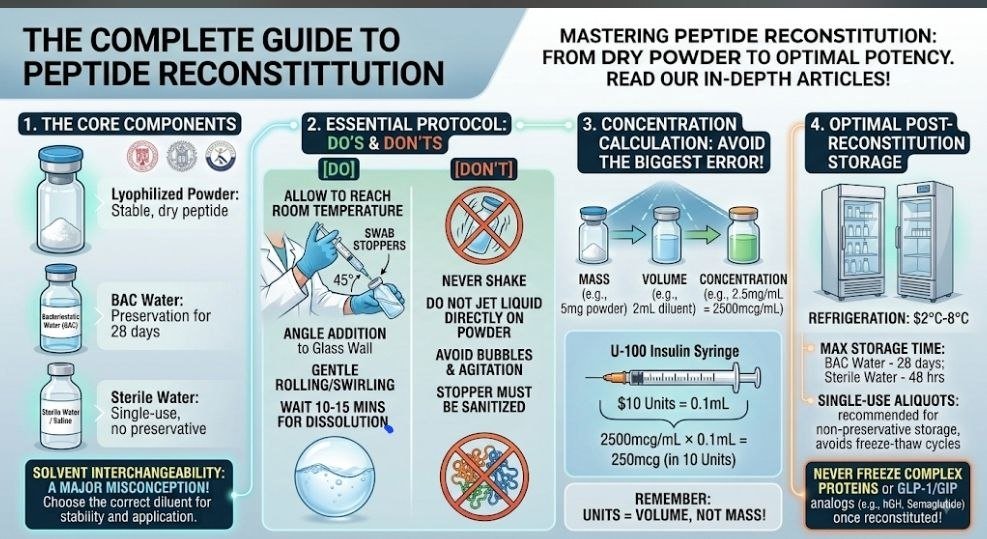
Table of Contents
1. What’s Peptide Reconstitution?
2. Why Peptide Reconstitution Matters
3. The Biggest Misconceptions
4. Understanding Reconstitution Solvents
5. Hydrophobic Peptides & pH Adjustment
6. Step-by-Step Laboratory Reconstitution Protocol
7. The 45° Glass-Wall Technique
8. Real Case Study: The Gelled AOD-9604 Vial
9. Peptide Concentration Calculations
10. U-100 Syringe Conversion Guide
11. Common Calculation Mistakes
12. Post-Reconstitution Storage Rules
13. Freeze-Thaw Risks
14. Which Peptides Should Not Be Frozen?
15. Advanced Troubleshooting
16. Regional Laboratory Best Practices
17. Frequently Asked Questions
18. Expert Recommendations
19. Final Conclusion
What’s Peptide Reconstitution?
https://pubmed.ncbi.nlm.nih.gov/
What’s Peptide Reconstitution? Peptide reconstitution is the process of converting a lyophilized (freeze-dried) peptide powder into a usable liquid solution by adding a carefully selected sterile solvent under controlled conditions.
The goal is not simply to dissolve the powder.
A successful peptide reconstitution process creates a solution that is:
• Clear
• Sterile
• Chemically stable
• Accurately concentrated
• Suitable for reliable research use
In professional laboratories, peptide reconstitution is treated as a critical quality-control step, not a casual preparation procedure.
Why Peptide Reconstitution Matters
Understanding What’s Peptide Reconstitution is essential because most peptide stability problems occur after the peptide leaves the manufacturer, not during synthesis.
Improper peptide reconstitution can lead to:
• Cloudy or gelled solutions
• Incorrect dosing concentrations
• Peptide aggregation
• Oxidation
• Adsorption to plastic containers
• Loss of biological activity
• Contaminated multi-use vials
This is why experienced peptide researchers pay as much attention to reconstitution technique as they do to HPLC purity and Certificates of Analysis (COAs).
The Biggest Misconception About What’s Peptide Reconstitution
The most widespread misunderstanding is that all solvents are interchangeable.
Researchers often assume that:
• Bacteriostatic Water
• Sterile Water
• Normal Saline
• Acetic Acid solutions
are essentially the same thing.
They are not.
Choosing the wrong solvent is one of the fastest ways to create solubility problems, aggregation, precipitation, and premature peptide degradation.
Understanding Common Reconstitution Solvents
Bacteriostatic Water
Best for
• Multi-use refrigerated storage
• Repeated withdrawals from the same vial
• Research protocols lasting up to 28 days
Why it works
Bacteriostatic Water contains 0.9% benzyl alcohol, which helps inhibit bacterial growth after the vial has been punctured.
Important note
Because benzyl alcohol absorbs UV light and may affect certain sensitive analytical or cell-based assays, some laboratories prefer preservative-free solvents for highly sensitive applications.
Sterile Water for Injection
Best for
• Immediate use
• Single-use preparations
• Sensitive downstream analytical applications
Limitation
Once opened, Sterile Water contains no preservative, so microbial contamination becomes a concern if the solution is stored for extended periods.
For this reason, preservative-free preparations are usually used immediately or aliquoted into single-use frozen portions.
Normal Saline (0.9% NaCl)
Best for
• Specific isotonic biological applications
• Certain physiological or cell-culture systems
Limitation
Some peptides aggregate or precipitate in the presence of salt, making saline unsuitable for many hydrophobic peptide sequences.
Acetic Acid (0.6%)
Best for
• Hydrophobic peptides
• Peptides that form cloudy suspensions
• Difficult-to-dissolve sequences such as AOD-9604 or HGH Frag 176-191
A small amount of diluted acetic acid can dramatically improve peptide solubility by adjusting the pH and disrupting hydrophobic interactions.
What’s Peptide Reconstitution for Hydrophobic Peptides?
Hydrophobic peptides behave very differently from highly water-soluble peptides.
Common warning signs include:
• Floating particles
• Milky cloudiness
• Gel-like clumps
• Powder stuck to the vial wall
• Incomplete dissolution after several minutes
Researchers often interpret these signs as impurity or degradation, but in many cases they simply indicate incorrect pH conditions.
For hydrophobic peptides, remember this rule:
«Acid First, Dilute Second»
Adding a small volume of 0.6% sterile acetic acid before further dilution with Bacteriostatic Water often produces a completely clear solution within seconds.
Why Cloudiness Does Not Always Mean a Bad Peptide
One of the most valuable lessons in What’s Peptide Reconstitution is that cloudiness does not automatically mean the peptide is fake, impure, or degraded.
Several perfectly legitimate factors can cause temporary cloudiness:
• Dense high-purity peptide cakes
• Cold solvent
• Slow hydration kinetics
• Hydrophobic aggregation
• Exceeding the peptide’s solubility limit
For example, attempting to dissolve 10 mg of a bulky hydrophobic peptide in only 0.5 mL of neutral water may exceed its practical solubility threshold, producing a cloudy suspension even though the peptide itself is chemically intact.
This is why experienced laboratories evaluate:
• Solvent choice
• pH
• Temperature
• Peptide sequence
• Dissolution time
before concluding that a batch is defective.
A Real-World Example
A common support request involves AOD-9604, a hydrophobic HGH fragment.
What happened?
A researcher added 2 mL of standard Bacteriostatic Water directly onto the lyophilized peptide cake.
Result
• Thick gel-like clumps formed
• The solution became cloudy and milky
• The peptide appeared unusable
The researcher assumed the product was impure or counterfeit.
The actual problem
AOD-9604 often requires a slightly acidic environment to dissolve efficiently.
The fix
Adding 0.1–0.2 mL of 0.6% sterile acetic acid followed by gentle swirling converted the cloudy gel into a clear, fully usable solution within about one minute.
This is a perfect example of why understanding What’s Peptide Reconstitution is so important for avoiding unnecessary product replacement requests and protecting research quality.
Key Takeaways
If you remember only a few concepts from this first section, remember these:
• What’s Peptide Reconstitution? It is a controlled laboratory process, not simply adding water to a vial.
• The correct solvent depends on peptide chemistry, pH requirements, and storage goals.
• Bacteriostatic Water is generally preferred for multi-use refrigerated storage.
• Sterile Water is best for immediate or single-use preparations.
• Hydrophobic peptides often require pH adjustment using a small amount of diluted acetic acid.
• Cloudiness does not automatically indicate impurity or degradation.
• Proper peptide reconstitution protects concentration accuracy, stability, sterility, and experimental reproducibility.
The Complete Step-by-Step Laboratory Reconstitution Protocol
In Part 1, we answered the question What’s Peptide Reconstitution? and explained why solvent selection, pH, and peptide chemistry are critical for successful dissolution.
Now we’ll focus on the most important practical section of the entire guide: the professional laboratory reconstitution procedure used to maximize:
– Sterility
– Concentration accuracy
– Structural integrity
– Solubility
– Long-term stability
Many peptide problems begin not with the solvent itself but with how the solvent is added to the vial. A perfectly good peptide can foam, aggregate, or lose activity if it is handled aggressively during reconstitution.
This section will show you the exact workflow that experienced peptide laboratories use to minimize those risks.
For additional peptide handling resources and research-grade products, visit OAS BioScience at https://oasbioscience.com.
Why Technique Matters in What’s Peptide Reconstitution
One of the biggest misconceptions about What’s Peptide Reconstitution is that the peptide powder is mechanically indestructible.
Peptides are chains of amino acids that can be affected by:
• Mechanical shear stress
• Foaming
• Localized overhydration
• Air-liquid interface exposure
• Rapid pH changes
• Aggressive mixing
This is especially important for:
• Semaglutide
• Tirzepatide
• Retatrutide
• CJC-1295
• Ipamorelin
• AOD-9604
• HGH Frag 176-191
A gentle, controlled technique is often the difference between a clear, stable solution and a cloudy, unusable suspension.
Phase 1: Thermal Equilibration
Step 1: Remove the Peptide from Cold Storage
Take the lyophilized peptide vial out of:
• -20°C freezer
• -80°C freezer
• 2°C–8°C refrigerator
Step 2: Allow the Sealed Vial to Reach Room Temperature
Leave the vial sealed for 15–20 minutes at approximately 20°C–25°C.
Why this step is critical
Cold glass exposed to warm room air causes condensation.
If you open the vial immediately, microscopic water droplets can form inside the vial and contact the dry peptide before controlled reconstitution begins.
This unwanted moisture can initiate:
• Hydrolysis
• Aggregation
• Loss of long-term stability
Golden Rule
«Never open a cold peptide vial immediately after removing it from refrigeration or freezing.»
Phase 2: Sterile Workspace Preparation
Step 1: Sanitize the Work Surface
Wipe the bench or preparation area with 70% Isopropyl Alcohol (IPA).
Allow the surface to air dry completely.
Step 2: Remove the Flip-Off Caps
Carefully remove the protective plastic caps from:
• The peptide vial
• The diluent vial
Avoid touching the exposed rubber stoppers.
Step 3: Disinfect Both Stoppers
Use a fresh alcohol swab for each vial.
Thoroughly wipe the rubber stopper and allow it to air dry for 10–15 seconds.
This reduces the risk of introducing bacteria or particulate contamination during reconstitution.
Phase 3: Drawing the Diluent Correctly
Using a sterile syringe and needle:
1. Draw the exact calculated volume of diluent.
2. Hold the syringe upright.
3. Tap out large air bubbles.
4. Expel excess air carefully.
Why volume accuracy matters
Every concentration calculation depends on the actual volume added.
Even small volume errors can significantly affect mcg/mL concentration, especially when working with potent research peptides.
Phase 4: Vacuum Pressure Equalization
Many lyophilized peptide vials are sealed under a strong internal vacuum.
If the syringe plunger is not controlled, the vacuum can violently suck the liquid into the vial, causing the solvent to strike the peptide cake with excessive force.
Correct approach
• Insert the needle through the stopper.
• Maintain firm control of the plunger.
• Allow pressure to equalize gradually before adding the liquid.
This simple step prevents:
• Foaming
• Splashing
• Mechanical stress on the peptide cake
The 45° Glass-Wall Technique
This is one of the most important professional techniques in What’s Peptide Reconstitution.
Correct Needle Position
Insert the needle through the stopper at approximately 45° and aim toward the inside glass wall of the vial.
Correct Technique
• Needle enters at an angle
• Liquid flows down the glass wall
• The peptide cake becomes hydrated gradually from the bottom upward
Incorrect Technique
• Spraying the liquid directly onto the peptide cake
• Forcing the solvent in rapidly under pressure
Direct impact can cause:
• Foaming
• Localized clumping
• Surface denaturation
• Incomplete dissolution
• Aggregation of sensitive peptides
Remember
«Trickle down the glass wall — never blast the peptide cake directly.»
Phase 5: Gentle Dissolution Methods
After all the diluent has been added:
Recommended Methods
Gentle Swirling
Move the vial in a slow circular motion.
Palm Rolling
Roll the vial gently between your palms for several seconds.
Slow Inversion
Invert the vial slowly a few times if powder remains on the upper walls.
Methods to Avoid
Never Vortex Aggressively
Vortexing can introduce:
• Excessive air
• Foam
• Mechanical shear stress
Never Shake Violently
Rapid shaking is one of the most common causes of:
• Protein unfolding
• Peptide aggregation
• Persistent foam formation
This is particularly important for GLP-1 analogs and growth hormone secretagogues.
Phase 6: Dissolution Window and Visual Inspection
Allow Time for Complete Hydration
Place the vial upright and let it sit undisturbed for 10–15 minutes.
Some peptides dissolve almost instantly, while others require additional time for full molecular hydration.
Perform a Visual Inspection
Hold the vial up to a light source against a dark background.
A successful reconstitution should appear:
• Clear
• Colorless
• Particle-free
• Water-like in appearance
If the Solution Remains Cloudy
Before assuming the peptide is defective, ask:
• Was the solvent appropriate?
• Is the peptide hydrophobic?
• Was the pH suitable?
• Was the concentration too high?
• Has enough time elapsed for complete dissolution?
For hydrophobic sequences such as AOD-9604, adding 0.1–0.2 mL of 0.6% sterile acetic acid often resolves persistent cloudiness within seconds.
Common Handling Mistakes to Avoid
Mistake 1: Injecting Directly Onto the Peptide Cake
Problem
• Foaming
• Clumping
• Uneven hydration
Fix
Use the 45° glass-wall technique.
Mistake 2: Using Cold Diluent Straight from the Refrigerator
Problem
Cold solvent slows dissolution and can promote temporary precipitation.
Fix
Allow the diluent to reach room temperature before use.
Mistake 3: Vortexing to “Speed Up” Dissolution
Problem
Mechanical agitation may damage delicate peptide structures and create persistent foam.
Fix
Use gentle swirling or rolling instead.
Mistake 4: Assuming Slow Dissolution Means a Bad Batch
Problem
Dense, high-purity peptide cakes may require 10–15 minutes for complete hydration.
Fix
Allow adequate time before troubleshooting.
Professional Laboratory Checklist
Use this quick checklist every time you perform What’s Peptide Reconstitution:
Before Reconstitution
• ✔ Remove vial from cold storage
• ✔ Allow 15–20 minutes to reach room temperature
• ✔ Sanitize the workspace
• ✔ Swab both vial stoppers
• ✔ Prepare the correct sterile diluent
During Reconstitution
• ✔ Draw the exact calculated volume
• ✔ Equalize vacuum pressure slowly
• ✔ Add liquid down the glass wall
• ✔ Swirl gently
• ✔ Avoid shaking or vortexing
After Reconstitution
• ✔ Allow 10–15 minutes for full dissolution
• ✔ Inspect for clarity
• ✔ Refrigerate immediately at 2°C–8°C
• ✔ Protect from light exposure
Key Takeaways
The most important lessons from this section are:
• What’s Peptide Reconstitution is a precision laboratory procedure, not simply mixing powder with water.
• Thermal equilibration prevents condensation-related degradation.
• Sterile preparation protects against microbial contamination.
• Vacuum pressure equalization prevents violent solvent injection.
• The 45° glass-wall technique is the safest method for hydrating lyophilized peptides.
• Gentle swirling is preferred over shaking or vortexing.
• Many peptides require 10–15 minutes for complete dissolution.
• Persistent cloudiness should trigger solubility troubleshooting, not an immediate assumption of impurity.
Peptide Concentration Calculations, U-100 Syringe Conversions & the Most Common Math Mistakes
In Part 2, we covered the professional laboratory procedure for What’s Peptide Reconstitution, including thermal equilibration, sterile handling, vacuum pressure equalization, and the 45° glass-wall technique.
Now we’ll tackle the section that causes more researcher confusion than almost any other topic:
Peptide concentration calculations
A peptide can be reconstituted perfectly and still produce incorrect experimental results if the concentration is calculated incorrectly.
This is where many researchers accidentally confuse:
• Mass (mg or mcg)
• Volume (mL)
• Syringe units
• Concentration (mcg/mL)
Understanding this relationship is essential for anyone learning What’s Peptide Reconstitution.
For additional peptide handling resources and research-grade products, visit OAS BioScience at https://oasbioscience.com.
Why Concentration Errors Happen
One of the biggest misunderstandings in What’s Peptide Reconstitution is the belief that adding more water changes the total amount of peptide in the vial.
For example, researchers often ask:
• “Did I weaken the peptide by adding 2 mL instead of 1 mL?”
• “Is the vial less potent now?”
• “Did I lose half the peptide when I doubled the water volume?”
The answer is no.
Adding more diluent changes the concentration, not the total peptide mass.
The Golden Formula for What’s Peptide Reconstitution
Every peptide calculation should follow this exact sequence:
Step 1: Convert mg to mcg
1 mg = 1,000 mcg
Step 2: Calculate concentration
Concentration = Total mcg ÷ Total mL
Step 3: Calculate the required volume
Required volume = Desired mcg dose ÷ Concentration (mcg/mL)
The Most Important Rule
«Never calculate syringe units directly from the vial size. Always calculate mcg/mL first.»
Step-by-Step Calculation Example
Let’s use a common research scenario.
Starting Material
• 5 mg peptide
• 2 mL Bacteriostatic Water
Step 1: Convert to Micrograms
5 mg × 1,000 = 5,000 mcg
Step 2: Calculate Concentration
5,000 mcg ÷ 2 mL = 2,500 mcg/mL
This means:
• 1 mL contains 2,500 mcg
• 0.5 mL contains 1,250 mcg
• 0.1 mL contains 250 mcg
Step 3: Calculate a Desired Dose
Suppose the researcher wants 250 mcg.
250 mcg ÷ 2,500 mcg/mL = 0.1 mL
So the correct withdrawal volume is:
0.1 mL = 250 mcg
What Happens When You Add More Water?
This is one of the most common support questions in What’s Peptide Reconstitution.
Scenario A
5 mg + 1 mL
| Value | Result |
| Total peptide | 5,000 mcg |
| Total volume | 1 mL |
| Concentration | 5,000 mcg/mL |
Scenario B
5 mg + 2 mL
| Value | Result |
| Total peptide | 5,000 mcg |
| Total volume | 2 mL |
| Concentration | 2,500 mcg/mL |
Important Observation
The vial still contains 5,000 mcg total.
The peptide is not weaker.
The dose is simply spread across more liquid volume.
This distinction is fundamental to understanding What’s Peptide Reconstitution.
U-100 Syringe Conversion Guide
A standard U-100 insulin syringe is calibrated so that:
| Syringe Units | Volume |
| 100 unit | 1.0 mL |
| 50 units | 0.5 mL |
| 10 units | 0.1 mL |
| 1 unit | 0.01 mL |
Example Using 5 mg in 2 mL
We already calculated:
2,500 mcg/mL
Now divide by 100 to determine the amount per syringe unit:
2,500 mcg/mL ÷ 100 = 25 mcg per unit
| Syringe Reading | Peptide Amount |
| 1 unit | 25 mcg |
| 5 units | 125 mcg |
| 10 units | 250 mcg |
| 20 units | 500 mcg |
Therefore
If the target is 250 mcg, the syringe should be filled to:
10 units
Quick Reference Concentration Table
Common Peptide Reconstitution Setups
| Total Powde | Diluent Volume | Concentration | 10 Units (0.1 mL) | 1 Unit (0.01 mL) |
| 2 mg | 1 mL | 2,000 mcg/mL | 200 mcg | 20 mcg |
| 2 mg | 2 mL | 1,000 mcg/mL | 100 mcg | 10 mcg |
| 5 mg | 1 mL | 5,000 mcg/mL | 500 mcg | 50 mcg |
| 5 mg | 2 mL | 2,500 mcg/mL | 250 mcg | 25 mcg |
| 10 mg | 2 mL | 5,000 mcg/mL | 500 mcg | 50 mcg |
This table solves a large percentage of the real-world calculation questions researchers encounter when learning What’s Peptide Reconstitution.
Real-World Researcher Mistakes
Mistake 1: Confusing Vial Size with Dose
Incorrect Thinking
«“I have a 5 mg vial, so every syringe pull contains 5 mg.”»
Correct Thinking
The vial contains 5,000 mcg total, but the amount withdrawn depends entirely on the volume removed.
Mistake 2: Ignoring Unit Conversion
A researcher reconstitutes 5 mg with 2 mL and wants 250 mcg.
They mistakenly pull 25 units instead of 10 units.
Result
• Intended dose: 250 mcg
• Actual dose: 625 mcg
This type of error can dramatically affect experimental consistency.
Mistake 3: Forgetting the mg → mcg Conversion
Incorrect
5 mg ÷ 2 mL = 2.5 mcg/mL
Correct
5 mg = 5,000 mcg
5,000 mcg ÷ 2 mL = 2,500 mcg/mL
Missing this conversion creates a 1,000-fold error.
Why Visual Clarity Does Not Confirm Correct Concentration
A completely clear peptide solution can still have the wrong concentration.
Researchers sometimes assume:
• Clear solution = correct preparation
• No particles = correct dose
In reality, visual inspection only confirms dissolution, not concentration accuracy.
Two perfectly clear vials may contain:
• 1,000 mcg/mL
• 5,000 mcg/mL
without any visible difference.
This is why careful calculation is just as important as proper dissolution technique when performing What’s Peptide Reconstitution.
Professional Calculation Workflow
Experienced peptide laboratories follow a consistent workflow every time.
Step 1: Record the Peptide Mass
Example:
• 5 mg
Step 2: Convert to Micrograms
• 5,000 mcg
Step 3: Record the Added Volume
Example:
• 2 mL
Step 4: Calculate Concentration
• 2,500 mcg/mL
Step 5: Calculate mcg per Syringe Unit
• 25 mcg/unit
Step 6: Determine the Required Units
Desired dose:
• 250 mcg
Calculation:
• 250 ÷ 25 = 10 units
This six-step process eliminates nearly all common concentration errors associated with What’s Peptide Reconstitution.
A Simple Memory Trick
Use this mental sequence:
Mass → Micrograms → Concentration → Units
If you skip the Concentration step, you are far more likely to make a dosing error.
Think of concentration as the bridge between the powder in the vial and the volume in the syringe.
Key Takeaways
The most important lessons from this section are:
• What’s Peptide Reconstitution requires accurate concentration calculations, not just proper dissolution.
• Adding more water changes concentration, not total peptide mass.
• Always convert mg to mcg before calculating concentration.
• Calculate mcg/mL first, then convert to syringe units.
• A standard U-100 syringe contains 100 units per mL.
• Visual clarity does not confirm correct concentration.
• Most real-world peptide dosing mistakes occur because researchers skip the concentration bridge.
Post-Reconstitution Storage, Freeze-Thaw Risks & Which Peptides Should Never Be Frozen
In Part 3, we covered the mathematics behind What’s Peptide Reconstitution, including mg-to-mcg conversions, concentration calculations, and U-100 syringe unit conversions.
Now we’ll focus on the stage where many researchers unintentionally destroy peptide stability:

Post-reconstitution storage
A peptide can be:
• Properly synthesized
• Correctly dissolved
• Accurately calculated
…and still lose activity if it is stored incorrectly after reconstitution.
This section explains how to protect peptide integrity after the powder has been converted into a liquid solution, including refrigeration rules, freeze-thaw limitations, single-use aliquot strategies, and which peptides should never be frozen once reconstituted.
For additional peptide handling resources and research-grade products, visit OAS BioScience at https://oasbioscience.com.
Why Storage Matters in What’s Peptide Reconstitution
Understanding What’s Peptide Reconstitution is only half the battle.
The moment water or buffer is added, the peptide becomes far more vulnerable to:
• Hydrolysis
• Oxidation
• Aggregation
• Microbial contamination
• Adsorption to plastic surfaces
• Freeze-concentration stress
This is why experienced peptide laboratories treat the post-reconstitution phase as a separate stability protocol, not simply “putting the vial in the fridge.”
The Critical Difference Between Dry and Liquid Peptides
Lyophilized (Dry) Peptides
Dry peptides are generally very stable because water has been removed.
Typical long-term storage:
| Storage Condition | Typical Stability |
| Room temperature | Short-term only |
| 2°C–8°C | Several months |
| -20°C | 1–2+ years |
| -80°C | Multiple years for sensitive sequences |
Without water, most hydrolytic degradation pathways are dramatically slowed.
Reconstituted (Liquid) Peptides
Once dissolved, the peptide is exposed to:
• Water-mediated hydrolysis
• Dissolved oxygen
• Temperature fluctuations
• Container interactions
• Bacterial growth if preservatives are absent
This is why liquid peptides require much stricter handling than lyophilized powder.
Immediate Refrigeration Rules
After successful reconstitution:
Store Immediately At
2°C–8°C (36°F–46°F)
Do not leave the vial sitting at room temperature for extended periods unless the protocol specifically requires it.
Best Refrigerator Location
Recommended
• Back shelf
• Main body of the refrigerator
• Stable temperature zone
Avoid
• Refrigerator door shelves
• Areas near the cooling vent that may freeze
• Frequently opened compartments
Temperature fluctuations are one of the most underestimated causes of peptide instability.
How Long Do Reconstituted Peptides Last?
The answer depends primarily on which solvent was used during What’s Peptide Reconstitution.
Bacteriostatic Water
Typical recommendation
Up to 28 days at 2°C–8°C
Why?
Bacteriostatic Water contains 0.9% benzyl alcohol, which inhibits bacterial growth after the vial has been punctured.
Important clarification
The preservative helps reduce microbial contamination, but it does not guarantee that peptide potency remains unchanged indefinitely.
Sensitive peptides may lose stability before the 28-day limit.
Sterile Water for Injection
Typical recommendation
24–48 hours maximum
Because Sterile Water contains no preservative, bacterial contamination becomes a significant concern once the stopper has been pierced.
For this reason, preservative-free preparations are usually:
• Used immediately, or
• Divided into single-use frozen aliquots
Phosphate-Buffered Saline (PBS)
PBS may be appropriate for certain biological systems, but storage duration depends heavily on:
• Peptide sequence
• Buffer composition
• Downstream application
• Sterility controls
When in doubt, use single-use aliquots rather than repeatedly accessing the same vial.
The Freeze-Thaw Cycle Problem
Many researchers believe freezing is always protective.
In reality, repeated freeze-thaw cycles are one of the most common causes of peptide instability.
What Happens During Freezing?
As water freezes:
• Ice crystals form.
• Solutes become concentrated.
• Local pH may shift.
• Peptide molecules are forced into crowded microscopic regions.
This can promote:
• Aggregation
• Precipitation
• Oxidation
• Loss of biological activity
Why Repeated Thawing Is Worse
A typical problematic workflow looks like this:
1. Remove vial from freezer.
2. Allow partial thawing.
3. Withdraw a small amount.
4. Return the vial to the freezer.
5. Repeat several times over days or weeks.
Each cycle exposes the peptide to additional physical and chemical stress.
Golden Rule
«One thaw is acceptable for many small peptides. Repeated thawing is the real enemy.»
Single-Use Aliquots: The Professional Solution
Experienced laboratories rarely freeze and thaw the master vial repeatedly.
Instead, they use single-use aliquoting.
Recommended Workflow
Step 1
Perform What’s Peptide Reconstitution using the appropriate sterile solvent.
Step 2
Immediately divide the solution into small sterile aliquots.
Typical volumes:
• 50 µL
• 100 µL
• 250 µL
• 500 µL
Step 3
Place each aliquot into:
• Low-binding polypropylene tubes, or
• Glass mini-vials for high-value compounds
Step 4
Freeze the aliquots individually.
Step 5
Thaw only the aliquot needed for immediate use.
This approach dramatically improves:
• Stability
• Concentration consistency
• Reproducibility
• Contamination control
Which Peptides Should Never Be Frozen After Reconstitution?
This is one of the most important practical questions in What’s Peptide Reconstitution.
Not all peptides tolerate liquid freezing equally well.
GLP-1 & GIP Analogues
Examples
• Semaglutide
• Tirzepatide
• Retatrutide
• Liraglutide
Why they are sensitive
These are relatively large, structurally complex oligopeptides that can:
• Aggregate during freezing
• Form inactive fibrils
• Lose activity after freeze-thaw exposure
Best practice
• Store refrigerated at 2°C–8°C
• Use within the validated stability window
• Avoid freezing once reconstituted unless specific stability data supports it
Large Proteins and Pegylated Compounds
Examples
• Human Growth Hormone (hGH)
• Erythropoietin (EPO)
• Peg-MGF
• Other large folded protein therapeutics
These molecules possess complex tertiary structures that are particularly vulnerable to ice-crystal shear stress and denaturation.
Fragile HGH Fragments
Examples
• HGH Frag 176-191
• AOD-9604
These hydrophobic fragments may:
• Precipitate after thawing
• Form gels
• Lose solubility if repeatedly frozen and thawed
For these compounds, refrigeration is often safer than repeated freezing cycles.
Best Storage Containers for Reconstituted Peptides
Container choice matters more than many researchers realize.
Standard Polypropylene Tubes
Potential problem
Hydrophobic or positively charged peptides may adsorb to the plastic surface, reducing the amount of peptide remaining in solution.
Losses of 10–20% are not unusual for certain hydrophobic sequences.
Low-Binding Polypropylene Tubes
Advantages
• Reduced hydrophobic adsorption
• Improved peptide recovery
• Better concentration consistency
• Preferred for low-concentration working solutions
Glass Mini-Vials
Often preferred for:
• High-value synthetic peptides
• Long-term aliquot storage
• Very hydrophobic sequences
• Sensitive analytical applications
Glass eliminates many concerns related to plasticizer leaching and surface adsorption.
Light, Temperature & Handling Protection
Protect From Light
Store reconstituted peptides:
• In their original box
• In an amber container
• Away from direct sunlight
• Away from strong laboratory lighting whenever possible
Certain amino acids become increasingly susceptible to photo-oxidation during prolonged light exposure.
Minimize Mechanical Agitation
After What’s Peptide Reconstitution:
Avoid
• Vigorous shaking
• Continuous vortexing
• Transporting vials loosely in bags or boxes
Prefer
• Gentle handling
• Upright storage
• Minimal unnecessary movement
Professional Laboratory Storage Checklist
Use this checklist immediately after completing What’s Peptide Reconstitution.
Immediately After Dissolution
• ✔ Verify the solution is clear and particle-free
• ✔ Label the vial with date, concentration, and solvent used
• ✔ Refrigerate immediately at 2°C–8°C
• ✔ Protect from light exposure
If Using Bacteriostatic Water
• ✔ Store refrigerated
• ✔ Limit use to approximately 28 days
• ✔ Use aseptic technique for every withdrawal
If Using Sterile Water or PBS
• ✔ Use promptly whenever possible
• ✔ Prepare single-use aliquots for longer storage
• ✔ Avoid repeatedly accessing the same vial
For Long-Term Storage
• ✔ Aliquot into small low-binding tubes
• ✔ Freeze aliquots individually
• ✔ Thaw each aliquot only once
• ✔ Discard unused thawed remainder
Key Takeaways
The most important lessons from this section are:
• What’s Peptide Reconstitution does not end when the powder dissolves.
• Liquid peptides are far more vulnerable than lyophilized powder.
• Store reconstituted peptides immediately at 2°C–8°C.
• Bacteriostatic Water supports multi-use refrigerated storage, while Sterile Water is best for immediate or single-use preparations.
• Repeated freeze-thaw cycles are a major cause of peptide instability.
• Single-use aliquots are the professional solution for long-term storage.
• Semaglutide, Tirzepatide, Retatrutide, AOD-9604, and other sensitive peptides require extra care after reconstitution.
• Low-binding tubes or glass containers help minimize peptide loss through surface adsorption.
Advanced Troubleshooting, Global Laboratory Best Practices & Final Expert Conclusions
Advanced Troubleshooting Guide
Even when researchers follow the basic protocol, certain peptide sequences can present unexpected behavior.
The key is to diagnose the underlying cause rather than assuming the peptide is defective.
Scenario 1: “The Solution Is Cloudy”
Possible Causes
• Hydrophobic peptide aggregation
• Incorrect pH
• Excessively high concentration
• Cold solvent
• Incomplete hydration
What to Check
• Was Bacteriostatic Water used with a known hydrophobic peptide?
• Has the vial been allowed to sit for 10–15 minutes?
• Is the peptide concentration unusually high for the sequence?
Recommended Fix
For hydrophobic sequences such as AOD-9604 or HGH Frag 176-191:
1. Add 0.1–0.2 mL of 0.6% sterile acetic acid.
2. Swirl gently.
3. Allow 30–60 seconds for the pH adjustment to take effect.
In many cases, the cloudy suspension becomes completely clear almost immediately.
Scenario 2: “The Peptide Forms a Gel”
This is a classic hydrophobic peptide behavior.
Why it Happens
Neutral-pH water allows hydrophobic regions of the peptide to interact with each other instead of remaining dispersed in solution.
The peptide has not necessarily degraded—it has simply self-associated into a gel matrix.
Correct Response
• Do not shake aggressively.
• Do not assume the batch is fake.
• Adjust the pH first, then dilute further if necessary.
Scenario 3: “The Peptide Foamed During Mixing”
Foaming is extremely common with:
• Semaglutide
• Tirzepatide
• Retatrutide
• Certain growth hormone secretagogues
• Amphipathic peptide sequences
Common Cause
• Rapid solvent injection
• Vigorous shaking
• Vortex mixing
What to Do
1. Stop mixing immediately.
2. Allow the vial to sit upright for several minutes.
3. Gently swirl only if necessary.
Excessive foam increases the air-liquid interface, which can promote oxidation and aggregation in sensitive peptides.
Why Peptides Foam During Reconstitution
Understanding the physics helps prevent the problem.
When liquid is forced rapidly into a vial, air becomes trapped as tiny bubbles. Peptides with both hydrophobic and hydrophilic regions can behave similarly to mild surfactants, stabilizing those bubbles and creating persistent foam.
Prevention
• Use the 45° glass-wall technique
• Add solvent slowly
• Keep the needle tip directed toward the glass wall, not the liquid surface
• Avoid repeatedly drawing liquid in and out of the syringe
What to Do If the Peptide Will Not Dissolve
Before concluding that a peptide is defective, work through this checklist.
Step 1: Verify the Solvent
Ask:
• Is this peptide known to be hydrophobic?
• Would acetic acid be more appropriate than neutral BAC water?
• Is saline causing precipitation?
Step 2: Check the Temperature
Cold solvent significantly slows dissolution.
Allow both the peptide vial and the diluent to reach room temperature.
Step 3: Check the Concentration
Trying to force a large amount of peptide into too little liquid can exceed the peptide’s solubility limit.
Example
• 10 mg peptide + 0.5 mL water
This creates an extremely concentrated solution that may not remain fully dissolved.
Solution
Increase the diluent volume gradually and reassess clarity.
Regional Laboratory Best Practices
One interesting aspect of What’s Peptide Reconstitution is that laboratory culture differs significantly across countries, even though the chemistry is universal.
United States: Multi-Use BAC Water Workflows
Many U.S. research laboratories favor:
• Bacteriostatic Water
• Larger stock solutions
• Refrigerated multi-use vials
• Routine aseptic withdrawals over several weeks
Strength
Convenient for high-frequency research protocols.
Risk
Repeated access increases the importance of strict sterile technique.
Germany & United Kingdom: Single-Use Precision
German and UK laboratories often emphasize:
• Sterile Water or PBS
• Immediate aliquoting
• Single-use frozen portions
• Laminar-flow hood preparation
• Minimal preservative exposure
This approach is particularly valuable for sensitive analytical assays where benzyl alcohol could interfere with detection methods.
Canada & Australia: Hybrid Approaches
Many Canadian and Australian laboratories combine elements of both systems:
• BAC water for routine research
• Sterile water for sensitive applications
• Increased use of low-binding plasticware
• Strong emphasis on cold-chain handling due to transportation and climate considerations
Universal Best Practice
Regardless of country, experienced peptide laboratories generally agree on three principles:
1. Control Moisture
Allow frozen vials to reach room temperature before opening.
2. Control Adsorption
Use low-binding tubes for hydrophobic or low-concentration peptides.
3. Control Freeze-Thaw Exposure
Aliquot once and thaw only what is needed.
These practices improve peptide stability far more consistently than simply using a colder freezer.
Frequently Asked Questions
What’s Peptide Reconstitution in Simple Terms?
It is the process of dissolving a freeze-dried peptide powder with a sterile solvent to create a clear, accurately concentrated liquid solution suitable for research use.
Can I Use Tap Water?
Never.
Tap water may contain:
• Microorganisms
• Metal ions
• Chlorine
• Particulates
• pH variability
Always use sterile laboratory-grade diluents.
Why Didn’t My Peptide Dissolve Immediately?
Possible reasons include:
• Dense lyophilized cake
• Cold solvent
• Hydrophobic sequence
• High concentration
• Incomplete hydration time
Allow 10–15 minutes before troubleshooting aggressively.
Is Cloudiness Always a Sign of Impurity?
No.
For many hydrophobic peptides, cloudiness is often a solubility or pH issue, not evidence of contamination or poor manufacturing quality.
Should I Shake the Vial to Speed Things Up?
No.
Gentle swirling or rolling is preferred.
Violent shaking and vortexing can introduce foam, oxidation, and aggregation.
How Long Can I Keep a Reconstituted Peptide?
General guidelines:
| Solvent | Typical Refrigerated Storage |
| Bacteriostatic Water | Up to 28 days |
| Sterile Water | 24–48 hours |
| PBS | Sequence-dependent |
Always validate storage conditions for your specific peptide and application.
The Five Golden Rules of What’s Peptide Reconstitution
After years of supporting peptide researchers, these five rules consistently prevent the majority of reconstitution-related failures.
Rule 1: Warm Before Opening
Never open a cold peptide vial immediately after removing it from refrigeration or freezing.
This prevents condensation-related degradation.
Rule 2: Choose the Correct Solvent
• BAC Water for multi-use refrigerated storage
• Sterile Water for immediate or single-use preparations
• Acetic Acid for hydrophobic peptides that resist dissolution
Rule 3: Use the 45° Glass-Wall Technique
Allow the liquid to trickle gently down the glass wall rather than spraying directly onto the peptide cake.
This minimizes foaming and mechanical stress.
Rule 4: Calculate Concentration Before Syringe Units
Always follow:
mg → mcg → mcg/mL → syringe units
Skipping the concentration step is one of the most common causes of dosing errors.
Rule 5: Aliquot Instead of Repeatedly Freezing and Thawing
For long-term storage:
• Prepare single-use aliquots
• Freeze them individually
• Thaw each aliquot only once
This dramatically improves stability and reproducibility.
Final Expert Conclusions
So, What’s Peptide Reconstitution?
What’s Peptide Reconstitution is the controlled laboratory process of converting a lyophilized peptide powder into a sterile, stable, accurately concentrated liquid solution using the appropriate solvent, pH conditions, handling technique, and storage protocol.
A successful reconstitution procedure protects:
• Concentration accuracy
• Structural integrity
• Solubility
• Sterility
• Long-term stability
• Experimental reproducibility
Most peptide problems blamed on “bad batches” are actually caused by:
• Incorrect solvent selection
• Direct injection onto the peptide cake
• Aggressive vortexing or shaking
• Miscalculated concentrations
• Improper post-reconstitution storage
• Repeated freeze-thaw cycles
The single most important concept to remember is this:
«Reconstitution is not just adding water—it is the moment that determines peptide concentration accuracy, stability, sterility, and ultimately the reliability of the entire research experiment.»
Whether you are working with Semaglutide, Tirzepatide, Retatrutide, CJC-1295, Ipamorelin, BPC-157, TB-500, or AOD-9604, mastering What’s Peptide Reconstitution is one of the most valuable skills in peptide research.
By combining:
• Proper solvent selection
• Gentle handling
• Accurate concentration calculations
• Correct refrigeration practices
• Single-use aliquoting strategies
you can dramatically reduce wasted material, improve experimental consistency, and protect the value of your peptide research projects.
For additional peptide education, storage guides, and research-grade peptide products, visit https://oasbioscience.com and continue building your peptide research knowledge with OAS BioScience.
Scientific Reference: For additional peer-reviewed information on peptide stability, sterile preparation, and pharmaceutical reconstitution practices, visit PubMed: https://pubmed.ncbi.nlm.nih.gov/
Explore related article to improve your knowledge on peptide. read more about
