

No products in the cart.
Peptide Vendor Documents: 11 Essential Documents to Check Before You Buy — The Ultimate 2026 Research Buyer’s Guide
Introduction: Peptide Vendor Documents Matter More Than a Beautiful Website
Peptide vendor documents should be one of the first things a researcher evaluates before purchasing a research peptide.
A professional website, impressive product photography, competitive pricing, laboratory-looking graphics, and claims such as “99% pure” may create confidence—but none of these things independently establish the identity, purity, quantity, traceability, or analytical quality of a specific research material.
I have worked with peptides since 2003, and one of the biggest lessons I have learned is simple:
Experienced buyers do not evaluate a peptide vendor primarily by appearance. They evaluate evidence.
That evidence comes from documentation, analytical testing, batch traceability, independent verification, and a vendor’s willingness to make its quality information transparent.
This is particularly important because a Certificate of Analysis (COA) can be misunderstood. A COA is valuable, but simply receiving a PDF labeled “COA” does not automatically mean that the document is authentic, current, independently verified, or representative of the exact material being purchased.
A better question is:
Can you independently verify that the documentation belongs to the exact batch you are purchasing, and does the testing actually answer the questions your research requires?
In this guide, I will explain the most important peptide vendor documents, what each document can tell you, what it cannot tell you, how to identify suspicious documentation, and what questions researchers should ask before placing an order.
Table of Contents
- Why Peptide Vendor Documents Matter
- The 11 Essential Peptide Vendor Documents and Records
- 1. Batch-Specific Certificate of Analysis
- 2. Raw HPLC Chromatogram
- 3. Mass Spectrometry Report
- 4. Quantitative Peptide Content Testing
- 5. Endotoxin Testing
- 6. Residual Solvent Testing
- 7. Safety Data Sheet
- 8. Product Specification Sheet
- 9. Batch and Lot Traceability
- 10. Manufacturing and Quality Documentation
- 11. Independent Laboratory Verification
- Why 99% HPLC Purity Does Not Tell the Whole Story
- How to Verify a Peptide Vendor’s COA
- Green Flags vs. Red Flags
- Three Real-World Procurement Lessons
- What to Request Before Sending Payment
- Questions to Ask a Peptide Vendor
- How OasBioScience Approaches Documentation
- Frequently Asked Questions
- Final Buyer Checklist
Why Peptide Vendor Documents Matter
When researchers compare peptide suppliers, price is often the first thing they notice.
That can be a mistake.
A lower price does not necessarily represent better value if the material has inadequate documentation, questionable identity, inconsistent batch quality, or insufficient analytical characterization.
Likewise, paying a premium does not automatically guarantee superior quality.
The real value is verifiable quality information.
Good peptide vendor documents should allow a researcher to answer several fundamental questions:
- What exactly is this material?
- Which batch was tested?
- When was it tested?
- Who tested it?
- Can the report be independently verified?
- What analytical methods were used?
- Does the measured identity correspond to the expected peptide?
- What does the stated purity percentage actually represent?
- How much peptide material is actually present?
- Were additional contaminants evaluated?
- Can the product be traced from testing to fulfillment?
The more important the research application, the more important these questions become.
The 11 Essential Peptide Vendor Documents and Records
https://pubchem.ncbi.nlm.nih.gov
Not every research project requires every possible analytical test.
However, a serious procurement process should understand the purpose of each category.
The following are the major peptide vendor documents and supporting records researchers should know.
1. Batch-Specific Certificate of Analysis
A Certificate of Analysis is usually the first document buyers request.
But the important word is batch-specific.
A generic COA saying that a particular peptide is “99% pure” is much less useful than a report identifying the exact lot being supplied.
A credible COA should ideally include:
- Product name
- Batch or lot number
- Testing laboratory
- Testing date
- Sample identification
- Analytical method
- Report or accession number
- Analytical results
- Applicable specifications
- Relevant signatures or authorization
- Laboratory verification mechanism where available
- What should the batch number tell you?
Suppose a vendor’s website displays a COA for:
LOT-2026-A001
But the vial you receive is labeled:
LOT-2026-A009
Those are not the same batch.
The fact that both products have the same peptide name does not establish that the analytical report applies to the material you received.
This is why batch traceability is one of the most important principles in evaluating peptide vendor documents.
2. Raw HPLC Chromatogram
HPLC, or High-Performance Liquid Chromatography, is widely used to characterize peptide purity.
However, there is a major difference between:
“Purity: 99.2%”
and a complete analytical HPLC report containing the underlying chromatogram and integration information.
A useful HPLC report can show:
- Chromatographic trace
- Retention time
- Peak areas
- Main peak
- Additional peaks
- Integration information
- Analytical conditions where reported
What does HPLC tell you?
HPLC can provide information about the relative chromatographic purity of the analyzed sample.
It can help identify peptide-related impurities and other chromatographically distinguishable components.
What doesn’t HPLC prove?
HPLC purity alone does not necessarily establish:
- Correct molecular identity
- Correct peptide sequence
- Exact net peptide quantity
- Endotoxin status
- Sterility
- Absence of every possible contaminant
That distinction is extremely important.
HPLC purity is not the same thing as total product quality.
3. Mass Spectrometry Report
If HPLC primarily helps answer:
“How chromatographically clean is this sample?”
Mass spectrometry helps answer another fundamental question:
“Does the measured molecular mass correspond to the expected compound?”
A mass spectrometry report may include the observed mass-to-charge ratio (m/z) and other analytical information.
The observed result should be consistent with the expected molecular characteristics of the material being tested, taking into account charge states and the analytical method.
Why HPLC and MS should be considered together
Imagine a report says:
HPLC purity: 99.5%
That sounds impressive.
But without appropriate identity testing, you still need to ask:
99.5% of what?
A highly pure incorrect compound is still the wrong compound for a research experiment.
That is why experienced procurement teams evaluate peptide vendor documents as a complete evidence package rather than focusing on one attractive number.
4. Quantitative Peptide Content Testing
One of the most misunderstood subjects in peptide purchasing is the difference between:
relative purity
and
actual peptide content.
A vial labeled “10 mg” requires careful interpretation.
The reported HPLC purity percentage does not automatically mean that the vial contains exactly 10 mg of pure peptide molecules.
Depending on the material and manufacturing process, peptide preparations can involve counterions, residual moisture, salts, or formulation-related components.
Quantitative analytical approaches can therefore provide additional information about actual peptide content.
Why this matters
Consider two hypothetical products:
Product A
- Label: 10 mg
- HPLC purity: 99%
Product B
- Label: 10 mg
- HPLC purity: 99%
- Additional quantitative content characterization
The HPLC number alone does not tell you everything about the mass composition of the vial.
This is why researchers should understand precisely what a vendor means when it reports “10 mg” and “99% purity.
5. Endotoxin Testing
Endotoxins are bacterial components that can trigger biological responses.
For research involving sensitive biological systems, cell cultures, animal models, or other applications where endotoxin levels are relevant, endotoxin testing can be an important additional analytical consideration.
One commonly used method is the Limulus Amebocyte Lysate (LAL) assay.
Depending on the research application, researchers may want documentation showing the applicable endotoxin result.
Why isn’t HPLC enough?
Because endotoxin is not simply another peptide-related impurity that HPLC purity percentages are designed to characterize.
A sample could demonstrate strong chromatographic purity while still requiring separate biological contamination assessment.
Therefore:
Chemical purity and biological contamination are different questions.
This is one of the most important concepts when reviewing peptide vendor documents.
6. Residual Solvent Testing
Peptide synthesis involves chemical reagents and solvents.
Depending on the manufacturing process, residual solvent testing may be relevant.
Analytical approaches such as gas chromatography-based testing can be used for appropriate solvent panels.
A vendor that provides residual solvent documentation gives researchers additional information about the chemical composition of the material.
What should researchers ask?
Rather than simply asking:
“Is it solvent tested?”
ask:
“Which solvents were tested, using which analytical method, and what were the results?”
Specific documentation is always more useful than a generic marketing statement.
7. Safety Data Sheet
An SDS, or Safety Data Sheet, serves a different purpose from a COA.
A COA is primarily an analytical document.
An SDS provides important information relating to handling and hazards, such as:
- Product identification
- Hazard information
- Handling precautions
- Storage considerations
- Accidental release measures
- Exposure information where applicable
- Physical and chemical information
- Disposal considerations
- Transport information
Researchers should not confuse an SDS with proof of purity.
An SDS does not replace HPLC, MS, quantitative analysis, or other quality testing.
Instead, it belongs to a different category of responsible research documentation.
8. Product Specification Sheet
A product specification sheet can explain what the vendor expects a material to meet.
Depending on the supplier, it may identify:
- Product name
- Expected molecular characteristics
- Appearance
- Purity specification
- Quantity
- Storage conditions
- Testing requirements
- Packaging information
The important distinction is:
A specification describes the intended standard. A COA reports analytical results for a particular sample or lot.
These documents complement each other.
9. Batch and Lot Traceability
Traceability is one of the strongest indicators of disciplined inventory control.
A serious vendor should be able to connect:
Product → Lot Number → Sample → Laboratory Report → Fulfillment
If that chain breaks, confidence decreases.
For example:
Product: Peptide X
Lot: PX-2608-017
Laboratory report: PX-2608-017
Vial label: PX-2608-017
That is much stronger than:
Product: Peptide X
COA: “Peptide X 99%”
Why batch matching matters
One of the risks in online peptide purchasing is the possibility of a vendor testing one batch and subsequently selling another batch under the same documentation.
The solution is straightforward:
Match the batch.
Do not merely match the product name.
10. Manufacturing and Quality Documentation
Depending on the supplier and research requirements, additional documentation may include manufacturing or quality-system information.
Examples can include:
- Manufacturing specifications
- Quality-control procedures
- Batch records where appropriately shareable
- Storage procedures
- Packaging information
- Traceability records
- Manufacturing certificates
- Relevant quality-system documentation
However, buyers should be careful with broad claims.
For example:
“GMP”
is not itself a complete analytical result.
Likewise:
“Pharmaceutical grade”
does not substitute for batch-specific analytical evidence.
The strongest procurement approach is to ask:
“What exactly does this claim mean, and what documentation supports it?”
11. Independent Laboratory Verification
This is where peptide vendor documents become particularly powerful.
A PDF can be edited.
A laboratory’s independent verification system can provide another layer of confidence.
If a report contains a unique report number, sample ID, verification key, or QR code, researchers should verify where that code leads.
The key question
Does the verification system resolve to the actual testing laboratory’s domain?
If a QR code simply opens another copy of a PDF hosted on the vendor’s own website, it provides less independent verification than a laboratory-controlled lookup system.
The principle is simple:
Verify the evidence at its source whenever possible.
Why 99% HPLC Purity Does Not Tell the Whole Story
This is perhaps the most important lesson in the entire article.
A statement such as:
“99% HPLC purity”
can be useful.
But it is not a complete description of research material quality.
Think of quality as a series of questions:
Question 1: Is the material chromatographically pure?
HPLC can help answer this.
Question 2: Is it the expected molecular compound?
Appropriate MS analysis can help answer this.
Question 3: How much peptide material is actually present?
Additional quantitative characterization may be necessary.
Question 4: Are biological contaminants relevant to the intended application?
Additional biological testing may be appropriate.
Question 5: Are residual chemicals relevant?
Additional chemical testing may be appropriate.
Question 6: Does the report apply to the batch being purchased?
Batch traceability answers this.
This is why experienced buyers don’t stop at one percentage.
How to Verify a Peptide Vendor’s COA
When evaluating peptide vendor documents, use a structured process.
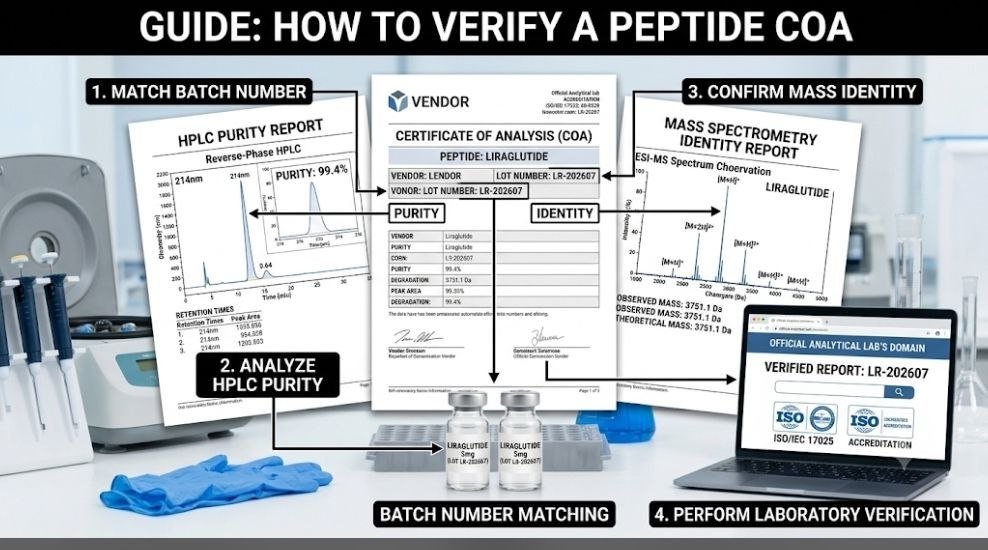
Step 1: Identify the exact product
Confirm:
- Full product name
- Peptide sequence where appropriate
- Expected molecular characteristics
- Quantity
- Intended research use
Step 2: Locate the batch number
The batch number should appear on the analytical documentation.
Step 3: Compare the batch number with the product label
If the physical material is already available, compare the two character-for-character.
Do not ignore small differences.
Step 4: Verify the laboratory
Look for:
- Full laboratory name
- Contact information
- Analytical capabilities
- Relevant accreditation information where applicable
- Independent verification system
Step 5: Verify the report
If a report number or verification key exists, enter it into the laboratory’s official verification system.
Do not assume that a logo on a PDF proves the report originated from that laboratory.
Step 6: Inspect the HPLC information
Look beyond the headline purity number.
Look for the actual chromatogram, retention time, integration information, and analytical details where provided.
Step 7: Inspect the MS data
Check whether the reported analytical data are consistent with the expected molecular characteristics.
Step 8: Determine whether additional testing is needed
Your research application determines whether additional testing such as endotoxin, residual solvents, or quantitative content analysis is relevant.
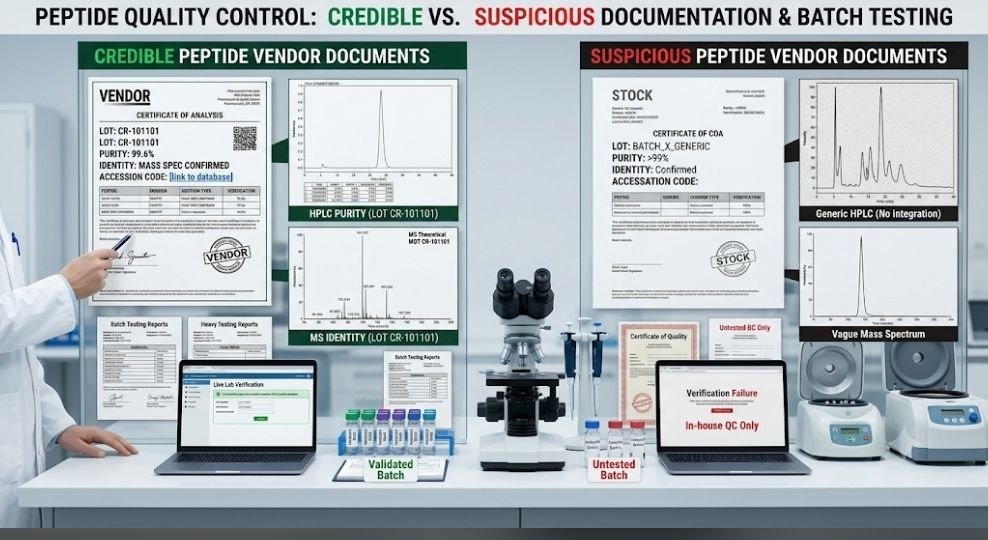
Green Flags vs. Red Flags
| Area | Green Flag 🟢 | Red Flag 🔴 |
|---|---|---|
| COA | Batch-specific analytical report | Generic product certificate |
| Verification | Independent laboratory lookup | Vendor-only PDF |
| HPLC | Chromatogram and analytical details | “99%” with no supporting data |
| MS | Identity data provided | No identity testing |
| Batch | Exact lot traceability | Missing or inconsistent lot |
| Testing | Appropriate third-party testing | Undisclosed testing source |
| Documentation | Available before purchase | “COA after payment” |
| Transparency | Questions answered clearly | Evasive responses |
| Claims | Specific and testable | “100% pure” marketing |
| Research scope | Appropriate testing for intended application | One test presented as proof of everything |
Three Real-World Procurement Lessons
Case Study 1: The $4,500 BPC-157 Order That Was Never Placed
An academic research group was evaluating a vendor for a bulk BPC-157 purchase intended for laboratory research.
The vendor presented:
- Professional website
- Competitive pricing
- 99.3% claimed purity
- COA
- Mass spectrometry information
- Laboratory verification key
The documentation initially looked convincing.
The researchers decided to verify the report before paying.
What happened?
The report key led to a legitimate laboratory record—but the record corresponded to a different compound.
The researchers then examined the analytical information more closely and identified additional inconsistencies between the reported compound and the underlying data.
The researchers ultimately avoided placing the approximately $4,500 order.
The lesson
The important lesson isn’t that every suspicious-looking COA is fraudulent.
The lesson is:
Verification should happen before payment—not after the research material has already been purchased.
This is precisely why independent verification is such an important part of evaluating peptide vendor documents.
Case Study 2: When a Verified COA Was Still Not Enough
A research team sourced a batch of Sermorelin for a metabolic research project.
The initial documentation appeared strong:
- HPLC data
- MS identity data
- Independent report verification
- High reported chromatographic purity
At that stage, the material appeared analytically acceptable based on those specific parameters.
But because the intended research application required additional characterization, the researchers performed additional testing.
Additional analysis raised concerns about endotoxin levels and quantitative peptide content.
The researchers rejected the lot.
The lesson
This case demonstrates an important principle:
A verified COA can be authentic and still not answer every question relevant to your particular research application.
That distinction is extremely important.
A COA should be evaluated according to what was actually tested—not according to what buyers hope it proves.
Case Study 3: The Recycled “Golden Batch”
Another common procurement risk is using a legitimate report from one batch to create confidence in another batch.
Imagine:
LOT-A8
was tested and achieved excellent analytical results.
The vendor publishes the report.
Later, inventory from:
LOT-A9
and
LOT-A10
is sold.
If those later lots are not independently characterized but are marketed under the reputation of LOT-A8, the original report does not establish the quality of the newer material.
The solution
Always ask:
“Does this COA correspond to the exact lot I am purchasing?”
If the answer is unclear, stop and investigate.
What to Request Before Sending Payment
Treat your peptide purchase like a formal research procurement process.
Before paying, request appropriate peptide vendor documents and verify them.
Minimum documentation request
Ask for:
1. Batch-specific COA
It should identify the exact lot.
2. HPLC data
Request the chromatographic information rather than only a percentage.
3. MS data
Request appropriate identity confirmation.
4. Independent verification
Ask how the report can be independently authenticated.
5. Product specification
Understand what the product is supposed to meet.
6. SDS
Obtain appropriate handling and safety information.
7. Additional testing where relevant
Depending on the research application, consider:
- Endotoxin testing
- Residual solvent testing
- Quantitative content testing
- Other analytical characterization
8. Batch traceability
Confirm that the documentation and physical material correspond to the same lot.
Questions to Ask a Peptide Vendor
Before purchasing, researchers can ask:
“Can you provide the COA for the exact batch currently being fulfilled?”
“Can I independently verify the laboratory report?”
“Does the report include raw HPLC data?”
“Is molecular identity confirmed by appropriate MS analysis?”
“What exactly does your stated purity percentage represent?”
“Is quantitative peptide content available?”
“Are endotoxin results available for this lot where relevant?”
“Are residual solvent results available?”
“What is the lot number on the material?”
“What documentation accompanies the product?”
A professional vendor should be able to explain its documentation process clearly.
Beware of These Marketing Claims
Certain phrases sound authoritative but should never be treated as substitutes for analytical evidence.
“99% Pure”
Ask:
99% purity according to which method?
HPLC purity is not necessarily equivalent to net peptide content, identity, or biological safety.
“Pharmaceutical Grade”
Ask what formal standard the claim refers to and what documentation supports it.
“GMP”
Ask what specific GMP framework, facility, certification, or manufacturing process the claim refers to.
“Lab Tested”
Ask:
Which laboratory?
Which batch?
Which tests?
Can I verify the report?
“FDA Approved”
Be particularly careful with this phrase.
A research peptide vendor should not use broad regulatory language to imply that an individual research peptide is approved for human use when that is not established.
“Made in Switzerland”
Country-of-origin or geographic branding does not establish analytical purity or identity.
“Third-Party Tested”
This is a good starting point—but it is not the end of the conversation.
Ask:
Which third party?
What was tested?
Which batch?
Can the report be independently verified?
How OasBioScience Approaches Documentation
At OasBioScience, the philosophy behind quality documentation is straightforward:
Researchers deserve evidence they can examine—not simply claims they are expected to trust.
The objective should be to make quality information understandable and traceable.
That means emphasizing several principles.
Batch Accountability
Documentation should connect the analytical report to the relevant product batch.
A report from an unrelated lot should never be treated as proof of the current lot.
Analytical Transparency
Where analytical data are provided, researchers should be able to understand what the test actually measures.
HPLC, MS, quantitative assays, endotoxin testing, and other analyses each answer different questions.
Independent Verification
When independent laboratory verification is available, researchers should be encouraged to verify the information at its original source rather than simply accepting a vendor-hosted PDF.
Buyer Education
Quality isn’t just about providing a document.
It is also about helping researchers understand the document.
That includes explaining:
- What HPLC means
- What MS means
- Why batch numbers matter
- What purity percentages actually represent
- Why additional testing may matter
- How to recognize suspicious documentation
This educational approach is important because a sophisticated-looking COA can still be misunderstood.
The Difference Between Transparency and Marketing
There is an enormous difference between:
“Our peptides are extremely high quality.”
and:
“Here is the batch-specific analytical documentation. Here is what was tested. Here is who performed the testing. Here is how you can verify the report. Here is what the results do—and do not—demonstrate.”
The second approach gives researchers something they can evaluate.
That’s what meaningful transparency looks like.
What Researchers Should Never Assume From a COA
A COA should not automatically be interpreted as proof of:
- Human safety
- Clinical efficacy
- Sterility
- Regulatory approval
- Correct dosing for humans
- Suitability for every research application
- Absence of every possible contaminant
- Long-term stability
- Manufacturing quality beyond the reported tests
Instead, read the COA literally.
Ask:
What did the laboratory actually test?
Then ask:
What does that result actually prove?
That mindset will protect researchers from many common purchasing mistakes.
A Simple 5-Minute Peptide Vendor Document Audit
If you are short on time, use this quick process.
Minute 1: Check the batch
Does the COA identify a specific lot?
Minute 2: Check the laboratory
Who performed the analysis?
Minute 3: Verify the report
Can the report be independently authenticated?
Minute 4: Check HPLC and MS
Are actual analytical results available rather than only summary percentages?
Minute 5: Check whether the testing fits your research
Do you need additional characterization such as quantitative content, endotoxin, or residual solvent testing?
If a vendor cannot answer basic questions during this process, that is information worth considering before proceeding.
Frequently Asked Questions About Peptide Vendor Documents
1. What documents should a peptide vendor provide before I buy?
At minimum, researchers should understand the vendor’s batch-specific COA, analytical testing, product specifications, SDS, and batch traceability. Depending on the intended research application, additional documentation such as endotoxin, residual solvent, and quantitative content testing may also be appropriate.
The most important factor is not the number of PDFs a vendor provides. It is whether the documents are authentic, relevant, current, and connected to the exact batch being supplied.
2. Is a 99% HPLC purity result enough?
No.
A high HPLC purity percentage can be useful, but it does not by itself establish every aspect of material quality.
HPLC and MS answer different analytical questions, while quantitative content, endotoxin, and residual solvent testing address other characteristics.
Researchers should therefore avoid treating one percentage as a complete quality assessment.
3. How can I tell whether a COA is real?
Start by checking whether the report contains a unique identifier, report number, sample ID, or verification mechanism.
If the laboratory provides an independent verification portal, enter the report information directly there.
Confirm that the:
- Product
- Batch
- Test date
- Results
- Laboratory
- Report identifier
correspond to the material being purchased.
Never assume that a laboratory logo on a PDF proves authenticity.
4. Should the COA match the peptide batch number?
Yes.
This is one of the simplest and most important checks.
A COA for one lot should not automatically be used as evidence for another lot.
The product documentation and physical vial should have consistent traceability information.
5. What is the difference between HPLC and mass spectrometry?
HPLC is commonly used to characterize chromatographic purity and separate components.
Mass spectrometry provides information about molecular mass and can support compound identity.
They are complementary rather than interchangeable.
A strong analytical package uses appropriate methods to answer different questions rather than relying on one test to establish everything.
6. Does an SDS prove peptide purity?
No.
An SDS is primarily a safety and handling document.
It should not be treated as a replacement for a COA, HPLC data, MS data, or other analytical testing.
Think of an SDS and COA as serving different purposes.
7. Should I buy from a vendor that says “COA available upon request”?
That phrase does not automatically prove that a vendor is unreliable.
However, researchers should ask why the documentation is not readily available and whether the vendor can provide the batch-specific report before purchase.
The key question is whether the vendor is transparent about the exact material being supplied.
8. Is “third-party tested” enough?
No.
“Third-party tested” is a starting point, not a complete quality statement.
Ask:
- Which laboratory?
- What analytical methods?
- Which batch?
- When was it tested?
- What were the results?
- Can the report be independently verified?
Specific evidence is more meaningful than a generic marketing statement.
9. Why does the lot number matter so much?
Because analytical testing applies to a specific sample or lot.
If a laboratory tested LOT-A but the vendor ships LOT-B, the original report does not automatically establish the characteristics of LOT-B.
Batch traceability connects the analytical evidence to the material being purchased.
10. What is the most important document to request before buying a peptide?
For most buyers, the starting point is a batch-specific Certificate of Analysis with appropriate analytical information and independent verification where available.
But don’t stop at the COA.
The real objective is to understand whether the complete documentation package answers the questions relevant to your research.
Final Peptide Vendor Documents Checklist
Before purchasing, ask yourself:
- Is there a batch-specific COA?
- Does the COA identify the exact lot?
- Does the lot correspond to the material being supplied?
- Is the testing laboratory clearly identified?
- Can the report be independently verified?
- Is HPLC data available?
- Is appropriate MS identity data available?
- Do I understand what the reported purity percentage means?
- Is quantitative content information available when relevant?
- Is endotoxin testing available when relevant to the research?
- Is residual solvent testing available when relevant?
- Is an SDS available?
- Is a product specification sheet available?
- Is the vendor transparent about batch traceability?
- Can the vendor explain its testing process clearly?
- Am I relying on evidence rather than marketing claims?
If several answers are “no,” slow down before purchasing.
Final Thoughts: Buy the Evidence, Not the Marketing
After more than two decades of working with peptides, one principle continues to stand out:
The strongest peptide supplier is not necessarily the one making the biggest claims. It is the one willing to show you the evidence behind those claims.
A professional website can be copied.
A marketing slogan can be invented.
A purity number can be misunderstood.
Even a PDF can be manipulated.
But disciplined documentation, independent verification, batch traceability, appropriate analytical testing, and transparent communication give researchers something much more valuable:
evidence.
When evaluating peptide vendor documents, don’t ask only:
“Does this vendor have a COA?”
Ask:
“Can I verify this COA, does it belong to the exact batch I am purchasing, and does the testing actually answer the questions relevant to my research?”
That is the difference between simply buying a product and conducting responsible research procurement.
For researchers interested in reviewing OasBioScience’s products and available documentation, visit:
Research Use Only: Research peptides and related materials should be used only for legitimate laboratory or scientific research in accordance with applicable laws, institutional requirements, and appropriate laboratory safety procedures. Analytical documentation does not establish suitability for human or veterinary use, clinical treatment, or consumption.
Continue Learning: If you found this guide helpful, you may also want to read our previous peptide education articles covering the following topics
- Explore 9 evidence-based facts about BPC-157, tendon repair research etc
- How long should a weight loss cycle last?
- Learn how to read peptide Certificates of Analysis step by step,
- Learn 15 proven storage practices for lyophilized and reconstituted peptides
- Learn the real shelf life of lyophilized and reconstituted peptides
- Learn the correct peptide reconstitution process, solvent selection, etc
- Learn the difference between BAC water and sterile water
- Discover 9 powerful fixes for peptide foaming
- Which peptide suppresses appetite the most?
Scientific Reference: For additional peer-reviewed information on peptide stability, sterile preparation, and pharmaceutical reconstitution practices, visit
European Medicines Agency (EMA)
United States Pharmacopeia (USP) – USP <797> Sterile Compounding

