Can BPC-157 Heal Tendon Injuries? 9 Powerful Facts Researchers Should Know

Table of Contents
- Can BPC-157 Heal Tendon Injuries? The Short Answer
- Why Tendon Injuries Are Difficult to Heal
- How BPC-157 Is Being Studied in Tendon Research
- BPC-157 and Angiogenesis
- BPC-157 and Fibroblast Migration
- BPC-157 and Collagen Remodeling
- Preclinical Tendon Injury Model
- Chronic Tendinopathy: Why Results May Differ
- Pain Relief Is Not the Same as Tendon Healing
- Mechanical Loading and Tendon Rehabilitation
- How Researchers Should Monitor Tendon Recovery
- BPC-157 Safety and Research Limitations
- How to Evaluate Research-Grade BPC-157
- BPC-157 vs. Common Tendon-Healing Claims
- Frequently Asked Questions
- Final Takeaway
Can BPC-157 Heal Tendon Injuries? The Short Answer
Can BPC-157 heal tendon injuries? The scientifically responsible answer is more complicated than a simple yes or no.
BPC-157 is an experimental peptide that has attracted considerable interest in tendon repair research, particularly because preclinical studies have investigated its potential effects on angiogenesis, fibroblast activity, inflammatory signaling, and tissue repair.
However, evidence from animal and laboratory research should not automatically be interpreted as proof that BPC-157 heals human tendon injuries.
That distinction is extremely important.
After more than two decades working with BPC-157 and educating and supplying researchers, I have seen how quickly interesting experimental findings can become exaggerated online.
BPC-157 is sometimes described as a “miracle tendon-healing peptide.”
That description goes far beyond what the available evidence can establish.
A more scientifically appropriate description is that BPC-157 is an experimental research compound being investigated for biological processes associated with tissue repair, including tendon-related repair mechanisms.
The difference between those statements matters.
A tendon is a highly organized mechanical structure. Repairing it is not simply a matter of reducing inflammation or increasing cellular activity.
Functional recovery requires the formation, organization, maturation, and remodeling of extracellular matrix—and ultimately the ability of the tendon to tolerate mechanical loads.
Why Tendon Injuries Are Difficult to Heal
https://pubchem.ncbi.nlm.nih.gov
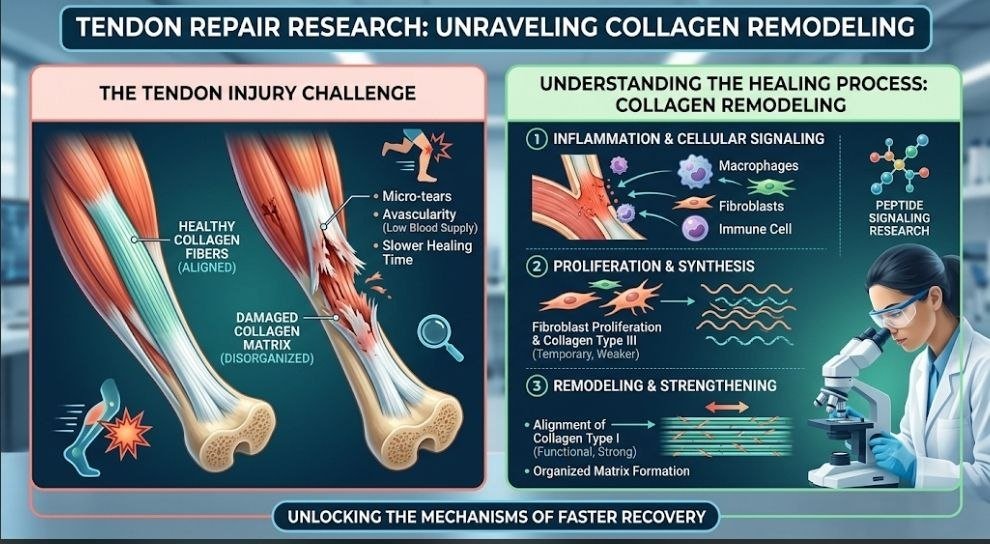
Tendons connect muscle to bone and transmit mechanical forces generated during movement.
They are predominantly composed of collagen, particularly Type I collagen, arranged into highly organized hierarchical structures.
That organization is critical.
A healthy tendon is not simply a mass of collagen.
Its collagen fibers are arranged in a manner that allows the tissue to withstand tensile forces.
Tendons also have relatively limited vascularity compared with many other tissues.
This contributes to the perception that tendon injuries heal slowly.
Common tendon conditions include:
- Achilles tendinopathy
- Achilles tendon tears
- Patellar tendinopathy
- Rotator-cuff injuries
- Tennis elbow
- Golfer’s elbow
- Tendon insertion injuries
- Chronic overuse tendinopathy
- Partial tendon tears
- Post-traumatic tendon damage
The biological environment is different for an acute injury compared with chronic degeneration.
That distinction is essential when interpreting BPC-157 research
How BPC-157 Is Being Studied in Tendon Research
Research into BPC-157 has investigated several biological mechanisms potentially relevant to tissue repair.
These include:
- Angiogenesis
- Fibroblast migration
- Cellular signaling
- Inflammatory modulation
- Nitric oxide pathways
- Tissue regeneration models
- Extracellular-matrix remodeling
- Tendon repair following experimental injury
One particularly interesting research area involves the interaction between cellular signaling and vascular responses.
BPC-157 and Tendon Repair: What Researchers Are Actually Investigating
The question isn’t simply:
“Does BPC-157 heal a tendon?”
A better research question is:
“Does BPC-157 influence biological processes involved in tendon repair, and if so, under what experimental conditions?”
That framing prevents researchers from confusing a biological mechanism with a proven clinical treatment.
BPC-157 and Angiogenesis
Angiogenesis refers to the formation of new blood vessels.
This is particularly interesting in tendon research because tendons have relatively limited vascularization.
Experimental research has investigated whether BPC-157 can influence pathways associated with vascular growth and tissue repair.
Among the pathways discussed in BPC-157 research are VEGF-related signaling and the FAK-paxillin pathway.
Why does this matter?
Because vascular responses can influence the delivery of oxygen, nutrients, signaling molecules, and cells involved in tissue repair.
However, there is an important distinction.
More Blood Vessels Does Not Automatically Mean a Better Tendon
Angiogenesis should not be interpreted as synonymous with successful tendon regeneration.
Chronic tendinopathy can involve abnormal vascular changes as well.
Therefore, researchers need to consider:
- Where vascularization occurs
- When it occurs
- Whether the vessels are functional
- How vascular changes correlate with tissue organization
- Whether biomechanical function improves
The objective isn’t simply “more blood vessels.”
The objective is functional tissue repair.
BPC-157 and Fibroblast Migration
Fibroblasts are important cells involved in connective-tissue repair.
Experimental models have investigated whether BPC-157 can influence fibroblast migration and cellular responses associated with wound repair.
This is potentially relevant because repairing damaged connective tissue requires coordinated cellular activity.
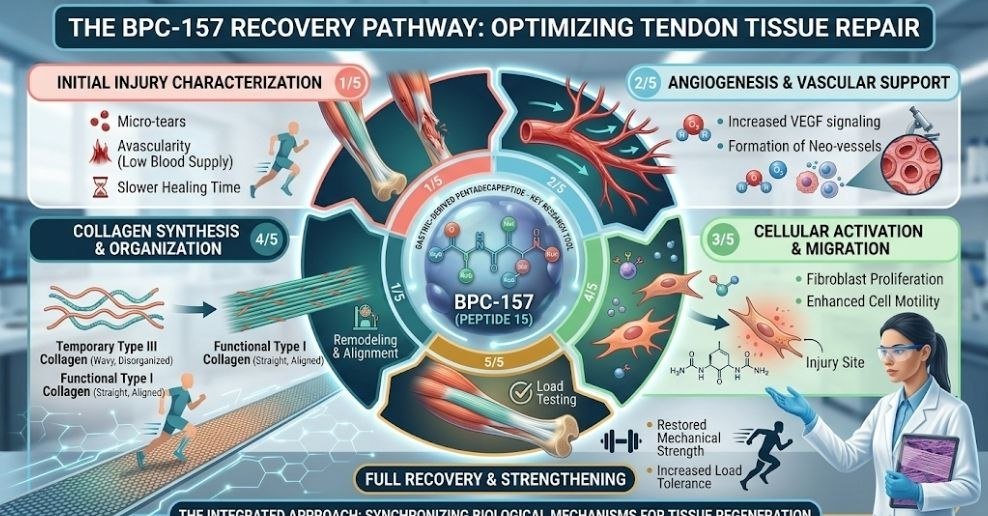
A simplified model looks like this:
Injury → cellular signaling → fibroblast activity → extracellular matrix production → collagen organization → remodeling → improved mechanical function
BPC-157 research is particularly interesting around the earlier portions of this sequence.
But the later stages are equally important.
A tendon cannot become mechanically functional simply because fibroblasts are active.
The newly produced matrix must eventually become appropriately organized and remodeled.
BPC-157 and Collagen Remodeling
Collagen is one of the most important structural components of tendon tissue.
After injury, the body doesn’t immediately recreate a perfectly organized tendon.
Healing involves multiple overlapping stages.
Early repair may involve:
- Inflammation
- Cellular recruitment
- Fibroblast proliferation
- Extracellular-matrix deposition
- Formation of relatively immature tissue
Later remodeling involves:
- Collagen organization
- Fiber alignment
- Matrix maturation
- Increasing mechanical strength
- Adaptation to mechanical loading
This is one reason the statement “BPC-157 healed my tendon in five days” should be treated cautiously.
Pain can change rapidly.
Tissue architecture does not necessarily change at the same speed.
Preclinical Tendon Injury Model
One of the most interesting experimental models involves severe tendon injury, including complete experimental tendon transection.
In a preclinical model of Achilles tendon transection, researchers can evaluate several objective parameters.
These may include:
Macroscopic Tendon Gap
Researchers can directly assess the physical defect between injured tendon ends.
A reduction in the gap may suggest accelerated tissue bridging.
Histological Organization
Microscopic examination can evaluate:
- Fibroblast density
- Collagen organization
- Inflammatory-cell infiltration
- Extracellular-matrix characteristics
- Tissue architecture
Biomechanical Testing
This is particularly important.
Researchers can test how much force repaired tissue can withstand before failure.
This provides information that pain scores alone cannot provide.
What the Experimental Model Suggests
In experimental tendon-injury models, BPC-157 administration has been associated with findings such as accelerated defect bridging, increased biomechanical strength, and improved organization of newly formed tissue.
However, these observations should remain in their proper context.
An animal model is not a human clinical trial.
Differences in species, metabolism, injury model, dosing, administration, rehabilitation, and biological response can significantly affect translation to humans.
Chronic Tendinopathy: Why Results May Differ
This is one of the most overlooked parts of the BPC-157 discussion.
A fresh experimental tendon injury is not the same biological problem as a tendon that has been degenerating for years.
Chronic tendinopathy may involve:
- Repetitive mechanical stress
- Altered collagen organization
- Degenerative matrix changes
- Fibrotic tissue
- Abnormal vascular responses
- Changes in tendon thickness
- Altered cellular behavior
- Persistent mechanical overload
Consequently, researchers should not assume that an intervention producing encouraging results in an acute injury model will automatically reverse established chronic degeneration.
BPC-157 and Chronic Tendinopathy
Chronic tendon pathology presents a much more complicated research environment.
A compound may influence cellular signaling without completely reversing established structural abnormalities.
This is especially relevant when a tendon contains substantial disorganized or fibrotic tissue.
Why Established Scar Tissue Matters
Imagine a tendon whose collagen architecture has been disrupted for months or years.
The problem isn’t simply a lack of a biological signal.
The tissue architecture itself has changed.
Therefore, the research question becomes:
Can the intervention promote meaningful remodeling of already-damaged matrix, and can that remodeling occur alongside appropriate mechanical rehabilitation?
That is a considerably harder problem than stimulating repair immediately after an experimental injury.
Pain Relief Is Not the Same as Tendon Healing
This may be the single most important concept in understanding BPC-157 and tendon injuries.
Pain reduction is not proof of structural healing.
Someone may experience less pain while the tendon remains mechanically compromised.
This creates an important potential problem.
If pain decreases quickly, an individual may assume the tendon has recovered and return to high-intensity training prematurely.
The result could be excessive loading of tissue that has not completed structural remodeling.
The Pain-versus-Architecture Problem
Pain is a symptom.
Tendon strength is a structural and biomechanical property.
They are related—but they are not identical.
A useful conceptual model is:
Pain reduction ≠ collagen maturation ≠ restored tensile strength
This principle applies regardless of whether BPC-157 is involved.
Mechanical Loading and Tendon Rehabilitation
Tendons are mechanical tissues.
They respond to mechanical forces through a process broadly described as mechanotransduction.
Mechanical loading influences cellular behavior and extracellular-matrix organization.
This is why progressive rehabilitation is such an important component of tendon recovery.
BPC-157 Cannot Replace Mechanical Rehabilitation
Even if experimental research demonstrates biological effects on fibroblasts, inflammatory pathways, or angiogenesis, that doesn’t mean a peptide can independently organize a tendon into fully functional load-bearing tissue.
Mechanical rehabilitation provides the physical environment in which tendon tissue adapts.
Depending on the injury and clinical circumstances, rehabilitation may involve carefully progressed:
- Isometric exercises
- Progressive resistance
- Heavy-slow resistance
- Controlled range-of-motion work
- Sport-specific loading
- Functional strengthening
The appropriate rehabilitation strategy depends on the injury.
For a complete tendon rupture, surgical and medical management may be necessary.
BPC-157 should never be presented as a substitute for professional diagnosis or appropriate treatment.
How Researchers Should Monitor Tendon Recovery
One of the most useful ways to evaluate tendon-repair research is to distinguish subjective improvements from objective structural changes.
A practical hierarchy looks like this:
| Recovery parameter | What it can tell researchers |
|---|---|
| Resting pain | Early symptom changes |
| Pain under load | Functional response to mechanical stress |
| Range of motion | Mobility and guarding |
| Swelling | Local inflammatory response |
| Load tolerance | Functional adaptation |
| Strength testing | Mechanical performance |
| Ultrasound | Structural and tissue changes |
| MRI | More detailed structural assessment |
| Histology | Cellular and collagen architecture |
| Load-to-failure testing | Experimental biomechanical strength |
Days 1–7
Researchers may observe:
- Resting pain
- Swelling
- Local discomfort
- Early inflammatory changes
These can change relatively quickly.
Weeks 2–4
More useful functional parameters may include:
- Pain during loading
- Range of motion
- Functional capacity
- Tolerance of rehabilitation
Weeks 4–8+
Researchers can increasingly examine:
- Force output
- Load tolerance
- Functional performance
- Tendon structure
- Imaging changes
Months 2–6+
Longer-term remodeling becomes particularly important.
This is where the distinction between symptom improvement and structural recovery becomes increasingly relevant.
BPC-157 Safety and Research Limitations
Anyone researching BPC-157 should understand that it remains an experimental compound.
That means claims about established human efficacy and long-term safety should be treated very cautiously.
Several major evidence limitations deserve attention.
Limited Human Clinical Evidence
Much of the enthusiasm surrounding BPC-157 originates from preclinical research and anecdotal reports.
Animal studies can provide valuable mechanistic information.
They cannot establish human clinical efficacy on their own.
Long-Term Safety Questions
Important questions remain regarding:
- Long-term systemic exposure
- Appropriate human dosing
- Pharmacokinetics
- Drug interactions
- Reproductive considerations
- Chronic administration
- Potential effects associated with angiogenic signaling
These questions require appropriately designed human research.
Product Quality
Even if a research compound is scientifically interesting, poor-quality material can compromise experimental results.
Researchers should therefore distinguish between:
The biology of BPC-157
and
The quality of the BPC-157 material being investigated.
They are separate issues.
How to Evaluate Research-Grade BPC-157
If you’re conducting laboratory research involving BPC-157, analytical verification is one of the most important parts of responsible research sourcing.
At minimum, researchers should pay attention to appropriate analytical documentation.
HPLC Testing
High-performance liquid chromatography can provide information about chromatographic purity.
A stated purity percentage without supporting analytical information is less useful than transparent documentation.
Mass Spectrometry
Mass spectrometry can help confirm whether the observed molecular mass corresponds to the expected compound.
This is particularly valuable when verifying peptide identity.
Endotoxin Testing
For research applications where endotoxin contamination could influence experimental outcomes, endotoxin testing may be important.
Sterility Considerations
Sterility requirements depend on the intended research application.
Researchers should not assume that a product labeled “research grade” is sterile.
Third-Party Laboratory Verification
Independent testing can provide an additional layer of confidence.
A strong quality-control package may include:
- HPLC results
- Mass spectrometry
- Batch identification
- Endotoxin testing where appropriate
- Sterility testing where appropriate
- Independent laboratory verification
For researchers evaluating peptide materials, traceability and analytical transparency matter just as much as the headline purity number.
BPC-157 vs. Common Tendon-Healing Claims
The internet is full of simplified claims.
Here is a more scientifically cautious interpretation.
| Popular claim | More responsible interpretation |
| “BPC-157 heals tendons instantly.” | Experimental research has investigated effects relevant to tissue repair, but structural healing occurs over a biological timeframe. |
| “Pain disappears, so the tendon is healed.” | Symptom improvement does not establish restored tendon strength. |
| “BPC-157 replaces physical therapy.” | A biochemical intervention cannot automatically replace mechanical rehabilitation. |
| “BPC-157 reverses every chronic tendon injury.” | Chronic tendinopathy is biologically complex and may respond differently from acute injury models. |
| “Animal results prove human effectiveness.” | Animal studies provide preclinical evidence, not definitive human clinical proof. |
| “Any BPC-157 product is equivalent.” | Analytical identity, purity, contamination control, and documentation can differ between products. |
| “More angiogenesis is always better.” | Vascular responses must be interpreted in the context of tissue structure and function. |
What About Achilles Tendon Injuries?
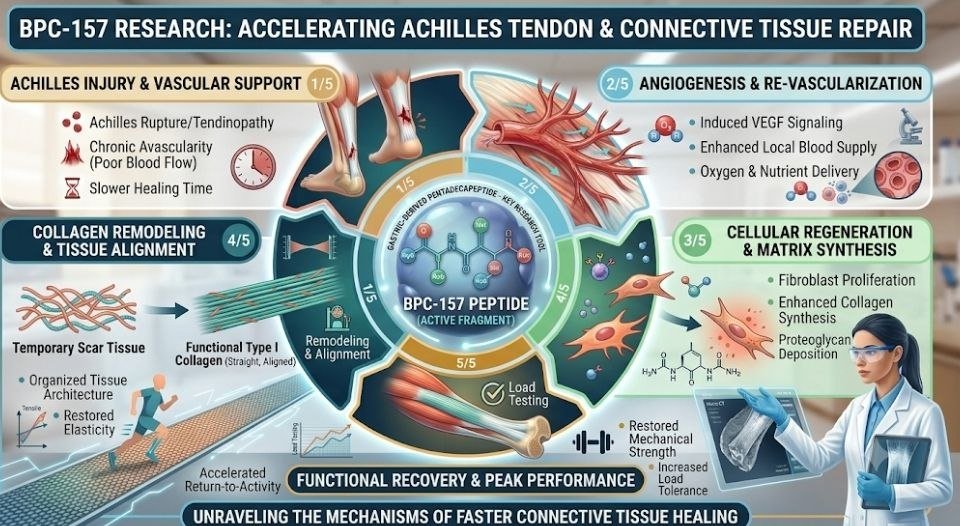
The Achilles tendon is particularly interesting in tendon-repair research because it experiences substantial mechanical loads while having relatively limited vascularity.
Research models can therefore provide useful information about:
- Tissue bridging
- Collagen deposition
- Fibroblast activity
- Vascular responses
- Mechanical strength
- Remodeling
But a complete Achilles rupture is a serious medical injury.
A person with a suspected rupture should obtain appropriate medical assessment rather than attempting to manage the injury based on online information about BPC-157.
A compound that looks promising in an experimental model cannot be assumed to reconnect a completely ruptured human tendon.
What About Rotator-Cuff Injuries?
Rotator-cuff pathology can range from tendinopathy to partial tears and full-thickness tears.
The underlying pathology can therefore vary considerably.
A research model of acute tendon damage cannot necessarily predict what happens in:
- Chronic degenerative rotator-cuff disease
- Long-standing partial tears
- Massive tears
- Tendon retraction
- Muscle atrophy
- Fatty degeneration
This is another reason why the question “Can BPC-157 heal tendon injuries?” cannot be answered without considering the specific injury.
What About Tennis Elbow and Patellar Tendinopathy?
Conditions such as lateral elbow tendinopathy and patellar tendinopathy are often chronic and load-related.
They are not necessarily equivalent to a clean acute tendon tear.
Researchers and clinicians therefore need to distinguish between:
Acute structural injury
and
Chronic tendinopathy.
That distinction can dramatically change how an experimental intervention should be interpreted.
What My Experience Since 2003 Has Taught Me
I’ve worked with BPC-157 research since 2003 and have educated and supplied more than 10,000 researchers.
One lesson repeatedly stands out:
The most useful peptide information is not the information that makes the biggest promise. It’s the information that accurately defines what the evidence can and cannot tell you.
BPC-157 is a fascinating research molecule.
Its potential effects on tissue-repair pathways justify continued scientific investigation.
But scientific curiosity should not be converted into certainty before the evidence supports it.
Researchers should ask:
- What model was used?
- What injury was created?
- What species was studied?
- What endpoints were measured?
- Was structural recovery demonstrated?
- Was mechanical strength measured?
- Was imaging performed?
- Was the research replicated?
- How closely does the model resemble the human condition?
Those questions are much more informative than simply asking whether BPC-157 “works.”
How OasBioScience Approaches BPC-157 Research
At OasBioScience, the emphasis should be on providing researchers with information that allows them to make informed decisions about experimental materials rather than making unsupported therapeutic promises.
For research applications, analytical documentation and product transparency are particularly important.
Researchers interested in BPC-157 should look for appropriate quality-control information and understand exactly what analytical testing does—and does not—establish.
A high-purity analytical result does not prove clinical efficacy.
Likewise, an interesting animal study does not establish that a peptide is an approved human treatment.
Keeping those distinctions clear is essential for responsible peptide research.
Continue Learning: If you found this guide helpful, you may also want to read our previous peptide education articles covering the following topics
- Learn how to determine the right duration using weight-loss progress
- Learn how GLP-1 muscle loss can be prevented
- Discover the best peptide for obesity research.
- Discover the foods to avoid on GLP-1 medications,
- Tirzepatide Side Effects: 15 Powerful Facts, Warning Signs & Safe Management:
- Why am I not losing weight on semaglutide?
- Learn How Much Weight Can You Lose on Tirzepatide
- Discover which peptide suppresses appetite the most
- Discover 9 powerful fixes for peptide foaming
- Learn the difference between BAC water and sterile water
- Learn the correct peptide reconstitution process
Frequently Asked Questions About BPC-157 and Tendon Injuries
1. Can BPC-157 heal tendon injuries?
Can BPC-157 heal tendon injuries? Current evidence does not allow us to state definitively that BPC-157 heals human tendon injuries. Preclinical research has investigated potentially relevant effects on tissue repair, angiogenesis, fibroblast activity, and other biological pathways, but robust human clinical evidence remains limited.
2. Does BPC-157 help tendon repair?
BPC-157 has demonstrated potentially interesting effects in experimental tissue-repair models. However, “helps tendon repair” should not be interpreted as established clinical efficacy in humans. Researchers should distinguish preclinical findings from proven medical outcomes.
3. Can BPC-157 repair a torn Achilles tendon?
There is insufficient human clinical evidence to claim that BPC-157 can repair a torn Achilles tendon. A complete Achilles rupture is a serious injury requiring appropriate medical evaluation and treatment.
Experimental tendon models may provide useful biological information, but they cannot guarantee the same outcome in humans.
4. Does BPC-157 rebuild collagen?
Research has investigated BPC-157 in relation to cellular and tissue-repair mechanisms associated with collagen formation and remodeling. However, collagen production is only one component of functional tendon recovery.
The organization and maturation of collagen—and its adaptation to mechanical loading—are also critical.
5. How quickly does BPC-157 heal a tendon?
There is no scientifically established human timeline showing that BPC-157 heals tendon injuries within a specific number of days.
Early changes in pain or inflammation can occur much faster than structural remodeling.
Therefore, rapid symptom improvement should not automatically be interpreted as complete tendon healing.
6. Can BPC-157 replace physical therapy for tendon injuries?
No evidence currently justifies treating BPC-157 as a replacement for appropriate rehabilitation.
Tendon tissue responds to mechanical loading, and progressive rehabilitation is an important part of restoring functional capacity.
7. Is BPC-157 FDA-approved for tendon injuries?
BPC-157 should not be presented as an FDA-approved treatment for tendon injuries. Researchers should verify the current regulatory status applicable to their jurisdiction and intended use.
8. Is BPC-157 safe for humans?
The available human evidence is insufficient to establish long-term safety comprehensively. Questions remain regarding appropriate human exposure, pharmacokinetics, long-term effects, and other safety considerations.
That is why responsible research communication should avoid presenting BPC-157 as a proven human therapy.
9. What testing should researchers look for when buying BPC-157?
Researchers should consider analytical documentation such as HPLC, mass spectrometry, and appropriate endotoxin or sterility testing, depending on the intended research application.
Independent third-party laboratory verification can provide additional confidence in identity and quality.
10. What is the biggest misconception about BPC-157 and tendon healing?
The biggest misconception is that pain relief equals structural healing.
A tendon can feel significantly better while its collagen architecture and mechanical strength remain incomplete.
For meaningful research, symptom changes should therefore be separated from objective measures of structural and biomechanical recovery.
Final Takeaway: Can BPC-157 Heal Tendon Injuries?
So, can BPC-157 heal tendon injuries?
The most scientifically responsible answer is:
BPC-157 is a promising experimental research peptide with preclinical findings relevant to tendon and connective-tissue repair, but current evidence does not justify claiming that it has been proven to heal human tendon injuries.
The distinction between biological potential and clinical proof is critical.
Experimental research has investigated BPC-157 in areas including:
- Fibroblast migration
- Angiogenic signaling
- Inflammatory modulation
- Tissue repair
- Collagen-related processes
- Experimental tendon injury
- Biomechanical recovery
But tendon healing is not simply a biochemical process.
Functional tendon recovery requires appropriate biological remodeling and mechanical adaptation.
Perhaps the most important principle to remember is this:
Pain reduction is not tissue healing—and a biochemical signal cannot replace the mechanical organization required to create a functional tendon.
For researchers, that distinction provides a much more useful framework for evaluating BPC-157.
Rather than asking only, “Does BPC-157 heal tendons?”, ask the more meaningful scientific questions:
What biological pathway is being affected?
What experimental model demonstrated the effect?
Was structural repair actually measured?
Was mechanical strength restored?
Does the evidence translate to humans?
And how reliable and analytically verified is the research material being studied?
Those questions lead to better science, better research decisions, and more responsible communication.
For researchers exploring BPC-157 and other experimental peptides, OasBioScience can serve as a resource for learning more about peptide research materials, analytical documentation, and responsible research practices.
Research Use Only. Not for human or veterinary use.
Scientific Reference: For additional peer-reviewed information on peptide stability, sterile preparation, and pharmaceutical reconstitution practices, visit
United States Pharmacopeia (USP) Official Website
