
What Happens If You Shake Peptides? 9 Powerful Facts to Prevent Peptide Handling Damage In 2026

what happens if you shake peptides
Accidentally shook your peptide vial? Don’t panic. A single accidental shake does not automatically mean the peptide has been destroyed.
What happens if you shake peptides depends on several factors, including whether the peptide is still lyophilized or has already been reconstituted, how vigorously it was shaken, how long it was agitated, and how sensitive the particular peptide formulation is to mechanical stress.
For shaking reconstituted peptides, the most immediate effects are often foam, microbubbles, temporary cloudiness, and increased contact between the solution and the air-liquid interface. In some susceptible formulations, more significant physical changes such as adsorption, precipitation, or aggregation may also occur.
This is why gentle handling is recommended.
However, there is an important distinction between “avoid vigorous shaking” and “one shake destroys the peptide.” Those statements are not equivalent.
A normal accidental shake does not simply snap the covalent peptide bonds holding the amino-acid sequence together. The more realistic concern is whether vigorous or repeated agitation changes the physical state of the reconstituted solution.
At OasBioScience, our approach to peptide handling and care is based on practical experience reviewing peptide documentation, batches, COAs, manufacturers, and third-party laboratory information since 2003.
The goal is simple: help researchers understand what actually matters, what does not, and what to do when something unexpected happens.
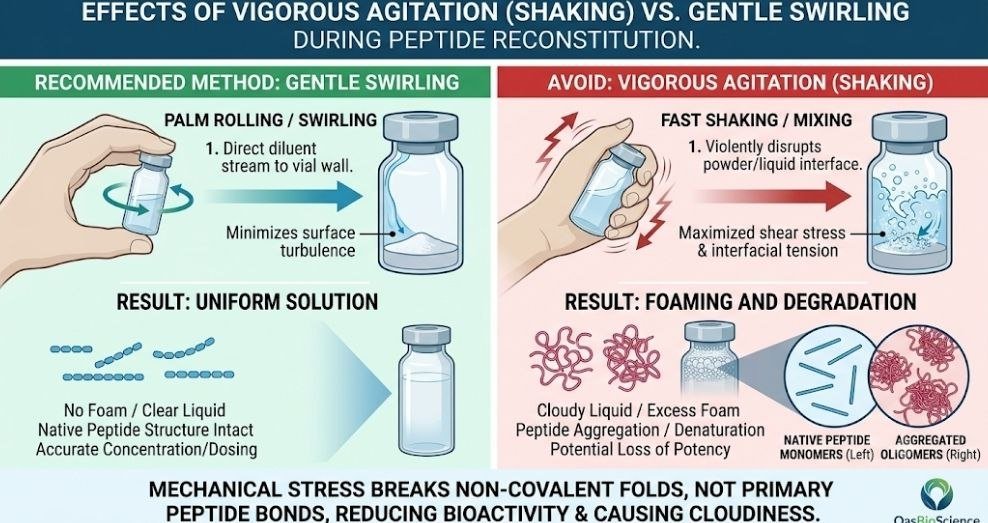
Table of Contents
What Happens If You Shake Peptides?
https://pubmed.ncbi.nlm.nih.gov/
The question “what happens if you shake peptides?” sounds simple, but there is no single answer that applies equally to every peptide.
A peptide can be affected differently depending on its sequence, formulation, concentration, pH, solvent, temperature, physical state, and exposure to mechanical agitation.
The first distinction to understand is whether the peptide is dry and lyophilized or already reconstituted in liquid.
That difference is critical.
A dry lyophilized peptide does not have the same air-liquid interface as a dissolved peptide solution. Normal movement during transportation therefore should not automatically be interpreted as peptide degradation.
A reconstituted peptide is different.
Once liquid has been introduced, vigorous shaking can create foam and large numbers of tiny air bubbles. It can also increase the amount of peptide exposed to the air-liquid interface and to the inside surface of the vial.
For some formulations, these conditions may contribute to physical instability.
Therefore, the practical rule is:
Avoid unnecessary vigorous agitation, but do not assume that one accidental shake has destroyed the peptide.
That is the balanced answer researchers need.
Does Shaking Actually Break Peptide Bonds?
One of the biggest misconceptions surrounding peptide handling is the idea that vigorous shaking mechanically “snaps” peptide bonds.
Ordinary manual shaking does not normally provide the chemical conditions necessary to break the covalent peptide bonds in the amino-acid backbone.
Peptide bonds are chemical bonds, not mechanical hinges that break because someone moves a vial quickly.
Chemical degradation can occur through processes such as hydrolysis, oxidation, deamidation, or other modification pathways depending on the peptide and environment.
Mechanical agitation is more commonly associated with physical stress in a liquid system.
This distinction is important.
Mechanical stress versus chemical degradation
Mechanical agitation can:
- Introduce air bubbles
- Produce foam
- Increase air-liquid interfacial area
- Increase contact with container surfaces
- Promote adsorption in susceptible systems
- Contribute to aggregation in susceptible formulations
- Make visual inspection more difficult
Chemical degradation, on the other hand, involves actual changes to the molecular structure.
Therefore, if you accidentally shake a vial, it is not scientifically accurate to immediately say:
“The peptide bonds have been broken.”
The correct question is:
“Did the agitation cause a measurable change in the physical or chemical quality of this particular formulation?”
That is something analytical testing can investigate.
Lyophilized vs. Reconstituted Peptides
Understanding the difference between these two states is one of the most important parts of peptide handling and care.
Lyophilized peptides
Lyophilization, commonly called freeze-drying, removes most of the water from the formulation.
The resulting material is typically a dry cake or powder inside the vial.
During ordinary transportation, a dry vial may experience:
- Vibration
- Movement
- Orientation changes
- Handling
- Minor impacts
- Transportation-related agitation
These events do not automatically mean the peptide has been chemically destroyed.
The dry state does not behave the same way as a liquid solution exposed to vigorous agitation.
This is why researchers should not confuse ordinary shipping movement with deliberate shaking of a reconstituted peptide.
Reconstituted peptides
After a diluent has been added, the physical environment changes.
The peptide is now present in a liquid system.
Vigorous shaking can create a large number of bubbles and increase the air-liquid interface.
This is where shaking reconstituted peptides becomes a more meaningful handling concern.
The solution can potentially experience:
- Foaming
- Microbubble formation
- Surface adsorption
- Precipitation
- Aggregation
- Other formulation-dependent physical changes
Not every peptide will experience all of these effects.
That is why blanket statements should be avoided.
What Happens During Shaking Reconstituted Peptides?
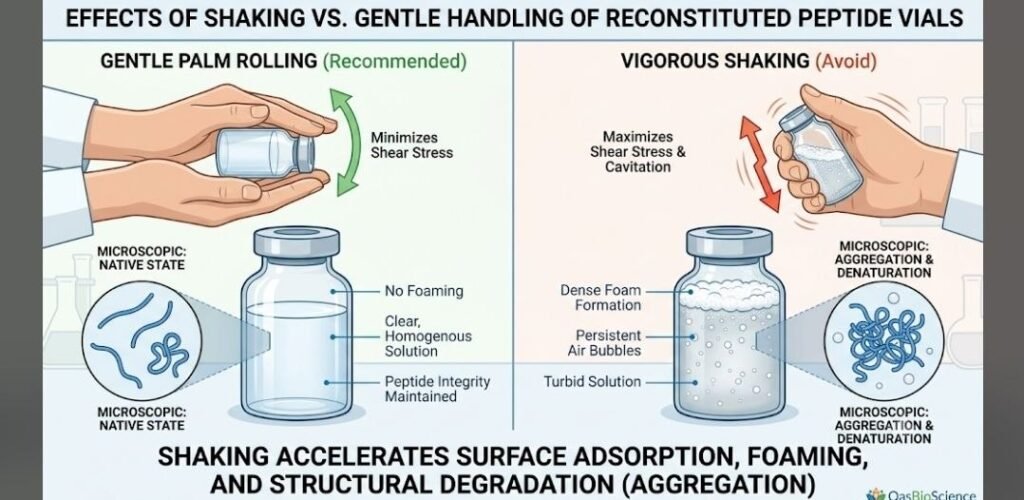
When a researcher vigorously shakes a reconstituted peptide vial, several physical processes can occur at the same time.
Air is incorporated into the solution
Vigorous movement forces air into the liquid.
The result can be thousands of tiny bubbles suspended throughout the solution.
Those bubbles scatter light.
This can make a normally clear solution temporarily appear hazy or cloudy.
That does not automatically mean the peptide itself has degraded.
Foam develops at the surface
Some formulations produce more persistent foam than others.
Foam is essentially a collection of gas bubbles stabilized at the liquid surface.
If a vial is heavily shaken, a thick layer of foam can appear.
The foam may disappear as the solution rests.
This is why immediately inspecting a freshly shaken vial can be misleading.
The air-liquid interface increases
Every bubble creates additional surface area between air and liquid.
That matters because some peptides can interact with interfaces.
Molecules can adsorb to surfaces or undergo conformational changes depending on their characteristics and formulation.
The effect varies substantially between different molecules.
Aggregation may be possible
Aggregation occurs when individual molecules associate into larger assemblies.
Some peptides are relatively resistant to agitation.
Others can be more sensitive.
Potential contributing factors include:
- Peptide sequence
- Concentration
- pH
- Temperature
- Ionic strength
- Excipients
- Solvent
- Container surfaces
- Agitation intensity
- Agitation duration
Therefore, peptide agitation damage should not be treated as an automatic consequence of shaking.
It is a potential risk that depends on the specific system.
Why Do Shaken Peptides Become Foamy or Cloudy?
This is probably the most common practical question researchers ask.
Someone reconstitutes a peptide, becomes concerned that it is dissolving too slowly, shakes the vial, and suddenly sees foam or cloudiness.
The immediate reaction is often:
“I ruined it.”
That conclusion is premature.
Foam does not equal degradation
Foam primarily indicates that air has been incorporated into the liquid.
It may disappear as the solution rests.
Microbubbles can look like cloudiness
Tiny suspended bubbles scatter light.
A solution containing enough microbubbles can appear white or hazy even though the apparent cloudiness is primarily physical rather than chemical.
Persistent cloudiness deserves attention
If the solution remains cloudy after adequate settling, the possibilities become broader.
Potential explanations include:
- Aggregation
- Precipitation
- Incomplete dissolution
- Formulation effects
- Particulate contamination
- Persistent microbubbles
Visual inspection alone cannot determine which explanation is correct.
Visible particles are different
If you can see definite particles floating in the solution, that should be treated more seriously than temporary foam.
The correct response is not to guess.
Instead, follow the appropriate product and laboratory quality-control procedures and contact the supplier when necessary.
The important lesson
A visual observation is not the same thing as an analytical diagnosis.
A clear solution does not prove molecular identity.
A cloudy solution does not automatically prove molecular destruction.
Good peptide handling and care requires understanding that difference.
How Much Agitation Is Too Much?
There is no universal number of seconds that defines the exact point at which a peptide becomes damaged.
Instead, it is useful to think about agitation in levels.
Level 1: Brief accidental movement
Examples include:
- Accidentally shaking the vial once
- Moving it quickly
- Turning it over
- Handling it roughly for a moment
This does not automatically mean the peptide has been damaged.
The appropriate response is to stop further agitation and inspect the material after it has settled.
Level 2: Vigorous shaking for several seconds
This creates substantially more foam and air-liquid interface.
It may also increase physical stress on susceptible formulations.
This is why vigorous shaking is not recommended for reconstituted peptide solutions.
Level 3: Repeated shaking
Repeated agitation creates repeated exposure to the same physical stress.
If the solution repeatedly becomes foamy, cloudy, or visibly altered, the situation deserves greater attention.
Level 4: Prolonged mechanical agitation
Laboratory instruments can apply much more controlled and sustained agitation than normal hand movement.
This type of stress can be used in formal stability studies to determine whether a formulation is sensitive to mechanical stress.
The important point is that there is no universal “X seconds equals destroyed” rule.
The response is formulation-dependent.
Peptide Agitation Damage and Laboratory Testing
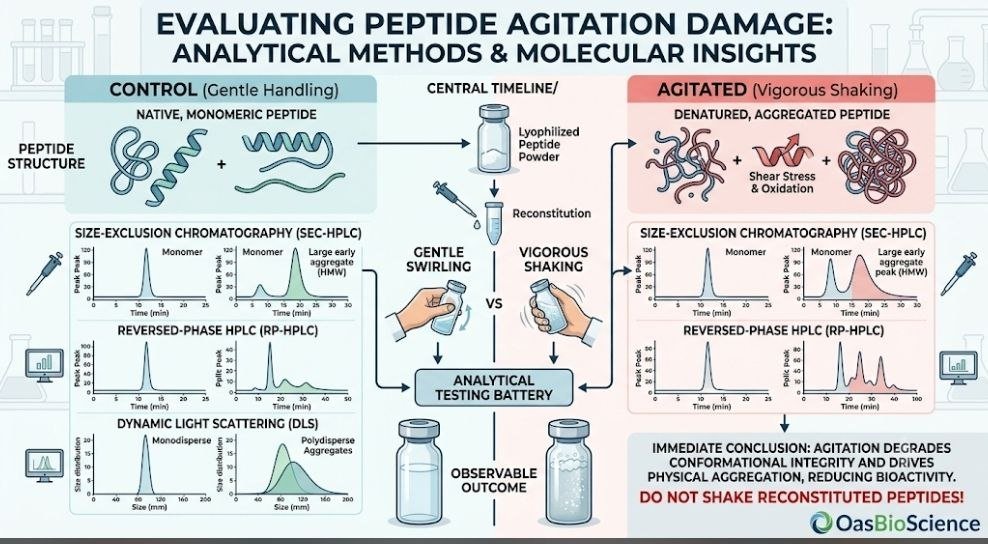
If researchers genuinely want to determine whether agitation changed a peptide, analytical testing is much more informative than looking at the vial.
Different analytical techniques answer different questions.
Visual inspection
Visual inspection can identify:
- Foam
- Turbidity
- Particles
- Precipitation
- Color changes
It is a useful first-line observation.
But it has limitations.
It cannot prove peptide identity, purity, molecular mass, or the exact cause of cloudiness.
Reversed-Phase HPLC
RP-HPLC can be used to evaluate chromatographic purity and detect changes in the chromatographic profile.
A control sample can be compared with an agitated sample.
Researchers may look for:
- Changes in the main peak
- New peaks
- Peak broadening
- Changes in retention behavior
- Other chromatographic differences
However, HPLC does not answer every possible quality question.
Size-Exclusion Chromatography
If aggregation is specifically suspected, size-based chromatographic methods can provide additional information.
Larger assemblies can behave differently from monomeric material.
This makes SEC useful when the research question concerns aggregation or higher-molecular-weight species.
Mass Spectrometry
LC-MS can help evaluate molecular mass and investigate certain chemical modifications.
For example, it can help determine whether the observed molecular mass is consistent with the expected peptide.
But mass spectrometry should not be treated as a universal test for every type of physical instability.
Orthogonal testing
The strongest approach is often to use complementary methods.
For example:
Visual inspection + HPLC + MS
can answer considerably more questions than relying on one measurement.
If aggregation is specifically suspected, additional size-based or particle-focused methods may be appropriate.
This is one reason OasBioScience places importance on understanding what a COA actually demonstrates rather than focusing on one isolated number.
A Real-World Customer Support Case
A useful way to understand what happens if you shake peptides is to look at a real support scenario.
A customer reported:
“I just reconstituted my 5 mg BPC-157 vial with 2 mL of bacteriostatic water. The powder wasn’t dissolving fast enough, so I gave the vial a fast, hard shake. Now it looks completely cloudy and has a thick layer of foam at the top. Did I just ruin it?”
This is a realistic problem because researchers sometimes become impatient when a lyophilized material does not dissolve immediately.
Step 1: Stop the agitation
The first instruction is simple:
Stop shaking the vial.
Continuing to shake it will only introduce more air and make the visual situation harder to evaluate.
Step 2: Allow the vial to settle
Keep the vial upright and follow the applicable storage instructions for the specific material.
The goal is to give foam and microbubbles time to dissipate.
Step 3: Reinspect the solution
After the solution has had time to settle, examine it carefully.
Ask:
- Has the foam disappeared?
- Is the solution becoming clearer?
- Is persistent turbidity present?
- Are visible particles present?
- Is there precipitation?
- Does the material look substantially different from its expected appearance?
Step 4: Don’t diagnose molecular destruction from appearance alone
Suppose the foam disappears but the solution remains faintly cloudy.
That observation deserves attention.
However, it does not prove that the peptide backbone has irreversibly unfolded.
There are several possible explanations for persistent cloudiness.
The appropriate conclusion is:
The solution has an unexpected physical appearance and should be evaluated rather than automatically assumed to be destroyed.
What this case teaches
The most important lesson is not simply “never shake.”
It is:
Do not respond to slow dissolution with increasingly aggressive agitation.
Slow dissolution can have several causes.
The correct response is to follow the appropriate reconstitution instructions, allow sufficient time, and investigate unexpected behavior instead of assuming that more force will solve the problem.
What to Do If You Accidentally Shake a Peptide
If you searched what happens if you shake peptides because you have just shaken a vial, use this practical checklist.
Step 1: Stop shaking
Do not continue manipulating the vial.
Step 2: Keep it upright
Place the vial somewhere stable.
Step 3: Follow the specified storage conditions
Do not automatically apply one storage temperature to every peptide.
Follow the documented requirements for the particular material.
Step 4: Allow bubbles and foam to dissipate
Give the solution time to settle.
A freshly shaken vial can look dramatically different from the same vial after the bubbles disappear.
Step 5: Inspect the vial
Look for:
- Persistent cloudiness
- Visible particles
- Precipitation
- Unexpected color changes
- Unusual material on the vial walls
- Failure to return toward its expected appearance
Step 6: Don’t automatically discard it
An accidental shake alone does not establish that the peptide has been destroyed.
If the solution returns to its expected appearance, that is reassuring from a visual standpoint.
It is not, however, equivalent to laboratory confirmation of purity or identity.
Step 7: Contact the supplier when necessary
If the material remains visibly abnormal, contact the supplier and provide useful information such as:
- Product name
- Lot number
- Reconstitution details
- Diluent used
- Approximate agitation
- Storage conditions
- Description or photograph of the appearance
This information makes troubleshooting much more useful.
Troubleshooting Common Problems
“My peptide is covered in foam.”
This may simply reflect air incorporated during vigorous agitation.
Stop shaking and allow the vial to settle.
Do not use foam alone as evidence that the peptide has been chemically degraded.
“My peptide is cloudy immediately after shaking.”
Microbubbles may be responsible for some or all of the initial appearance.
Allow the solution to settle before drawing conclusions.
“My peptide is still cloudy.”
Persistent turbidity deserves investigation.
Possible causes include aggregation, precipitation, incomplete dissolution, formulation effects, or particles.
Do not assume one cause without evidence.
“I can see particles.”
Visible particles should be treated as a quality-control concern.
Do not simply assume that they are harmless bubbles.
If the particles remain after settling, consult the applicable laboratory procedure or supplier.
“The peptide isn’t dissolving quickly.”
Do not respond by shaking harder.
Slow dissolution does not automatically mean poor quality.
Factors such as concentration, formulation, solvent, pH, temperature, and peptide characteristics can influence dissolution.
Follow the specific product instructions and allow sufficient time“I shook the vial several times.”
Repeated agitation deserves more caution than one brief accidental movement.
Allow the vial to settle and inspect it.
If unexpected changes persist, further investigation may be appropriate.
Why Gentle Swirling Is Recommended
The recommendation to swirl rather than shake exists for a practical reason.
Gentle swirling can help mix the contents while minimizing the amount of air incorporated into the liquid.
The goal is not to eliminate all movement.
The goal is to avoid unnecessary turbulence.
A good general handling principle is:
Use enough movement to facilitate mixing, but avoid deliberately creating vigorous foam.
When adding a diluent, controlled addition can also help.
Rather than forcefully directing liquid at the center of a fragile lyophilized cake, researchers can follow the specific reconstitution instructions provided for the material.
Then allow the liquid to interact with the material naturally.
If dissolution is slow, patience is often preferable to aggressive agitation.
Peptide Handling and Care Best Practices
Good peptide handling and care starts before the vial is reconstituted.
Protect the material from inappropriate temperatures
Follow the storage conditions specified for the particular product.
Do not assume that every peptide has identical stability.
Minimize unnecessary temperature cycling
Repeated movement between warm and cold environments can introduce unnecessary stress.
Consistent storage is generally preferable.
Protect from unnecessary light exposure
Some peptide materials may be sensitive to light.
When specified, protect the vial from unnecessary direct light exposure.
Avoid unnecessary agitation
This is the simplest rule in the entire article.
You do not need to treat a peptide vial as though one movement will destroy it.
But there is also no benefit to aggressively shaking it.
Be patient during dissolution
A slow-dissolving material should not automatically be treated as defective.
Investigate the reconstitution instructions before increasing mechanical force.
Keep handling consistent
Researchers should aim for repeatable procedures.
Consistent handling makes it easier to identify genuine problems because there are fewer uncontrolled variables.
Common Myths About Shaking Peptides
Myth #1: “One hard shake destroys every peptide.”
This is an exaggeration.
A single shake does not automatically break peptide bonds or prove that the peptide is unusable.
The response depends on the material and conditions.
Myth #2: “If the solution is cloudy, the peptide is ruined.”
Not necessarily.
Cloudiness can be caused by microbubbles, incomplete dissolution, precipitation, formulation effects, or aggregation.
Appearance alone cannot determine the cause.
Myth #3: “Shaking only matters for proteins.”
This is also too simplistic.
Large proteins can be particularly sensitive to interfacial stress, but peptide formulations can also have physical stability issues.
The correct approach is to consider the specific molecule and formulation.
Myth #4: “Shipping movement destroys lyophilized peptides.”
Normal transportation involves movement and vibration.
That does not automatically mean a dry peptide has degraded.
Quality should be assessed according to product specifications and analytical evidence.
Myth #5: “HPLC proves that shaking caused no damage.”
HPLC is extremely useful, but it does not answer every possible quality question.
If the concern is aggregation, additional analytical approaches may be appropriate.
If the concern is identity, mass spectrometry may provide additional information.
The analytical method should match the question.
How Quality-Control Testing Helps
One of the biggest lessons from peptide quality evaluation is that no single analytical test tells the entire story.
A supplier might provide an HPLC purity value such as 98% or 99%.
That is useful information.
But it does not automatically answer every question about:
- Molecular identity
- Molecular mass
- Aggregation
- Counterions
- Residual solvents
- Water content
- Other formulation components
- Biological activity
This is why researchers should learn to read COAs critically.
At OasBioScience, our educational approach is based on looking at peptide quality from multiple angles.
Our experience reviewing batches and COAs since 2003 has reinforced a simple principle:
The value of an analytical result depends on what the test actually measures.
For example, HPLC can provide important chromatographic purity information.
Mass spectrometry can provide molecular-mass information.
Other methods can investigate other quality attributes.
When the question concerns peptide agitation damage, the strongest evaluation is a properly designed comparison between an appropriate control and an agitated sample using analytical methods capable of detecting the suspected change.
Frequently Asked Questions
What happens if you shake peptides after reconstitution?
What happens if you shake peptides after reconstitution depends on the specific peptide and formulation. Vigorous agitation can introduce foam and microbubbles, increase air-liquid interfacial exposure, and potentially contribute to adsorption, precipitation, or aggregation in susceptible systems. A single accidental shake does not automatically mean the peptide has been destroyed.
What should I do if I accidentally shake a peptide vial?
Stop shaking it, keep it stable, follow the appropriate storage conditions, and allow foam and bubbles to dissipate. Then inspect the solution for persistent cloudiness, particles, precipitation, or other unexpected changes.
Does shaking break peptide bonds?
Normal manual shaking does not ordinarily provide the chemical conditions needed to break the covalent peptide bonds in the backbone. Mechanical agitation is more commonly associated with physical effects such as foaming, interfacial stress, adsorption, or possible aggregation.
Why does my peptide become foamy when I shake it?
Vigorous agitation incorporates air into the solution and creates many small bubbles. Some formulations stabilize those bubbles, producing visible foam. Foam alone does not prove chemical degradation.
Does cloudy peptide mean it is ruined?
No. Cloudiness can have several causes, including microbubbles, incomplete dissolution, precipitation, formulation effects, aggregation, or particulate material. Persistent cloudiness deserves investigation rather than an automatic conclusion that the peptide is destroyed.
Should I shake a peptide that is taking too long to dissolve?
Aggressive shaking is generally not the preferred response. Follow the product-specific reconstitution instructions and allow adequate time for dissolution. Gentle mixing may be preferable when appropriate.
Is shaking a lyophilized peptide the same as shaking a reconstituted peptide?
No. A dry lyophilized material does not have the same liquid-air interface as a reconstituted solution. Consequently, the concerns associated with shaking reconstituted peptides are different from ordinary movement of a dry vial during transportation.
Can peptide aggregation happen after shaking?
It can occur in susceptible systems, but shaking does not guarantee aggregation. Aggregation depends on the peptide, formulation, concentration, pH, temperature, surfaces, and agitation conditions.
How can I prevent peptide agitation damage?
Minimize unnecessary vigorous agitation. Use appropriate reconstitution procedures, avoid deliberately generating foam, allow slow-dissolving material sufficient time to dissolve, and follow the documented handling requirements for the specific peptide.
What is the best peptide handling and care practice?
Good peptide handling and care means using controlled, gentle handling; following product-specific storage requirements; minimizing unnecessary temperature cycling and agitation; protecting the material from inappropriate environmental exposure; and investigating unexpected physical changes instead of guessing their cause.
A Simple “Accidentally Shaken” Checklist
If you are worried because you just shook a vial, remember:
STOP
Stop further agitation.
REST
Allow the vial to remain upright and undisturbed under the appropriate storage conditions.
INSPECT
Look for foam, bubbles, cloudiness, precipitation, or visible particles.
WAIT
Give temporary bubbles and foam an opportunity to dissipate.
COMPARE
Compare the appearance with the expected appearance described in the applicable product documentation.
INVESTIGATE
If unexpected changes persist, seek supplier guidance or perform appropriate analytical testing.
DON’T PANIC
An accidental shake is not automatically evidence that a peptide has been destroyed.
Final Takeaway: Don’t Panic—Handle the Vial Correctly
So, what happens if you shake peptides?
The answer is more nuanced than the common internet warning that “shaking destroys peptides.”
A brief accidental shake does not automatically break peptide bonds or make a peptide unusable.
The bigger concern, particularly with shaking reconstituted peptides, is the physical stress created by vigorous agitation.
That stress can introduce air, produce foam and microbubbles, increase the air-liquid interface, and potentially contribute to adsorption, precipitation, or aggregation in susceptible formulations.
That is why gentle handling remains the preferred approach.
But if you accidentally shake a vial, don’t panic.
Instead:
Stop. Rest. Inspect. Evaluate.
Allow temporary foam and bubbles to dissipate.
Look for persistent turbidity, precipitation, or visible particles.
Do not diagnose molecular degradation from appearance alone.
And if you genuinely need to determine whether peptide agitation damage occurred, appropriate analytical testing is much more reliable than visual inspection.
At OasBioScience, our goal is to provide researchers with practical, technically responsible information—not exaggerated warnings.
With experience reviewing peptide batches, COAs, manufacturers, and third-party analytical information since 2003, we believe good peptide handling and care starts with understanding the difference between a potential handling issue and a proven quality problem.
An accidental shake is not automatically a disaster.
Good research practice means understanding what happened, avoiding unnecessary additional stress, and using appropriate evidence when a genuine quality concern exists.
For additional peptide-quality education, COA guidance, analytical information, and research-use products, visit OasBioScience.
Research Use Only. Not for human or veterinary use.
Continue Learning: If you found this guide helpful, you may also want to read our previous peptide education articles covering the following topics
• Does adding more diluent make peptides weaker?
• Peptide vendor documents explained
• Explore 9 evidence-based facts about BPC-157
• How long should a weight loss cycle last?
• Can GLP-1 muscle loss be prevented?
• Discover the best peptide for obesity research.
• Which peptide suppresses appetite the most?
• Discover 9 powerful fixes for peptide foaming
• Learn how to read peptide Certificates of Analysis step by step.
• How Should Peptides Be Stored?
• Learn the correct peptide reconstitution process 2026
- Does adding more diluent make peptides weaker?
- Learn 7 powerful reasons why, how HPLC methods affect results
- Peptides warmed in transit are not automatically ruined
- How long can peptides stay unrefrigerated during shipping?
- Learn the complete peptide synthesis and manufacturing process
- HPLC vs Mass Spectrometry explained
- Can I use sterile water instead of bacteriostatic water?
- A 99% HPLC result can look impressive—but what does it really tell you?
- Why won’t my peptide dissolve?
- Should you swirl or shake peptides after mixing?
- Our latest guide explains the best practices for storing lyophilized research peptide
- What questions you should ask a peptide supplier before ordering
- Can HPLC really detect every peptide impurity?
- Learn how Peptide Freeze-Thaw Cycles can affect peptide purity
- Can sunlight damage peptide powders?
- What does peptide identity testing confirm?
Scientific Reference: For additional peer-reviewed information on peptide stability, sterile preparation, and pharmaceutical reconstitution practices, visit
