

No products in the cart.
How Do I Read a COA? The Complete Beginner-to-Expert Guide for Peptide Buyers
How do I read a COA? If you have ever purchased a research peptide and received a Certificate of Analysis (COA), you may have looked at the document and seen terms such as HPLC purity, assay, LC-MS, batch number, retention time, moisture content, and peptide content without fully understanding what they mean.
This guide is designed to answer the question “How do I read a COA?” in a practical, real-world way that helps beginners, intermediate researchers, and experienced peptide buyers avoid expensive mistakes.
I have been reviewing peptide Certificates of Analysis since 2003, have evaluated more than 3,000 peptide batches, and work directly with manufacturers. The insights in this article are based on actual supplier-side quality control experience, not just textbook explanations.
By the end of this guide, you will know:
• What a peptide COA really proves
• How to verify HPLC purity
• Why LC-MS identification is essential
• The difference between purity, assay, NPC, and fill weight
• How to spot fake or manipulated COAs
• A copyable COA Approval Checklist
• The exact workflow I use after reviewing thousands of peptide batches
If you want professional help verifying a peptide certificate, you can also contact OasBioScience through https://oasbioscience.com for independent COA review assistance.
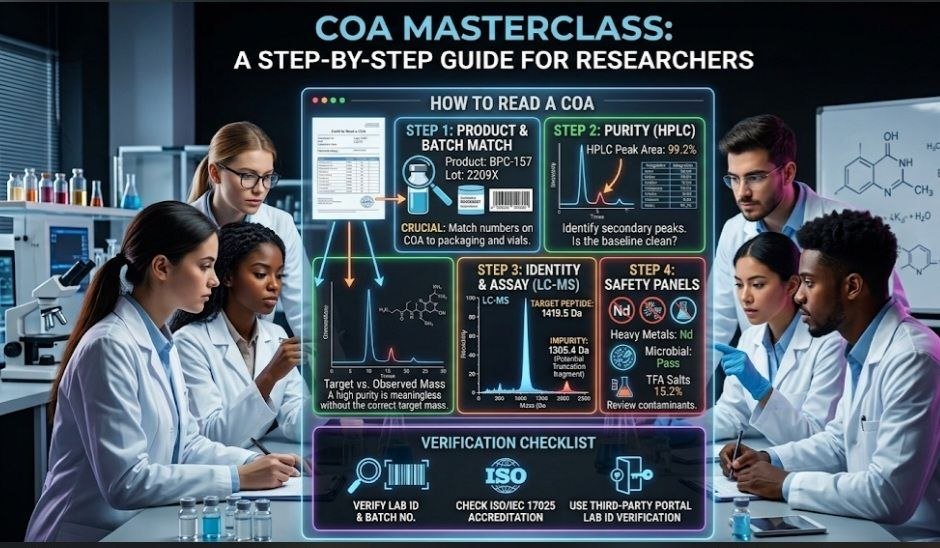
Table of Contents
1. What Is a COA?
2. Why Every Peptide Buyer Must Learn How to Read a COA
3. My 20+ Years Reviewing Peptide COAs
4. The 7 Sections Found in Most Peptide COAs
5. How Do I Read a COA? Step-by-Step Workflow
6. Understanding HPLC Purity
7. Why LC-MS Is More Important Than Most Buyers Realize
8. The Critical Difference Between Purity and Peptide Content
9. COA Comparison Table: Purity vs Assay vs NPC vs Fill Weight
10. Case Study: The “99% Pure” BPC-157 Fragment
11. Case Study: The Fill-Weight & Salt-Factor Trap
12. Visual COA Walkthroughs
13. How to Read a BPC-157 COA
14. How to Read a Semaglutide COA
15. How to Read a Tirzepatide COA
16. How to Read a TB-500 COA
17. How to Read a GHK-Cu COA
18. The 6 Red Flags That Make Me Reject a COA Immediately
19. How to Verify a Third-Party Testing Laboratory
20. A 5-Minute COA Verification Routine
21. Copyable COA Approval Checklist
22. Frequently Asked Questions
23. Final Thoughts
What Is a COA?
https://pubmed.ncbi.nlm.nih.gov/
A Certificate of Analysis (COA) is a laboratory document that reports the analytical test results for a specific peptide batch or lot.
A proper peptide COA should include:
• Product name
• Batch or lot number
• Manufacturing or synthesis date
• Test date
• Analytical methods used
• HPLC purity results
• LC-MS or mass spectrometry identification
• Analyst signature or approval
• Laboratory contact information
The purpose of a COA is to demonstrate that the peptide was tested and that the results meet predefined quality specifications.
However, a COA is not automatically proof that a peptide is authentic. Many suppliers provide edited screenshots, summary sheets, or recycled certificates that do not contain the underlying analytical evidence.
This is why understanding how do I read a COA is one of the most valuable skills a peptide researcher can develop.
Why Every Peptide Buyer Must Learn How to Read a COA
Most peptide buyers make one dangerous assumption:
«“If the COA says 99% purity, the peptide must be genuine.”»
Unfortunately, that is not always true.
A COA can be misleading when:
• The HPLC peak is not the correct peptide
• The mass spectrum is missing
• The batch number does not match the vial
• The certificate was copied from another lot
• The purity refers only to chromatographic peak area
• The active peptide content is much lower than the labeled amount
Learning how do I read a COA protects you from:
• Incorrect peptide sequences
• Truncated synthesis fragments
• Excess TFA or acetate salts
• Underfilled vials
• Manipulated purity claims
• Counterfeit products
For research laboratories, these problems can invalidate experimental results and waste significant time and resources.
My 20+ Years Reviewing Peptide COAs
Since 2003, I have worked directly with peptide manufacturers and have reviewed 3,000+ peptide batches across categories including:
• Healing peptides (BPC-157, TB-500)
• GLP-1 peptides (Semaglutide, Tirzepatide)
• Cosmetic peptides (GHK-Cu)
• Growth hormone–related peptides
• Custom research sequences
After reviewing thousands of certificates, I developed a simple rule:
«Never approve a peptide batch based on HPLC purity alone.»
Every approved batch must pass three independent checks:
1. Batch identity verification
2. HPLC chromatogram review
3. LC-MS molecular weight confirmation
This workflow has prevented multiple problematic lots from reaching active research protocols.
The 7 Sections Found in Most Peptide COAs
Before answering how do I read a COA step by step, it helps to know the typical structure.
| Section | Purpose |
| Product Information | Identifies the peptide and batch |
| Specifications | Lists acceptable limits |
| HPLC Results | Measures chromatographic purity |
| LC-MS Results | Confirms molecular identity |
| Additional Tests | Moisture, residual solvents, salts |
| Approval Section | Analyst and QA signatures |
| Laboratory Details | Identifies the testing laboratory |
If any of these sections are missing, the COA deserves additional scrutiny.
How Do I Read a COA? Step-by-Step Workflow
This is the exact workflow I teach new peptide buyers.
Step 1: Verify the Product Name
Check that the COA clearly states the peptide:
• BPC-157
• Semaglutide
• Tirzepatide
• TB-500
• GHK-Cu
Be cautious of vague descriptions such as:
• “Research Peptide”
• “Sample A”
• “Peptide Batch”
• “Test Compound”
A professional COA should identify the exact compound.
Step 2: Match the Batch or Lot Number
The lot number on the vial must match the lot number on the COA.
Example:
• Vial: BPC157-240812-A
• COA: BPC157-240812-A
Even a small mismatch may indicate:
• A recycled certificate
• Incorrect packaging
• A substituted batch
• Poor inventory control
This is one of the most common issues I encounter when reviewing customer-submitted certificates.
Step 3: Check the Test Date
A COA without a test date is essentially incomplete.
For research peptides, I generally prefer certificates tested within the previous 12 months, especially for:
• Semaglutide
• Tirzepatide
• TB-500
• Other moisture-sensitive peptides
Older certificates may not reflect the current inventory lot.
Step 4: Review the HPLC Purity Section
Look for:
• Purity percentage
• Chromatogram image
• Retention time (Rt)
• Method conditions
Example:
| Parameter | Result |
| Purity | 99.2% |
| Method | RP-HPLC |
| Column | C18 |
| Detection | 220 nm |
| Retention Time | 12.84 min |
A numerical purity value without a raw chromatogram is not sufficient.
Step 5: Confirm LC-MS Identification
The LC-MS section should report the observed molecular weight.
Example for BPC-157:
| Paramete | Expected |
| Theoretical Mass | 1419.5 Da |
| Observed Mass | 1419.6 Da |
A difference of ~0.1–0.5 Da is generally acceptable for many peptide LC-MS systems.
If the observed mass differs significantly from the theoretical mass, the peptide may be:
• Truncated
• Oxidized
• Deamidated
• Incorrectly synthesized
Step 6: Look for Analyst Approval
A valid COA should include:
• Analyst name
• Signature or electronic approval
• QA reviewer
• Laboratory identification
Unsigned certificates are a major warning sign.
Understanding HPLC Purity
One of the biggest misunderstandings surrounding how do I read a COA involves HPLC purity.
What HPLC Measures
HPLC (High-Performance Liquid Chromatography) separates compounds based on their interaction with the column and solvent system.
The instrument produces peaks.
Purity is often calculated as:
Main Peak Area ÷ Total Peak Area × 100
For example:
| Peak | Area % |
| Main Peak | 99.1% |
| Impurity 1 | 0.5% |
| Impurity 2 | 0.4% |
Reported purity = 99.1%
What HPLC Does NOT Guarantee
HPLC does not guarantee:
• Correct amino acid sequence
• Correct molecular weight
• Correct stereochemistry
• Correct peptide length
• Correct biological activity
This distinction is critical.
Why LC-MS Is More Important Than Most Buyers Realize
Mass spectrometry answers a different question:
• HPLC asks: “How many components are present?”
• LC-MS asks: “What is the molecular identity of the main component?”
When evaluating peptide authenticity, identity is more important than purity.
A peptide can be:
• 99.5% pure
• 100% the wrong sequence
This is exactly what happened in the following real-world case study.
The Critical Difference Between Purity and Peptide Content
Many researchers confuse purity with how much active peptide is actually in the vial.
These are completely different concepts.
Imagine a vial containing:
• 6 mg peptide
• 2 mg TFA salts
• 1 mg moisture
• 1 mg mannitol
The peptide portion could still be 99% pure, even though the vial contains only 6 mg of active peptide.
This misunderstanding leads to major concentration calculation errors.
COA Comparison Table: Purity vs Assay vs NPC vs Fill Weight
| Term | What It Means | Why It Matters |
| Purity (%) | Percentage of chromatographic peak area belonging to the main component | Indicates how clean the sample is |
| Assay (%) | Quantitative measurement of active peptide relative to a reference standard | Indicates actual potency |
| Net Peptide Content (NPC) | Amount of active peptide excluding salts and water | Most important for dosing calculations |
| Gross Fill Weight | Total material physically present in the vial | Includes peptide, moisture, salts, and excipients |
Simple Example
| Parameter | Value |
| Gross Fill Weight | 10.0 mg |
| Purity | 98.8% |
| Assay | 62% |
| Net Peptide Content | 6.2 mg |
A buyer assuming 10 mg active peptide would be wrong by 3.8 mg, resulting in nearly 40% under-dosing.
This is why understanding how do I read a COA requires looking beyond the purity number.
Case Study: The “99% Pure” BPC-157 Fragment
This is one of the most educational examples from my batch-review experience.
The Setup
• Compound: BPC-157 (10 mg vial)
• Vendor Claim: “≥98% Purity, HPLC & MS Verified”
• COA Summary: 99.1% HPLC purity
At first glance, everything appeared excellent.
What the Full Analytical Report Revealed
After requesting the raw chromatogram and complete LC-MS report, several red flags appeared.
1. Retention Time Inconsistency
The main peak retention time did not match known reference standards for intact BPC-157 under the reported HPLC conditions.
2. Mass Spectrometry Discrepancy
The LC-MS data showed a primary mass approximately 114 Da lower than the theoretical mass of intact BPC-157 (1419.5 Da).
3. Final Diagnosis
The material was not intact BPC-157.
It was a truncated synthesis fragment missing two amino acids.
Because the fragment was relatively homogeneous, it produced a single dominant HPLC peak, leading the supplier to report 99.1% purity without verifying the molecular identity.
Key Lesson
«A high HPLC purity percentage only means that most of the material eluted as one peak. It does not prove that the peak is the correct peptide.»
This case permanently changed our approval protocol.
Protocol Update
No peptide batch is approved unless:
• HPLC purity is acceptable
• Retention time is consistent
• LC-MS molecular weight matches the theoretical target
• Raw analytical data are available for review
Case Study: The Fill-Weight & Salt-Factor Trap
Another common COA problem involves gross weight vs active peptide content.
Initial Label
• BPC-157 / 10 mg vial
COA Summary
• Purity: 98.5%
• Result: PASS
Many buyers would stop reading here.
The Deeper Investigation
The quantitative assay showed:
| Componen | Amount |
| Active BPC-157 | 6.2 mg |
| TFA Counter-Ions | 1.7 mg |
| Moisture | 1.1 mg |
| Mannitol | 1.0 mg |
Total = 10.0 mg
The vial physically contained 10 mg of material, but only 6.2 mg was active peptide.
Actions Taken
1. Batch quarantined
2. Independent FTIR + LC-MS testing ordered
3. Excess TFA and reduced peptide content confirmed
4. Vendor issued a full refund and lot recall
5. New mandatory NPC verification policy implemented
This case demonstrates why assay and NPC are often more important than purity alone.
Visual COA Walkthroughs
The following sections show how I would evaluate several common research peptides.
How to Read a BPC-157 COA
What to Check First
| Parameter | Target |
| Purity | ≥98% |
| LC-MS Mass | ~1419.5 Da |
| Chromatogram | Single dominant peak |
| Batch Match | Exact |
Special Concern
BPC-157 is particularly vulnerable to truncated synthesis fragments, making LC-MS confirmation essential.
Approval Rule
Never approve a BPC-157 batch based solely on HPLC purity.
How to Read a Semaglutide COA
Semaglutide is more complex than many shorter peptides.
Important Sections
| Parameter | What to Look For |
| HPLC Purity | ≥98% |
| Major Impurity Profile | Clearly reported |
| LC-MS Identity | Matches theoretical semaglutide mass |
| Moisture Content | Preferably low |
| Storage Conditions | Should be stated |
Common Problem
Some suppliers provide only a summary purity certificate without the full chromatogram or impurity profile.
For GLP-1 peptides, I strongly recommend requesting the complete analytical report.
How to Read a Tirzepatide COA
Tirzepatide is a large multi-functional peptide with a more complicated analytical profile.
Minimum Acceptable Data
• HPLC chromatogram
• LC-MS molecular weight
• Impurity specification table
• Batch-specific test date
• Third-party laboratory identification
Because Tirzepatide is a high-value peptide, it is also a frequent target for COA recycling and counterfeit documentation.
How to Read a TB-500 COA
TB-500 (Thymosin Beta-4 fragment) should be evaluated for:
| Checkpoint | Importance |
| Retention Time Consistency | High |
| Multiple Minor Peaks | Moderate |
| LC-MS Identity | Essential |
| Moisture Content | Important |
TB-500 often shows small secondary peaks, so understanding the impurity profile is more important than expecting a mathematically perfect chromatogram.
How to Read a GHK-Cu COA
GHK-Cu introduces an additional challenge: copper complexation.
Key Questions
• Is the peptide identified as GHK-Cu, not just GHK?
• Does the LC-MS report reflect the copper-bound complex?
• Is the copper content quantified?
• Is the chromatogram consistent with the complexed form?
A COA reporting only GHK purity without confirming copper complexation may not accurately represent the finished cosmetic peptide material.
The 6 Red Flags That Make Me Reject a COA Immediately
After reviewing thousands of peptide certificates, these are my automatic rejection triggers.
1. Missing Raw Chromatogram
A purity number without the chromatogram is insufficient.
2. No Analyst Signature
Unsigned COAs cannot be properly authenticated.
3. No Test Date
Without a test date, you cannot determine whether the certificate applies to the current batch.
4. Batch or Lot Mismatch
If the vial and COA do not match exactly, the batch is rejected until verified.
5. Impossible “100.00% Purity” Claims
Real peptide synthesis almost always produces trace impurities.
Claims of 100.00% purity are often marketing-driven and should be viewed with skepticism.
6. Reused COAs Across Multiple Products
I have seen suppliers use the same chromatogram image for multiple peptides by simply changing the product name.
Always compare:
• Retention times
• Peak shapes
• Injection dates
• File identifiers
Reused analytical data is a serious integrity concern.
How to Verify a Third-Party Testing Laboratory
A trustworthy peptide COA should come from an identifiable laboratory.
Laboratories I Personally Trust
Based on my professional experience reviewing manufacturer-submitted peptide certificates, I place the highest confidence in:
• MZ Biolabs
• BioRegen
• Biovirdian
Verification Steps
Check the Laboratory Website
Confirm that:
• The lab exists
• Contact information is real
• The analytical services offered match the COA
Look for Report Identifiers
Professional laboratories usually include:
• Report number
• Sample ID
• Instrument ID
• Analyst initials
• Date of analysis
Request Direct Verification
For high-value peptide orders, ask the supplier whether the laboratory can confirm the report number directly.
A 5-Minute COA Verification Routine
When customers send me a peptide COA for quick review, this is the routine I follow.
Minute 1: Identity Check
• Product name
• Batch number
• Test date
Minute 2: Chromatogram Check
• Is the image present?
• Is the main peak dominant?
• Are the integration values visible?
Minute 3: LC-MS Check
• Theoretical mass
• Observed mass
• Acceptable deviation
Minute 4: Approval Check
• Analyst signature
• QA approval
• Laboratory identification
Minute 5: Plausibility Check
Ask:
• Does the purity claim look realistic?
• Does the peptide content make sense?
• Are the dates internally consistent?
• Does the document appear professionally generated?
This simple routine catches the majority of problematic peptide certificates.
Copyable COA Approval Checklist
Save or print this checklist before purchasing any research peptide.
OasBioScience COA Approval Checklist
Product Verification
• □ Peptide name clearly stated
• □ Batch/lot number present
• □ Batch number matches vial exactly
• □ Manufacturer or supplier identified
Date Verification
• □ Test date included
• □ Certificate issued within the last 12 months
• □ Dates are internally consistent
HPLC Verification
• □ Raw chromatogram attached
• □ Main peak clearly identified
• □ Purity percentage reported
• □ Retention time visible
• □ Integration table included
LC-MS Verification
• □ Mass spectrum attached
• □ Theoretical molecular weight listed
• □ Observed molecular weight listed
• □ Observed mass matches expected target
Additional Quality Checks
• □ Moisture content reported (if available)
• □ Counter-ion or salt information reported
• □ Assay or peptide content reported
• □ No impossible “100.00% purity” claim
Authentication
• □ Analyst signature present
• □ QA approval present
• □ Third-party laboratory identified
• □ Laboratory contact information available
Final Decision
• □ APPROVE
• □ REQUEST MORE DATA
• □ REJECT
If you are unsure how to interpret any of these items, contact OasBioScience through https://oasbioscience.com for professional COA verification assistance.
Frequently Asked Questions
Is 95% purity good enough for research peptides?
For many research applications, ≥95% purity may be acceptable, but 98–99%+ is generally preferred for higher-confidence experimental work.
Can a fake peptide have a real COA?
Yes. A supplier may attach a real certificate from a different batch or even from a different manufacturer. Always verify the batch number match.
What is more important: HPLC or LC-MS?
For peptide authenticity:
1. LC-MS confirms identity.
2. HPLC confirms purity.
Both are important, but identity comes first.
Why do some COAs show 99% purity but only 90% assay?
Because purity measures chromatographic cleanliness, while assay measures the amount of active peptide relative to a reference standard.
Should I trust a screenshot of a COA sent through Telegram?
No. Always request the full PDF analytical report, including:
• Chromatogram
• Integration table
• LC-MS spectrum
• Laboratory identifiers
• Signatures
Final Thoughts: The Most Important Lesson About How Do I Read a COA
If you remember only one thing from this entire guide, remember this:
«A peptide COA is only trustworthy when identity, purity, and peptide content are all verified together.»
After reviewing 3,000+ peptide batches since 2003, the biggest mistake I continue to see is buyers focusing on one impressive purity number while ignoring:
• LC-MS molecular identity
• Batch matching
• Assay values
• Net peptide content
• Raw chromatographic data
A properly evaluated COA should answer three separate questions:
| Question | Analytical Tool |
| Is it the correct peptide? | LC-MS |
| Is it relatively free of impurities? | HPLC |
| How much active peptide is actually present? | Assay / NPC |
When all three answers are verified, you can have much greater confidence in the quality of the research peptide material.
For researchers who need help interpreting a Certificate of Analysis, comparing HPLC and LC-MS data, or verifying whether a peptide COA appears authentic, OasBioScience provides professional peptide quality review support at https://oasbioscience.com.
A few minutes spent learning how do I read a COA can save weeks of failed experiments, inaccurate concentrations, wasted research budgets, and unreliable peptide data.
In the peptide industry, the safest buyer is not the one who receives a COA—it is the one who knows how to read it correctly.
Website: https://oasbioscience.com
Need COA verification help? Contact OasBioScience for professional peptide certificate review and quality assessment support.
Scientific Reference: For additional peer-reviewed information on peptide stability, sterile preparation, and pharmaceutical reconstitution practices, visit PubMed: https://pubmed.ncbi.nlm.nih.gov/
Brows Related Topics To Boost Your Knowledge on Peptide Education

