
Can Peptides Lose Potency Without Changing Appearance? 9 Critical Reasons to Know

Can Peptides Lose Potency Without Changing Appearance?
Peptide potency can decrease even when a peptide looks completely normal.
A peptide can remain a clear, colorless solution after reconstitution. A lyophilized peptide can remain a white, uniform cake. There may be no visible particles, no precipitation, no unusual odor, and no obvious change in texture.
Yet chemical degradation may already have occurred.
This is one of the most important concepts researchers should understand when evaluating peptide quality.
Appearance is a physical observation. Peptide potency is a chemical and, where applicable, biological question.
A clear solution primarily tells you that the material is visibly soluble under the conditions you are observing. It does not prove that the peptide’s molecular structure remains unchanged, that the expected amount of intact target peptide is present, or that the molecule retains its intended biological activity.
Scientific literature describes several chemical degradation pathways that can affect peptides, including oxidation, deamidation, hydrolysis, isomerization and other modifications. These reactions can occur during manufacturing, storage, handling and transportation.
That is why researchers should never use visual appearance as the only indicator of peptide potency.
At OasBioScience, this distinction is central to how we approach peptide quality. Instead of asking only, “Does the vial look normal?”, we believe the better questions are:
- Does the chromatographic profile remain acceptable?
- Does the molecular mass match the intended peptide?
- Are degradation products detectable?
- How much peptide is actually present by mass?
- Has storage or transportation exposed the material to conditions that could affect stability?
- Where biological activity matters, has functional activity actually been demonstrated?
This article explains how a peptide can lose potency silently, what researchers should look for, and why analytical testing is more informative than appearance alone.
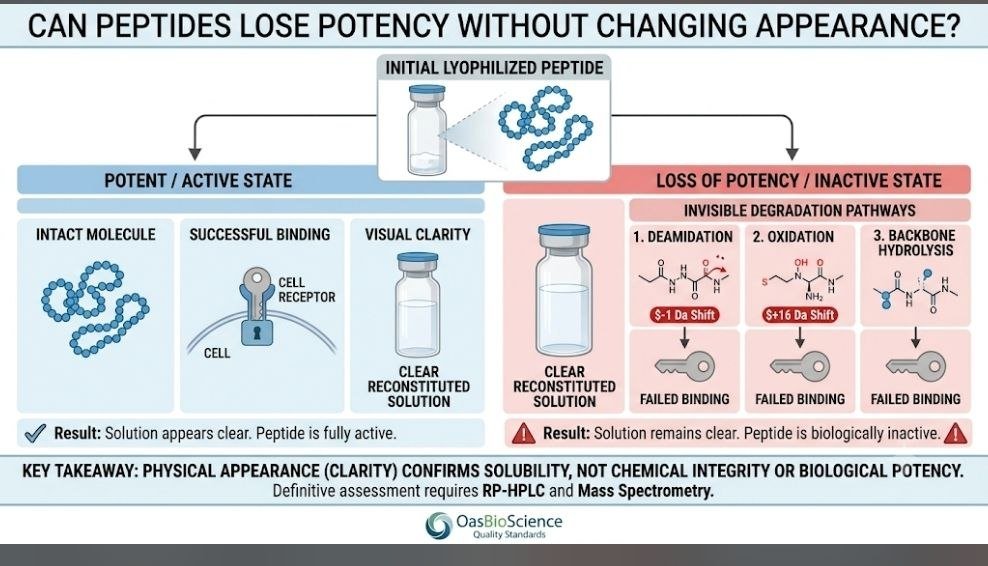
Table of Contents
Why Appearance Does Not Prove Peptide Potency
One of the easiest mistakes to make with peptides is confusing physical appearance with chemical integrity.
Imagine reconstituting a peptide and seeing a perfectly clear solution.
It dissolves quickly.
There are no visible particles.
There is no cloudiness.
The solution has not changed color.
It looks exactly as expected.
That is encouraging from a physical-solubility standpoint, but it is not an analytical measurement of peptide potency.
The molecule could have undergone a chemical modification that does not produce visible particles.
For example, oxidation can modify susceptible amino-acid residues while leaving the resulting molecule soluble. Deamidation can alter an asparagine or glutamine residue without necessarily causing precipitation. Hydrolysis can produce smaller peptide fragments that remain dissolved.
Research on peptide and protein stability identifies oxidation, deamidation, hydrolysis, isomerization and other chemical reactions as important degradation pathways.
This creates a critical distinction:
A peptide can look physically normal while being chemically different from the original material.
That is why a visual inspection should be treated as the first checkpoint, not the final quality-control test.
How Peptides Can Lose Potency Without Looking Different
There are several pathways through which peptide integrity can change without producing an obvious visual warning.
The most important include:
- Deamidation
- Oxidation
- Hydrolysis
- Isomerization
- Changes involving cysteine and disulfide bonds
- Moisture-related degradation
- Temperature-related degradation
- Light-induced degradation
- Repeated freeze-thaw exposure
- Loss of actual peptide concentration or net peptide content
The exact susceptibility depends on the peptide sequence, formulation, pH, temperature, moisture, container, oxygen exposure and other environmental factors.
For example, cysteine, methionine and tryptophan are among residues that can be susceptible to oxidation, while asparagine and glutamine can undergo deamidation under appropriate conditions.
The important point is that not every degradation reaction produces a visible change.
A Clear Solution Is Not a Potency Test
This deserves repeating because it is such a common misunderstanding.
A clear solution means there is no obvious large-scale precipitation or turbidity.
It does not tell you:
- whether the molecular mass is correct;
- whether the sequence is intact;
- whether oxidized species are present;
- whether deamidation has occurred;
- whether peptide fragments are present;
- whether the actual peptide concentration matches the expected concentration;
- whether counterions or residual moisture make up a substantial part of the gross mass; or
- whether biological activity has been retained.
In other words:
Clarity tells you something about physical appearance. It does not independently establish peptide potency.
Deamidation: The Invisible Change
Deamidation is one of the clearest examples of how a peptide can change chemically without becoming visibly different.
Asparagine and glutamine residues can undergo deamidation. Depending on sequence and conditions, this can generate acidic products such as aspartate or glutamate, and Asn deamidation can also be associated with isoAsp formation.
From an analytical perspective, deamidation can produce a mass increase of approximately 0.984 Da, commonly described in educational material as a +1 Da shift.
That change is invisible to the eye.
The solution can remain completely clear.
The peptide can remain fully dissolved.
But the molecule is no longer chemically identical to the original target.
Depending on where the modification occurs and the peptide’s biological mechanism, such a change can influence charge, conformation, molecular interactions or biological recognition.
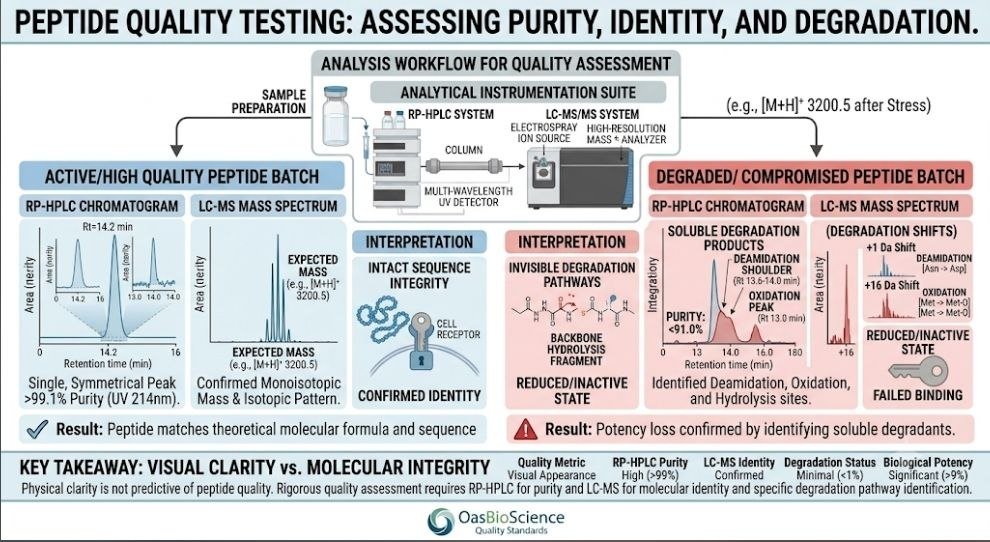
Mass spectrometry is particularly useful for detecting and characterizing peptide modifications, while chromatographic separation can help reveal related species.
Why Deamidation Matters for Peptide Potency
Suppose a researcher has a peptide containing a susceptible asparagine residue.
The original peptide has one chemical structure.
During storage, a fraction undergoes deamidation.
The resulting material may still:
- dissolve normally;
- remain colorless;
- remain free of particles; and
- appear identical to the original solution.
But chemically, the sample has become a mixture of the original peptide and modified peptide species.
This is why peptide potency cannot be judged from clarity alone.
Methionine and Cysteine Oxidation
Oxidation is another major reason peptide potency can change without an obvious visual warning.
Certain amino-acid residues are particularly susceptible to oxidation, including methionine and cysteine. Tryptophan, tyrosine and histidine can also undergo oxidative modifications under appropriate conditions.
Methionine oxidation can produce a mass increase of approximately +16 Da per oxidation event.
Again, the resulting peptide does not necessarily precipitate.
A solution containing oxidized peptide can remain completely transparent.
What can cause oxidation?
Potential contributors include:
- oxygen exposure;
- reactive oxygen species;
- light;
- trace metals;
- unsuitable storage conditions;
- prolonged storage;
- repeated handling; and
- formulation-dependent factors.
Scientific reviews describe peptide oxidation as a degradation pathway that can occur during production, purification, formulation, transportation, storage and handling.
This is why storage conditions should not be treated as an afterthought.
Hydrolysis and Peptide Bond Cleavage
Peptides can also undergo hydrolytic degradation.
Hydrolysis can break chemical bonds within the peptide structure, producing shorter fragments or other degradation products.
What makes this particularly deceptive is that the resulting fragments may remain highly soluble.
There may be no cloudiness.
There may be no precipitation.
There may be no dramatic change in color.
The solution may therefore look completely normal even though part of the original sequence has been chemically altered.
Analytical chromatography can help separate the original target from degradation products, while mass spectrometry can provide molecular-mass information about the resulting species.
Peptide stability literature recognizes peptide-bond cleavage and hydrolysis among the important chemical degradation pathways that should be considered during stability evaluation.
The Problem With High HPLC Purity
This is another area where researchers sometimes draw conclusions that the analytical method does not actually support.
High HPLC purity is valuable, but HPLC purity is not the same thing as peptide potency.
Reversed-phase HPLC separates components according to their chromatographic behavior. In peptide analysis, it is commonly used to evaluate the proportion of chromatographically detected material associated with the target/main peak.
A high percentage is useful information.
But it does not answer every question.
For example, HPLC alone may not establish:
- exact molecular identity;
- every structural isomer;
- all co-eluting species;
- net peptide content;
- residual moisture;
- counterion content; or
- biological activity.
Peptide characterization literature emphasizes the use of complementary chromatographic and mass-spectrometric techniques because peptide impurities and degradation products can require different analytical approaches.
Why 99% HPLC Does Not Necessarily Mean 99% Active Peptide by Weight
Consider a lyophilized peptide cake.
The gross weight of the cake can include more than the peptide itself.
Depending on the manufacturing and purification process, the material can contain counterions such as TFA or acetate and residual moisture.
Standard chromatographic purity measurements do not simply convert the gross vial weight into grams of intact peptide.
This is why chromatographic purity and net peptide content should be treated as different measurements.
A researcher who assumes that every milligram of gross lyophilized powder represents one milligram of intact peptide can therefore misinterpret the actual amount of target material.
Our Illustrative Case Study
One of the most useful ways to understand silent peptide degradation is to look at an analytical scenario.
The following case study is presented as an illustrative analytical example based on the testing scenario provided, rather than as a claim that every peptide batch will produce these exact results.
The Vial Looked Perfect
Imagine a 10 mg lyophilized peptide vial.
The vial arrives with:
- a uniform white cake;
- no visible discoloration;
- no obvious collapse;
- no visible contamination.
The material is reconstituted with 2.0 mL of water.
It dissolves completely in less than 15 seconds.
The resulting solution is:
Clear. Colorless. Particle-free.
If visual inspection were the only quality test, the sample would appear to pass.
But analytical testing tells a different story.
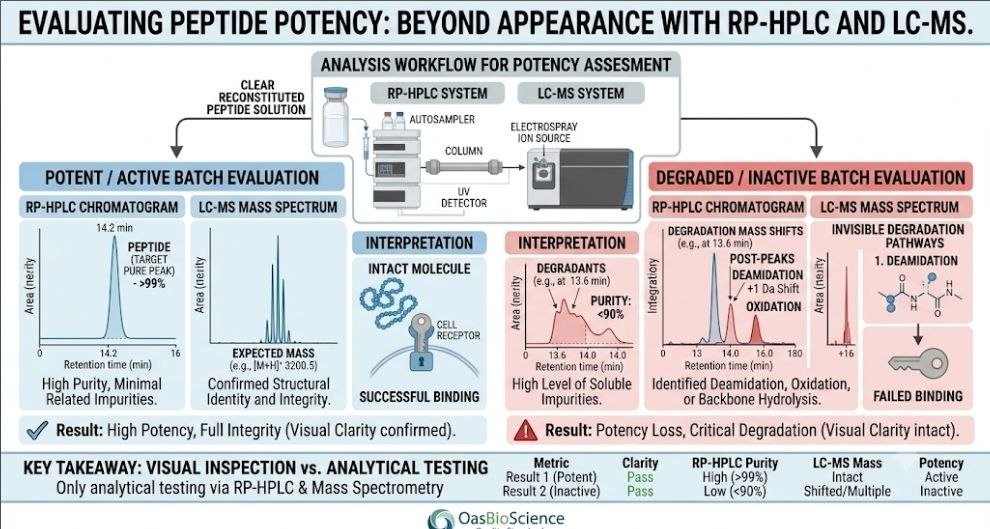
RP-HPLC Findings
The expected target peak has a retention time of approximately 14.2 minutes.
A shoulder/pre-peak appears around 13.6 minutes.
The target/main chromatographic purity is measured at 81.4%.
That means a substantial proportion of the chromatographically detected material is not represented by the desired main peak.
The important lesson is not simply the number 81.4%.
It is the contrast:
The solution looked perfect, but the chromatogram did not.
LC-MS Findings
Mass spectrometry identifies the expected molecular mass alongside a modified species approximately +0.984 Da higher.
That is consistent with a deamidation-related modification.
However, it is important not to overstate what intact-mass MS alone proves. A mass shift can identify a modification class, but determining the precise site and distinguishing certain isomeric products can require additional characterization.
This is why orthogonal analytical testing is so valuable.
Net Peptide Content
The illustrative calculation uses:
- 4.8% residual moisture;
- 28.2% TFA-associated mass;
- approximately 67.0% estimated net peptide fraction.
The calculation is:
100% − 4.8% − 28.2% = 67.0%
If 10.0 mg represents the gross cake mass used in the calculation:
10.0 mg × 0.670 × 0.814 = approximately 5.45 mg
Under those assumptions, the estimated intact target peptide would therefore be approximately 5.45 mg.
The calculation demonstrates an important analytical principle:
Gross powder weight, chromatographic purity and actual intact peptide mass are three different concepts.
Case Study Summary
| Measurement | Result | What It Shows |
|---|---|---|
| Visual appearance | Clear/colorless after reconstitution | Good physical solubility |
| Main/target HPLC purity | 81.4% | Significant non-main chromatographic material |
| Modified MS species | ~+0.984 Da | Consistent with deamidation-related modification |
| Residual moisture | 4.8% | Water contributes to gross material mass |
| TFA-associated mass | 28.2% | Counterion contribution to gross mass |
| Estimated net peptide fraction | 67.0% | Gross weight does not equal peptide mass |
| Illustrative intact target estimate | ~5.45 mg | Shows potential difference between gross mass and target peptide mass |
The lesson is more important than the numbers:
A peptide can look flawless and still require serious analytical investigation.
Storage Mistakes That Can Reduce Peptide Potency
Storage is one of the biggest factors researchers can control.
Peptides are not all equally stable. Their sequence, physical state, formulation, pH, temperature and storage environment all influence stability.
Research guidance for analytical peptides recommends minimizing freeze-thaw cycles, protecting susceptible peptides from air and light, and using appropriately low temperatures for long-term storage of lyophilized material.
Repeated Freeze-Thaw Cycles
Repeatedly freezing and thawing a peptide solution can increase the risk of instability.
During freezing, solutes become concentrated in the remaining unfrozen phase. This can change local conditions such as pH and ionic environment.
Depending on the peptide and formulation, repeated cycles can contribute to aggregation, oxidation or other degradation mechanisms.
The practical lesson is simple:
Do not repeatedly freeze and thaw the same working solution unless its stability has been demonstrated under those conditions.
Where appropriate and validated for the particular peptide, preparing smaller single-use aliquots can reduce unnecessary freeze-thaw exposure.
Heat Exposure
Higher temperatures generally accelerate many chemical reactions.
A peptide that experiences a brief temperature excursion may not immediately become cloudy.
That does not mean nothing happened chemically.
This is particularly relevant during:
- transportation;
- customs delays;
- storage in warm environments;
- power failures;
- repeated refrigerator/freezer cycling; and
- accidental exposure to heat.
The effect depends on the particular peptide and exposure conditions, so temperature history should be considered alongside analytical evidence.
Light Exposure
Light can contribute to photochemical degradation in susceptible molecules.
Peptides containing residues such as tryptophan and tyrosine can be vulnerable to photochemical reactions under appropriate conditions.
A peptide does not necessarily turn yellow when this happens.
Therefore, protecting sensitive peptide materials from unnecessary light exposure is a sensible storage practice.
Moisture
Moisture is particularly important for lyophilized peptides.
Chemical reactions can occur in the solid state, and moisture content is one of the factors influencing peptide stability.
A lyophilized cake does not have to visibly collapse before moisture becomes analytically relevant.
That is why residual-moisture testing can provide information that visual inspection cannot.
Can Shipping Affect Peptide Potency?
Yes, transportation can become part of the stability story.
A peptide can leave a facility in an acceptable condition and subsequently experience:
- prolonged heat;
- temperature cycling;
- uncontrolled freezing and thawing;
- excessive light exposure;
- moisture exposure; or
- extended storage during transportation or customs processing.
Whether any particular event causes meaningful degradation depends on the peptide and conditions.
This is why responsible quality assessment should distinguish between manufacturing quality and post-manufacturing handling.
For particularly sensitive materials, temperature monitoring can provide useful evidence about the conditions experienced during transportation.
Importantly, however, a temperature excursion alone does not prove that a peptide has lost potency. It identifies a potential stability risk that should be evaluated using appropriate stability data or analytical testing.
How to Investigate a Peptide That Looks Normal but Performs Differently
Suppose a researcher notices that a peptide solution looks normal but an experiment is producing unexpected results.
The first mistake would be to conclude:
“The peptide looks fine, so the peptide cannot be the problem.”
A better troubleshooting approach is to investigate systematically.
Step 1: Review Storage History
Ask:
- How long was the peptide stored?
- At what temperature?
- Was the temperature stable?
- Was it repeatedly frozen and thawed?
- Was the vial exposed to light?
- Was the container opened repeatedly?
- Was the peptide stored as a dry powder or solution?
Storage history can help identify potential degradation pathways.
Step 2: Review Reconstitution Conditions
Check:
- diluent used;
- approximate pH where relevant;
- concentration;
- mixing technique;
- exposure to air;
- temperature during reconstitution; and
- time between reconstitution and use.
Different peptides have different solubility and stability characteristics, so generic assumptions should be avoided.
Step 3: Inspect the COA
Do not stop at the headline purity number.
Look for:
- lot number;
- testing date;
- laboratory identity;
- full chromatogram;
- analytical method;
- molecular-mass result;
- moisture information where relevant;
- counterion information where relevant; and
- traceability between the COA and the actual lot.
Step 4: Consider Orthogonal Testing
If the question is whether the peptide has chemically changed, complementary testing can be more informative than visual inspection alone.
A useful analytical combination may include:
RP-HPLC + LC-MS
HPLC helps examine chromatographic purity and related species.
LC-MS helps assess molecular mass and detect modifications that change mass.
Depending on the question, additional methods may be appropriate.
Step 5: Separate Chemical Identity From Biological Activity
This distinction is critical.
A peptide can have the expected molecular mass but still require additional testing to establish biological activity.
Conversely, an unexpected experimental result does not automatically prove that the peptide has degraded.
Biological assays can be influenced by:
- experimental design;
- concentration;
- buffer;
- target system;
- handling;
- assay variability; and
- many other factors.
Therefore, chemical testing and functional testing answer different questions.
How OasBioScience Approaches Peptide Quality
At OasBioScience, our approach is built around a simple principle:
A peptide should be evaluated using evidence, not appearance alone.
Our quality-control philosophy emphasizes lot-specific documentation and complementary analytical information.
Lot-Specific COAs
A COA should correspond to the specific production lot being evaluated.
A generic document that cannot be traced to a particular batch provides much less useful information.
Full HPLC Chromatograms
A reported purity percentage is more informative when researchers can also review the underlying chromatogram.
An uncropped chromatogram can provide additional context about:
- peak shape;
- shoulders;
- secondary peaks;
- baseline behavior;
- retention time; and
- integration.
LC-MS Confirmation
Molecular-mass confirmation provides an important analytical layer beyond HPLC.
The goal is to determine whether the observed molecular mass is consistent with the intended peptide.
Independent Testing
Where available, independent third-party laboratory testing can add another layer of confidence.
For formal laboratory quality systems, accreditation such as ISO/IEC 17025 relates to laboratory competence and testing activities. The specific scope of accreditation should always be checked rather than assuming that accreditation covers every possible peptide test.
Purity Is Not Net Peptide Content
This is another principle we emphasize.
A 98% or 99% HPLC result should not automatically be interpreted as meaning that 98% or 99% of the gross vial weight consists of intact target peptide.
Chromatographic purity and quantitative peptide content answer different questions.
What Researchers Should Check on a COA
When evaluating peptide documentation, I recommend asking five basic questions.
1. Is the COA lot-specific?
The lot number should match the material being evaluated.
2. Is the HPLC result supported by the actual chromatogram?
A percentage without the underlying chromatographic information provides less context.
3. Is molecular identity independently assessed?
Look for LC-MS or another appropriate identity method.
4. Is there information about moisture or net peptide content when relevant?
These measurements can help explain why gross powder weight and actual peptide mass are not necessarily identical.
5. Can the testing laboratory and analytical method be verified?
Traceability matters.
Researchers should also consider whether the analytical method is appropriate for the peptide and the question being asked.
How to Reduce Silent Peptide Potency Loss
There is no universal storage rule that guarantees stability for every peptide.
The sequence and formulation matter.
However, several general practices can reduce avoidable stability risks.
Keep Lyophilized Material Dry
Moisture can contribute to degradation.
Keep unopened lyophilized material appropriately sealed and protected from unnecessary humidity.
Minimize Temperature Excursions
Stable storage conditions are preferable to repeated warming and cooling.
For long-term peptide storage, published peptide-handling guidance commonly recommends appropriately stored lyophilized material at approximately −20°C to −80°C, depending on the specific application and stability information available.
Do not interpret this as a universal shelf-life guarantee.
Minimize Freeze-Thaw Cycles
If a solution must be frozen and the peptide’s stability under those conditions has been established, aliquoting can reduce repeated thawing of the same container.
Protect From Unnecessary Light
For light-sensitive sequences, dark or light-protective storage can reduce photochemical exposure.
Minimize Unnecessary Air Exposure
For oxidation-sensitive sequences, reducing unnecessary exposure to air can be useful.
Follow Peptide-Specific Stability Information
This is perhaps the most important recommendation.
There is no single storage temperature, solution lifetime or freeze-thaw limit that applies equally to every peptide.
Sequence, formulation, concentration, buffer, container and environmental conditions all matter.
Published research specifically notes that peptide stability is sequence-dependent and that storage conditions should be evaluated rather than assuming one universal stability profile.
What Does a Clear Peptide Solution Actually Tell You?
A clear solution tells you something useful:
The material is visibly soluble under the conditions you are observing.
That matters.
Cloudiness, precipitation, particles, gelation or major color changes can all be important warning signs.
But the reverse does not work.
You cannot logically conclude:
“It is clear, therefore it is chemically intact and potent.”
That conclusion requires evidence beyond appearance.
Think of it this way:
Visual inspection asks:
“Does anything obviously look wrong?”
HPLC asks:
“What chromatographic components can I separate and quantify under this method?”
LC-MS asks:
“Is the observed molecular mass consistent with the expected molecule, and are mass-shifting modifications detectable?”
Quantitative peptide-content testing asks:
“How much peptide is actually present?”
A functional assay asks:
“Does the material produce the expected biological response under defined test conditions?”
These are different questions.
No single observation should be forced to answer all of them.
Frequently Asked Questions
1. Can peptides lose potency without changing appearance?
Yes. A peptide can undergo chemical degradation while remaining clear, colorless and fully soluble. Deamidation, oxidation and hydrolysis can produce chemically modified or fragmented species without necessarily producing visible precipitation or cloudiness.
2. Does a clear peptide solution mean the peptide is still good?
No. A clear solution primarily indicates that the material is visibly soluble. It does not establish molecular identity, chromatographic purity, net peptide content or biological activity.
3. Can a peptide have 99% HPLC purity but still contain less peptide than expected?
Yes. HPLC purity and net peptide content are different measurements. Counterions, residual moisture and other non-peptide components can contribute to gross material weight without appearing as peptide impurities in the same way as chromatographic degradation products.
4. Can deamidation reduce peptide potency?
It can. Deamidation changes the chemical structure and charge characteristics of susceptible residues. Depending on the peptide and the location of the modification, this can affect molecular behavior or biological recognition. The actual functional effect needs to be demonstrated for the specific peptide rather than assumed universally.
5. How can you detect peptide oxidation?
Chromatographic methods can reveal additional or shifted species, while mass spectrometry can identify mass changes associated with oxidation. For example, methionine oxidation commonly produces an approximately +16 Da mass shift per oxidation event.
6. Can heat reduce peptide potency without making the peptide cloudy?
Yes. Chemical degradation can occur without obvious physical changes. The severity depends on the peptide sequence, formulation, temperature and exposure time.
7. Can freeze-thaw cycles damage peptides?
Repeated freeze-thaw cycles can contribute to peptide instability, although the specific mechanism and severity depend on the peptide and formulation. Potential effects include oxidation, aggregation and changes associated with concentration and pH during freezing. Peptide-handling guidance generally recommends minimizing unnecessary freeze-thaw cycles.
8. Is HPLC enough to confirm peptide identity?
No. HPLC provides chromatographic information, but it does not by itself establish complete molecular identity. LC-MS or another appropriate identity method provides complementary evidence.
9. Does LC-MS prove biological potency?
No. LC-MS can provide strong evidence about molecular mass and identity, but chemical identity is not identical to biological activity. Where biological activity is important, an appropriate functional assay may be necessary.
10. What is the best way to check peptide quality?
Use an orthogonal analytical approach appropriate to the peptide and research question. This can include RP-HPLC for chromatographic purity, LC-MS for molecular-mass confirmation, quantitative peptide-content testing, moisture analysis and, where relevant, functional testing.
Final Takeaway: Never Judge Peptide Potency by Appearance Alone
The answer to the question “Can peptides lose potency without changing appearance?” is straightforward:
Yes.
And this is one of the most important reasons researchers should understand the difference between physical appearance, chemical integrity, peptide content and biological activity.
A peptide can remain:
- clear;
- colorless;
- completely dissolved;
- free of visible particles; and
- apparently unchanged.
At the same time, it may contain oxidized, deamidated, hydrolyzed or otherwise modified molecules.
Storage conditions can contribute to these changes.
Heat can accelerate degradation.
Light can contribute to oxidation.
Moisture can affect stability.
Repeated freeze-thaw exposure can create additional instability risks.
Transportation can introduce temperature excursions that are invisible when the package eventually arrives.
And even an impressive HPLC purity percentage should not be interpreted as a complete measurement of peptide potency.
The more reliable approach is to ask multiple analytical questions.
Is the peptide chromatographically acceptable?
Does the molecular mass match the intended target?
How much peptide is actually present?
Are there detectable degradation products?
Has the material been stored and handled appropriately?
Where biological activity matters, has functional activity been demonstrated?
That is the difference between simply looking at a vial and actually evaluating its quality.
At OasBioScience, we believe researchers deserve more than a generic purity number or a photograph of a clean-looking vial. Quality assessment should be based on traceable, relevant analytical evidence and a clear understanding of what each test can—and cannot—prove.
For more information about our research-focused peptide quality approach, analytical education and available research-use materials, visit OasBioScience.
Research Use Only. Not for human or veterinary use.
Continue Learning: If you found this guide helpful, you may also want to read our previous peptide education articles covering the following topics
• Does adding more diluent make peptides weaker?
• Peptide vendor documents explained
• Explore 9 evidence-based facts about BPC-157
• How long should a weight loss cycle last?
• Can GLP-1 muscle loss be prevented?
• Discover the best peptide for obesity research.
• Which peptide suppresses appetite the most?
• Discover 9 powerful fixes for peptide foaming
• Learn how to read peptide Certificates of Analysis step by step.
• How Should Peptides Be Stored?
• Learn the correct peptide reconstitution process 2026
- Does adding more diluent make peptides weaker?
- Learn 7 powerful reasons why, how HPLC methods affect results
- Peptides warmed in transit are not automatically ruined
- How long can peptides stay unrefrigerated during shipping?
- Learn the complete peptide synthesis and manufacturing process
- HPLC vs Mass Spectrometry explained
- Can I use sterile water instead of bacteriostatic water?
- A 99% HPLC result can look impressive—but what does it really tell you?
- Why won’t my peptide dissolve?
- Should you swirl or shake peptides after mixing?
- Our latest guide explains the best practices for storing lyophilized research peptide
- What questions you should ask a peptide supplier before ordering
- Can HPLC really detect every peptide impurity?
- Learn how Peptide Freeze-Thaw Cycles can affect peptide purity
- Can sunlight damage peptide powders?
- What does peptide identity testing confirm?
- What happens if you shake peptides?
Scientific Reference: For additional peer-reviewed information on peptide stability, sterile preparation, and pharmaceutical reconstitution practices, visit
