
HPLC vs Mass Spectrometry: 9 Powerful Differences Every Peptide Researcher Should Know

HPLC vs Mass Spectrometry: What Is the Difference?
HPLC vs Mass Spectrometry is one of the most important comparisons to understand when evaluating peptide quality, laboratory reports, and Certificates of Analysis (COAs).
If you have ever looked at a peptide COA and seen:
- HPLC Purity: 98%
- MS: Pass
- Molecular Weight: Expected
you may have wondered:
Are these two tests basically measuring the same thing?
They are not.
HPLC and Mass Spectrometry examine a peptide from different analytical perspectives.
In simple terms:
HPLC separates and detects components in a mixture, while Mass Spectrometry measures ions according to their mass-to-charge ratio and can provide powerful evidence about molecular mass and identity.
Neither technique should automatically be treated as a complete quality assessment on its own.
After working with peptides since 2003, one of the first things I personally examine when reviewing peptide analytical documentation is the combination of:
- HPLC purity percentage
- HPLC chromatogram
- Mass Spectrometry molecular weight
- Retention time
- Testing laboratory
- Batch number
This approach is important because a large HPLC purity number can look impressive while leaving important questions unanswered.
Likewise, an MS spectrum showing the expected molecular mass does not automatically establish that the entire sample is pure.
That is why understanding HPLC vs Mass Spectrometry is so important.
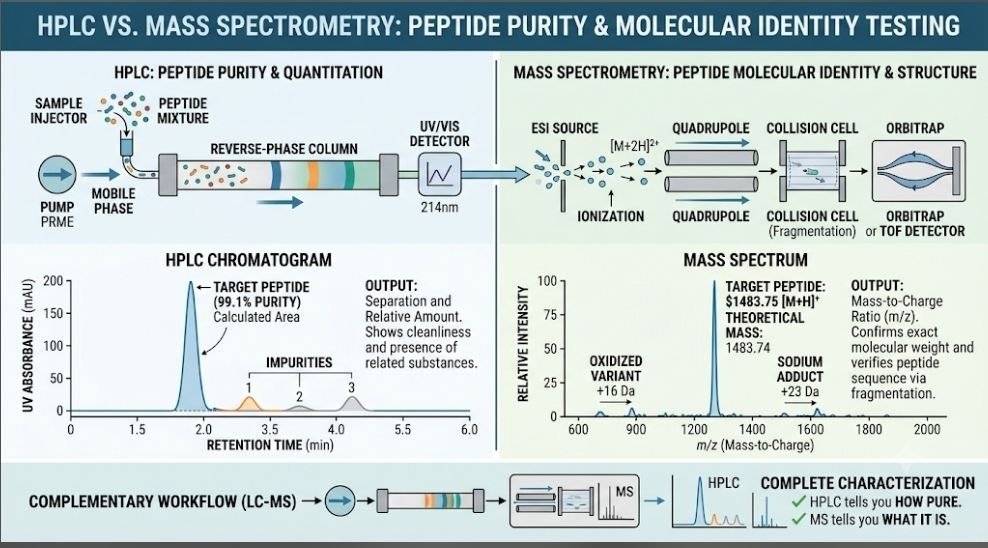
Table of Contents
Table of Contents
HPLC vs Mass Spectrometry: The Short Answer
https://pubmed.ncbi.nlm.nih.gov/
The simplest way to understand HPLC vs Mass Spectrometry is:
HPLC asks:
“How does this sample separate into different chromatographic components?”
Mass Spectrometry asks:
“What molecular masses and ion signals are present?”
HPLC is particularly useful for assessing chromatographic purity and separating the target peptide from related impurities.
Mass Spectrometry is particularly useful for determining molecular mass and supporting molecular identity.
The two techniques answer different questions.
A simple analogy
Imagine receiving a box labeled:
“BPC-157.”
HPLC is like opening the box and sorting everything according to physical characteristics that determine how it moves through the separation system.
Mass Spectrometry is like weighing the molecular components with an extremely precise molecular scale.
One method gives you separation information.
The other gives you mass information.
For serious peptide quality control, those pieces of information complement each other.
What Is HPLC?
HPLC stands for High-Performance Liquid Chromatography.
In peptide analysis, HPLC is commonly used to separate compounds in a sample and detect the resulting components.
A useful way to visualize HPLC is as a highly sophisticated sorting system.
The peptide sample is injected into a flowing mobile phase.
That mobile phase passes through a chromatographic column under pressure.
Different molecules interact differently with the stationary phase inside the column.
As a result, they travel through the column at different rates.
The instrument records these components as peaks.
The resulting graph is called a chromatogram.
What is an HPLC peak?
A peak represents material detected as it passes through the analytical system.
The location of the peak is related to its retention time.
The area under a peak can be used for quantitative calculations under appropriate validated conditions.
For many peptide purity analyses, the principal peptide peak is compared with other detected peaks.
A laboratory may report something such as:
HPLC purity: 98.5%
That number can be useful.
But it must be interpreted correctly.
It does not mean:
“Every molecule in the vial has been proven to be the intended peptide.”
It means something more specific about the chromatographic measurement and integration method used by the laboratory.
This distinction is essential.
What Is Mass Spectrometry?
Mass Spectrometry, commonly abbreviated MS, is an analytical technique that measures ions according to their mass-to-charge ratio (m/z).
For peptide analysis, a sample is introduced into the mass spectrometer and converted into ions.
The instrument then measures the resulting ion signals.
The resulting spectrum can provide information about molecular mass.
For a peptide, this can help answer an important question:
Does the observed molecular mass agree with what is expected for the intended molecule?
This makes MS particularly valuable for identity-related characterization.
What does “molecular weight” mean on a peptide COA?
A COA may provide:
- Theoretical molecular mass
- Observed molecular mass
- Calculated mass
- Measured mass
- Mass-to-charge ratios
- Deconvoluted molecular mass
The exact reporting format depends on the laboratory and analytical method.
A good result should be interpreted against the expected molecular characteristics of the specific peptide.
Mass spectrometry can also provide evidence of certain chemical modifications.
Examples can include signals consistent with:
- Oxidation
- Deamidation
- Truncation
- Adduct formation
- Other mass-altering modifications
However, interpreting these signals requires appropriate expertise.
HPLC vs Mass Spectrometry: The Core Difference
The fundamental difference between HPLC vs Mass Spectrometry is what each technique measures.
| Feature | HPLC | Mass Spectrometry |
|---|---|---|
| Primary function | Separation | Mass analysis |
| Main output | Chromatogram | Mass spectrum |
| Retention time | Yes | Not inherently |
| Chromatographic purity | Yes | Not by itself |
| Molecular mass | Not directly | Yes |
| Molecular identity evidence | Limited alone | Stronger |
| Sequence confirmation | Limited | MS/MS can provide evidence |
| Degradation products | Often visible as separate peaks | Can characterize mass changes |
| Co-eluting impurities | May be difficult to resolve | Can sometimes distinguish by mass |
| Quantitative purity | Possible with validated method | Not automatically quantitative |
| Sterility | No | No |
| Endotoxin | No | No |
This table explains why neither test should be considered a complete substitute for the other.
What HPLC Can Tell You About a Peptide
HPLC can provide purity-related information
One of the most common uses of HPLC in peptide QC is assessing chromatographic purity.
A major target peak accompanied by small impurity peaks may indicate a relatively clean sample.
For example:
Main peak = 98.2% area
Other detected peaks = 1.8% area
That can be a useful purity measurement under the method conditions.
But the exact meaning of the percentage depends on the analytical method, detector, integration rules, reference standard, and laboratory procedure.
HPLC can reveal related impurities
Peptide synthesis can generate related substances.
These can include:
- Truncated sequences
- Deletion sequences
- Modified peptides
- Oxidized variants
- Side products
- Synthesis impurities
If those compounds separate from the main peptide under the chromatographic conditions, they may appear as additional peaks.
HPLC can reveal retention-time changes
Retention time is another important parameter.
If a peptide consistently elutes at a particular retention time under controlled analytical conditions, a significant shift can raise questions.
However, retention time should never be interpreted in isolation.
Changes in:
- Column
- Mobile phase
- Gradient
- Temperature
- Flow rate
- Instrument
- Sample preparation
can affect retention.
HPLC can support batch-to-batch comparisons
Suppose a laboratory produces multiple lots.
If the same validated analytical method is used, the chromatograms can be compared.
Researchers can evaluate:
- Main peak position
- Peak shape
- Secondary peaks
- Overall chromatographic profile
This can be valuable for quality-control monitoring.
What HPLC Cannot Tell You
This is where many customers misunderstand HPLC vs Mass Spectrometry.
HPLC does not directly determine molecular mass
A clean chromatographic peak does not directly tell you the exact molecular mass of the compound responsible for that peak.
That is one reason MS is so valuable.
HPLC does not automatically confirm the complete sequence
A chromatographic peak cannot, by itself, read a peptide sequence letter by letter.
Two structurally related compounds can sometimes exhibit similar chromatographic behavior.
Positional isomers can be particularly challenging.
HPLC can encounter co-elution
One of the most important limitations is co-elution.
Two compounds may travel through the column at nearly the same rate.
If they are not resolved, they can appear as one chromatographic peak.
That can make a sample appear cleaner than it actually is under that particular method.
This is one reason orthogonal analytical techniques are important.
HPLC purity does not automatically represent total powder composition
This is another major misconception.
A reported HPLC purity percentage is related to what the analytical method detects and how the peaks are integrated.
It does not automatically mean that every gram of the dry material consists of peptide.
Other components may include:
- Counterions
- Residual solvents
- Water
- Salts
- Formulation excipients
Therefore:
HPLC purity ≠ total peptide content by weight.
Those are different measurements.
What Mass Spectrometry Can Tell You
MS can provide molecular-mass evidence
This is one of its most important advantages.
If a peptide has a calculated molecular mass, MS can determine whether the observed molecular mass is consistent with the expected molecule.
This is powerful evidence.
But it should be interpreted together with the analytical method and sample context.
MS can detect mass-changing modifications
Certain chemical modifications change molecular mass.
For example:
Oxidation
Methionine oxidation can produce a mass increase consistent with oxidation.
A commonly observed mass difference is approximately +16 Da for conversion of methionine to methionine sulfoxide.
Deamidation
Deamidation can produce a mass change of approximately +1 Da.
MS can therefore help investigate changes that might not be obvious from a simple chromatographic purity percentage.
MS/MS can provide deeper structural information
Tandem Mass Spectrometry, or MS/MS, goes beyond simply measuring the intact molecular mass.
The peptide can be fragmented.
The resulting fragments can provide sequence-related information.
This can be particularly useful when investigating:
- Sequence errors
- Truncated peptides
- Modified residues
- Structural variants
Again, the exact information obtained depends on the method and interpretation.
What Mass Spectrometry Cannot Tell You
Understanding HPLC vs Mass Spectrometry also means understanding MS limitations.
MS does not automatically prove purity
Seeing the expected molecular mass does not mean the sample contains only that molecule.
A sample can contain the target peptide plus many impurities.
If the target ionizes efficiently, its MS signal may be very strong even when the overall sample is not highly pure.
MS does not prove sterility
Mass spectrometry does not replace microbiological testing.
It does not establish that a sample is sterile.
MS does not automatically prove endotoxin safety
Endotoxin requires dedicated testing.
For research materials, an endotoxin result should come from an appropriate validated assay rather than being inferred from an MS spectrum.
MS does not automatically establish biological potency
Chemical identity and biological activity are related but different questions.
A peptide can have the expected molecular mass while still requiring additional evaluation for:
- Biological activity
- Folding
- Aggregation
- Functional performance
- Formulation stability
Therefore:
MS identity evidence ≠ biological potency proof.
HPLC vs Mass Spectrometry: Detailed Comparison
HPLC
Strengths:
- Excellent separation capability
- Useful for chromatographic purity
- Detects many related impurities
- Produces an easily interpretable chromatogram
- Useful for batch comparison
- Can support quantitative analysis with validated methods
Limitations:
- Molecular identity is not established by retention time alone
- Co-eluting compounds can be difficult to distinguish
- UV detection does not respond equally to every substance
- Does not directly determine molecular mass
- Does not establish sterility or endotoxin status
Mass Spectrometry
Strengths:
- Molecular-mass measurement
- Strong identity-related evidence
- Detection of mass-changing modifications
- Can support sequence analysis through MS/MS
- Can identify certain adducts
- Useful for investigating unexpected peaks
Limitations:
- Ionization efficiency varies between compounds
- Signal intensity does not automatically equal concentration
- Does not independently establish chromatographic purity
- Does not establish sterility
- Does not automatically establish biological activity
Why HPLC and MS Work Better Together
The most powerful lesson from HPLC vs Mass Spectrometry is that these are complementary techniques.
Imagine you receive a peptide COA showing:
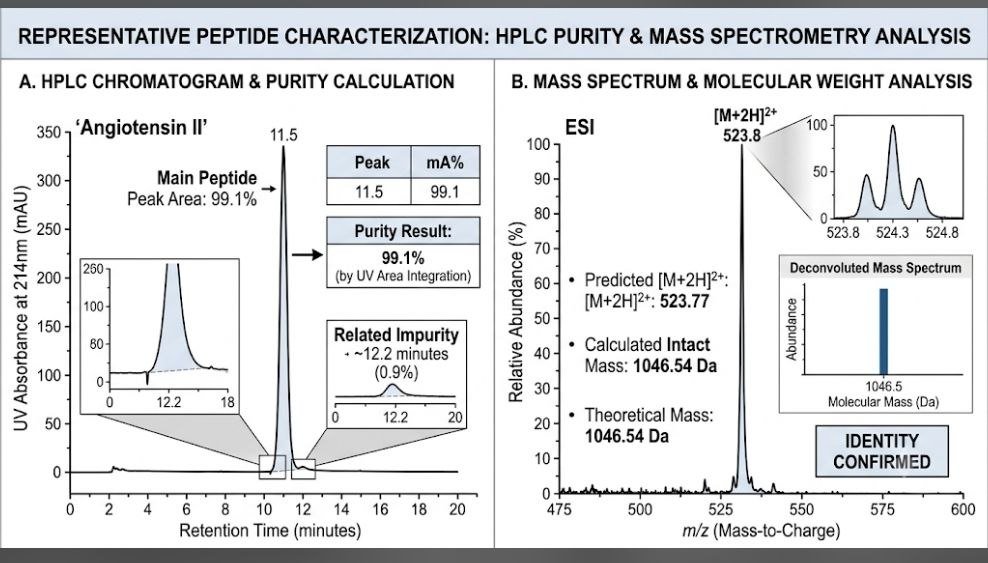
HPLC purity: 99.1%
That sounds excellent.
But what exactly is the 99.1%?
Was the correct peptide actually synthesized?
Could an impurity be co-eluting?
Could the sample contain a structurally similar compound?
HPLC alone may not answer all of those questions.
Now consider an MS result.
The molecular mass matches the theoretical mass.
Excellent.
But what percentage of the sample is actually the target?
MS alone may not answer that either.
This is why a strong quality-control strategy uses orthogonal evidence.
Think of it as two questions:
HPLC:
How does the sample separate?
MS:
What molecular mass is associated with the detected material?
When both datasets agree, confidence in the analytical characterization increases.
Three Real-World Peptide QC Case Studies
The following examples illustrate why HPLC vs Mass Spectrometry is not merely an academic comparison.
These are the types of situations that demonstrate why orthogonal testing matters.
Case Study 1: The Invisible Methionine Oxidation
A synthetic peptide containing methionine was analyzed.
The HPLC chromatogram looked excellent.
The main peak was symmetrical and represented approximately 98.5% of the integrated chromatographic area.
At first glance, the batch appeared highly pure.
Then the sample was examined using LC-MS.
The mass spectrum showed the expected molecular mass along with a signal approximately 16 Da higher.
This was consistent with a potential oxidation product such as methionine sulfoxide.
Why did HPLC miss it?
The oxidized and unoxidized species were not adequately resolved under the original chromatographic conditions.
They therefore contributed to the same apparent chromatographic region.
What did MS contribute?
MS provided mass information that revealed the additional species.
Quality-control lesson
A strong HPLC percentage does not necessarily eliminate the need for molecular characterization.
Case Study 2: The Perfect Peak of the Wrong Sequence
A custom peptide was synthesized for a specific research application.
HPLC showed a sharp peak with approximately 99.1% chromatographic purity.
The intact molecular mass also appeared consistent with the expected formula.
At this point, a superficial evaluation might conclude that everything was perfect.
But MS/MS fragmentation provided additional sequence-related information.
The fragmentation pattern raised evidence of a sequence-order problem involving amino acids near the N-terminus.
The important point is that two compounds can potentially have:
- The same molecular formula
- The same overall molecular mass
- Similar chromatographic behavior
while differing in the arrangement of residues.
Quality-control lesson
Molecular mass alone does not necessarily establish complete sequence correctness.
For complex identity questions, MS/MS and other orthogonal methods may be necessary.
Case Study 3: Deamidation and the +1 Da Signal
A peptide containing an Asn-Gly sequence motif was subjected to thermal stress.
HPLC showed a primary peak accompanied by a subtle shoulder.
The shoulder suggested that a related component was present.
However, HPLC alone did not establish exactly what the related component was.
High-resolution LC-MS identified a mass difference consistent with deamidation.
MS/MS provided additional structural information supporting the interpretation.
Why this matters
Deamidation is a classic example of why chromatographic and mass information complement one another.
HPLC can reveal that something separates differently.
MS can help investigate what molecular change may account for that difference.
Quality-control lesson
When a chromatogram contains an unexpected shoulder or secondary peak, MS can provide critical molecular information.
How to Read HPLC Results on a Peptide COA
If you are reviewing a peptide COA, don’t stop at the percentage.
Look at the actual chromatogram when available.
Step 1: Check the reported purity
A high percentage is encouraging.
But ask:
How was the percentage calculated?
Step 2: Examine the chromatogram
Look for:
- Main peak
- Secondary peaks
- Shoulders
- Tailing
- Baseline abnormalities
- Unexpected early or late peaks
A single percentage without the chromatogram provides less context than the complete analytical record.
Step 3: Check retention time
Compare the reported retention time with the laboratory’s expected value or reference material where appropriate.
Do not compare retention times from unrelated methods as if they were interchangeable.
Step 4: Identify the laboratory
Look at:
- Laboratory name
- Testing date
- Batch number
- Analytical method
- Report identification
- Any verification information provided
A COA should be traceable to the specific batch being evaluated.
How to Read Mass Spectrometry Results on a Peptide COA
When evaluating MS data, begin with the expected molecular characteristics.
Check theoretical vs observed mass
Ask:
Does the measured mass agree with the expected molecular mass within the stated analytical tolerance?
Do not simply look for a number that appears similar.
Look at the ionization state
Peptides can appear as multiple charge states.
For larger peptides, a single molecular species may generate several m/z signals corresponding to different charge states.
This is normal in electrospray MS.
The spectrum may therefore require deconvolution to estimate the intact molecular mass.
Look for additional signals
Additional peaks may represent:
- Adducts
- Impurities
- Modified forms
- Different charge states
- Other molecular species
Interpretation requires context.
Check whether MS/MS was performed
For straightforward molecular-mass confirmation, intact MS may be sufficient for the analytical question.
For sequence-related questions, MS/MS can provide substantially more structural information.
7 Common COA Mistakes Customers Make
Mistake 1: “98% HPLC means 98% confirmed identity.”
Not necessarily.
HPLC purity and molecular identity are different analytical questions.
Mistake 2: “MS passed, so the peptide is pure.”
Not necessarily.
MS can confirm that the expected molecular species is present without establishing that it represents essentially the entire sample.
Mistake 3: Looking only at the numbeA COA should be evaluated as an analytical document, not just a marketing percentage.
Mistake 4: Ignoring the chromatogram
A purity percentage without the underlying chromatographic information provides less context.
Mistake 5: Ignoring the batch number
The test should correspond to the actual batch being supplied.
Mistake 6: Assuming MS proves sterility
It doesn’t.
Sterility and microbiological quality require appropriate microbiological testing.
Mistake 7: Treating a COA as a complete quality assessment
HPLC and MS are valuable.
But depending on the intended use, additional testing may include:
- Water content
- Residual solvents
- Counterion analysis
- Endotoxin
- Microbiological testing
- Heavy metals
- Biological activity
- Other formulation-specific tests
The appropriate analytical package depends on the material and intended application.
HPLC vs Mass Spectrometry for Common Peptides
Researchers frequently encounter peptides such as:
- BPC-157
- TB-500
- CJC-1295
- Ipamorelin
- Semaglutide
- Tirzepatide
- Retatrutide
- GHK-Cu
The analytical principles remain the same.
A COA for BPC-157 should not be interpreted using fundamentally different definitions of HPLC purity simply because it is BPC-157.
Likewise, a COA for semaglutide, tirzepatide, or retatrutide should not be judged solely by the headline purity number.
The specific peptide may have unique:
- Molecular mass
- Sequence characteristics
- Chemical modifications
- Degradation pathways
- Formulation requirements
This is why analytical interpretation should remain peptide-specific rather than percentage-specific.
How to Evaluate a Peptide COA Like a Professional
When I review peptide documentation, I don’t look at one number and immediately make a conclusion.
I work through a checklist.
1. Identify the batch
Does the COA correspond to the exact lot?
2. Check the testing laboratory
Who performed the analysis?
When was it performed?
Is the report traceable?
3. Examine HPLC purity
What is the reported percentage?
How was it calculated?
4. Inspect the chromatogram
Does the trace support the reported result?
Are there obvious secondary peaks or shoulders?
5. Review retention time
Does the retention time make sense under the stated analytical conditions?
6. Review MS molecular mass
Does the observed molecular mass agree with the expected target?
7. Look for additional MS signals
Are there indications of:
- Oxidation?
- Deamidation?
- Adducts?
- Truncations?
- Other unexpected species?
8. Check the testing date
Analytical results are associated with a particular sample and point in time
9. Look for additional quality tests
Depending on the material, additional testing may be relevant.
10. Never judge quality from one number
This is perhaps the most important principle.
98% is not a complete story.
99% is not a complete story.
A matching molecular mass is not a complete story.
The analytical context matters.
Why HPLC Purity Percentage Can Be Misleading
Let’s take a hypothetical peptide sample.
The laboratory reports:
HPLC purity = 99.0%
That sounds excellent.
But the number should trigger the next question:
99% of what?
The percentage represents the analytical measurement defined by the particular HPLC method and integration approach.
It does not automatically represent:
- 99% total powder composition
- 99% structural identity
- 99% biological activity
- 99% sterility
- 99% endotoxin-free material
These are separate analytical concepts.
This is one of the most important lessons I have learned from working with peptide documentation since 2003.
Never let one attractive number replace analytical reasoning.
Why Mass Spectrometry Alone Is Also Not Enough
The opposite mistake is equally common.
A researcher sees:
Expected mass: 1234.56 Da
Observed mass: 1234.57 Da
and concludes:
“The peptide is 100% pure.”
That conclusion goes too far.
The spectrum demonstrates that material consistent with the expected molecular mass was detected.
It does not automatically establish that no other substances are present.
Other compounds may:
- Ionize poorly
- Fall outside the analytical window
- Produce overlapping signals
- Be present below detection limits
- Behave differently during ionization
This is why MS should be viewed as powerful identity-related evidence, not a universal purity test.
HPLC vs Mass Spectrometry: Which One Is Better?
This is a trick question.
There is no universal winner.
They are designed to answer different analytical questions.
If your primary question is:
“How clean is the chromatographic separation?”
HPLC is extremely useful.
If your primary question is:
“Does the observed molecular mass agree with the expected peptide?”
MS is extremely useful.
If your question is:
“Do I have strong evidence that this is the intended peptide and that the sample has a high degree of chromatographic purity?”
Using both techniques provides a much stronger analytical picture.
HPLC and MS: The Two-Part Quality-Control Strategy
A useful way to remember the relationship is:
HPLC = Separation evidence
HPLC tells you how the sample behaves during chromatographic separation.
MS = Molecular-mass evidence
MS tells you what molecular masses are detected.
MS/MS = Structural evidence
When appropriate, tandem MS can provide additional sequence-related information.
Together, these techniques create a more comprehensive analytical picture than either one alone.
What HPLC and MS Do NOT Replace
Even a peptide with excellent HPLC and MS results may require additional testing depending on the intended application.
For example:
Sterility
Requires appropriate microbiological methods.
Endotoxin
Requires an appropriate endotoxin assay.
Water content
May require techniques such as Karl Fischer analysis.
Residual solvents
May require dedicated analytical methods such as gas chromatography.
Counterion content
May require separate analytical characterization.
Biological activity
May require an appropriate functional assay.
This is why a truly professional COA should be interpreted as part of a broader quality-control system.
The OasBioScience Approach to Peptide Documentation
At OasBioScience, quality documentation should be more than a large purity number displayed on a page.
Researchers should be able to understand what their analytical documents actually mean.
When evaluating peptide documentation, look beyond:
“98%.”
Ask:
What did the HPLC show?
What did the MS show?
What laboratory performed the test?
Which batch was tested?
When was it tested?
What additional analytical information is available?
That is the approach I have developed through years of working with peptides and reviewing analytical documentation.
For researchers interested in peptide products, laboratory documentation, COAs, and additional educational resources, visit OasBioScience through the official website.
Continue Learning: If you found this guide helpful, you may also want to read our previous peptide education articles covering the following topics
• Does adding more diluent make peptides weaker?
• Peptide vendor documents explained
• Explore 9 evidence-based facts about BPC-157
• How long should a weight loss cycle last?
• Can GLP-1 muscle loss be prevented?
• Discover the best peptide for obesity research.
• Which peptide suppresses appetite the most?
• Discover 9 powerful fixes for peptide foaming
• Learn how to read peptide Certificates of Analysis step by step.
• How Should Peptides Be Stored?
• Learn the correct peptide reconstitution process 2026
- Does adding more diluent make peptides weaker?
- Learn 7 powerful reasons why, how HPLC methods affect results
- Peptides warmed in transit are not automatically ruined
- How long can peptides stay unrefrigerated during shipping?
- Learn the complete peptide synthesis and manufacturing process
Scientific Reference: For additional peer-reviewed information on peptide stability, sterile preparation, and pharmaceutical reconstitution practices, visit
European Medicines Agency (EMA)
National Center for Biotechnology Information (NCBI)
Frequently Asked Questions About HPLC vs Mass Spectrometry
What is the difference between HPLC and Mass Spectrometry?
HPLC is primarily a separation technique used to separate and detect components within a sample.
Mass Spectrometry measures ions according to their mass-to-charge ratio and can provide molecular-mass and identity-related information.
They are complementary techniques rather than interchangeable tests.
Is HPLC better than Mass Spectrometry for peptides?
Neither is universally better.
HPLC is particularly valuable for chromatographic separation and purity-related analysis.
MS is particularly valuable for molecular-mass characterization and identity-related evidence.
For comprehensive peptide characterization, using both can provide stronger evidence.
Does 99% HPLC purity mean the peptide is 99% pure?
It means the sample produced a chromatographic purity result of approximately 99% under the specified analytical method and integration approach.
It should not automatically be interpreted as proof that 99% of the total powder mass is the intended peptide or that the peptide’s complete molecular identity has been independently confirmed.
Does Mass Spectrometry prove peptide identity?
MS can provide strong evidence that a detected molecular species has the expected mass.
However, the strength of identity confirmation depends on the analytical method.
For difficult structural questions, additional approaches such as MS/MS or orthogonal characterization may be appropriate.
Can HPLC detect peptide degradation?
HPLC can detect degradation products when they are sufficiently separated from the parent compound and detected by the analytical method.
Additional analytical techniques, particularly MS, can help identify the molecular nature of unexpected peaks.
Can Mass Spectrometry detect peptide oxidation?
MS can often detect oxidation because oxidation can produce a measurable change in molecular mass.
For example, oxidation of methionine to methionine sulfoxide is associated with an approximately +16 Da mass change.
The actual interpretation depends on the peptide and analytical method.
Can HPLC detect a wrong peptide sequence?
HPLC alone generally cannot establish complete sequence identity.
A wrong or scrambled sequence can potentially have similar chromatographic behavior to the intended peptide.
Sequence-specific characterization may require MS/MS or other structural analytical techniques.
Can Mass Spectrometry prove peptide purity?
Not by itself.
MS is extremely powerful for molecular characterization, but signal intensity is influenced by ionization efficiency and other factors.
Chromatographic purity assessment and MS characterization answer different questions.
Does HPLC prove sterility?
No.
HPLC does not establish sterility.
Sterility requires appropriate microbiological testing.
Does Mass Spectrometry prove sterility?
No.
Mass spectrometry is not a substitute for validated microbiological sterility testing.
Why should a peptide COA contain both HPLC and MS?
Because the techniques provide complementary information.
HPLC provides chromatographic separation and purity-related evidence.
MS provides molecular-mass and identity-related evidence.
Together, they allow a researcher to evaluate the sample from more than one analytical perspective.
What should I look for first on a peptide COA?
Start with:
- Batch number
- Testing laboratory
- HPLC purity
- HPLC chromatogram
- Retention time
- MS molecular mass
- Testing date
- Additional analytical tests where relevant
Do not rely solely on the headline purity percentage.
Final Verdict: HPLC vs Mass Spectrometry
The most important lesson about HPLC vs Mass Spectrometry is that these techniques are not competing tests.
They are complementary analytical tools.
HPLC separates.
Mass Spectrometry measures molecular mass.
MS/MS can provide deeper structural information.
When reviewing a peptide COA, don’t ask:
“Which number is higher?”
Ask:
“What analytical question did each test actually answer?”
A 99% HPLC result can be valuable evidence of chromatographic purity while still leaving molecular-identity questions unanswered.
An MS result matching the expected molecular mass can provide strong identity-related evidence while still leaving overall sample purity unresolved.
That is why experienced peptide quality control looks at the complete analytical picture.
The professional COA mindset
Don’t just check:
HPLC: 98%
Instead, check:
HPLC → chromatogram → retention time → MS → molecular mass → batch → laboratory → testing date → additional quality tests.
This approach is especially important when working with complex research peptides such as BPC-157, TB-500, CJC-1295, Ipamorelin, semaglutide, tirzepatide, retatrutide, and GHK-Cu.
The goal is not to find the most impressive number.
The goal is to understand what the data actually proves, what it suggests, and what it cannot establish.
That distinction separates professional peptide quality evaluation from simply reading a percentage on a COA.
For additional peptide education, quality documentation, and research-product information, visit OasBioScience through its official website.
Research-use disclaimer: This article is provided for educational and analytical-information purposes. HPLC, MS, and related analytical results should be interpreted according to the validated method, laboratory documentation, reference standards, and intended use of the material. Neither HPLC nor MS alone establishes every aspect of peptide quality, including sterility, endotoxin status, biological activity, or suitability for a particular application.
