
Can I Use Sterile Water Instead of Bacteriostatic Water? 7 Critical Facts Every Peptide Researcher Should Know

Can I Use Sterile Water Instead of Bacteriostatic Water?
Can I use sterile water instead of bacteriostatic water? Yes—but the answer depends on how the preparation will be used.
This is one of the most common questions I have encountered during my years working with peptide reconstitution.
Since 2003, I have worked with peptide reconstitution and advised beginners, professional researchers, and laboratory teams. One of the biggest sources of confusion I repeatedly see is the assumption that sterile water and bacteriostatic water are simply two interchangeable versions of the same product.
They are not.
The most important distinction is straightforward:
Sterile water provides sterility at the point of manufacture and before the container is breached. Bacteriostatic water contains a preservative intended to inhibit microbial growth after repeated access under appropriate conditions.
That distinction becomes extremely important when deciding whether a preparation is intended for single-use access or repeated access over multiple days.
A single-use laboratory preparation is fundamentally different from a multidose vial that will be entered repeatedly.
This guide explains the difference in practical terms, including contamination risk, preservation, storage considerations, laboratory SOPs, peptide stability, common reconstitution mistakes, and how researchers should think about the choice of diluent.
Important: This article is educational information for research and laboratory contexts. It does not replace product labeling, validated stability data, institutional SOPs, or advice from a qualified healthcare or laboratory professional.
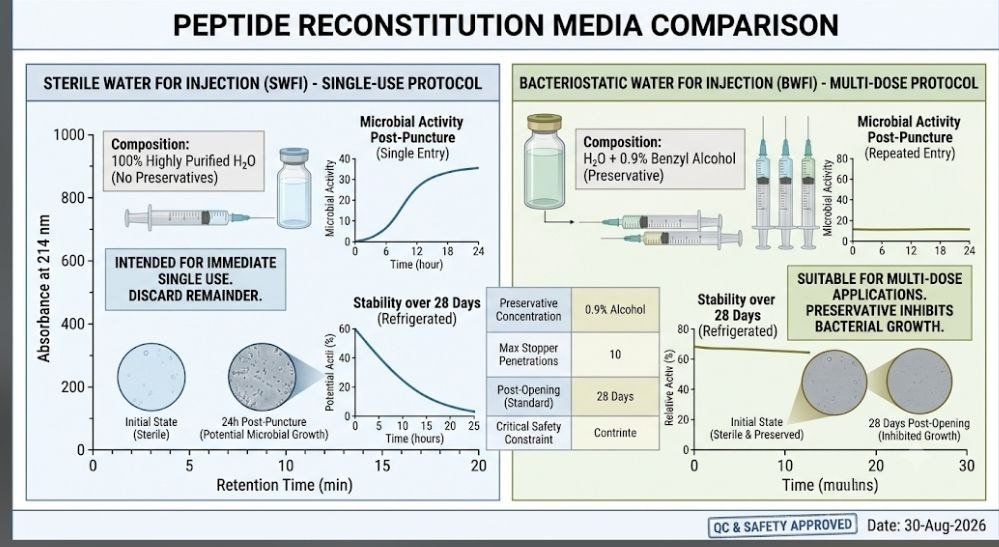
Table of Contents
Table of Contents
The Short Answer
Can I Use Sterile Water Instead of Bacteriostatic Water?
https://pubmed.ncbi.nlm.nih.gov/
Yes, sterile water can be appropriate for a single-use preparation when the applicable product instructions and laboratory protocol permit it.
The problem begins when researchers assume that sterile water is automatically appropriate for repeated access.
Sterile water generally contains no antimicrobial preservative.
Bacteriostatic water contains an antimicrobial preservative, commonly 0.9% benzyl alcohol, specifically to inhibit microbial growth in multidose applications.
Therefore, the operational distinction is:
Single-use preparation
A preservative-free sterile diluent may be appropriate when the preparation is intended to be used according to a validated single-use protocol and is not retained for repeated access.
Repeated-access preparation
A multidose preparation requires an appropriately preserved system or another validated aseptic protocol designed specifically for repeated access.
This distinction is much more important than simply asking which liquid is “stronger.”
Neither sterile water nor bacteriostatic water makes an unsuitable peptide formulation suitable.
The diluent is only one component of the overall preparation.
Sterile Water vs. Bacteriostatic Water
To understand can I use sterile water instead of bacteriostatic water, start with what each product is designed to accomplish.
What Is Sterile Water?
Sterile water for injection is water that has been sterilized and supplied for appropriate pharmaceutical or laboratory applications.
Its defining characteristic is the absence of microbial contamination when supplied in its sterile container.
However, sterile water is generally preservative-free.
That means it should not automatically be treated as a multidose solution simply because the original container was sterile.
Once the container is opened or its closure is breached, the conditions change.
A sterile product cannot be assumed to remain sterile indefinitely after repeated access.
What Is Bacteriostatic Water?
Bacteriostatic water is sterile water containing an antimicrobial preservative.
A common formulation uses 0.9% benzyl alcohol.
The purpose of the preservative is not to make the water “more sterile.”
Its purpose is to inhibit microbial growth.
This distinction is essential.
Bacteriostatic water therefore provides an additional layer of protection against microbial proliferation when used in applications for which the product is labeled and appropriate.
But it is important not to misunderstand this protection.
Bacteriostatic water is not a guarantee against contamination.
A contaminated vial can still be contaminated despite the presence of a preservative.
Good aseptic technique remains essential.
Why Sterility and Preservation Are Different
This is the most important concept in the entire article.
Sterility
Sterility concerns whether viable microorganisms are present.
A sterile diluent begins as a microbiologically controlled product.
But sterility does not mean:
“This vial can be repeatedly accessed forever without contamination.”
Repeated access creates opportunities for contamination.
Preservation
Preservation is different.
A preservative is incorporated into a formulation to inhibit microbial growth.
This means the formulation has an additional defense against microorganisms introduced during handling.
The preservative does not replace aseptic technique.
It does not eliminate the need to disinfect vial closures.
It does not guarantee peptide stability.
And it does not mean every peptide can be stored for the same length of time.
The simplest way to remember it
Sterility protects the starting product.
Preservation helps control microbial growth after repeated access.
That is why asking only whether water is “sterile” does not answer whether it is appropriate for a multidose preparation.
Single-Use vs. Multi-Access Reconstitution
This is where most practical confusion occurs.
Single-Use Research Protocol
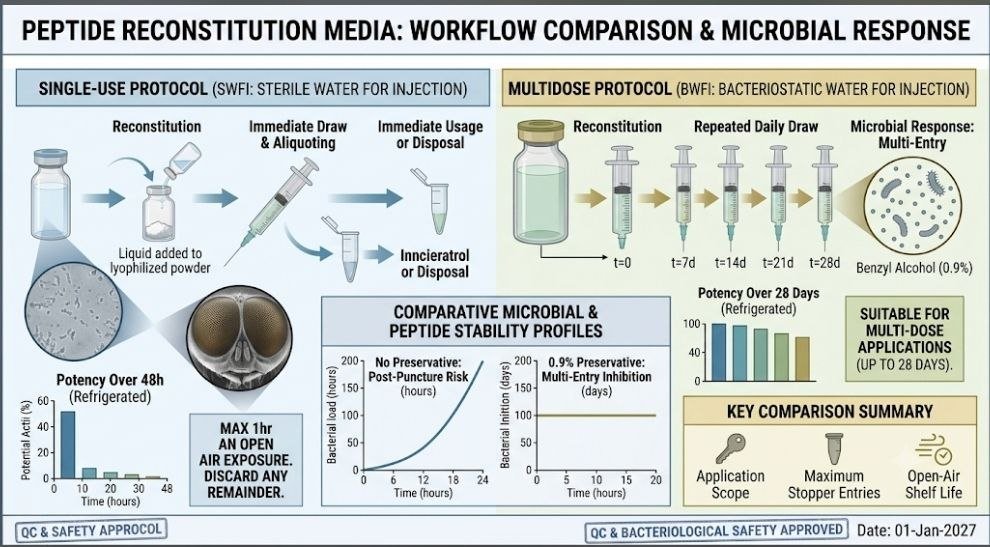
In a single-use protocol, the researcher introduces the diluent, prepares the material according to the applicable laboratory SOP, uses the preparation for the intended experiment or application, and does not repeatedly return to the same container over several days.
This is fundamentally different from keeping a reconstituted vial in a refrigerator and returning to it repeatedly.
For single-use applications, a preservative-free sterile diluent may be appropriate when the protocol and product instructions specify it.
Multi-Access Protocol
A multidose or multi-access protocol involves repeated entry into the same container.
Every additional access is another opportunity for contamination.
This is why multidose formulations often use a preservative.
The important point is not simply:
“Bacteriostatic water lasts longer.”
The correct question is:
What formulation, container, handling procedure, and validated stability data support this particular application?
Can I Use Sterile Water Instead of Bacteriostatic Water for Peptides?
For peptide research, the answer depends on the experimental design.
If the preparation is genuinely single-use
Sterile water may be appropriate if:
- the peptide is compatible with the diluent;
- the laboratory SOP permits it;
- the diluent is intended for the application;
- the preparation is used according to the applicable protocol;
- and unused material is handled or discarded according to that protocol.
If the same vial will be accessed repeatedly
Do not assume sterile water is an appropriate substitute for bacteriostatic water.
The absence of a preservative means repeated access requires particular attention to validated aseptic handling and the applicable storage/disposal requirements.
For a researcher planning repeated access, the diluent should be selected based on:
- intended number of accesses;
- formulation requirements;
- preservative compatibility;
- peptide stability;
- container/closure system;
- storage conditions;
- laboratory SOP;
- and manufacturer or supplier documentation.
What Happens When a Preservative-Free Vial Is Repeatedly Accessed?
Repeated access introduces several risks.
Contamination Risk
A needle can introduce microorganisms from the environment, equipment, gloves, skin, or other sources.
Even when researchers use a new needle for every access, contamination can occur through poor aseptic technique or environmental exposure.
The fact that the needle is new does not automatically make the entire process sterile.
The Refrigerator Is Not a Sterilizer
This is one of the most persistent misconceptions I have encountered.
Researchers sometimes think:
“I put it in the refrigerator, so bacteria cannot grow.”
That is incorrect.
Refrigeration can slow microbial growth, but it does not transform a contaminated preparation back into a sterile preparation.
Cold storage also does not automatically establish chemical stability.
This is why:
Refrigeration ≠ sterilization.
Does Refrigeration Make Sterile Water Safe to Reuse?
No.
Refrigeration should not be viewed as a substitute for preservation or validated aseptic handling.
If a preservative-free preparation is intended for single use, retaining it for repeated access simply because it is refrigerated changes the risk profile.
There is another important distinction:
Microbiological stability and chemical stability are different.
A solution can appear perfectly clear and still have experienced chemical degradation.
Conversely, cloudiness can indicate aggregation, precipitation, contamination, or another formulation problem.
Visual inspection is useful, but it cannot replace validated analytical testing.
Bacteriostatic Water and the 28-Day Question
Is Bacteriostatic Water Automatically Good for 28 Days?
This requires careful wording.
The commonly discussed 28-day multidose period should not be treated as a universal expiration date for every reconstituted peptide.
The presence of benzyl alcohol does not automatically establish that every peptide remains chemically stable for 28 days.
There are two separate questions:
Question 1: Microbial control
Does the formulation and handling system adequately inhibit microbial growth?
Question 2: Chemical stability
Does the peptide remain chemically and biologically suitable under the selected conditions?
These questions must not be confused.
A preservative can address microbial growth without guaranteeing the stability of the peptide itself.
Therefore, researchers should follow the relevant product labeling, stability data, validated laboratory procedures, and institutional requirements.
Peptide Stability Is a Separate Problem
Choosing between sterile water and bacteriostatic water is only part of peptide handling.
Peptides can be sensitive to:
- pH;
- temperature;
- oxidation;
- light;
- aggregation;
- concentration;
- ionic strength;
- freeze-thaw cycles;
- adsorption to surfaces;
- and formulation conditions.
Different peptides can behave differently.
That is why researchers should avoid assuming that a procedure that works for one peptide automatically works for another.
Examples of Peptides Requiring Careful Stability Consideration
Common research peptides such as:
- BPC-157
- TB-500
- CJC-1295
- Ipamorelin
- Semaglutide
- Tirzepatide
- GHK-Cu
should not all be treated as chemically identical simply because they are supplied as lyophilized powders.
Their molecular structures and formulation requirements differ.
A Critical Warning About “Cloudy” Peptide Solutions
Cloudiness is a warning sign.
A change in appearance can potentially indicate:
- aggregation;
- precipitation;
- particulate contamination;
- incompatibility;
- degradation;
- or another formulation issue.
However, it is inaccurate to say that cloudiness automatically proves bacterial contamination.
Similarly, a clear solution does not prove sterility.
This is why laboratory-quality assessment should go beyond appearance whenever the research application requires analytical confirmation.
Common Reconstitution Mistakes
1. Forcefully Injecting Diluent Onto the Powder
One common mistake is directing a high-speed stream directly onto the lyophilized cake.
For delicate peptide/protein formulations, aggressive handling can promote foaming, aggregation, or other undesirable physical effects.
A gentler approach is generally preferable.
Allow the diluent to enter the vial in a controlled manner rather than aggressively blasting the powder.
2. Shaking the Vial Aggressively
Another common mistake is vigorously shaking a vial to make the powder dissolve faster.
This can introduce substantial foaming and agitation.
For susceptible proteins and peptides, excessive agitation can contribute to aggregation or denaturation.
Gentle handling is generally preferable unless the product-specific instructions say otherwise.
3. Assuming Sterile Water Can Be Reused Because It Was Sterile
This is perhaps the biggest conceptual error.
The fact that the water was sterile before opening does not establish indefinite sterility after repeated access.
This is the exact reason the distinction between sterility and preservation matters.
4. Treating Benzyl Alcohol as a Universal Solution
Bacteriostatic water is not automatically the best diluent for every application.
Benzyl alcohol can be inappropriate for certain populations and experimental systems.
For example, neonatal and infant applications require particular caution with benzyl alcohol exposure.
In laboratory research, compatibility with the experimental system must also be considered.
5. Ignoring Aseptic Technique
Even bacteriostatic water should be handled aseptically.
Researchers should pay attention to:
- clean working surfaces;
- appropriate personal protective equipment;
- disinfected vial closures;
- sterile equipment;
- minimizing unnecessary vial exposure;
- and appropriate laboratory SOPs.
Preservatives are an additional safeguard—not permission to relax sterile technique.
Case Studies
Case Study 1: The Multidose Reconstitution Problem
Consider an anonymized research scenario.
A researcher prepared a multidose peptide vial using preservative-free sterile water.
The first access was performed correctly.
The vial was then refrigerated.
Over the following days, the researcher repeatedly returned to the vial using fresh needles.
The researcher assumed that refrigeration would protect the preparation.
That assumption was incorrect.
The key problem was not that sterile water was “bad.”
The problem was that a preservative-free preparation was being managed as though it were a validated multidose formulation.
The lesson
The original sterility of the diluent does not eliminate contamination risk created by repeated access.
Case Study 2: When Preservative-Free Water Makes Sense
A contrasting research scenario involves a single-use preparation.
A laboratory requires a preservative-free diluent because the experimental system is sensitive to antimicrobial preservatives.
The researcher prepares the material according to the laboratory’s validated SOP.
The preparation is used for the intended single experimental application.
There is no repeated access to the same preparation over subsequent days.
Here, the absence of benzyl alcohol is not a weakness.
It is an intentional part of the experimental design.
The lesson
The correct diluent is determined by the application—not by the assumption that bacteriostatic water is always superior.
Case Study 3: Microbial Stability vs. Chemical Stability
Consider a third research scenario.
A peptide is reconstituted and stored under refrigerated conditions.
No obvious contamination is observed.
However, analytical testing later identifies changes in the peptide profile.
This illustrates an important point:
Microbial control does not equal chemical stability.
The absence of visible contamination does not prove that the peptide has retained its original chemical characteristics.
This is where analytical methods such as HPLC and mass spectrometry can become important.

Laboratory SOP and Quality Control
Researchers working with peptides should think beyond the water itself.
A robust peptide handling SOP can address:
1. Material identification
Confirm:
- peptide identity;
- lot number;
- intended research application;
- supplied formulation;
- storage requirements.
2. Diluent compatibility
Determine whether the selected diluent is compatible with the peptide and experimental system.
3. Aseptic handling
Define how:
- vial closures are disinfected;
- sterile equipment is handled;
- work surfaces are prepared;
- and contamination is minimized.
4. Storage
Document:
- temperature;
- light exposure;
- storage duration;
- access frequency;
- and applicable stability information.
5. Analytical verification
Where appropriate, quality-control programs can use analytical techniques such as:
HPLC: Useful for assessing chromatographic purity and detecting changes in the peptide profile.
Mass spectrometry: Useful for confirming molecular mass and investigating potential molecular changes.
Neither technique, however, replaces microbiological controls.
Why HPLC/MS Matters
One of the things I emphasize in peptide education is that a Certificate of Analysis should not be treated as a decorative document.
A serious researcher should understand what the analytical data actually show.
A strong quality-control package may include information about:
- peptide identity;
- chromatographic purity;
- molecular mass;
- analytical method;
- laboratory identity;
- lot number;
- and testing date.
But there is an important limitation:
HPLC purity does not prove sterility.
Likewise:
Mass spectrometry confirms molecular characteristics; it does not automatically prove microbiological safety.
Different tests answer different questions.
That is why peptide quality should be evaluated as a complete system rather than reduced to a single percentage printed on a COA.
Sterile Water vs. Bacteriostatic Water Comparison
| Factor | Sterile Water | Bacteriostatic Water |
|---|---|---|
| Preservative | Generally none | Commonly 0.9% benzyl alcohol |
| Primary purpose | Sterile, preservative-free diluent | Sterile diluent with antimicrobial preservative |
| Single-use applications | May be appropriate when specified | May be unnecessary where preservative-free formulation is required |
| Repeated access | Requires particular caution and appropriate validated protocol | Designed for multidose applications when product labeling permits |
| Microbial growth inhibition | No antimicrobial preservative | Preservative provides growth inhibition |
| Refrigeration | Does not make an opened preparation sterile | Does not eliminate need for aseptic technique |
| Peptide stability | Depends on peptide/formulation | Depends on peptide/formulation |
| HPLC purity | Separate analytical question | Separate analytical question |
| MS identity | Separate analytical question | Separate analytical question |
| Universal 28-day peptide stability? | No | No |
The most important row in this table is the last one.
Neither diluent automatically guarantees 28 days of peptide stability.
Troubleshooting Common Researcher Questions
“I only have sterile water. Can I use it?”
The answer depends on the application.
If the preparation is genuinely single-use and the selected peptide is compatible with the diluent, sterile water may be appropriate.
If you intend to repeatedly access the same reconstituted vial, do not assume sterile water is an adequate substitute for a preserved multidose system.
“I already reconstituted with sterile water. What should I do?”
Do not automatically assume the preparation is safe or unsafe based solely on the type of water.
Review:
- the product’s instructions;
- the laboratory SOP;
- how the vial was handled;
- whether it was repeatedly accessed;
- storage conditions;
- and applicable stability information.
If sterility or stability is uncertain, the safest research decision may be to discard the preparation rather than gamble on an unknown condition.
“Can I put sterile-water reconstituted peptide in the refrigerator?”
Refrigeration may be appropriate for some peptide formulations, but refrigeration alone does not establish microbiological safety or guarantee chemical stability.
Always distinguish storage temperature from preservation.
“Does bacteriostatic water make the peptide stronger?”
No.
Bacteriostatic water does not increase the intrinsic potency of a peptide.
Its distinguishing feature is the presence of an antimicrobial preservative.
Peptide potency depends on the peptide itself, formulation, concentration, integrity, and other factors.
“Does sterile water reduce peptide potency?”
Not automatically.
The answer depends on the peptide, formulation, pH, concentration, storage conditions, and compatibility.
The critical mistake is assuming that the choice between sterile and bacteriostatic water alone determines peptide potency.
It does not.
How OasBioScience Approaches Peptide Quality
For researchers evaluating peptide suppliers, the diluent question is only one part of a much larger quality-control process.
At OasBioScience, our educational approach is centered on helping researchers understand what they are purchasing and how to interpret the supporting documentation.
You can explore our research peptide resources and quality documentation through the OasBioScience website.
When evaluating research peptides, look beyond marketing claims.
Consider asking:
- Is the peptide clearly identified?
- Is the lot documented?
- Is analytical testing available?
- Is HPLC data provided?
- Is mass spectrometry available where appropriate?
- Can the documentation be independently verified?
- Are storage requirements clearly communicated?
- Is there a transparent explanation of the product’s intended research use?
These questions help researchers distinguish between a supplier that simply sells a vial and one that takes documentation and education seriously.
Continue Learning: If you found this guide helpful, you may also want to read our previous peptide education articles covering the following topics
• Does adding more diluent make peptides weaker?
• Peptide vendor documents explained
• Explore 9 evidence-based facts about BPC-157
• How long should a weight loss cycle last?
• Can GLP-1 muscle loss be prevented?
• Discover the best peptide for obesity research.
• Which peptide suppresses appetite the most?
• Discover 9 powerful fixes for peptide foaming
• Learn how to read peptide Certificates of Analysis step by step.
• How Should Peptides Be Stored?
• Learn the correct peptide reconstitution process 2026
- Does adding more diluent make peptides weaker?
- Learn 7 powerful reasons why, how HPLC methods affect results
- Peptides warmed in transit are not automatically ruined
- How long can peptides stay unrefrigerated during shipping?
- Learn the complete peptide synthesis and manufacturing process
- HPLC vs Mass Spectrometry explained
Scientific Reference: For additional peer-reviewed information on peptide stability, sterile preparation, and pharmaceutical reconstitution practices, visit
European Medicines Agency (EMA)
National Center for Biotechnology Information (NCBI)
Frequently Asked Questions
1. Can I use sterile water instead of bacteriostatic water?
Yes, sterile water may be appropriate for certain single-use applications when compatible with the preparation and permitted by the applicable protocol. It should not automatically be treated as a substitute for bacteriostatic water in a repeatedly accessed multidose preparation.
2. What is the main difference between sterile water and bacteriostatic water?
The key difference is preservation.
Sterile water is generally preservative-free.
Bacteriostatic water contains an antimicrobial preservative, commonly 0.9% benzyl alcohol, intended to inhibit microbial growth in appropriate multidose applications.
3. Can I reuse sterile water after opening it?
You should not assume that an opened preservative-free sterile-water container remains suitable for repeated use.
The correct handling depends on the specific product labeling, container type, intended application, and laboratory or clinical protocol.
4. Can I store sterile-water reconstituted peptides in the refrigerator?
Refrigeration may be appropriate for some formulations, but it does not automatically make an opened preservative-free preparation suitable for repeated access.
Storage temperature and microbial preservation are separate considerations.
5. Does bacteriostatic water keep peptides stable for 28 days?
Not necessarily.
The presence of benzyl alcohol can inhibit microbial growth, but it does not establish universal chemical stability for every peptide.
The peptide’s formulation and validated stability information must also be considered.
6. Is bacteriostatic water always better for peptide reconstitution?
No.
The appropriate diluent depends on the peptide, research system, intended access pattern, preservative compatibility, and applicable SOP.
Some experimental systems specifically require preservative-free conditions.
7. Does HPLC prove that a peptide is sterile?
No.
HPLC primarily provides chromatographic information about the material.
Sterility and microbiological quality require appropriate microbiological controls and testing.
8. Does mass spectrometry prove that a peptide is safe?
No.
Mass spectrometry can provide valuable information about molecular identity and mass, but it does not by itself establish sterility, endotoxin status, or overall suitability for a particular application.
9. Why does my reconstituted peptide look cloudy?
Cloudiness can have multiple causes, including aggregation, precipitation, incompatibility, particulate contamination, or degradation.
It should not automatically be assumed to mean bacterial contamination.
When appearance changes unexpectedly, follow the relevant laboratory SOP and investigate rather than assuming the material is acceptable
10. What is the most important thing to remember about sterile water?
Remember this:
Sterility and preservation are not the same thing.
Sterile water can be appropriate for certain single-use applications.
A repeatedly accessed multidose preparation requires a different level of microbiological control
Final Takeaway
So, can I use sterile water instead of bacteriostatic water?
Yes—but only when the intended application, formulation, and applicable protocol support its use.
The mistake is treating sterile water and bacteriostatic water as interchangeable.
They solve different problems.
Sterile water provides a preservative-free sterile diluent.
Bacteriostatic water adds an antimicrobial preservative intended to inhibit microbial growth in appropriate multidose applications.
The practical distinction is therefore:
Single-use
A preservative-free sterile diluent may be appropriate when the entire preparation is handled according to the applicable single-use protocol.
Multi-access
Repeatedly entering a preparation requires appropriate microbiological controls. A preservative-containing multidose diluent may be appropriate when compatible and permitted by the relevant instructions.
And remember the most important lesson:
Sterility and preservation are different layers of protection.
Refrigeration does not replace preservation.
A preservative does not replace aseptic technique.
HPLC does not prove sterility.
Mass spectrometry does not prove microbiological safety.
And neither sterile water nor bacteriostatic water can compensate for an unsuitable formulation or poor handling practices.
For researchers, the best approach is to evaluate the peptide, diluent, formulation, access frequency, storage conditions, analytical documentation, and laboratory SOP as one complete system.
If you are researching peptide quality, documentation, analytical testing, and responsible laboratory handling, visit OasBioScience for additional educational resources and research-product information.
