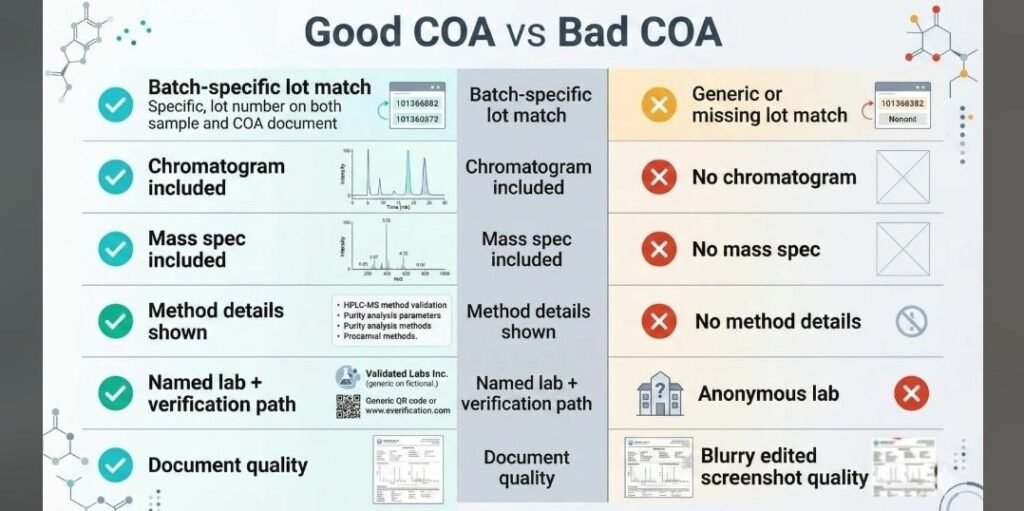
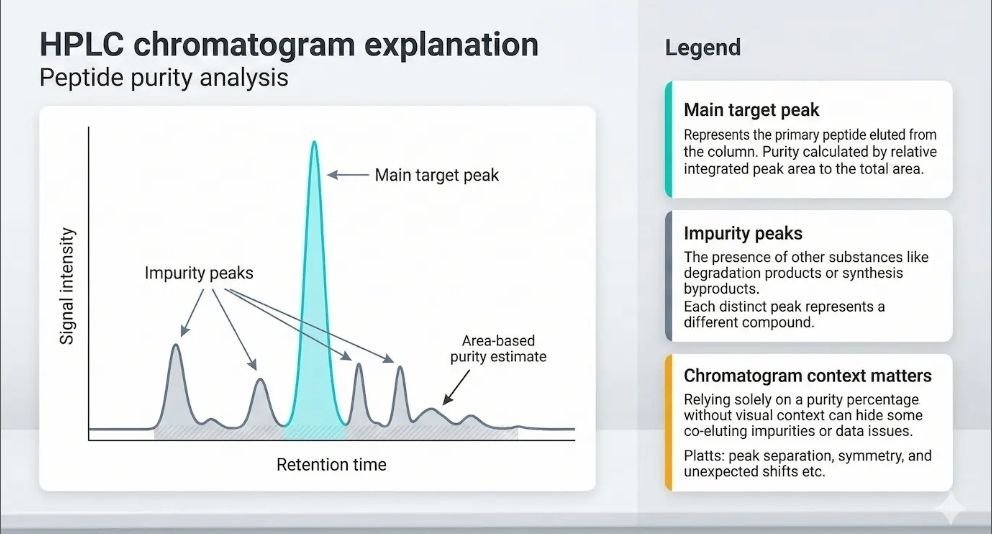
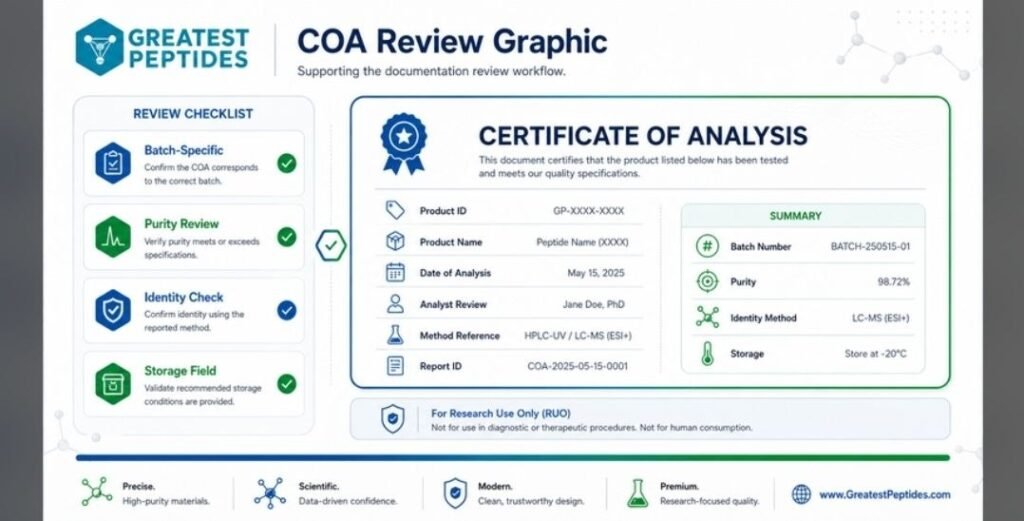
Batch-specific peptide COA documentation is one of the most important quality-control tools researchers can use when evaluating research-grade peptides.
A peptide can have the same name, sequence, advertised purity, manufacturer, and nominal vial size as another batch and still have a different analytical profile.
That is the central reason a batch-specific peptide COA matters.
A laboratory report should not simply tell you what a manufacturer claims a peptide normally looks like. It should tell you what was actually tested from the particular batch or lot associated with the material being supplied.
For researchers, that distinction is enormous.
Imagine ordering a peptide labeled as 5 mg and receiving a vial accompanied by a report showing 99% HPLC purity.
At first glance, everything appears acceptable.
But what if that report was generated from a different production lot?
What if the vial says Lot 101 while the COA says Lot 098?
What if the HPLC report is only a cropped screenshot?
What if the report contains no mass spectrum?
What if the headline purity is high but the actual peptide content is substantially lower because of water, counterions, residual salts, or other non-peptide material?
This is where a batch-specific peptide COA becomes much more than a PDF.
It becomes part of the traceability chain connecting the laboratory result to the physical material.
This article explains exactly what researchers should look for, why generic COAs can be misleading, how HPLC and LC-MS answer different questions, how to verify a report, and how OasBioScience approaches peptide quality education and documentation.
Important: The information in this article is intended for research-use-only quality assessment and analytical education. It is not medical advice and does not establish suitability for human or animal administration.
Table of Contents
What Is a Batch-Specific Peptide COA?
A batch-specific peptide COA is a Certificate of Analysis associated with a particular production lot or batch of peptide.
The key word is specific.
The report should allow a researcher to determine that the analytical results belong to the exact material being evaluated.
A strong batch-specific peptide COA should therefore connect several pieces of information:
Physical vial → lot number → sample identification → laboratory testing → analytical results → final report
If one part of that chain cannot be connected to the others, the value of the report becomes weaker.
For example:
Vial: Lot 101
Packaging: Lot 101
Invoice: Lot 101
Laboratory report: Lot 098
That is not a clean traceability chain.
The problem is not simply that the numbers are different.
The deeper problem is that the researcher cannot confidently establish that the reported analytical results belong to the material in the vial.
A batch-specific peptide COA should solve this problem by making the tested batch identifiable.
Why Every Peptide Lot Should Have Its Own Report
Peptide synthesis is a multistep chemical process.
Whether synthesis uses solid-phase peptide synthesis, solution-phase methods, or another manufacturing approach, the final analytical profile can be affected by process conditions and purification.
Small differences can influence the final material.
Examples include:
Incomplete coupling
Truncated sequences
Deletion sequences
Oxidation
Deamidation
Aggregation
Residual solvents
Residual counterions
Moisture
Purification efficiency
Lyophilization conditions
Salt composition
That is why a batch-specific peptide COA is more informative than a generic statement saying that a peptide normally meets a specification.
Two batches of the same peptide are not automatically analytically identical simply because they have the same product name.
A laboratory test performed on Batch A does not automatically establish the analytical characteristics of Batch B.
This is particularly important when a supplier changes:
Manufacturing date
Production lot
Manufacturing facility
Raw-material source
Purification conditions
Formulation or salt form
Testing laboratory
Analytical method
A batch-specific peptide COA gives researchers a much stronger basis for evaluating the actual lot.
Why One COA Cannot Automatically Represent Multiple Batches
One of the most common questions researchers ask is:
“If the manufacturer produces the same peptide using the same process, why can’t one COA cover several batches?”
The answer is traceability.
A representative or historical report can provide useful background information about a product.
It does not necessarily provide direct evidence about every later production batch.
Consider an example.
A manufacturer produces:
Batch A in January
Batch B in March
Batch C in June
The same peptide name appears on all three.
The same nominal purity specification appears on all three.
The same vial size appears on all three.
But only Batch A was tested.
The Batch A report may tell you something about Batch A.
It does not automatically demonstrate that Batches B and C have identical:
Purity
Molecular mass
Impurity profile
Net peptide content
Moisture
Counterion level
Residual solvent profile
This is the representative sample fallacy.
A sample may represent a production process under certain conditions, but it should not automatically be treated as analytical proof for unrelated lots.
That is why a batch-specific peptide COA is such an important quality-control principle.
What Should a Batch-Specific Peptide COA Contain?
A useful batch-specific peptide COA should provide enough information for a researcher to understand what was tested, who tested it, when it was tested, and what the results actually showed.
At minimum, look for:
1. Peptide identification
The report should clearly identify the material tested.
Ideally, this includes:
Peptide name
Sample identification
Lot number
Batch number
Manufacturer or supplier identification
Testing laboratory
Test date
2. HPLC purity
The report should identify the analytical method and provide the purity result.
For example:
HPLC purity: 98.7%
But do not stop there.
The actual chromatogram is much more informative than the headline percentage alone.
3. Full chromatogram
A useful chromatogram should show relevant analytical information rather than only a polished cropped image.
Look for:
Retention time
Baseline
Peaks
Peak integration
Integration percentages
Run time
Method information where available
Detector information
4. Mass spectrometry
A batch-specific peptide COA becomes substantially more informative when identity is supported by LC-MS or another appropriate orthogonal method.
Mass spectrometry can provide information about molecular mass that HPLC retention time alone cannot establish.
5. Net peptide content
A vial labeled “10 mg” does not necessarily mean that all 10 mg consists of intact peptide.
The gross powder may contain:
Peptide
Water
Counterions
Residual salts
Residual solvents
Other non-peptide components
Therefore, researchers should distinguish gross material weight from actual peptide content.
6. Moisture
Moisture can contribute to differences between gross powder mass and actual peptide content.
A moisture measurement can therefore add useful context to a quantitative assessment.
7. Residual solvents
Depending on the manufacturing and purification process, residual solvents may be relevant.
The appropriate analytical approach depends on the peptide and manufacturing process.
8. Counterions or salt components
Peptides may be supplied in forms involving counterions such as TFA or acetate.
Those components can affect the relationship between gross material mass and peptide content.
9. Application-dependent safety testing
For certain research applications, additional tests may be relevant.
Depending on the intended research use, researchers may investigate:
Endotoxin
Bioburden
Residual solvents
Heavy metals
Other process-related impurities
Not every analytical test applies to every peptide or every research application.
The important point is that a batch-specific peptide COA should clearly communicate what was tested rather than implying that one test proves everything.
The Most Important Part: Lot-to-COA Traceability
A beautiful PDF is not enough.
The report needs to connect to the material.
Imagine receiving a vial marked:
Lot: SEM-2304-B
The packaging also says:
Lot: SEM-2304-B
But the laboratory report says:
Lot: SEM-2304-A
The report may be genuine.
The laboratory may be genuine.
The analytical data may even be genuine.
But the documentation still does not establish that the results belong to the vial you received.
This is why a batch-specific peptide COA should be checked against the physical product.
Ideally, compare:
Vial label = Box label = Invoice/packing documentation = COA lot number
Where applicable, a QR code, task ID, report number, verification key, or laboratory portal can add another layer of traceability.
Some analytical laboratories provide verification mechanisms that allow a report to be checked independently.
The exact verification system varies by laboratory.
The principle remains the same:
The researcher should be able to connect the report to the specific tested sample.
How to Read HPLC Purity on a Peptide COA
HPLC is one of the most frequently reported analytical methods in peptide documentation.
In typical reverse-phase HPLC-UV purity reporting, the chromatographic peaks are detected through UV absorbance and the relative areas are used to calculate reported purity.
A result such as:
98.9% HPLC purity
can therefore be useful.
But it should not be interpreted as:
98.9% confirmed molecular identity + 98.9% actual peptide mass + 98.9% safety + 98.9% potency
Those are different analytical questions.
A batch-specific peptide COA should therefore be evaluated as a complete analytical package.
Ask:
What HPLC method was used?
How long was the run?
What wavelength was used?
Is the baseline visible?
Are the minor peaks shown?
Is the peak integration table available?
Does the chromatogram appear cropped?
Is the retention time documented?
Was identity independently tested?
A short chromatographic run with inadequate separation can provide a very different picture from a longer, better-resolved analytical method.
Why HPLC Purity Does Not Prove Peptide Identity
This is one of the most important concepts researchers should understand.
A chromatographic peak tells you that a component eluted at a particular time under particular conditions.
It does not automatically prove that the component has the expected molecular structure.
Regulatory analytical guidance makes the same general distinction. FDA’s Q6A guidance states that identification based solely on a single chromatographic retention time is not regarded as specific and describes combinations such as HPLC/MS as acceptable approaches for improving identification specificity.
This is why a batch-specific peptide COA should not be judged solely by the percentage printed next to “HPLC Purity.”
Consider two compounds that happen to have similar chromatographic behavior.
They might produce:
Similar retention times
Similar UV responses
Similar major peaks
Yet they could have different molecular masses or structures.
Mass spectrometry provides another analytical dimension.
That is the principle of orthogonal testing.
One method answers one question.
A second method based on a different analytical principle can answer another.
Why LC-MS Matters on a Batch-Specific Peptide COA
LC-MS combines chromatographic separation with mass spectrometric detection.
For peptide identity assessment, researchers may compare an observed mass with the expected molecular mass.
Depending on the peptide and analytical method, the mass spectrum may contain multiple charge states.
The resulting information can help identify whether the observed material is consistent with the expected molecular species.
This does not mean MS answers every quality question.
It does not automatically prove:
Sterility
Endotoxin status
Biological activity
Complete sequence in every circumstance
Absence of every possible impurity
Long-term stability
But it provides a valuable identity dimension.
A batch-specific peptide COA containing both chromatographic purity data and appropriate mass-spectrometric identity data gives researchers more information than HPLC alone.
The broader analytical principle is well established: when one analytical procedure does not provide enough specificity, combining complementary procedures can improve overall confidence. FDA’s current Q2(R2) guidance provides a framework for analytical procedure validation, while ICH analytical principles support scientifically justified complementary approaches.
The Hidden Problem of Net Peptide Content
This is an area that is frequently overlooked.
Suppose a vial is labeled:
10 mg peptide
That does not necessarily tell you that 10 mg of the powder is intact peptide.
The gross material can contain other components.
For example:
10.0 mg gross material
could theoretically consist of:
7.5 mg peptide
1.5 mg counterion/salt
0.7 mg moisture
0.3 mg other material
The exact composition must be measured rather than assumed.
This is why a batch-specific peptide COA should ideally distinguish purity from quantitative content.
Purity and content are related, but they are not interchangeable.
A sample could have a high chromatographic purity percentage while still containing substantial non-peptide material.
Researchers therefore need to ask:
“Is the reported percentage chromatographic purity, or does it represent actual peptide content?”
That single question can prevent significant misunderstanding.
How Generic or Reused COAs Can Mislead Researchers
A generic COA may look professional.
It may contain:
A laboratory logo
A product name
A purity percentage
A test date
A signature
A “PASS” statement
But professional appearance is not the same as traceability.
Potential warning signs include:
Identical data across different lots
If multiple supposedly different production batches have exactly the same:
Retention time
Peak profile
Baseline
Noise pattern
Integration percentages
a researcher may reasonably ask whether the data are actually batch-specific.
Some similarities can occur naturally.
Exact duplication across unrelated samples deserves verification.
Missing task or sample identification
If there is no meaningful laboratory sample identifier, independent verification becomes more difficult.
Cropped chromatograms
A cropped chromatogram may hide:
Minor peaks
Baseline problems
Integration boundaries
Retention-time context
Other regions of the run
Missing MS data
If identity is important but the report provides only HPLC purity, ask what additional identity evidence is available.
Recycled dates or templates
A template itself is not a problem.
Laboratories use templates routinely.
The issue is whether the underlying analytical data actually correspond to the stated batch.
Mismatched lot numbers
This is one of the simplest and most important checks.
If the vial and COA have different lot numbers, stop and investigate before relying on the report.
Real-World Case Study: Two Semaglutide Lots, Two Very Different Results
The following is an anonymized quality-control case study supplied for this article.
It illustrates why batch-specific documentation matters.
Two research-grade semaglutide synthesis lots came through the same vendor chain.
Both were labeled as:
5.0 mg
The analytical outcomes were substantially different.
Lot A — SEM-2304-A
Reported findings included:
Claimed quantity: 5.0 mg
HPLC purity: 99.2%
Target mass: 4113.5 Da
Trace baseline noise: below 0.8%
Net peptide: 4.82 mg
Net peptide percentage: 96.4%
Appearance after dissolution: clear
Dissolution: rapid
Lot B — SEM-2304-B
The second lot showed:
Claimed quantity: 5.0 mg
HPLC purity: 84.7%
Main target mass: 4113.5 Da
Secondary mass: 3985.2 Da
Truncated sequence impurity: approximately 11.4%
Net peptide: 3.15 mg
Net peptide percentage: 63%
Appearance: slight turbidity
Dissolution: slower
The difference between the two lots was significant.
Lot B contained substantially less measured peptide content than Lot A despite carrying the same nominal label.
The analytical interpretation supplied for the case associated the secondary species with a deletion consistent with a missing glutamate-spacer residue, while the lower net content was associated with non-peptide material such as residual moisture and salt/counterion contribution.
The important lesson is not that every semaglutide batch will behave this way.
The lesson is that the same product name does not guarantee identical analytical results across production lots.
If Lot A’s COA had simply been reused for Lot B, a researcher could have received a dramatically different material while reading a document suggesting approximately 99% purity.
That is exactly the problem a batch-specific peptide COA is designed to reduce.
Case Study: Why a 99.4% HPLC Result Was Not Enough
Another anonymized quality-control example involved a research peptide with a vendor-provided COA reporting:
99.4% HPLC purity
The document looked professional.
But deeper review revealed several problems.
The chromatogram had:
Cropped axes
Limited baseline information
No complete peak table
No accompanying MS result
No net peptide content
No independently verifiable laboratory task ID
Additional testing was requested.
The supplier declined to provide the raw analytical files and stated that internal factory standards were sufficient.
The material was rejected for the intended quality-control standard.
An independent retest later showed a significant mass discrepancy consistent with a deletion sequence involving two amino acids.
The deletion species appeared capable of co-eluting close to the target under the original HPLC conditions.
The lesson is extremely important:
A high HPLC number does not automatically prove that the expected peptide structure is present.
A batch-specific peptide COA should therefore be evaluated by the completeness and traceability of its evidence, not simply by the largest number on the first page.
The Convincing COA That Failed Deeper Testing
A particularly memorable example involved a long-chain peptide containing more than 30 amino acids.
The supplied report stated:
10 mg
99.1% HPLC purity
The chromatogram looked excellent at first glance.
There was a sharp main peak around 6.8 minutes.
The baseline looked flat.
The batch number matched the vial.
The testing date was listed.
The report identified C18 HPLC with detection at 214 nm.
There was even an ISO-related laboratory designation.
The report appeared convincing.
But the initial report did not include MS identity data.
Independent LC-MS testing was then performed.
The expected monoisotopic mass was approximately:
3751.2 Da
The observed mass was approximately:
3623.1 Da
The difference was approximately:
128.1 Da
That difference was consistent with a glutamate-related deletion in the case analysis.
Further quantitative testing estimated the active peptide content at approximately:
5.8 mg from 10 mg gross material
or roughly:
58%
The remaining material was associated with components such as TFA salts and moisture.
The original HPLC method also used a short gradient and an integration threshold that could exclude small peaks from the reported purity calculation.
The batch was rejected.
The quality-control protocol was subsequently changed to require:
Batch-specific HPLC
LC-MS identity
More complete chromatographic information
Net content assessment where appropriate
Traceable laboratory documentation
This example demonstrates why a batch-specific peptide COA should be treated as an analytical evidence package rather than a decorative certificate.
How to Verify a Batch-Specific Peptide COA Before Buying
Before accepting a batch-specific peptide COA, work through a structured verification process.
Step 1: Check the lot number
Compare the COA against the physical vial.
Ask:
Does the lot number match exactly?
Not approximately.
Not “close enough.”
Exactly.
Step 2: Check the product name
Make sure the report identifies the same peptide.
Pay attention to:
Peptide name
Product code
Salt form
Sequence where applicable
Molecular weight
Sample identification
Step 3: Check the laboratory identity
Find out:
Who performed the testing?
Is the laboratory independently identifiable?
Is there a report number?
Is there a task ID?
Is there a verification portal?
Can the report be independently checked?
Step 4: Inspect the HPLC chromatogram
Do not look only at the percentage.
Look at the actual data.
Check:
Retention time
Peak shape
Baseline
Minor peaks
Integration
Run duration
Method details
Step 5: Look for identity testing
Ask whether LC-MS or another appropriate identity method was performed.
The question is:
“Does the analytical evidence support the identity of this particular batch?”
Not simply:
“Does the PDF say the peptide name?”
Step 6: Ask about net content
If the material is sold by mass, determine what the stated mass represents.
Is it:
Gross powder?
Estimated peptide?
Assayed peptide?
Peptide plus counterion?
Another defined basis?
A batch-specific peptide COA is more useful when these distinctions are clear.
Step 7: Check additional testing when relevant
Depending on the research application, investigate whether additional testing is appropriate.
This could include:
Moisture
Residual solvents
Counterions
Endotoxin
Bioburden
Elemental analysis
Other impurity testing
No single test answers every quality question.
What Makes a Laboratory Report More Credible?
A useful way to think about a batch-specific peptide COA is through five quality pillars.
1. Authenticity
Can the report be shown to correspond to a real sample and real laboratory record?
2. Traceability
Can the report be connected to the exact batch supplied?
3. Orthogonal analytical evidence
Are multiple analytical principles used when one method cannot adequately answer the question?
4. Data transparency
Can researchers see meaningful analytical information rather than only a final percentage?
5. Laboratory competence
Is the testing laboratory operating under an appropriate quality framework?
These factors work together.
A laboratory logo by itself does not establish analytical quality.
A purity number by itself does not establish identity.
An ISO statement by itself does not prove that a particular vial contains a particular amount of intact peptide.
The strength comes from the entire evidence chain.
Why ISO/IEC 17025 Can Matter
ISO/IEC 17025:2017 is the international standard for the competence of testing and calibration laboratories.
ISO states that the standard addresses laboratory competence, impartiality, and consistent operation. The current 2017 edition was reviewed and confirmed in 2023.
For researchers reviewing a batch-specific peptide COA, laboratory accreditation can therefore be a useful credibility signal.
However, there is an important distinction.
ISO/IEC 17025 accreditation does not mean that every result from every report is automatically correct.
Instead, it provides a framework for demonstrating laboratory competence and consistent operation.
Researchers should still examine:
What sample was tested?
Which method was used?
What were the results?
Does the report identify the batch?
Can the report be verified?
Does the analytical method answer the question being asked?
Think of accreditation as part of the laboratory’s quality framework—not as a substitute for reading the actual data.
COA Red Flags Researchers Should Never Ignore
A batch-specific peptide COA should trigger additional questions if you notice any of the following.
Red Flag 1: Lot mismatch
The vial says Lot 101.
The report says Lot 098.
Investigate.
Red Flag 2: No laboratory identity
A PDF contains a logo but no meaningful laboratory identification or verification information.
Ask for clarification.
Red Flag 3: HPLC percentage without chromatogram
A percentage alone provides limited context.
Ask to see the underlying chromatographic output.
Red Flag 4: Cropped chromatogram
A cropped image can prevent proper assessment of the entire analytical run.
Red Flag 5: No MS when identity is important
HPLC retention time alone is not a complete identity confirmation.
Red Flag 6: Identical results across supposedly different lots
Identical data are not automatically fraudulent, but they deserve verification when different batches supposedly underwent independent testing.
Red Flag 7: No sample or task number
A report without meaningful sample traceability is harder to independently verify.
Red Flag 8: Refusal to explain the testing method
A reputable quality discussion should be able to explain what was tested and what the reported result means.
Red Flag 9: “99% purity” presented as proof of everything
Purity is only one part of analytical characterization.
Red Flag 10: No distinction between purity and content
A researcher should know whether the percentage refers to chromatographic purity, assay, or another measurement.
What a Good Peptide Supplier Should Be Able to Explain
A professional peptide supplier should not become defensive when a researcher asks reasonable analytical questions.
A supplier should be able to explain:
Which batch is this?
Where was it tested?
When was it tested?
What method was used?
Does the COA correspond to this exact lot?
Can the report be independently verified?
What does the HPLC percentage actually represent?
Was identity independently confirmed?
Was net peptide content measured?
Were additional tests performed?
What limitations apply to the report?
These are not unreasonable questions.
They are basic quality-control questions.
For a research-use-only material, analytical transparency is particularly valuable because researchers need to understand the characteristics and limitations of the material before incorporating it into laboratory work.
At OasBioScience, the educational approach is simple:
Do not treat a single purity percentage as the entire quality story.
The purpose of peptide documentation should be to help researchers understand what was actually tested and what the test results can—and cannot—demonstrate.
Our quality-focused educational approach emphasizes several principles:
Batch traceability
The documentation should be connected to the relevant production lot.
Analytical transparency
Researchers should understand the difference between HPLC purity, molecular identity, net peptide content, and other analytical measurements.
Orthogonal thinking
When one analytical method has limitations, researchers should consider whether another analytical method can provide complementary information.
Third-party laboratory evidence
Independent laboratory testing can provide additional transparency when appropriately documented and traceable.
Researcher education
A COA is only useful when the person reading it understands what the numbers mean.
That is why OasBioScience focuses not only on peptide products but also on educational material covering:
HPLC purity
LC-MS identity
COA verification
Peptide impurities
Storage considerations
Analytical limitations
Batch traceability
Laboratory documentation
For additional educational information and OasBioScience resources, researchers can visit oasbioscience.com.
Batch-Specific Peptide COA Checklist
Before relying on a peptide report, use this simple batch-specific peptide COA checklist.
1. Lot matching
Vial lot = packaging lot = documentation lot = COA lot
2. Laboratory verification
Can the report be independently verified?
3. Identity testing
Is there appropriate mass or other orthogonal identity evidence?
4. Complete HPLC information
Can you see the chromatogram, baseline, retention time, and integration information?
5. Net content
Do you know whether the reported mass represents gross material or actual peptide content?
6. Additional testing
Are moisture, counterions, residual solvents, endotoxin, or other tests relevant to the research application?
7. Data transparency
Can the supplier explain what each reported number means?
8. Batch specificity
Was this exact batch tested, or is the document merely representative?
A simple way to remember the process is:
Match the batch. Verify the laboratory. Inspect the data. Confirm identity. Understand the content.
That is far more informative than simply searching for a “99%” number.
Frequently Asked Questions
1. Does every peptide need its own COA?
A strong batch-level quality-control practice is for each production lot to have its own dedicated batch-specific peptide COA.
The purpose is traceability.
A report associated with one production lot should not automatically be treated as analytical proof for unrelated production lots.
The exact testing requirements can vary by product, intended research use, applicable specifications, and quality system.
2. Can one COA be used for multiple peptide batches?
A generic COA can provide background information about a product or manufacturing process, but it does not automatically establish the analytical characteristics of every separate batch.
For batch-level verification, the preferred approach is a batch-specific peptide COA tied directly to the lot being supplied.
If a supplier says that one historical COA covers several batches, ask why and request documentation showing how the batches are connected.
3. Is 99% HPLC purity enough?
No.
A 99% HPLC result can be useful, but it should not automatically be interpreted as proof of:
Molecular identity
Actual peptide content
Complete sequence
Absence of all impurities
Endotoxin status
Sterility
Biological activity
A batch-specific peptide COA should be assessed as a complete analytical package.
HPLC and MS can answer different analytical questions.
4. Does HPLC prove peptide identity?
Not by itself.
A chromatographic retention time is not automatically a unique molecular fingerprint.
FDA’s Q6A guidance specifically notes that identification based solely on a single chromatographic retention time is not regarded as specific and identifies HPLC/MS among combinations that can provide stronger identification evidence.
That is why researchers should understand the difference between purity measurement and identity confirmation.
5. Why is LC-MS useful for peptide testing?
LC-MS can provide molecular-mass information that complements chromatographic purity testing.
For peptide identity work, an observed mass can be compared with the expected mass.
The exact interpretation depends on:
Peptide sequence
Molecular form
Charge state
Instrument
Calibration
Analytical method
Sample preparation
LC-MS is therefore powerful, but it is not a universal substitute for every other quality test.
6. What should I do if the vial and COA have different lot numbers?
Do not assume they are interchangeable.
Contact the supplier and request clarification.
Ask for documentation that establishes which report belongs to the exact physical batch.
A mismatch between the vial and COA is a traceability problem that should be resolved before relying on the analytical report.
7. What does ISO/IEC 17025 mean on a peptide COA?
ISO/IEC 17025 is an international standard concerning the competence, impartiality, and consistent operation of testing and calibration laboratories.
It can be a useful indicator of laboratory quality infrastructure.
However, an ISO/IEC 17025 reference does not eliminate the need to examine the specific report, sample identity, method, and analytical results.
8. Should a peptide COA include the raw HPLC chromatogram?
For meaningful analytical review, a complete chromatogram is much more informative than a single purity number.
Where available, researchers should look for:
Full chromatographic trace
Baseline
Retention times
Peak integration
Peak table
Analytical conditions
The exact report format varies between laboratories.
9. What is the difference between HPLC purity and peptide content?
HPLC purity generally describes the chromatographic composition according to the specific analytical method.
Peptide content addresses how much actual peptide is present in the tested material.
Those measurements should not automatically be treated as identical.
For example, a gross powder may contain peptide plus counterions, water, or other non-peptide material.
That is why a batch-specific peptide COA should clearly identify what each reported measurement represents.
10. Can a peptide look perfect but still have an analytical problem?
Yes.
Appearance is useful as an observation, but visual appearance cannot establish molecular identity or quantitative purity.
A powder can look clean.
A solution can look clear.
A vial can have professional packaging.
None of those observations replaces appropriate analytical testing
11. Why should researchers care about the testing date?
The testing date helps establish when the sample was analyzed.
It becomes particularly important when comparing the report with:
Manufacturing date
Batch date
Packaging date
Expiration or retest information
Storage history
A batch-specific peptide COA is most useful when its timing and lot information make sense within the product’s traceability history
12. What if a supplier refuses to provide batch-specific documentation?
Ask what documentation they can provide and why.
If the supplier cannot establish that the report belongs to the exact batch being supplied, the researcher should recognize the limitation.
A supplier may have legitimate confidentiality or laboratory-documentation policies, but those limitations should be clearly understood.
When independent verification and batch-specific analytical evidence are unavailable, confidence in the characterization of the material should be adjusted accordingly.
A Practical 60-Second COA Audit
If you only have one minute to inspect a batch-specific peptide COA, check these six things first:
1. Lot number
Does the COA match the vial?
2. Laboratory
Is the laboratory clearly identified?
3. Verification
Is there a report number, task ID, or other verification mechanism?
4. HPLC
Is the complete chromatogram available?
5. Identity
Is there LC-MS or another appropriate identity test?
6. Content
Is there information about actual peptide content or another appropriate quantitative measurement?
If the answer to several of these questions is “no,” do not let a large purity percentage make the entire report appear stronger than it is.
A good batch-specific peptide COA does more than satisfy a paperwork requirement.
It helps researchers build a traceable analytical record.
Suppose an experiment produces an unexpected result.
The researcher may later need to investigate:
Which peptide batch was used?
When was it tested?
What was the reported purity?
What was the measured mass?
Was there a secondary peak?
Was the material from the same production lot as a previous experiment?
Did the supplier change laboratories?
Did the manufacturing lot change?
Without batch-level documentation, those questions become much harder to answer.
With strong traceability, the researcher has a clearer starting point.
This is particularly important for laboratories performing repeated experiments where reproducibility matters.
If the material changes between experiments, analytical documentation can help determine whether the material itself may be one variable worth investigating.
Why “Same Peptide” Does Not Always Mean “Same Material”
This distinction deserves repeating.
Two vials can both be labeled:
Peptide X — 5 mg
Yet they may differ in:
Purity
Impurity profile
Net peptide content
Moisture
Counterion level
Molecular species
Degradation products
Analytical history
That is why the phrase batch-specific peptide COA is so important.
The COA should characterize the batch—not merely the product name.
The Difference Between a Product Sheet and a COA
Researchers should also distinguish between a product specification sheet and a Certificate of Analysis.
A product specification may describe what a product is expected to meet.
For example:
HPLC purity: ≥98%
That is a specification.
A COA should report what was actually observed or determined for a particular tested sample.
For example:
HPLC purity: 99.1%
The first tells you the target requirement.
The second reports a result.
A batch-specific peptide COA adds another critical layer:
Which batch produced that result?
That distinction is fundamental to analytical traceability.
What Researchers Should Ask Suppliers
Before purchasing or evaluating research-grade peptide material, consider asking:
Is the COA specific to the exact production lot?
Does the vial lot number match the COA?
Who performed the testing?
Can the laboratory report be independently verified?
Was HPLC performed?
Was molecular identity independently assessed?
Is the complete chromatogram available?
Is the peak integration table available?
Is net peptide content measured?
Were counterions or moisture assessed?
Were application-specific tests performed where relevant?
What limitations apply to the reported results?
A supplier who can clearly explain these points makes it easier for researchers to understand the documentation.
The Bottom Line: What Should a Researcher Trust?
Do not trust a peptide report simply because it looks professional.
Do not trust it simply because the purity number is high.
Do not trust it simply because there is a laboratory logo.
Do not trust it simply because the document says “PASS.”
Instead, evaluate the evidence.
A strong batch-specific peptide COA should give you confidence that:
The report belongs to the correct batch.
The laboratory is identifiable.
The analytical methods are understandable.
The HPLC data can be inspected.
Identity is supported appropriately.
Content and purity are not confused.
Relevant additional testing is documented.
The report can be traced back to the physical material.
That is the difference between having a COA and having useful analytical documentation
Final Takeaway
The question is not simply:
“Does this peptide have a COA?”
The better question is:
“Does this exact batch have a verifiable, meaningful, batch-specific peptide COA that supports what is being claimed about the material?”
That change in thinking can dramatically improve how researchers evaluate peptide documentation.
A batch-specific peptide COA provides a direct connection between the production lot and its analytical record.
HPLC can provide valuable purity information.
LC-MS can provide complementary molecular-mass information.
Net-content testing can help distinguish gross material from actual peptide content.
Moisture, counterions, residual solvents, endotoxin, and other tests may provide additional information depending on the material and intended research application.
And laboratory accreditation such as ISO/IEC 17025 can provide useful context about laboratory competence and quality systems.
But no single number should be treated as the entire quality story.
At OasBioScience, our educational philosophy is straightforward:
Read the report. Match the batch. Verify the data. Understand the limitations.
Researchers looking for additional peptide-quality and analytical education can explore the resources available at oasbioscience.com.
Research Use Only. Not for human or veterinary use.
Final Takeaway: Never Judge Peptide Potency by Appearance Alone
The answer to the question “Can peptides lose potency without changing appearance?” is straightforward:
Yes.
And this is one of the most important reasons researchers should understand the difference between physical appearance, chemical integrity, peptide content and biological activity.
A peptide can remain:
clear;
colorless;
completely dissolved;
free of visible particles; and
apparently unchanged.
At the same time, it may contain oxidized, deamidated, hydrolyzed or otherwise modified molecules.
Storage conditions can contribute to these changes.
Heat can accelerate degradation.
Light can contribute to oxidation.
Moisture can affect stability.
Repeated freeze-thaw exposure can create additional instability risks.
Transportation can introduce temperature excursions that are invisible when the package eventually arrives.
And even an impressive HPLC purity percentage should not be interpreted as a complete measurement of peptide potency.
The more reliable approach is to ask multiple analytical questions.
Is the peptide chromatographically acceptable?
Does the molecular mass match the intended target?
How much peptide is actually present?
Are there detectable degradation products?
Has the material been stored and handled appropriately?
Where biological activity matters, has functional activity been demonstrated?
That is the difference between simply looking at a vial and actually evaluating its quality.
At OasBioScience, we believe researchers deserve more than a generic purity number or a photograph of a clean-looking vial. Quality assessment should be based on traceable, relevant analytical evidence and a clear understanding of what each test can—and cannot—prove.
For more information about our research-focused peptide quality approach, analytical education and available research-use materials, visit OasBioScience.
Research Use Only. Not for human or veterinary use.
Continue Learning: If you found this guide helpful, you may also want to read our previous peptide education articles covering the following topics
Scientific Reference: For additional peer-reviewed information on peptide stability, sterile preparation, and pharmaceutical reconstitution practices, visit
Premium Research Peptides OasBioScience provides high-purity research peptides, laboratory-tested compounds, and reliable worldwide service for professional research and educational purposes.