


No products in the cart.
99% Peptide Purity: 9 Powerful Reasons a “99% Pure” Peptide Can Still Be Poor Quality
99% Peptide Purity: The Number That Can Be Misleading
99% peptide purity sounds almost perfect.
When researchers see a Certificate of Analysis (COA) showing 99%, 99.5%, or even 99.9% purity, it is tempting to assume the material is chemically correct, biologically reliable, stable, safe for the intended research application, and free from meaningful contaminants.
That assumption can be wrong.
99% peptide purity is an important analytical result, but it is not a complete definition of peptide quality.
A peptide can produce an impressive HPLC purity percentage while still having problems involving molecular identity, counterions, residual solvents, water content, endotoxins, aggregation, degradation, stereochemical integrity, or physical stability.
This is one of the most important lessons researchers can learn when purchasing or evaluating synthetic peptides.
At OasBioScience, we believe researchers should look beyond a single number on a COA and understand what the analytical data actually means.
The goal of this article is not to suggest that 99% HPLC purity is meaningless.
It is to explain what 99% peptide purity tells you, what it does not tell you, and how to determine whether a peptide is genuinely suitable for your research requirements.
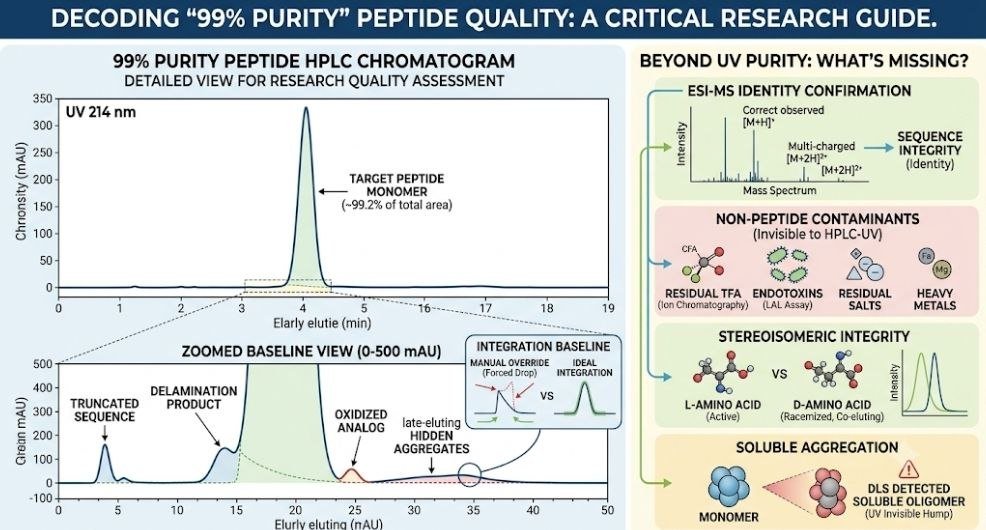
Table of Contents
What Does 99% Peptide Purity Actually Mean?
https://pubmed.ncbi.nlm.nih.gov/
The first thing to understand about 99% peptide purity is that the word “purity” needs context.
When a synthetic peptide is analyzed by reversed-phase HPLC with UV detection, the instrument separates components according to their interaction with the chromatographic system.
The resulting chromatogram contains peaks.
The principal peak is assigned to the target peptide, while other detectable chromatographic components may appear as smaller peaks.
The reported purity percentage is generally based on the relative chromatographic area assigned to the principal component under that specific analytical method.
Therefore, a result such as:
HPLC purity: 99.2%
does not automatically mean:
“99.2% of everything inside this vial is the intended peptide.”
Those are two different statements.
What 99% Peptide Purity Can Tell You
A properly performed HPLC assay can provide valuable information about chromatographic homogeneity.
A high percentage can indicate that the analytical method detected relatively little of the measured, UV-responsive chromatographic impurity relative to the principal peak.
This can help identify problems such as:
- Truncated peptide sequences
- Deletion sequences
- Certain synthesis byproducts
- Some degradation products
- Certain modified peptide species
- Other chromatographically separable organic impurities
That makes HPLC extremely valuable.
But HPLC is not designed to answer every question about the material.
Why 99% Peptide Purity Does Not Equal 99% Peptide Quality
99% peptide purity is one measurement. Peptide quality is a multidimensional assessment.
Think about quality as a chain:
Identity → Purity → Composition → Physical State → Stability → Biological Suitability
If one link is weak, the overall research material may not perform as expected.
A peptide can have:
- Excellent chromatographic purity but questionable identity.
- Correct molecular mass but significant aggregation.
- Correct sequence but excessive endotoxin.
- High HPLC purity but substantial counterion content.
- A valid COA but poor storage history.
- Excellent analytical data when tested but degradation after improper transportation.
- Correct mass but an incorrect stereochemical configuration.
This is why experienced researchers should avoid treating 99% peptide purity as a universal quality score.
The “Pure Wrong Molecule” Problem
One of the most important concepts is that a chromatographically clean sample can still have an identity problem.
Imagine a synthesis error produces a peptide that is structurally different from the intended sequence but happens to behave similarly on the HPLC method.
The resulting chromatogram could still show one dominant peak.
The percentage could still be extremely high.
Without appropriate identity testing, however, the researcher may not know whether the peak represents the intended molecular species.
That is where orthogonal analytical testing becomes important.
What HPLC Can and Cannot Tell You
HPLC is one of the most important analytical tools used in peptide characterization.
However, understanding its limitations is just as important as understanding its strengths.
HPLC Is Primarily a Separation Technique
HPLC separates compounds based on their interaction with the stationary and mobile phases.
For reversed-phase peptide analysis, differences in hydrophobicity and other chemical properties influence retention.
The detector then measures the compounds as they elute.
The resulting chromatogram gives researchers a chemical fingerprint under the specified conditions.
But a chromatogram is not a complete molecular biography.
What HPLC Can Help Evaluate
Depending on the method, HPLC can help identify:
- Major chromatographic impurities
- Relative chromatographic purity
- Degradation peaks
- Retention-time consistency
- Batch-to-batch differences
- Unexpected chromatographic components
- Some synthesis-related impurities
What HPLC Alone Cannot Establish
HPLC purity alone does not necessarily establish:
- Complete molecular identity
- Exact amino-acid sequence
- Net peptide content
- Counterion quantity
- Endotoxin concentration
- Heavy-metal concentration
- Residual solvent concentration
- Stereochemical purity
- Physical aggregation state under the intended assay conditions
This distinction is essential.
A high HPLC percentage is good evidence of chromatographic purity. It is not proof of total product quality.
How to Inspect a 99% Peptide Purity Chromatogram
Do not look only at the number.
Look at the chromatogram itself.
1. Examine the Entire Run
A cropped screenshot showing only a large central peak tells you very little.
Researchers should ideally be able to see the relevant chromatographic window, including early and late-eluting regions.
Small peaks may be easy to miss when the chromatogram is aggressively cropped or displayed at an unsuitable scale.
2. Examine the Baseline
Look for unusual baseline manipulation.
Ask:
- Where does integration begin?
- Where does it end?
- Are small peaks included?
- Are shoulders properly represented?
- Does the baseline return naturally?
- Are there unexplained integration exclusions?
Manual integration is sometimes necessary in chromatography, but any unusual integration should be scientifically justified rather than used simply to produce a more attractive percentage.
3. Look for Shoulder Peaks
A shoulder next to the primary peak can be important.
It may represent:
- A related impurity
- A degradation product
- Structural heterogeneity
- Another chromatographic species
- An analytical artifact
It should be investigated rather than automatically dismissed.
4. Examine Peak Shape
Peak symmetry can provide useful diagnostic information.
Tailing or fronting can result from multiple causes, including column interactions, loading, mobile-phase conditions, sample-solvent effects, or analyte behavior.
Therefore, abnormal peak shape should be treated as a reason to investigate, not automatically as proof of contamination.
5. Compare Retention Time
Retention time is useful when comparing batches tested under genuinely comparable conditions.
A meaningful shift can indicate changes in:
- Chemical composition
- Hydrophobicity
- Method conditions
- Column behavior
- Sample preparation
- Instrument performance
However, retention time alone does not establish molecular identity.
Why Mass Spectrometry Matters
If HPLC answers:
“How chromatographically homogeneous does this sample appear?”
Mass spectrometry helps answer:
“Does the observed molecular mass correspond to the intended molecular species?”
This makes MS a powerful complement to HPLC.
The Importance of 99% Peptide Purity + MS
Consider a peptide reported at:
HPLC purity: 99.6%
That sounds excellent.
Now suppose MS shows a molecular mass inconsistent with the intended sequence.
The 99.6% number does not rescue the sample.
You may have a highly homogeneous sample of the wrong molecular species.
Conversely, MS may confirm the expected molecular mass while HPLC reveals substantial chromatographic impurities.
That is why the two techniques provide different pieces of information.
HPLC vs MS
| Question | HPLC | Mass Spectrometry |
|---|---|---|
| Chromatographic purity | Yes | Not usually by itself |
| Retention behavior | Yes | No |
| Molecular mass | No | Yes |
| Identity confirmation | Limited | Yes, within method limitations |
| Sequence-related investigation | Limited | More informative |
| Co-eluting species | May miss them | Can reveal multiple masses |
| Overall composition | Not by itself | Not by itself |
For complex research applications, additional orthogonal methods may be appropriate.
The Hidden Issue of Counterions and Salt Forms
One of the most overlooked aspects of 99% peptide purity is the peptide’s salt or counterion form.
Synthetic peptides are commonly isolated in association with counterions.
Trifluoroacetate, acetate, chloride, and other forms can affect the final material’s composition and behavior.
A researcher may therefore have a peptide with excellent chromatographic purity but a substantial amount of non-peptide material associated with the isolated product.
Why Counterions Matter
Counterions can influence:
- Net peptide content
- Mass calculations
- Solution chemistry
- pH behavior
- Solubility
- Ionic strength
- Biological assay compatibility
This becomes particularly important when a peptide is being used in sensitive biological experiments.
TFA Is an Important Example
Trifluoroacetic acid is widely used in peptide synthesis and chromatography.
A peptide isolated as a TFA salt can contain associated TFA.
That does not automatically mean the peptide is poor quality.
The important question is:
What salt form was supplied, and has the composition been characterized appropriately for the intended research application?
This is much more useful than simply asking whether the HPLC number is 99%.
Net Peptide Content vs HPLC Purity
This distinction causes significant confusion.
Suppose a vial contains lyophilized peptide material.
The total mass may include:
- Target peptide
- Counterions
- Water
- Residual solvents
- Other non-peptide components
Therefore:
HPLC purity ≠ total peptide mass percentage.
A chromatographic purity value describes the relationship between detected chromatographic components under the method.
It does not necessarily tell you the absolute amount of target peptide in the vial.
Why This Matters
Researchers performing quantitative experiments should know what their mass measurement actually represents.
If a protocol assumes that every milligram of lyophilized powder is one milligram of peptide molecule, but the material contains significant associated non-peptide mass, the calculation may not reflect the actual amount of target peptide.
For quantitative work, appropriate compositional analysis may be needed.
Depending on the application, techniques such as amino acid analysis, elemental analysis, water determination, or counterion analysis can provide additional information.
Aggregation and Physical State
This is where 99% peptide purity becomes particularly interesting.
A peptide can look excellent on a standard RP-HPLC test while behaving differently after reconstitution.
Why?
Because chromatography and biological environments are not identical.
During reversed-phase HPLC, the peptide may encounter:
- Organic solvent
- Strong mobile-phase conditions
- Acidic modifiers
- A chromatographic surface
- Dilution conditions
- A short analytical timescale
Those conditions can disrupt some non-covalent interactions.
A peptide that behaves as a monomer or low-order species under assay conditions may therefore behave differently in a biological buffer.
Why Aggregation Matters
Depending on the peptide and experiment, aggregation can affect:
- Solubility
- Apparent concentration
- Reproducibility
- Binding measurements
- Optical measurements
- Cellular interactions
- Release kinetics
- Assay interpretation
This does not mean every cloudy solution is contaminated.
It also does not mean every clear solution is monomeric.
The physical behavior of a peptide must be interpreted according to its sequence, formulation, concentration, pH, ionic strength, solvent, and intended application.
When Additional Testing Helps
For aggregation-sensitive projects, techniques such as:
- Size-exclusion chromatography
- Dynamic light scattering
- Analytical ultracentrifugation
- Appropriate spectroscopic methods
may provide information that conventional RP-HPLC does not.
Can a 99% Pure Peptide Degrade After Testing?
Absolutely.
This is one of the most important reasons researchers should pay attention to storage and handling, not just the date printed on a COA.
A COA is a snapshot.
It describes material that was tested under particular conditions at a particular point in time.
It does not automatically prove that the material remained unchanged afterward.
Common Peptide Degradation Pathways
Different sequences have different vulnerabilities.
Potential pathways include:
- Asparagine deamidation
- Glutamine deamidation
- Methionine oxidation
- Cysteine oxidation
- Aspartate-related degradation
- Hydrolysis
- Aggregation
- Adsorption to surfaces
The exact degradation pathways depend on the peptide sequence and environment.
Temperature Matters
Temperature excursions can accelerate some degradation pathways.
Transit may expose material to conditions different from those used during long-term storage.
Repeated freeze-thaw cycles can also create unnecessary physical stress.
Moisture Matters
Many lyophilized peptide preparations are sensitive to moisture.
Opening a vial in a humid environment can introduce water into the material.
For moisture-sensitive products, careful handling and appropriate storage are therefore important.
The COA May Be Perfect—But the Material May Have Changed
Imagine:
January: HPLC = 99.7%
Then:
- repeated temperature excursions,
- humidity exposure,
- repeated opening,
- inappropriate storage,
occur over the following months.
The original January COA can remain completely authentic.
But it does not necessarily describe the material’s condition today.
That is why 99% peptide purity must always be considered together with storage history and stability.
Stereochemical Integrity and Racemization
Peptides are built from amino acids with defined stereochemistry.
The intended biological activity of many peptide sequences depends on that stereochemical arrangement.
During synthesis, unwanted stereochemical changes can sometimes occur.
Why Mass Alone Is Not Always Enough
Different stereochemical forms can have the same molecular mass.
Therefore, simply seeing the expected mass does not necessarily answer every stereochemical question.
Likewise, conventional RP-HPLC may not reliably resolve every stereoisomer.
When stereochemical integrity is critical, specialized approaches such as chiral chromatography or validated derivatization techniques may be appropriate.
The lesson is simple:
Correct molecular mass is necessary information, but it may not answer every structural question.
Endotoxins, Heavy Metals and Residual Solvents
Another major misconception about 99% peptide purity is assuming that everything not included in the HPLC percentage is automatically harmless.
It isn’t.
Different analytical tests measure different things.
Endotoxins
Endotoxins are bacterial components that can seriously interfere with biological experiments.
They are particularly important in:
- Cell culture research
- Immunological assays
- Animal studies
- Inflammation research
- Sensitive receptor assays
An HPLC-UV purity percentage does not function as an endotoxin test.
If endotoxin contamination matters to the research application, it should be assessed using an appropriate validated endotoxin assay and acceptance criterion.
Heavy Metals
Trace metals can originate from:
- Raw materials
- Catalysts
- Manufacturing equipment
- Processing
- Environmental contamination
ICP-MS can be used to measure elements at trace levels.
Again:
99% HPLC purity does not mean “99% free of heavy metals.”
Residual Solvents
Solvents may also remain after synthesis or purification.
Their evaluation requires an appropriate analytical method rather than relying on HPLC peptide purity.
Depending on the solvent, gas chromatography or another validated method may be appropriate.
How to Audit a Peptide COA
A professional COA audit should involve more than reading the bold number.
1. Verify the Laboratory
Ask:
- Who performed the testing?
- Is the laboratory independently identifiable?
- Can the report be verified?
- What analytical methods were used?
- Is the laboratory accredited for the relevant testing scope?
An accreditation logo alone is not enough.
The scope of accreditation matters.
2. Match the Batch Number
The physical vial should correspond to the analytical report.
Check:
Vial lot number = COA lot number
A generic COA for a peptide name is considerably less useful than a report traceable to the actual production batch.
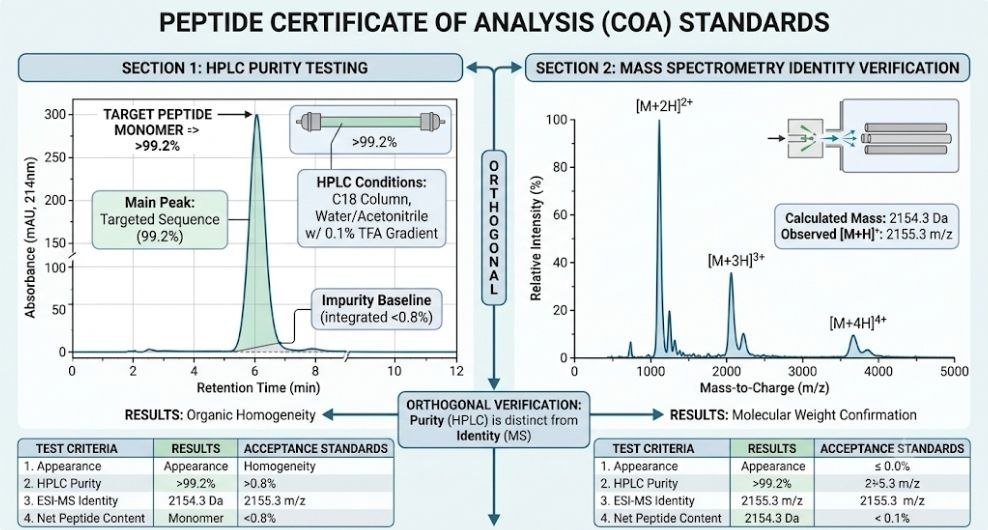
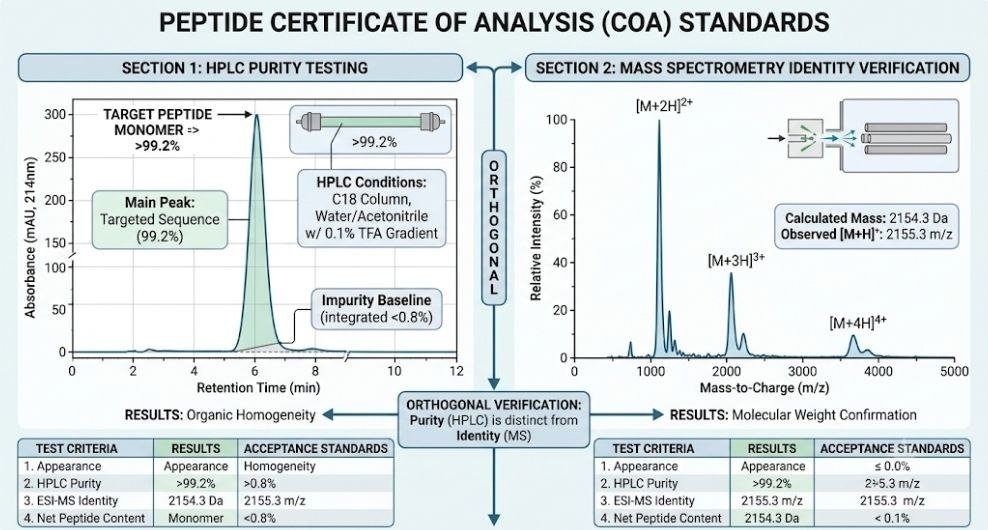
3. Review the HPLC Chromatogram
Do not settle for:
“Purity: 99.5%”
Ask to see the actual chromatographic data where appropriate.
Look for:
- Main peak
- Minor peaks
- Run window
- Baseline
- Integration
- Retention time
- Method conditions
4. Review Mass Spectrometry
Look for:
- Observed m/z
- Expected molecular mass
- Charge states
- Spectrum
- Relevant adducts
- Consistency with the intended molecular species
A single typed molecular-weight number is less informative than an actual analytical spectrum.
5. Identify the Salt Form
Determine whether the peptide is supplied as:
- TFA salt
- Acetate
- Hydrochloride
- Another counterion form
This can matter for composition and downstream experimental behavior.
6. Consider Endotoxin Requirements
If the research application is sensitive to endotoxins, request appropriate endotoxin information.
Do not assume:
99% HPLC purity = endotoxin-free.
It does not.
7. Consider Additional Tests
Depending on the peptide and application, researchers may need information concerning:
- Water
- Residual solvents
- Heavy metals
- Counterions
- Aggregation
- Amino-acid composition
- Stereochemistry
The right analytical panel depends on the scientific question.
Case Study: When 99% Peptide Purity Was Not Enough
One of the most instructive examples from peptide research involves a highly cationic antimicrobial research peptide derived from lactoferricin B.
The material arrived with impressive documentation.
The reported result was approximately:
99.2% RP-HPLC purity
The mass spectrum was also consistent with the expected molecular mass.
On paper, the material looked excellent.
But the biological experiment produced unexpectedly severe cytotoxicity.
Healthy control cells were affected far more strongly than expected.
Instead of immediately concluding that the peptide’s biological mechanism was responsible, the material required further investigation.
Investigation 1: Counterion Composition
Additional analysis indicated substantial associated TFA.
The issue was not that the HPLC result was necessarily false.
The issue was that the HPLC number was answering a narrower question.
The peptide’s chromatographic purity could remain high while the total material contained significant counterion mass.
Investigation 2: Physical Behavior
Further examination of the reconstituted material indicated aggregation behavior that was not obvious from the original RP-HPLC result.
This highlighted a critical principle:
A peptide’s behavior in the HPLC mobile phase can differ from its behavior in physiological or cell-culture conditions.
Investigation 3: Endotoxin
An endotoxin assay subsequently identified a substantial endotoxin burden.
At that point, the original biological results could no longer be interpreted simply as evidence of the peptide’s intended mechanism.
The Lesson
The important lesson is not:
“99% HPLC purity is useless.”
The correct lesson is:
“The 99% HPLC result was only one part of the analytical picture.”
Once the material’s salt chemistry, physical behavior, and endotoxin status were considered, the unexpected biological behavior became much easier to investigate.
This is exactly why researchers should troubleshoot the material before blaming the biological hypothesis.
Case Study: When an “Ugly” Peptide Was Actually High Quality
The opposite situation can also occur.
A hydrophobic peptide can arrive looking completely different from what a researcher expects.
Consider an amyloid-beta fragment such as Aβ25–35.
A researcher may open the vial and see a:
- Dense collapsed cake
- Thin film
- Glass-like residue
- Poorly soluble material
The first reaction may be:
“This peptide must have been damaged.”
But appearance alone does not establish chemical purity.
Why the Cake Can Look Unusual
Lyophilized appearance depends on:
- Peptide sequence
- Concentration
- Solubility
- Freezing conditions
- Excipient selection
- Drying cycle
- Salt form
- Formulation
A fluffy cake is not automatically proof of a better peptide.
Likewise, a collapsed cake is not automatically proof of degradation.
The Reconstitution Problem
Hydrophobic peptides can be difficult to dissolve in neutral aqueous buffers.
A cloudy solution may therefore indicate a solubility or aggregation issue rather than contamination.
For research involving difficult-to-solubilize peptides, the appropriate solvent and preparation procedure should be determined from validated product-specific or literature-supported procedures.
Orthogonal Testing Changes the Conclusion
In this example, subsequent analytical testing showed:
- High chromatographic purity
- Expected molecular mass
- No obvious major deletion products
- Acceptable behavior after appropriate solubilization
The original visual appearance had been misleading.
The Lesson
Poor appearance does not necessarily mean poor peptide quality.
And that is just as important as the opposite lesson.
Researchers should investigate unusual physical behavior instead of making an immediate quality judgment.
The 99% Peptide Purity Verification Checklist
Before accepting a peptide simply because the COA says “99%,” work through this checklist.
1. Authenticate the COA
Can the report be independently verified?
Look for:
- Report number
- Laboratory identification
- Verification mechanism
- Test date
- Batch number
2. Match the Batch
Confirm that the vial and COA refer to the same lot.
3. Examine the Full HPLC Trace
Don’t rely exclusively on the printed percentage.
Review:
- Main peak
- Minor peaks
- Baseline
- Integration
- Retention time
- Complete relevant run window
4. Confirm Molecular Identity
Review the MS data.
Ask whether the observed molecular mass is consistent with the intended peptide.
5. Determine the Salt Form
Find out whether the peptide is supplied as a TFA, acetate, hydrochloride, or other form.
6. Understand Net Peptide Content
Do not automatically equate powder mass with molecular peptide mass.
7. Check Endotoxin Requirements
For sensitive biological research, determine whether endotoxin testing is necessary.
8. Consider Heavy Metals
For applications where trace metals could interfere, request appropriate elemental analysis.
9. Consider Residual Solvents
Determine whether residual-solvent testing is relevant to the research.
10. Consider Aggregation
If aggregation could affect the experiment, consider an appropriate orthogonal physical or chromatographic test.
11. Review Storage History
Ask:
- How was the peptide stored?
- Was it exposed to heat?
- Was it exposed to moisture?
- Has it experienced repeated freeze-thaw cycles?
- How long has it been stored?
12. Match Testing to the Research Question
This may be the most important step.
There is no universal analytical package that answers every possible peptide-quality question.
A peptide intended for a basic biochemical experiment may require a different analytical profile from material intended for a highly sensitive cell-based assay.
What Researchers Should Ask a Peptide Supplier
A knowledgeable supplier should be able to explain the analytical documentation rather than simply repeating:
“Our peptides are 99% pure.”
Ask specific questions.
Question 1
Is the 99% purity figure based on RP-HPLC area percentage?
Question 2
Can I review the chromatogram rather than only the reported percentage?
Question 3
Is the COA specific to the batch I am purchasing?
Question 4
How was molecular identity confirmed?
Question 5
What is the peptide’s salt or counterion form?
Question 6
Is there information about endotoxin, residual solvents, water, or elemental impurities where relevant?
Question 7
What are the recommended storage conditions?
Question 8
How should this particular peptide be handled to minimize degradation or aggregation?
A supplier who understands peptide analytics should be comfortable discussing these questions.
At OasBioScience, our educational approach is built around helping researchers understand the analytical information behind peptide materials rather than asking them to blindly trust a single purity number.
For product-specific information, analytical documentation, or research-material questions, researchers can visit oasbioscience.com.
Why a Good COA Should Be Audited, Not Worshipped
A COA is valuable.
But a COA is not a substitute for scientific judgment.
A strong COA should allow the researcher to understand:
What was tested?
Which batch was tested?
Which method was used?
What did the chromatogram actually look like?
Was molecular identity confirmed?
What additional quality attributes were evaluated?
The more important the experiment, the more important these questions become.
A beautiful PDF containing a large “99%” number should never automatically end the investigation.
99% Peptide Purity vs Overall Peptide Quality
Here is the distinction worth remembering:
| Quality Attribute | Does 99% HPLC Purity Establish It? |
|---|---|
| Relative chromatographic purity | Yes, within the analytical method |
| Molecular identity | No — MS or another identity method may be required |
| Complete sequence confirmation | Not necessarily |
| Counterion quantity | No |
| Net peptide content | No |
| Endotoxin level | No |
| Heavy metals | No |
| Residual solvents | No |
| Water content | No |
| Aggregation under assay conditions | Not necessarily |
| Stereochemical purity | Not necessarily |
| Long-term stability | No |
| Correct storage history | No |
This table explains why the question:
“Is the peptide 99% pure?”
is only the beginning.
A better question is:
“What evidence demonstrates that this peptide is appropriate for my specific research application?”
How OasBioScience Approaches Peptide Quality
Peptide quality should be approached as an analytical system rather than a marketing slogan.
At OasBioScience, we believe researchers benefit from understanding the difference between:
Purity
Identity
Composition
Physical state
Stability
Application-specific quality requirements
That distinction helps researchers ask better questions and troubleshoot experiments more intelligently.
If an experiment produces unexpected results, the peptide should not automatically be blamed—and neither should the biological hypothesis.
The analytical material itself should be investigated.
Frequently Asked Questions About 99% Peptide Purity
1. Can a peptide be 99% pure but still be poor quality?
Yes.
A 99% HPLC purity result can indicate excellent chromatographic purity while leaving other quality questions unanswered.
For example, the result does not by itself establish molecular identity, endotoxin level, counterion content, residual solvent level, aggregation state, stereochemical integrity, or long-term stability.
Therefore, 99% peptide purity is best understood as one quality attribute rather than a complete quality score.
2. Does 99% HPLC purity mean that 99% of the vial is peptide?
No, not necessarily.
HPLC purity is generally a relative chromatographic measurement under a particular analytical method.
The total vial mass can also contain water, counterions, residual solvents, salts, and other non-peptide components.
If accurate quantitative peptide content matters, researchers should consider appropriate compositional testing rather than assuming the HPLC percentage represents total mass purity.
3. Is 99% peptide purity good?
Generally, a high HPLC purity result is desirable, but the answer depends on what else has been established.
A 99% result is much more meaningful when supported by appropriate identity testing, batch-specific documentation, a credible chromatogram, suitable storage, and additional testing relevant to the research application.
The number itself is not the problem.
The problem is treating the number as the entire quality assessment.
4. Why do I need MS if my peptide already has 99% HPLC purity?
Because HPLC and mass spectrometry answer different questions.
HPLC primarily evaluates chromatographic separation and relative purity.
Mass spectrometry provides molecular-mass information that can help confirm whether the detected material corresponds to the intended molecular species.
A peptide can therefore have excellent HPLC purity while still requiring independent identity confirmation.
5. Can endotoxins exist in a 99% pure peptide?
Yes.
HPLC peptide purity does not function as an endotoxin assay.
Endotoxin contamination must be evaluated using an appropriate endotoxin test when relevant to the research application.
This is particularly important for sensitive biological experiments where endotoxin could alter cellular or immune responses.
6. Does a cloudy peptide solution mean the peptide is poor quality?
Not necessarily.
Cloudiness can result from several causes, including poor solubility, aggregation, pH, ionic strength, concentration, solvent compatibility, or sequence-specific behavior.
Some hydrophobic peptides are naturally difficult to dissolve in neutral aqueous buffers.
A cloudy solution should therefore trigger investigation rather than an automatic conclusion that the peptide is contaminated or degraded.
7. Does a collapsed lyophilized peptide cake mean the peptide is degraded?
Not automatically.
Lyophilized morphology depends on formulation, freezing and drying conditions, excipients, concentration, peptide sequence, and salt form.
A dense or collapsed cake can occur without indicating unacceptable chemical degradation.
Analytical testing is more reliable than visual appearance alone.
8. How can I verify whether a peptide COA is legitimate?
Start by checking:
- Laboratory identity
- Report or verification number
- Batch/lot number
- Test date
- HPLC chromatogram
- MS data
- Analytical method
- Consistency between the physical vial and documentation
If the laboratory provides an independent verification portal, use it rather than relying exclusively on a PDF supplied by the vendor.
9. What is more important: HPLC purity or MS?
Neither replaces the other.
HPLC and MS are complementary.
HPLC provides important information about chromatographic purity.
MS provides important information about molecular mass and identity.
The appropriate combination depends on the peptide and research application.
10. What should I look for in a high-quality peptide COA?
At minimum, researchers should look for clear batch traceability, appropriate analytical methods, HPLC purity data, molecular-identity information, and a credible laboratory source.
For applications sensitive to biological contaminants or composition, additional information such as endotoxin, residual solvent, elemental, counterion, water, or aggregation testing may be appropriate.
The correct analytical package depends on the intended research use.
Continue Learning: If you found this guide helpful, you may also want to read our previous peptide education articles covering the following topics
• Does adding more diluent make peptides weaker?
• Peptide vendor documents explained
• Explore 9 evidence-based facts about BPC-157
• How long should a weight loss cycle last?
• Can GLP-1 muscle loss be prevented?
• Discover the best peptide for obesity research.
• Which peptide suppresses appetite the most?
• Discover 9 powerful fixes for peptide foaming
• Learn how to read peptide Certificates of Analysis step by step.
• How Should Peptides Be Stored?
• Learn the correct peptide reconstitution process 2026
- Does adding more diluent make peptides weaker?
- Learn 7 powerful reasons why, how HPLC methods affect results
- Peptides warmed in transit are not automatically ruined
- How long can peptides stay unrefrigerated during shipping?
- Learn the complete peptide synthesis and manufacturing process
- HPLC vs Mass Spectrometry explained
- Can I use sterile water instead of bacteriostatic water?
Scientific Reference: For additional peer-reviewed information on peptide stability, sterile preparation, and pharmaceutical reconstitution practices, visit
European Medicines Agency (EMA)
National Center for Biotechnology Information (NCBI)
Final Takeaway: Never Judge a Peptide by Its Peak Area Alone
The most important lesson is simple:
99% peptide purity is not the same thing as 99% overall peptide quality.
A 99% HPLC result can be an excellent result.
But it is still only one measurement.
It tells you about chromatographic behavior under defined analytical conditions.
It does not automatically tell you:
- Whether the molecular identity is correct
- Whether the sequence is completely correct
- How much target peptide is actually present by mass
- Which counterion is associated with the peptide
- Whether endotoxins are present
- Whether heavy metals are present
- Whether residual solvents remain
- Whether aggregation occurs under experimental conditions
- Whether stereochemical integrity is correct
- Whether the material remained stable after testing
This is why experienced peptide researchers look beyond the headline number.
HPLC provides purity information.
MS provides identity information.
Additional analytical methods answer additional questions.
And the researcher’s job is to determine which questions actually matter for the experiment.
The best way to evaluate a peptide is therefore not to ask:
“Does this peptide say 99% pure?”
Instead, ask:
“What evidence demonstrates that this material is the correct, well-characterized, appropriately handled peptide for my research?”
That is the difference between reading a COA and auditing a COA.
At OasBioScience, we encourage researchers to take that second approach.
Because when research results matter, a large number on a certificate should be the beginning of the quality assessment—not the end.
For additional peptide research information and product documentation, visit OasBioScience at oasbioscience.com.

