
Peptide Sequence Verification: 7 Powerful Reasons It Matters for Research-Grade Peptides

Peptide sequence verification is important because it confirms that the amino acids in a peptide are assembled in the correct order and that the material being tested is actually the intended molecule—not simply a sample that happens to show high HPLC purity. HPLC, mass spectrometry, and other analytical methods answer different questions, so reliable peptide quality assessment requires more than a single purity percentage.
Table of Contents
What Is Peptide Sequence Verification?
https://pubmed.ncbi.nlm.nih.gov/
Peptide sequence verification is the analytical process used to determine whether a peptide contains the intended primary amino acid sequence.
A peptide is not defined simply by its molecular weight.
Its identity depends on the arrangement of its amino acid residues from the N-terminus to the C-terminus, along with relevant terminal groups, chemical modifications, stereochemistry, and, where applicable, disulfide connectivity.
For example:
N-terminus → AA₁ → AA₂ → AA₃ → AA₄ → … → AAₙ → C-terminus
Every position matters.
Changing one amino acid can potentially change the chemical properties of the molecule. Deleting one residue, inserting an unintended residue, leaving a protecting group attached, changing an L-amino acid to a D-amino acid, or creating an incorrect disulfide pairing can produce material that is analytically different from the intended peptide.
This is why peptide sequence verification should not be treated as simply another name for HPLC purity testing.
They are related, but they answer different questions.
The simplest way to understand peptide sequence verification
Think about ordering a book containing the same sentence 1,000 times.
An optical scanner might confirm that 99% of the pages have extremely consistent printing.
But what if the sentence repeatedly says:
“The quick brown box jumps over the lazy dog.”
instead of:
“The quick brown fox jumps over the lazy dog.”
The printing may be highly consistent.
The words are still wrong.
That is essentially the distinction between purity and identity.
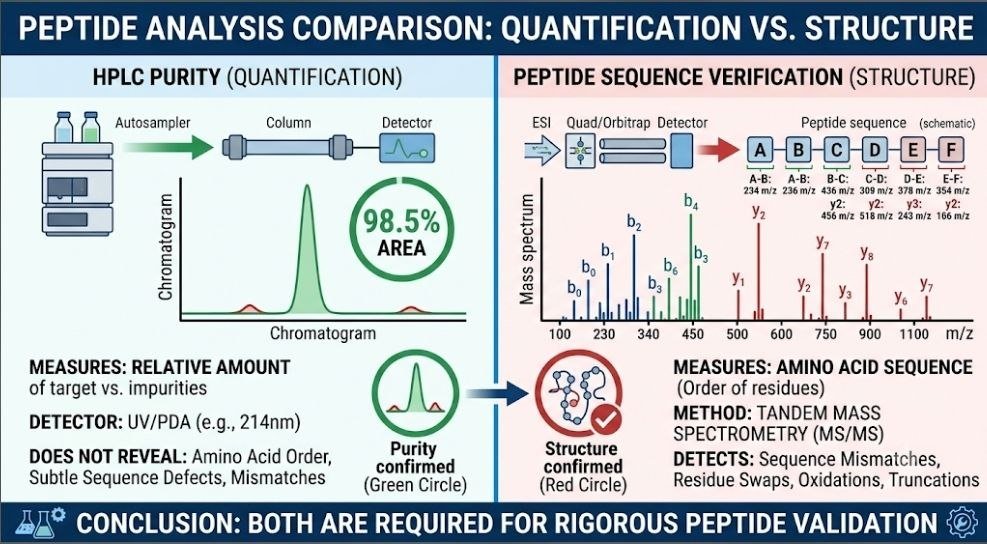
HPLC can help determine how chromatographically homogeneous a sample appears.
Peptide sequence verification asks a deeper question:
Is the molecule actually the peptide it is supposed to be?
Why Is Peptide Sequence Verification Important?
Peptide sequence verification is important because a peptide can appear highly pure while containing a structural defect that ordinary purity testing does not adequately identify.
This distinction is particularly important for researchers purchasing custom or research-use peptides.
A Certificate of Analysis might report:
HPLC purity: 98.7%
At first glance, that sounds reassuring.
But what does the 98.7% actually represent?
Typically, chromatographic purity is calculated from the relative area of detected peaks under a particular analytical method.
It does not automatically prove:
- The amino acid sequence is correct.
- Every residue is in the intended position.
- No deletion sequence is present within a co-eluting peak.
- No D-amino acid has replaced an L-amino acid.
- Leucine has not been substituted for isoleucine.
- A terminal modification is correct.
- A protecting group has been completely removed.
- A disulfide bond has formed correctly.
- The observed molecule has the expected structural identity.
This is where peptide sequence verification becomes critical.
Seven reasons peptide sequence verification matters
1. It confirms the intended amino acid order.
A peptide can have the correct general composition but an incorrect sequence.
2. It helps identify deletion sequences.
Incomplete coupling during synthesis can create truncated or deletion products.
3. It can reveal unexpected modifications.
Mass shifts can indicate oxidation, protecting-group remnants, terminal-group differences, or other structural changes.
4. It can expose problems hidden beneath an HPLC peak.
Two chemically different species can sometimes have similar chromatographic behavior.
5. It provides stronger evidence of molecular identity.
Mass and fragmentation data provide information that a percentage-based purity result cannot provide by itself.
6. It improves COA transparency.
A lot-specific analytical report gives researchers more information with which to evaluate a supplier and a batch.
7. It reduces the risk of assuming that “high purity” means “correct peptide.”
This final point is perhaps the most important.
HPLC Purity vs. Peptide Sequence Verification
One of the most common mistakes when evaluating peptides is treating HPLC purity as a substitute for peptide sequence verification.
It is not.
What does HPLC tell you?
Reversed-phase HPLC separates compounds according to their interaction with the chromatographic system.
With UV detection, commonly around 214 nm for peptides, the resulting chromatogram can be integrated to estimate the relative contribution of detected peaks.
In simple terms, HPLC helps answer:
“How chromatographically homogeneous does this sample appear under this method?”
That is valuable information.
But it is not the same as asking whether the compound has the intended sequence.
What does mass spectrometry tell you?
Mass spectrometry measures mass-to-charge ratio.
MS1 can provide evidence that the observed molecular mass is consistent with the expected molecular mass.
That answers:
“Does the detected molecular species have the expected mass?”
Again, extremely useful.
But mass alone does not necessarily prove the complete sequence.
What does MS/MS add?
Tandem mass spectrometry fragments the peptide and analyzes the resulting ions.
Depending on the peptide, instrument, fragmentation method, and analytical strategy, fragment-ion patterns can provide evidence for the arrangement of residues along the peptide backbone.
This makes MS/MS an important component of peptide sequence verification.
A useful comparison
| Analytical approach | Main question | Important limitation |
|---|---|---|
| RP-HPLC | How chromatographically homogeneous is the sample? | Does not by itself prove sequence |
| MS1 | Does the molecular mass agree with expectation? | Mass alone does not establish residue order |
| MS/MS | Do fragmentation patterns support the expected sequence? | Interpretation depends on peptide and method |
| Chiral analysis | Is stereochemical identity consistent? | Not replaced by ordinary MS |
| Disulfide mapping | Are cysteine linkages correctly paired? | Relevant primarily to disulfide-containing peptides |
The key lesson is simple:
No single analytical result should automatically be interpreted as proving every aspect of peptide identity.
What Does Peptide Sequence Verification Actually Confirm?
A rigorous peptide sequence verification strategy can examine several different structural characteristics.
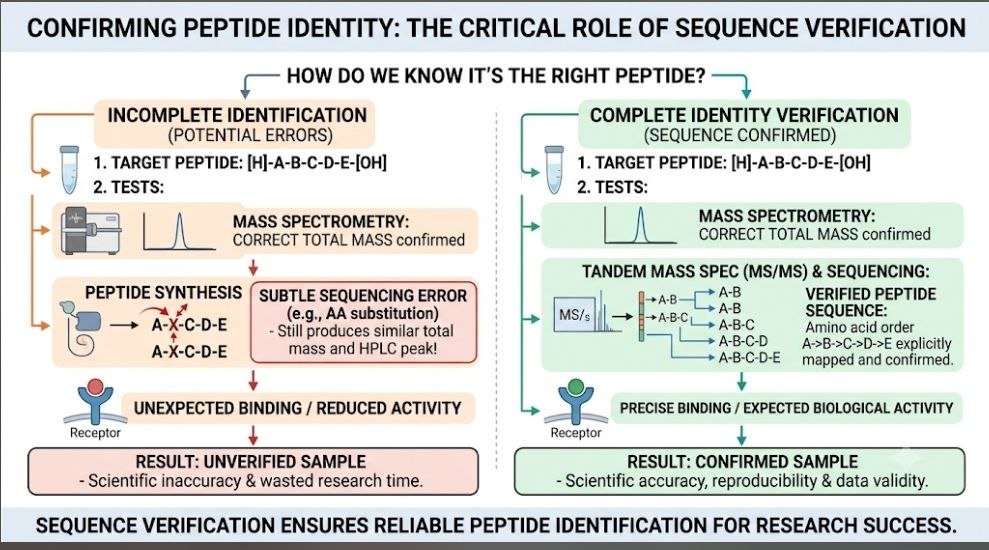
1. Primary Amino Acid Order
The first question is whether the residues occur in the intended order.
For example, suppose the target is:
Ala–Gly–Phe–Leu–Lys
A deletion could produce:
Ala–Phe–Leu–Lys
The resulting molecule is not the same peptide.
During solid-phase peptide synthesis, incomplete coupling can produce deletion sequences. If the synthesis proceeds without adequately controlling the incomplete coupling event, the resulting truncated chain can continue through subsequent synthesis steps.
The final product can therefore contain a structurally incorrect peptide.
This is one reason peptide sequence verification is valuable after synthesis.
2. Residue Identity
The analytical question is not only whether the chain has the correct length.
Researchers also need evidence that the residues themselves are correct.
This becomes particularly interesting with residues that have the same or very similar mass characteristics.
Leucine and isoleucine
Leucine and isoleucine are structural isomers with the same elemental composition and essentially identical mass.
Therefore, ordinary mass measurement cannot simply look at the molecular weight and determine:
“This residue is definitely leucine rather than isoleucine.”
Additional analytical approaches may be required depending on the level of confirmation needed.
3. Terminal Modifications
A peptide may intentionally contain modifications such as:
- N-terminal acetylation
- C-terminal amidation
- Other defined terminal groups
These modifications affect the molecular structure.
Therefore, peptide sequence verification should consider the intended terminal chemistry rather than looking only at the unmodified backbone.
An observed mass difference can sometimes provide an important clue that the expected modification is absent or that an unintended modification remains
4. Side-Chain Modifications and Protecting Groups
Solid-phase synthesis uses protecting groups to control peptide chemistry.
These groups are intended to be removed at the appropriate stage.
Incomplete deprotection can leave an unexpected chemical group attached to the peptide.
Examples can include remnants associated with protected arginine, cysteine, histidine, aspartic acid, or glutamic acid residues.
Mass spectrometry can be particularly useful for detecting unexpected mass shifts.
5. Stereochemical Integrity
This is an important limitation that researchers should understand.
L- and D-amino acids can have the same molecular formula and therefore the same molecular mass.
Consequently, simply observing the expected mass does not establish stereochemistry.
A peptide containing one D-amino acid where an L-amino acid was intended can therefore require specialized analytical investigation.
Depending on the question being asked, approaches may include:
- Chiral chromatography
- Chiral amino acid analysis
- Reference-standard comparison
- Other validated stereochemical methods
This illustrates why peptide sequence verification should be viewed as a broader analytical concept rather than simply “check the mass.”
6. Disulfide Bond Connectivity
Some peptides contain multiple cysteine residues.
In these molecules, identity involves more than the linear sequence.
The cysteine residues must also form the intended disulfide connectivity.
A peptide can therefore have the correct amino acid sequence but an incorrect disulfide arrangement.
For such molecules, specialized peptide mapping and comparison of reduced and non-reduced conditions can provide additional structural information.
How Is Peptide Sequence Verification Performed?
There is no single universal test that is appropriate for every peptide.
The analytical strategy should reflect the molecule’s structure and the specific identity question being asked.
A typical multi-layered approach can include:
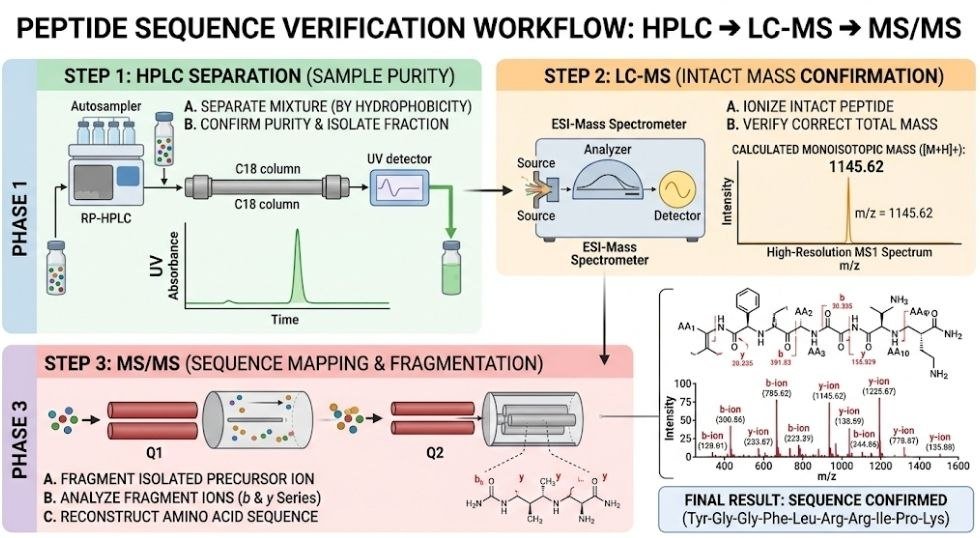
Step 1: Calculate the expected molecular mass
The theoretical molecular mass is established from the intended sequence and modifications.
Step 2: Perform chromatographic analysis
RP-HPLC provides information about chromatographic purity and potential impurities.
Step 3: Perform LC-MS or HRMS
The observed molecular species can be compared with the theoretical mass.
Step 4: Perform MS/MS when sequence information is required
Fragmentation can generate diagnostic ions that help map portions of the peptide sequence.
Step 5: Investigate stereochemistry where relevant
If racemization or epimerization is a concern, additional chiral analysis may be necessary.
Step 6: Investigate disulfide connectivity where applicable
For multi-cysteine peptides, specialized mapping can be used to evaluate connectivity.
The overall principle is orthogonal testing.
Different techniques should provide complementary information rather than repeatedly answering exactly the same question.
Why Mass Alone Cannot Prove a Peptide Sequence
A common misconception is:
“The mass matches, therefore the sequence must be correct.”
That conclusion can be too strong.
Imagine two different structures that have the same overall elemental composition.
Their molecular masses can be identical.
The mass spectrometer may correctly report the expected molecular weight.
Yet the structures can still differ.
This is especially relevant when considering:
- Isomeric residues
- Stereoisomers
- Certain structural rearrangements
- Some sequence-related possibilities
- Disulfide connectivity
This is why peptide sequence verification goes beyond MS1.
MS1 is highly useful for identity screening, but sequence confirmation may require fragmentation or other orthogonal analytical evidence.
Common Sequence Problems Found in Peptides
Researchers evaluating peptide documentation should understand the types of defects that can occur during synthesis or processing.
Deletion Sequences
A residue may fail to couple correctly during SPPS.
The chain can continue growing without that residue.
The resulting peptide is shorter than intended.
Truncation
Premature termination can create shorter peptide products.
Amino Acid Substitution
One residue can potentially be replaced by another.
If the substitution has a different mass, MS may provide an important clue.
If the residues are isomeric or otherwise analytically challenging, additional methods may be necessary.
Racemization
An L-amino acid can potentially undergo stereochemical inversion during synthesis.
The resulting D-containing peptide may have the same molecular mass as the intended molecule.
Incomplete Deprotection
A protecting group can remain attached.
The additional mass may be detected by high-resolution mass spectrometry.
Oxidation
Certain residues, particularly methionine and cysteine, can undergo oxidation.
Mass shifts can provide evidence of such modifications.
Deamidation
Asparagine and glutamine residues can undergo deamidation-related changes.
These modifications can produce characteristic mass differences that require interpretation in context.
Incorrect Disulfide Pairing
Multi-cysteine peptides can form alternative disulfide connectivity.
This can affect the molecule’s three-dimensional structure
Case Study: A 97.4% HPLC Result That Failed Identity Testing
One of the most useful ways to understand peptide sequence verification is through a practical analytical scenario.
Consider a representative custom 14-residue hydrophobic research peptide.
The intended peptide had a theoretical monoisotopic mass of approximately 1,548.88 Da.
The initial RP-HPLC result reported:
97.4% HPLC purity
The chromatogram showed a dominant, apparently clean peak.
If someone looked only at the HPLC percentage, the material could appear acceptable.
But the subsequent LC-MS/MS investigation produced a different picture.
The observed major molecular species was approximately 57 Da lower than expected.
That mass difference was consistent with a glycine deletion.
What happened?
An incomplete glycine coupling event during synthesis had produced a deletion sequence.
The synthesis subsequently continued, allowing the incomplete chain to progress through later coupling steps.
The resulting material was not simply an impurity floating beside the target peptide.
It was a structurally different peptide.
Why did HPLC appear acceptable?
The deletion product had similar chromatographic behavior under the particular RP-HPLC conditions.
The two species could therefore occupy a similar retention region.
The UV detector could not simply look at the chromatogram and determine that the molecular structure underneath the peak was incorrect.
What did mass spectrometry reveal?
LC-MS showed the unexpected mass deficit.
MS/MS then provided additional information supporting the sequence-level defect.
The analytical conclusion was therefore different from the initial HPLC impression.
The batch was rejected.
The lesson is not that HPLC is useless.
Quite the opposite.
HPLC provided useful chromatographic information.
The problem was treating HPLC purity as though it answered the identity question.
This is exactly why peptide sequence verification matters.
Case Study: When 98.6% HPLC Purity Hid a D-Amino Acid
Consider another representative scenario involving a peptide containing histidine.
The peptide showed approximately:
98.6% RP-HPLC purity
A standard mass measurement was also consistent with the expected molecular weight.
Yet the analytical investigation raised a stereochemical concern.
A portion of the material contained a D-histidine-containing diastereomer rather than the intended L-histidine form.
Why didn’t ordinary MS reveal it?
Because the D- and L-forms have the same elemental composition.
Consequently, their molecular masses are the same.
Standard MS1 cannot simply distinguish the stereochemical orientation from mass alone.
Even ordinary peptide fragmentation can have limitations in resolving stereochemistry.
How was the problem investigated?
A chiral amino acid analysis approach can be used to investigate the L/D composition of constituent amino acids.
In the representative case, the analytical result indicated approximately:
65% L-His / 35% D-His
That changed the interpretation of the apparently high-purity HPLC result.
The chromatographic peak represented material that was not necessarily a single stereochemically uniform target molecule.
The lesson is important:
A high HPLC percentage and correct molecular mass do not automatically establish stereochemical integrity.
Case Study: Protecting-Group Remnant Detected by MS/MS
A third representative failure mode involves incomplete removal of a protecting group.
Consider a peptide containing arginine synthesized using a protected arginine building block.
The intended peptide has a theoretical mass of approximately:
1,188.70 Da
The HPLC result appears acceptable at approximately:
96.5%
However, high-resolution LC-MS reveals another molecular species with a mass approximately 252 Da higher than the target.
That mass difference can be consistent with a residual Pbf protecting group.
Why does this matter?
The peptide is not chemically identical to the intended product.
MS/MS fragmentation can provide additional localization information.
If fragments containing the affected arginine residue show the corresponding mass shift while fragments before that position do not, the analytical evidence can help identify where the modification resides.
This is a powerful example of how peptide sequence verification and structural characterization can move beyond a simple HPLC percentage
Why High-Purity Peptides Can Still Be Structurally Wrong
The phrase “98% pure peptide” sounds definitive.
But purity must always be interpreted according to the analytical method used to generate it.
A reported HPLC purity percentage does not automatically mean:
“98% of the molecules have been proven to possess the exact intended sequence.”
It generally means something closer to:
“Under the specified chromatographic conditions and detection method, the integrated target-associated peak represents this percentage of the detected chromatographic signal.”
That distinction is extremely important.
Co-elution is one reason
Two chemically different species can sometimes have similar retention behavior.
If they overlap, the detector may see one combined chromatographic feature.
Detection method matters
A UV detector responds to light absorption.
It does not read amino acid order.
The analytical method matters
A short or poorly optimized gradient may not resolve compounds that a longer or different method could separate.
Baseline treatment matters
Peak integration and baseline processing can influence reported percentages.
This is why reviewing the actual chromatogram can be more informative than looking at a percentage alone.
How Researchers Should Read a Peptide COA
A Certificate of Analysis should be treated as an analytical document, not simply a marketing certificate.
When reviewing a peptide COA, researchers should look for enough information to establish:
What was tested?
Which lot was tested?
Which laboratory performed the analysis?
Which methods were used?
What were the actual results?
Can the reported data be traced back to the specific batch?
Key information to look for
1. Lot number
The analytical report should clearly correspond to the production lot being evaluated.
A generic COA is substantially less useful than a lot-specific report.
2. Theoretical molecular weight
The expected mass should be stated clearly.
3. Observed LC-MS mass
The report should show what was actually observed.
Researchers can then compare theoretical and experimental values.
4. HPLC chromatogram
Do not rely exclusively on a large “purity %” number.
Look at the actual trace.
5. MS or MS/MS data
When sequence identity is important, supporting mass spectrometric information is valuable.
6. Laboratory information
The report should identify the testing laboratory and relevant analytical details.
7. Test date
Dates help establish when the sample was actually tested.
8. Raw or sufficiently detailed analytical information
A document containing only a pass/fail statement gives the researcher limited visibility.
The 2-Minute Peptide Sequence Verification COA Check
If you have only a few minutes to review a COA, prioritize the identity evidence.
Check 1: Compare theoretical and observed mass
Find the expected molecular mass.
Then locate the experimental LC-MS result.
Ask:
Do they agree within the stated method and instrument tolerance?
Do not automatically assume every small difference is a failure. Adducts, charge states, calibration, sample preparation, and reporting conventions can affect how masses appear.
Investigate meaningful discrepancies rather than relying on an arbitrary universal tolerance.
Check 2: Look at the complete HPLC chromatogram
Do not inspect only the headline percentage.
Look for:
- Shoulder peaks
- Split peaks
- Unusual baseline behavior
- Late-eluting material
- Poorly resolved peaks
- Evidence that the chromatogram has been cropped
A full chromatogram provides more context
Check 3: Confirm lot traceability
Make sure the:
COA lot number = peptide batch lot number
If the report is generic or cannot be connected to the specific material, its usefulness for batch verification is limited.
Check 4: Determine whether the identity test is actually an identity test
Ask whether the documentation includes:
- LC-MS
- HRMS
- MS/MS
- Sequence mapping
- Other appropriate orthogonal identity analysis
A document saying “HPLC 99%” does not automatically constitute complete peptide sequence verification.
What a Strong Peptide Testing Package Should Include
There is no universal analytical package that is appropriate for every peptide.
The exact testing requirements should reflect molecular structure and intended research use.
However, a robust quality framework can include:
RP-HPLC
Useful for assessing chromatographic purity.
LC-MS or HRMS
Useful for molecular-mass confirmation and detection of unexpected mass shifts.
MS/MS
Useful for sequence-related structural evidence.
Chiral analysis
Important when stereochemical integrity needs to be independently assessed.
Peptide mapping
Useful for more detailed structural characterization.
Counterion analysis
Relevant when salts such as TFA or acetate contribute substantially to the material.
Moisture analysis
Useful for understanding the composition of lyophilized material.
Endotoxin testing
Relevant when the research application requires biological contaminant assessment.
The important principle is that peptide sequence verification should be matched to the analytical question.
Why Orthogonal Testing Matters
“Orthogonal” means using analytical approaches that provide different types of information.
Consider a peptide evaluated using:
HPLC + MS + MS/MS
Each method contributes something different.
HPLC asks about chromatographic behavior.
MS asks about molecular mass.
MS/MS provides fragmentation information that can support sequence interpretation.
Now consider:
HPLC + HPLC
Running two similar HPLC methods may provide useful information, but the techniques remain closely related.
Orthogonal methods can expose different failure modes.
This is particularly important because every analytical method has limitations.
A strong quality-control strategy does not ask:
“Which single test proves everything?”
It asks:
“Which combination of complementary tests provides convincing evidence for the questions that matter?”
That is the philosophy behind effective peptide sequence verification.
Peptide Sequence Verification for Custom Peptides
Custom peptide synthesis introduces additional reasons to pay attention to identity documentation.
A custom peptide may contain:
- Unusual amino acids
- Terminal modifications
- Fluorescent labels
- Lipid modifications
- Multiple cysteines
- Non-standard sequences
- Conjugated groups
- Special stereochemical requirements
The more structurally complex the peptide becomes, the more important it is to define exactly what “identity confirmed” means.
For a simple peptide, molecular mass plus chromatographic purity may provide useful initial evidence.
For a structurally complicated peptide, additional characterization may be necessary.
Researchers should therefore discuss the required analytical package with the supplier or testing laboratory before accepting a custom batch.
What Researchers Should Never Assume From “≥98% HPLC”
A high HPLC result is useful.
But avoid automatically translating:
≥98% HPLC
into:
≥98% correctly sequenced target peptide.
Those statements are not equivalent.
A chromatographic purity percentage can be affected by:
- Co-elution
- Detection wavelength
- Column chemistry
- Gradient conditions
- Baseline processing
- Sample preparation
- Detector response
- Unresolved structural variants
Therefore, the phrase “98% pure” needs analytical context.
The more important question is:
98% pure according to which method, and identity confirmed by which method?
That is a much better question to ask when reviewing peptide documentation.
How OasBioScience Approaches Peptide Documentation
At OasisBioScience our preferred quality framework emphasizes analytical transparency rather than relying on a single headline purity number.
Where documentation is available, our evaluation approach prioritizes several layers of information.
These include:
- Lot-specific documentation
- Theoretical molecular mass
- Observed mass information
- RP-HPLC purity data
- Full chromatographic traces where available
- Appropriate mass spectrometry
- Sequence-related analytical evidence where applicable
- Laboratory identification
- Test dates
- Traceability of analytical reports
- Relevant contaminant and composition testing
The goal is straightforward:
Researchers should have enough analytical information to understand what was tested and what the test actually demonstrates.
For additional information about OasBioScience and our research-focused peptide resources, visit:
A Practical Peptide Sequence Verification Checklist
Before accepting peptide documentation, ask:
Identity
☐ Is the exact peptide sequence clearly stated?
☐ Is the theoretical molecular mass provided?
☐ Is an experimental LC-MS or HRMS result available?
☐ Does the observed mass correspond to the expected structure?
Sequence
☐ Is there sequence-related MS/MS or equivalent analytical evidence when appropriate?
☐ Are deletion sequences considered?
☐ Are substitutions or isomeric residues a potential concern?
Modifications
☐ Are terminal modifications confirmed?
☐ Are side-chain protecting groups completely removed?
☐ Are expected chemical modifications present?
Stereochemistry
☐ Could racemization or epimerization be relevant?
☐ If relevant, has an appropriate stereochemical method been used?
Disulfides
☐ Does the peptide contain multiple cysteine residues?
☐ If so, has disulfide connectivity been investigated when necessary?
Documentation
☐ Is the COA lot-specific?
☐ Is the testing laboratory identified?
☐ Is the test date provided?
☐ Are chromatograms and analytical results sufficiently detailed?
☐ Can the documentation be independently verified where applicable?
Frequently Asked Questions About Peptide Sequence Verification
1. Why is peptide sequence verification important?
Peptide sequence verification is important because it provides evidence that the amino acid sequence of a peptide corresponds to the intended molecular structure. HPLC purity alone does not establish sequence correctness. Depending on the peptide, sequence verification can involve MS/MS, HRMS, peptide mapping, chiral analysis, or other complementary analytical methods.
2. Does 98% HPLC purity mean a peptide has the correct sequence?
No.
A 98% or 99% HPLC result indicates a high degree of chromatographic purity under the specified analytical conditions, but it does not automatically prove that the material has the exact intended sequence.
A structurally incorrect compound can sometimes co-elute with the intended peptide.
This is one of the most important reasons to distinguish HPLC purity from peptide sequence verification.
3. Can mass spectrometry confirm a peptide sequence?
Mass spectrometry can provide powerful evidence about peptide identity.
MS1 can establish whether the observed molecular mass is consistent with the expected peptide.
MS/MS can provide additional sequence-related information by analyzing peptide fragments.
However, mass spectrometry has limitations. For example, some stereochemical differences cannot be resolved by mass alone.
Therefore, the analytical method should be selected according to the specific identity question.
4. What is the difference between HPLC purity and peptide sequence verification?
HPLC purity primarily evaluates chromatographic homogeneity.
Peptide sequence verification evaluates whether the molecular structure corresponds to the intended sequence.
In simple terms:
HPLC asks: “How clean does this chromatographic profile look?”
Sequence verification asks: “Is this actually the molecule I intended to obtain?”
Both forms of information are valuable, but they should not be confused.
5. Can two peptides have the same molecular weight but different sequences?
Yes.
Different molecular structures can sometimes have identical or indistinguishable overall mass.
Leucine and isoleucine are a classic example of residues with the same elemental composition and mass.
Stereoisomers can also have the same molecular mass.
Consequently, molecular-weight confirmation alone cannot always establish complete sequence identity.
6. What test is best for peptide sequence verification?
There is no single universal “best” test for every peptide.
LC-MS or HRMS can provide molecular-mass evidence, while MS/MS can provide sequence-related fragmentation information.
Additional methods may be necessary for stereochemistry, disulfide connectivity, unusual modifications, or other specialized structural questions.
The appropriate strategy depends on the peptide.
7. What should I look for on a peptide COA?
At minimum, look for the peptide sequence, lot number, theoretical molecular mass, experimental mass, HPLC chromatogram, test date, laboratory information, and appropriate identity data.
For more complex peptides, investigate whether additional sequence, stereochemical, modification, disulfide, or composition testing is necessary.
8. Can peptide synthesis create incorrect sequences even when HPLC looks good?
Yes.
Solid-phase peptide synthesis involves repeated coupling and deprotection steps.
Incomplete coupling can generate deletion sequences or truncated products.
Some structurally different species may have similar chromatographic behavior and therefore require mass spectrometric or other orthogonal analysis for detection.
9. Why should researchers look at the actual HPLC chromatogram instead of only the purity percentage?
The chromatogram provides information that a single percentage does not.
Researchers can examine peak shape, shoulders, additional peaks, baseline behavior, and chromatographic separation.
A headline number without the underlying trace provides limited context.
10. Is peptide sequence verification necessary for every research peptide?
The appropriate level of testing depends on the peptide, its complexity, the research objective, and the consequences of an incorrect identity.
For simple materials, a basic analytical package may provide useful evidence.
For custom, modified, multi-cysteine, stereochemically sensitive, or otherwise complex peptides, more extensive characterization may be appropriate.
The key principle is to match the analytical evidence to the identity question.
Final Takeaway: High Purity Is Not the Same as Correct Identity
Peptide sequence verification matters because purity and identity are two different analytical questions.
RP-HPLC can provide valuable information about chromatographic purity.
Mass spectrometry can provide valuable evidence about molecular mass.
MS/MS can provide additional sequence-related information.
Chiral analysis can investigate stereochemical integrity.
Specialized mapping can investigate disulfide connectivity.
Together, these complementary approaches can provide a much more informative picture of peptide quality than a single purity percentage.
The most important lesson for researchers is simple:
Never interpret a high HPLC purity percentage as automatic proof of the exact peptide sequence.
A peptide can look clean chromatographically and still require additional identity testing.
When evaluating a peptide supplier, do not ask only:
“Is it 98% or 99% pure?”
Ask:
“How was the peptide’s identity verified, and what does the analytical data actually prove?”
That question moves peptide quality assessment from a simple percentage toward a more complete understanding of molecular identity.
For research-focused peptide information, analytical education, and peptide documentation resources, you can learn more through:
Research Use Only. Not for human or veterinary use.
Continue Learning: If you found this guide helpful, you may also want to read our previous peptide education articles covering the following topics
• Does adding more diluent make peptides weaker?
• Peptide vendor documents explained
• Explore 9 evidence-based facts about BPC-157
• How long should a weight loss cycle last?
• Can GLP-1 muscle loss be prevented?
• Discover the best peptide for obesity research.
• Which peptide suppresses appetite the most?
• Discover 9 powerful fixes for peptide foaming
• Learn how to read peptide Certificates of Analysis step by step.
• How Should Peptides Be Stored?
• Learn the correct peptide reconstitution process 2026
- Does adding more diluent make peptides weaker?
- Learn 7 powerful reasons why, how HPLC methods affect results
- Peptides warmed in transit are not automatically ruined
- How long can peptides stay unrefrigerated during shipping?
- Learn the complete peptide synthesis and manufacturing process
- HPLC vs Mass Spectrometry explained
- Can I use sterile water instead of bacteriostatic water?
- A 99% HPLC result can look impressive—but what does it really tell you?
- Why won’t my peptide dissolve?
- Should you swirl or shake peptides after mixing?
- Our latest guide explains the best practices for storing lyophilized research peptide
- What questions you should ask a peptide supplier before ordering
- Can HPLC really detect every peptide impurity?
- Learn how Peptide Freeze-Thaw Cycles can affect peptide purity
- Can sunlight damage peptide powders?
- What does peptide identity testing confirm?
- What happens if you shake peptides?
- Can peptides lose potency without changing appearance?
Scientific Reference: For additional peer-reviewed information on peptide stability, sterile preparation, and pharmaceutical reconstitution practices, visit
