
Questions to Ask a Peptide Supplier: 15 Powerful Ways to Verify Quality Before You Order

Introduction: Why the Questions to Ask a Peptide Supplier Matter
The questions to ask a peptide supplier should go far beyond, “What is the purity?”
That question is important, but by itself it is not enough.
A supplier can advertise “99% purity,” display a professional website, publish attractive product photographs, and provide a downloadable Certificate of Analysis (COA). None of those things, individually, proves that the specific material you are considering ordering has the identity, quantity, analytical quality, and traceability you expect.
For researchers, laboratories, and other qualified buyers, choosing a peptide supplier should be treated as a quality-verification exercise, not simply a price comparison.
The most useful questions to ask a peptide supplier are designed to establish several things:
- Is the material actually the compound claimed?
- Does the COA correspond to the exact batch being supplied?
- Was the material independently tested?
- Can the laboratory report be independently verified?
- Does the HPLC report show complete analytical information?
- Was mass spectrometry performed?
- Does the labeled quantity represent actual peptide content or gross lyophilized material?
- Can the supplier demonstrate batch traceability?
- How was the material stored and transported?
- What happens if a batch fails independent verification?
These questions become particularly important because chromatographic purity, molecular identity, net peptide content, structural integrity, sterility, endotoxin status, and physical handling are different quality attributes.
At OasBioScience, our approach is built around a simple principle: quality should be supported by verifiable analytical evidence rather than unsupported marketing claims.
This article explains the most important questions to ask a peptide supplier before placing an order and, more importantly, what the answers can tell you.
Table of Contents
Why the Questions to Ask a Peptide Supplier Go Beyond Price
https://pubmed.ncbi.nlm.nih.gov/
Price is one of the first things many buyers compare.
It should not be the first thing they trust.
Two vials carrying the same nominal label can represent very different analytical situations. One supplier may provide batch-specific independent testing, complete HPLC data, MS confirmation, traceability, and documentation. Another may provide nothing more than a generic PDF saying “99.9% purity.”
The difference is not necessarily visible from the product photograph.
That is why the questions to ask a peptide supplier should investigate the evidence behind the product.
A professional buyer should be able to ask:
“Show me how you know this material meets the specification.”
That question changes the entire conversation.
Instead of relying on advertising language, you are asking the supplier to demonstrate:
Identity → Purity → Quantity → Contaminants → Traceability → Handling → Documentation
This is the foundation of meaningful supplier evaluation.
Questions to Ask a Peptide Supplier About the COA
One of the first questions to ask a peptide supplier is:
“Can you provide a COA for the exact lot I am ordering?”
This distinction is extremely important.
A lot-specific COA should correspond to a particular manufacturing or production batch.
The lot number on the documentation should be traceable to the lot number on the material being supplied.
A generic COA from a product page does not provide the same level of confidence.
What should you compare?
Check whether these details correspond:
- Product name
- Batch or lot number
- Manufacturing date
- Testing date
- Report number
- Tested specification
- HPLC result
- Mass spectrometry result
- Laboratory identity
- Supplier documentation
If the vial says Lot ABC123 while the COA refers to Lot XYZ456, stop and ask questions.
The documentation may be genuine, but it does not establish that the documentation belongs to the material in front of you.
Why static COAs deserve additional scrutiny
A single “representative COA” displayed across every batch can create a false impression of batch-level testing.
Peptide synthesis is not perfectly identical from one production run to another.
Sequence length, amino-acid composition, hydrophobicity, aggregation tendencies, coupling efficiency, purification requirements, and other factors can influence analytical outcomes.
Therefore, one historical COA should not automatically be treated as evidence for every future batch.
Questions to Ask a Peptide Supplier About COA Verification
Another essential question to ask a peptide supplier is:
“Can the laboratory report be independently verified?”
A PDF is a document.
A verifiable laboratory record provides stronger evidence.
Look for:
- A report number
- Verification URL
- QR code
- Laboratory-hosted verification system
- Report authentication mechanism
- Matching lot information
- Matching compound information
Ideally, verification should lead to the testing laboratory’s own domain or authenticated reporting system.
This is important because a PDF can potentially be copied, altered, renamed, or reused.
A supplier should not be offended when a technically knowledgeable buyer wants to verify documentation.
In fact, transparency should make verification easier.
Questions to ask a peptide supplier about verification
Ask:
“Does the testing laboratory provide a public verification system?”
Then ask:
“Can you provide the original laboratory report or direct verification information?”
Finally:
“Does the report correspond to the exact lot being supplied?”
Those three questions can reveal considerably more than a large “99.9%” number printed on a PDF.
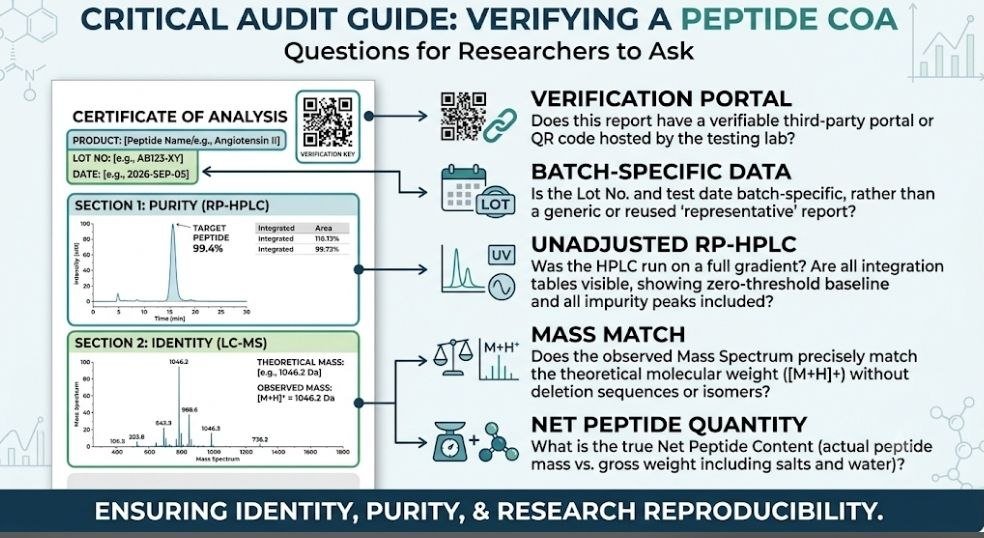
Questions to Ask a Peptide Supplier About HPLC Testing
HPLC is one of the most important analytical techniques you will encounter when evaluating peptide documentation.
One of the key questions to ask a peptide supplier is:
“Was the material tested by RP-HPLC, and can I see the complete chromatogram?”
Reverse-phase HPLC can provide valuable information about chromatographic purity and peptide-related impurities.
But buyers should understand what HPLC does—and does not—tell them.
A typical HPLC purity result is an area percentage calculated from detected chromatographic peaks.
It does not automatically mean:
- 99% of the vial’s total mass is peptide.
- The peptide has the correct sequence.
- The material is free of inorganic salts.
- The material is free of endotoxin.
- The peptide has the correct disulfide connectivity.
- The labeled quantity is the actual peptide mass.
That distinction is fundamental.
What should you inspect?
A useful chromatogram should provide sufficient information to understand the analysis, including:
- Retention time
- Peak areas
- Baseline
- Chromatographic axes
- Integration information
- Detection conditions where applicable
Cropped chromatograms deserve additional scrutiny because the missing portions may contain information relevant to interpretation.
Likewise, an integration table should be reviewed rather than simply accepting the headline purity number.
Questions to Ask a Peptide Supplier About Mass Spectrometry
One of the most important questions to ask a peptide supplier is:
“Was mass spectrometry performed on the same lot?”
HPLC and mass spectrometry answer different questions.
HPLC primarily helps evaluate chromatographic purity.
Mass spectrometry provides information about molecular mass, which can help assess whether the dominant material is consistent with the expected molecular species.
For example, an MS report can show an observed mass compared with a theoretical mass.
Depending on the instrument and ionization method, you may encounter:
- [M+H]+
- [M+2H]2+
- [M+3H]3+
- Sodium adducts
- Other ion forms
Therefore, the interpretation needs to account for the expected ionization state.
Why this matters
A chromatogram can look exceptionally clean while the dominant material has an unexpected molecular mass.
That is one reason the questions to ask a peptide supplier should never stop at HPLC purity.
Important scientific qualification
Mass spectrometry is powerful, but it should not automatically be described as proving every aspect of peptide structure.
For example, molecular mass alone may not establish:
- Complete sequence coverage
- Correct stereochemistry
- Exact disulfide connectivity
- Higher-order structural state
Those questions may require additional analytical techniques.
The best supplier documentation therefore uses complementary methods rather than relying on one number.
What Does “99% Purity” Actually Mean?
“99% purity” is probably one of the most misunderstood phrases in peptide purchasing.
If a supplier reports 99% purity by HPLC, the figure generally refers to the proportion of detected chromatographic signal assigned to the relevant peak under that particular analytical method.
It is not automatically equivalent to 99% peptide by total mass.
This distinction is critical.
Purity versus quantity
Imagine a hypothetical lyophilized sample containing:
- Peptide
- TFA or another counter-ion
- Water
- Residual salts
- Other formulation components
HPLC may report a very high chromatographic purity for the peptide-related peak.
That does not mean every milligram of the dry cake is peptide.
This is why one of the most valuable questions to ask a peptide supplier is:
“Is the reported purity an HPLC area percentage, and has actual peptide content been independently quantified?”
That question separates chromatographic purity from mass fraction.
Why a high purity number can still be misleading
Several issues can complicate interpretation:
Co-elution: Two compounds may elute at similar retention times and appear as one chromatographic peak.
Non-UV-absorbing material: Some substances contribute mass without contributing proportionally to the UV chromatographic signal.
Counter-ions: Peptide salts can contribute to gross material weight.
Water: Lyophilized material can contain residual moisture.
Identity: HPLC purity does not independently establish molecular identity.
This is why experienced researchers look at the entire analytical package rather than one percentage.
Questions to Ask a Peptide Supplier About Net Peptide Content
Another valuable question to ask a peptide supplier is:
“How was the actual peptide content determined?”
This is different from asking:
“How much does the vial weigh?”
The gross weight of a lyophilized cake does not necessarily equal the mass of the peptide itself.
Depending on the formulation and salt form, material can contain counter-ions and residual moisture, among other components.
Potential quantitative approaches can include appropriate elemental or nitrogen-based analysis, quantitative NMR, amino-acid analysis, or other validated methods depending on the material and laboratory.
The important point is to determine what the supplier’s stated quantity actually represents.
Ask this simple question
“Does the labeled milligram quantity represent nominal dry material weight or measured peptide content?”
This is one of the most useful questions to ask a peptide supplier because it prevents buyers from assuming that gross weight and active peptide mass are interchangeable.
Questions to Ask a Peptide Supplier About Counter-Ions and Excipients
Another important question to ask a peptide supplier is:
“What salt form or counter-ion is present?”
Depending on the manufacturing and purification process, peptides may be supplied in different forms.
Examples can include:
- TFA salts
- Acetate salts
- HCl salts
Some formulations may also contain excipients or bulking agents.
The purpose of asking is not to automatically label one form as “good” and another as “bad.”
The purpose is to understand what you are actually receiving.
For research applications, formulation composition can influence:
- Reconstitution behavior
- Concentration calculations
- pH
- Solubility
- Experimental reproducibility
The supplier should be able to explain the declared material form and provide appropriate documentation where available.
Questions to Ask a Peptide Supplier About the Finished Batch
One of the most revealing questions to ask a peptide supplier is:
“Was the sample tested after final filling and packaging, or was the test performed on bulk material?”
This matters because the point at which a sample is collected can influence what the test actually represents.
A rigorous QC system should have a clear relationship between:
Production batch → sampled material → laboratory test → approved lot → packaged vial
Random or representative sampling can help establish that the tested material corresponds to the production lot.
Why finished-vial traceability matters
Imagine testing a bulk powder and obtaining excellent analytical results.
The powder is subsequently:
- Transferred
- Filled
- Lyophilized or packaged
- Stoppered
- Crimped
- Labeled
- Stored
- Shipped
A quality system should maintain traceability throughout those stages.
This is why one of the best questions to ask a peptide supplier is:
“How do you connect the laboratory-tested sample to the finished lot that I receive?”
Questions to Ask a Peptide Supplier About Batch Traceability
Ask:
“Can you trace this vial back to its production lot and analytical documentation?”
A robust traceability system should connect relevant records across the supply chain.
At OasBioScience, our quality philosophy emphasizes this relationship:
Raw synthesis information → internal lot record → analytical report → packaged vial
The objective is straightforward: a buyer should not have to guess which analytical report belongs to which product.
What should you look for?
Check whether:
- The vial has a lot number.
- The outer packaging identifies the lot.
- The COA identifies the same lot.
- Analytical reports have unique report identifiers.
- Documentation can be retrieved later.
- Retention samples or archival procedures exist where appropriate.
Traceability becomes particularly important when investigating a discrepancy after delivery.
Questions to Ask a Peptide Supplier About Storage and Shipping
Quality does not end when a laboratory finishes its analytical test.
Another important question to ask a peptide supplier is:
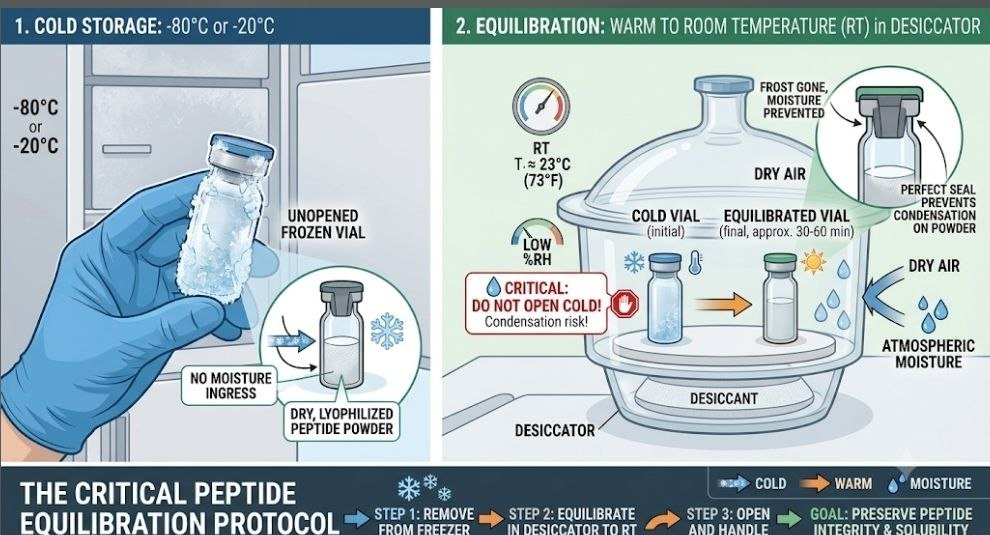
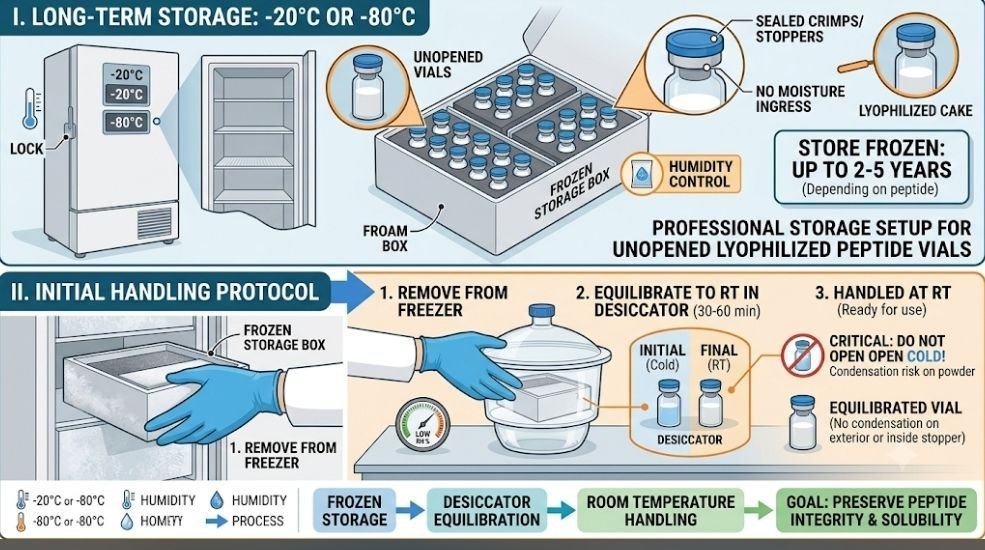
“How was this material stored before shipment, and how was it protected during transit?”
Peptides can be sensitive to environmental conditions depending on their sequence and formulation.
Potential concerns include:
- Temperature fluctuations
- Moisture exposure
- Repeated freeze-thaw events
- Light exposure
- Improper sealing
- Extended exposure to unsuitable conditions
Packaging questions to ask
Ask:
- How was the material stored before dispatch?
- Was the vial adequately sealed?
- Was moisture protection used?
- Was temperature-controlled packaging appropriate for the material?
- Was desiccant protection used where appropriate?
- How is lot identification maintained during shipping?
The objective is not to demand that every peptide be handled identically.
Different molecules have different stability characteristics.
The objective is to determine whether the supplier has a defined and documented handling strategy.
Questions to Ask a Peptide Supplier About Contaminant Testing
Another important group of questions to ask a peptide supplier concerns contaminants.
Ask:
“What additional testing is available for this material?”
Depending on the intended research application and specification, relevant analytical categories may include:
| Test | What It Helps Evaluate |
|---|---|
| RP-HPLC | Chromatographic purity and related impurities |
| LC-MS / ESI-MS | Molecular mass and identity assessment |
| Endotoxin testing | Lipopolysaccharide contamination |
| Sterility testing | Microbial contamination under the applicable test method |
| ICP-MS | Selected elemental/heavy-metal contaminants |
| Quantitative analysis | Peptide mass/content depending on method |
| Moisture analysis | Residual water |
| Structural analysis | Specific structural attributes where applicable |
Not every test is required for every research application.
The correct testing package depends on the material, specification, and intended use.
The important point is that a professional supplier should be able to explain what has been tested and what has not.
Questions to Ask a Peptide Supplier About Raw Analytical Data
Ask:
“Can I review the complete analytical report rather than only the headline result?”
This is an excellent question.
A high-quality analytical package should allow an informed researcher to inspect the underlying evidence.
Look for:
- Complete chromatogram
- Axes
- Retention times
- Integration table
- MS spectrum
- Observed mass
- Expected mass
- Laboratory identification
- Report number
- Lot information
- Testing date
Beware of overly polished documentation
Professional graphic design does not equal analytical validity.
A COA can look impressive while still being incomplete.
For example, a cropped chromatogram may hide portions of the run.
An integration table with unusual exclusion thresholds may deserve investigation.
A report without a verifiable laboratory identifier provides less independent confidence than one that can be authenticated directly.
The best questions to ask a peptide supplier therefore focus on data transparency.
Questions to Ask a Peptide Supplier About Failed Batches
This question is rarely asked, but it can reveal a great deal:
“What happens if a batch fails your specifications?”
A mature quality system needs a failure process.
Ask whether failed material is:
- Quarantined
- Investigated
- Re-tested where scientifically justified
- Rejected
- Reworked under documented controls
- Prevented from entering released inventory
A supplier who claims that every batch is perfect may actually provide less confidence than one who can explain how deviations are identified and handled.
Quality control is not the claim that nothing ever goes wrong.
Quality control is having a system capable of detecting, documenting, investigating, and controlling problems.
Questions to Ask a Peptide Supplier About Their QC Process
Ask:
“Can you explain your quality-control workflow from receiving material to final release?”
This question allows you to evaluate whether the supplier has a real system or simply a collection of marketing statements.
A rigorous workflow may involve:
Step 1: Quarantine
Incoming material is held separately until the required inspection and analytical review are completed.
Step 2: Physical Inspection
Vials are inspected for:
- Broken glass
- Damaged closures
- Label discrepancies
- Packaging damage
- Cake abnormalities
Step 3: Lot Documentation
Relevant lot identifiers and documentation are recorded.
Step 4: Representative Sampling
Appropriate samples are selected from the production lot according to the supplier’s sampling procedure.
Step 5: Independent Laboratory Testing
Where required, samples are submitted for appropriate analytical testing.
Step 6: Data Review
Analytical results are reviewed rather than simply accepting the laboratory’s headline percentage.
Step 7: Release or Rejection
Material meeting defined specifications can be released; material failing required criteria should remain controlled.
Step 8: Documentation and Retention
Records and appropriate retention samples can support later investigation or re-testing.
This type of system is far more meaningful than simply saying:
“Our peptides are 99.9% pure.”
Questions to Ask a Peptide Supplier About Business Transparency
The final category is not strictly analytical.
It is practical.
Ask:
“Can you provide a proper invoice, company information, product documentation, and clear purchasing terms?”
A buyer should understand:
- Who they are purchasing from
- What documentation accompanies the order
- What product specifications apply
- How orders are documented
- How discrepancies are handled
- What the applicable terms are
Be cautious about suppliers that pressure buyers into immediate payment while refusing reasonable documentation requests.
Do not allow an attractive price to override basic due diligence.
Real-World QC Case Study: When 99.2% Purity Wasn’t Enough
One of the most valuable lessons from peptide QC is that purity and identity are not interchangeable.
During a quality-control audit involving a custom synthesis batch, an intermediate-length peptide containing multiple disulfide bonds arrived with a manufacturer COA reporting approximately 99.2% purity by RP-HPLC.
On paper, the result looked excellent.
The chromatogram appeared clean.
But representative material from the production lot was submitted for independent dual-method testing.
The results told a different story.
Manufacturer report
RP-HPLC: 99.2%
Independent audit
RP-HPLC: approximately 98.6% under the laboratory’s analytical conditions
The HPLC result still appeared high.
The critical discovery came from mass spectrometry.
The observed molecular mass did not correspond to the expected target.
The dominant MS signal was approximately 128 Da below the expected molecular mass, consistent with a sequence-level discrepancy involving the loss of a glutamine residue.
In other words, the material could appear highly pure chromatographically while still failing the identity requirement.
The lesson
This is exactly why one of the most important questions to ask a peptide supplier is:
“Was mass spectrometry performed on the same lot, and does the observed mass correspond to the expected molecular species?”
HPLC answers one part of the question.
MS answers another.
Neither technique should automatically be treated as proof of every structural characteristic, but using complementary analytical methods provides substantially more information than relying on a single purity percentage.
The deeper lesson for researchers
A material can be:
Very clean + analytically consistent by one method + still not be the intended molecule.
That is a critical distinction.
Case Study: How a Questionable COA Exposed a Problem
A researcher was considering a bulk order from a competitor offering a long-chain peptide analog at a price substantially below typical production costs.
The website looked professional.
The supplier had positive-looking reviews.
A downloadable COA reported approximately 99.4% purity.
But a closer document audit revealed inconsistencies.
Finding 1: Date discrepancy
The COA stated a recent testing date, while analytical metadata associated with the chromatographic run indicated an older analysis date.
Finding 2: Integration concerns
The chromatogram and integration information raised questions about how certain peaks were treated.
Finding 3: Verification problem
The laboratory verification information could not be independently authenticated through the purported verification mechanism.
Finding 4: Pricing anomaly
The unusually low price added another reason to investigate rather than immediately place a large order.
The lesson was not that low prices automatically mean poor quality.
The lesson was that multiple inconsistencies should trigger additional verification.
What should a buyer do?
Rather than immediately placing a large order, a researcher can ask for:
- A current lot-specific COA
- Original laboratory verification
- Complete analytical data
- Lot-matched documentation
- Additional independent testing where appropriate
This is exactly what good due diligence looks like.
Major Peptide Supplier Red Flags
The questions to ask a peptide supplier become especially useful when the answers reveal inconsistencies.
Here are some warning signs worth investigating.
Red Flag 1: One COA for Everything
If every product or every batch appears to use the same COA, ask why.
Red Flag 2: Unverifiable Laboratory Reports
If a report claims third-party testing but cannot be authenticated through the purported laboratory, investigate further.
Red Flag 3: Cropped Chromatograms
Missing axes, missing early portions, missing late portions, or incomplete integration information deserve scrutiny.
Red Flag 4: Unrealistically Uniform Purity
Seeing exactly 99.9% or 100.0% for every peptide regardless of sequence complexity should prompt questions.
Real analytical data generally contains some variation.
Red Flag 5: No Mass Spectrometry
For materials where molecular identity is important, ask why MS confirmation is absent.
Red Flag 6: No Lot Number
If you cannot connect the vial to a specific batch, traceability becomes difficult.
Red Flag 7: No Explanation of Quantity
If the supplier says “10 mg” but cannot explain whether this refers to gross dry material or measured peptide content, ask for clarification.
Red Flag 8: Pressure to Pay Immediately
High-pressure sales tactics should never replace technical due diligence.
Red Flag 9: Technical Questions Are Avoided
A knowledgeable supplier should be able to explain what its documentation means.
Red Flag 10: Price Is Dramatically Inconsistent With the Product
Price alone does not prove quality.
However, a major price anomaly combined with poor documentation deserves investigation.
A Practical Pre-Purchase Audit for Researchers
If you are preparing to spend several hundred or several thousand dollars with an unfamiliar peptide supplier, do not treat the transaction as an ordinary online purchase.
Treat it as a small supplier audit.
Before ordering
Ask for:
1. Exact lot number
Can the supplier identify the lot you will receive?
2. Lot-specific COA
Does the COA correspond to that lot?
3. Independent verification
Can the laboratory report be authenticated?
4. HPLC
Can you see the complete chromatogram and integration information?
5. Mass spectrometry
Does the observed molecular mass correspond to the expected material?
6. Quantity
Does the stated quantity represent nominal dry weight or measured peptide content?
7. Salt/counter-ion information
What form is the material supplied in?
8. Additional testing
Are endotoxin, sterility, elemental contaminants, moisture, or other tests available when appropriate?
9. Traceability
Can the vial be traced to its analytical record?
10. Storage
How was the material stored before shipment?
11. Shipping
How was the material protected during transit?
12. Failure handling
What happens when a lot does not meet specification?
These questions give you a far more useful picture than simply asking:
“Are your peptides 99% pure?”
Safe to Investigate, Proceed With Caution, or Walk Away?
Use this framework when evaluating a new peptide supplier.
| Status | Indicators | Recommended Approach |
|---|---|---|
| Strong evidence / investigate further | Lot-specific COA, independently verifiable report, complete HPLC, MS data, matching lot numbers, clear documentation | Continue due diligence and evaluate the material against your research requirements |
| Proceed with caution | Valid documentation but old testing, incomplete quantity information, delayed technical answers, limited raw data | Request clarification and additional documentation before committing to a substantial order |
| Walk away | Unverifiable COA, mismatched lot numbers, fabricated-looking documentation, unexplained analytical inconsistencies, refusal to answer reasonable technical questions | Do not proceed until the fundamental documentation problems are resolved |
The key point is that this is a decision framework, not a mathematical certification system.
One isolated issue does not automatically prove that a supplier is fraudulent.
Likewise, a beautiful website does not prove quality.
Look at the entire evidence package.
Why OasBioScience Emphasizes Analytical Transparency
At OasBioScience, our quality philosophy begins with a simple principle:
Quality should be established through verifiable data, not unsupported sales claims.
That philosophy influences how we approach documentation, traceability, testing, packaging, and researcher education.
Batch-specific documentation
Each production lot should be associated with its corresponding analytical documentation and physical lot identification.
Complementary analytical methods
Our QC philosophy emphasizes the value of combining methods such as RP-HPLC and LC-MS/ESI-MS rather than relying exclusively on a single purity percentage.
Uncropped analytical information
Researchers need to be able to see the analytical evidence behind a reported result.
Independent laboratory validation
Where third-party testing is used, laboratory documentation should be independently verifiable where the laboratory provides such verification.
Traceability
Lot information should connect the material, analytical documentation, and inventory records.
Retention and auditability
Appropriate retention samples and records can support later investigation when questions arise.
Researcher education
We also believe suppliers have a responsibility to educate researchers.
That includes explaining the difference between:
HPLC purity ≠ net peptide content
and:
molecular-mass confirmation ≠ complete structural characterization
This distinction is important because better-informed researchers can make better purchasing and experimental decisions.
You can learn more about OasBioScience and its research-focused resources at OasBioScience.
Frequently Asked Questions About Questions to Ask a Peptide Supplier
What are the most important questions to ask a peptide supplier?
The most important questions to ask a peptide supplier concern lot-specific documentation, independent COA verification, HPLC testing, mass spectrometry, peptide content, batch traceability, storage, and additional contaminant testing.
Do not rely on a single purity percentage.
Ask for evidence that connects the analytical result to the exact material being supplied.
Should I always ask for a COA before ordering peptides?
For research materials where analytical documentation is important, requesting the applicable COA or specification documentation before ordering is a sensible part of supplier due diligence.
More importantly, determine whether the COA is lot-specific, complete, and verifiable.
A COA is only useful if you can establish what material it represents.
Is 99% peptide purity good?
A 99% HPLC purity result can be a strong chromatographic result, but its meaning depends on the analytical method and reporting conditions.
HPLC area percentage should not automatically be interpreted as 99% total mass being peptide.
It also does not independently establish every aspect of molecular identity or structural integrity.
Always ask what analytical method produced the percentage.
Why should I ask a peptide supplier for Mass Spectrometry results?
Mass spectrometry can provide molecular-mass evidence that complements HPLC.
This is important because HPLC primarily evaluates chromatographic behavior, while MS can help determine whether the observed molecular species is consistent with the expected molecular mass.
For important research applications, complementary analytical methods provide a more complete quality picture.
What should I look for in a peptide COA?
Look for:
- Exact lot number
- Product identification
- Testing laboratory
- Testing date
- HPLC chromatogram
- Integration information
- MS data where applicable
- Expected versus observed mass
- Report identifier
- Verification mechanism where available
- Relevant additional testing
Avoid judging a COA solely by its design or headline purity percentage.
What is the difference between peptide purity and peptide content?
Peptide purity commonly describes the relative proportion of chromatographic signal attributed to the target peak under a specified HPLC method.
Peptide content concerns how much of the total material is actually peptide.
Those are different measurements.
Counter-ions, moisture, salts, and excipients can affect the relationship between gross dry weight and actual peptide mass.
Should a peptide supplier provide a lot number?
Lot-level identification is extremely valuable for traceability.
A buyer should be able to connect the material to its corresponding production and analytical records.
A missing or inconsistent lot number makes that process more difficult.
What does an independent COA verification system accomplish?
When a testing laboratory provides an authenticated report-verification system, it can help establish that the report corresponds to the laboratory’s own records.
This is stronger than simply receiving a PDF that cannot be independently authenticated.
Should I choose the cheapest peptide supplier?
Not necessarily.
Price is only one purchasing variable.
A substantially lower price can be legitimate for many reasons, but when a major price difference is accompanied by poor documentation, missing testing, inconsistent lot information, or unverifiable COAs, additional due diligence is warranted.
Compare evidence, not just price.
What is the single biggest mistake researchers make when choosing a peptide supplier?
One of the biggest mistakes is treating “99% purity” as a complete quality specification.
It isn’t.
A serious evaluation should consider identity, chromatographic purity, quantity/content, contaminants, traceability, documentation, and handling.
24. Final Checklist: Questions to Ask a Peptide Supplier Before Ordering
Before placing an order with an unfamiliar supplier, save this checklist.
Questions to ask a peptide supplier
1. Can you provide the COA for the exact lot I will receive?
2. Does the lot number on the COA match the physical vial?
3. Can the laboratory report be independently verified?
4. Was RP-HPLC performed on the same lot?
5. Can I see the complete, uncropped chromatogram?
6. Can I review the complete integration information?
7. Was Mass Spectrometry performed on the same lot?
8. Does the observed molecular mass correspond to the expected molecular species?
9. Does the stated milligram quantity represent nominal dry weight or measured peptide content?
10. What salt or counter-ion form is supplied?
11. What additional contaminant testing is available?
12. Was the tested material representative of the finished batch?
13. How is the lot connected to the final packaged vial?
14. How was the material stored before shipment?
15. How was it protected during transportation?
16. What happens if a batch fails its specifications?
17. How long are relevant analytical records retained?
18. Can you explain your QC and batch-release process?
If a supplier can answer these questions clearly and provide supporting documentation, you have a much stronger basis for evaluating the material.
If the supplier becomes evasive when you ask reasonable technical questions, that is information too.
Final Thoughts
The best questions to ask a peptide supplier are not designed to make purchasing complicated.
They are designed to make purchasing informed.
A professional peptide buyer should never have to choose between blindly trusting a supplier and becoming a laboratory analytical expert overnight.
The supplier’s responsibility is to provide transparent documentation.
The researcher’s responsibility is to examine that documentation critically.
Start with the fundamentals:
Identity.
Purity.
Quantity.
Contaminants.
Traceability.
Storage.
Verification.
Then look at the entire evidence package rather than becoming anchored to one attractive number.
A “99.9%” claim may look impressive.
A lot-specific, independently verifiable analytical record is more meaningful.
A professional supplier should not simply tell you that a peptide is high quality.
The supplier should be able to show you why the available evidence supports that conclusion.
That is the standard researchers should look for when deciding who deserves their business.
For additional research-focused peptide information, analytical education, and supplier resources, visit OasBioScience.
Continue Learning: If you found this guide helpful, you may also want to read our previous peptide education articles covering the following topics
• Does adding more diluent make peptides weaker?
• Peptide vendor documents explained
• Explore 9 evidence-based facts about BPC-157
• How long should a weight loss cycle last?
• Can GLP-1 muscle loss be prevented?
• Discover the best peptide for obesity research.
• Which peptide suppresses appetite the most?
• Discover 9 powerful fixes for peptide foaming
• Learn how to read peptide Certificates of Analysis step by step.
• How Should Peptides Be Stored?
• Learn the correct peptide reconstitution process 2026
- Does adding more diluent make peptides weaker?
- Learn 7 powerful reasons why, how HPLC methods affect results
- Peptides warmed in transit are not automatically ruined
- How long can peptides stay unrefrigerated during shipping?
- Learn the complete peptide synthesis and manufacturing process
- HPLC vs Mass Spectrometry explained
- Can I use sterile water instead of bacteriostatic water?
- A 99% HPLC result can look impressive—but what does it really tell you?
- Why won’t my peptide dissolve?
- Should you swirl or shake peptides after mixing?
- Our latest guide explains the best practices for storing lyophilized research peptide
Scientific Reference: For additional peer-reviewed information on peptide stability, sterile preparation, and pharmaceutical reconstitution practices, visit
