
Why Won’t My Peptide Dissolve? 9 Powerful Reasons, Proven Fixes & QC Troubleshooting Guide

Why Won’t My Peptide Dissolve?
Why won’t my peptide dissolve? This is one of the most common questions researchers encounter when working with lyophilized peptides.
A vial can contain what appears to be a perfectly normal white or off-white lyophilized cake, yet after adding solvent, the material may remain cloudy, float on the surface, form particles, settle at the bottom, or develop strange gel-like structures.
The immediate assumption is often:
“The peptide must be defective.”
Not necessarily.
In many cases, the answer to why won’t my peptide dissolve has nothing to do with a defective peptide. The problem may be caused by the peptide’s sequence, hydrophobicity, pH environment, concentration, solvent selection, temperature, aggregation behavior, or reconstitution technique.
However, there are also situations where incomplete dissolution can be a legitimate quality-control warning.
The challenge is knowing the difference.
After working with peptides and peptide-related research materials since 2003, my approach has always been to treat poor dissolution as a diagnostic signal rather than an immediate verdict on product quality.
If a peptide refuses to dissolve, don’t immediately throw it away.
First determine why.
This guide explains the chemistry behind incomplete dissolution, the most common causes, practical troubleshooting principles, and how analytical testing such as HPLC and mass spectrometry can help distinguish an inherent solubility problem from a potential QC problem.
Important: This article is intended for laboratory and research education. Solvent compatibility, pH, concentration, temperature, and handling requirements are sequence-specific. Materials intended for biological applications should be handled according to validated laboratory protocols and the applicable safety requirements.
Table of Contents
Table of Contents
Why Won’t My Peptide Dissolve? Start With the Chemistry
https://pubmed.ncbi.nlm.nih.gov/
Before asking why won’t my peptide dissolve, it helps to understand what dissolution actually means.
Dissolution is not simply the physical disappearance of a powder.
A peptide must interact favorably with the surrounding solvent. The solvent has to penetrate the lyophilized material, separate peptide molecules from one another, and stabilize those molecules in solution.
That process is influenced by:
- Amino-acid sequence
- Hydrophobicity
- Net electrical charge
- Isoelectric point
- Peptide concentration
- Solvent composition
- pH
- Ionic strength
- Temperature
- Aggregation tendency
- Lyophilization characteristics
- Counter-ions
- Chemical purity
- Molecular modifications
This is why two peptides that look almost identical as dry powders can behave completely differently when a solvent is introduced.
One may dissolve rapidly.
Another may become cloudy.
A third may form floating particles.
A fourth may form a gel.
So when someone asks why won’t my peptide dissolve, the correct answer is rarely just “add more water.”
The chemistry must be diagnosed first.
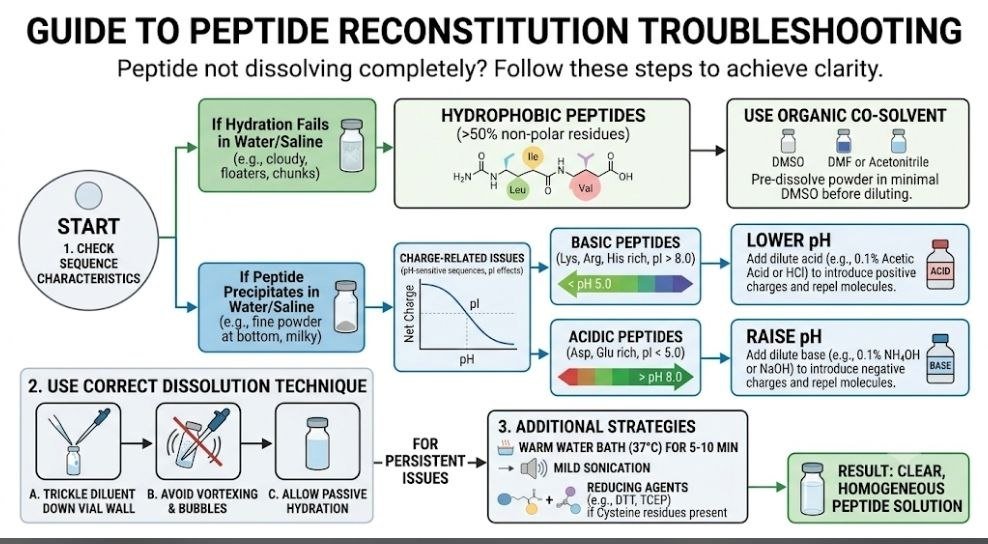
The 9 Most Common Reasons a Peptide Won’t Dissolve
The following are the most important causes I encounter when evaluating incomplete peptide dissolution.
| Rank | Root Cause | What Happens | Typical Appearance |
|---|---|---|---|
| 1 | High hydrophobicity | Water cannot effectively solvate non-polar regions | Floaters, oily-looking material |
| 2 | pI-related precipitation | Molecular charge approaches zero | Cloudiness or fine precipitate |
| 3 | Early salt exposure | Ionic strength promotes aggregation or salting-out | Immediate precipitation |
| 4 | Aggregation | Peptide molecules associate instead of remaining separated | Particles, haze, gel |
| 5 | Disulfide chemistry | Cysteine residues can form intermolecular bonds | Gel-like or persistent aggregates |
| 6 | Low temperature | Slower dissolution kinetics | Slow hydration |
| 7 | Excessive concentration | Solubility limit is exceeded | Persistent haze or sediment |
| 8 | Poor handling | Local concentration, foaming, or mechanical stress increases aggregation | Foam, particles, clumps |
| 9 | QC problem | Identity, purity, modification, or manufacturing issues affect behavior | Unexpected or irreversible insolubility |
The important point is that why won’t my peptide dissolve has multiple possible answers.
Let’s examine them individually.
High Hydrophobicity
If you’re asking why won’t my peptide dissolve, sequence hydrophobicity should be one of the first things investigated.
Hydrophobic amino acids such as leucine, isoleucine, valine, phenylalanine, tryptophan, and methionine have non-polar side chains.
Highly hydrophobic sequences do not interact with water as readily as strongly charged or polar sequences.
Instead, hydrophobic regions tend to associate with one another.
This can create aggregates.
Once several peptide molecules cluster together, water has an even harder time penetrating the aggregate.
That creates a cycle:
Hydrophobic sequence → poor hydration → molecular association → aggregation → even poorer apparent solubility.
This is one reason a peptide may appear to “float” rather than dissolve.
What does high hydrophobicity look like?
Typical observations include:
- Persistent floaters
- Oil-like droplets
- Dense particles
- Material sticking to the vial wall
- Powder remaining intact after hydration
- Cloudiness that does not disappear with gentle mixing
However, hydrophobicity should not be diagnosed solely from appearance.
A sequence-specific assessment is much more reliable.
There is no universal amino-acid percentage that automatically determines whether a peptide must use an organic solvent. A practical hydrophobicity threshold can be useful as a warning sign, but actual behavior depends on the entire molecular structure.
The Peptide Is Near Its Isoelectric Point
Another major answer to why won’t my peptide dissolve is the peptide’s isoelectric point, commonly abbreviated as pI.
The pI is the pH at which a molecule has approximately zero net electrical charge.
When molecules carry substantial positive or negative charges, electrostatic repulsion can help keep them apart.
Near the pI, that repulsion decreases.
The molecules can then associate more readily.
This may produce:
- Milky cloudiness
- Fine particles
- Precipitation
- Haze
- Aggregation
- Gel-like material
This is particularly important for peptides that have substantial numbers of acidic or basic residues.
Why pH matters
Imagine two peptide molecules carrying similar positive charges.
They tend to repel each other.
Now imagine those charges disappear.
The molecules are less strongly repelled.
They can approach each other more closely and potentially aggregate.
This is why changing the chemical environment can sometimes resolve a peptide that initially appears insoluble.
A critical warning
Changing pH is not automatically safe.
Some peptide sequences are unstable under strongly acidic or strongly alkaline conditions.
Therefore, pH adjustment should be based on the peptide’s chemistry and the requirements of the intended research application rather than blindly applying an extreme pH.
Salt or Buffer Was Introduced Too Early
Another common explanation for why won’t my peptide dissolve is introducing a high-ionic-strength buffer before the peptide has properly hydrated.
Researchers sometimes assume that saline or phosphate-buffered saline is automatically a better solvent because it is commonly used in biological experiments.
That isn’t always true.
A peptide may require an initial low-ionic-strength environment to become properly solvated.
Introducing salts too early can alter:
- Electrostatic interactions
- Water activity
- Charge screening
- Aggregation behavior
- Peptide-peptide interactions
The result may be rapid cloudiness or precipitation.
A useful principle
The solvent sequence matters.
Instead of assuming that the final experimental buffer should also be the first solvent, researchers should consider whether the peptide needs an initial solubilization stage before exposure to higher ionic strength.
This is particularly relevant when working with peptides whose solubility is sensitive to charge.
Aggregation and Self-Association
Sometimes the answer to why won’t my peptide dissolve is that the peptide has technically entered the liquid phase but has immediately aggregated.
This is an important distinction.
Dissolution and aggregation are not the same thing.
A peptide molecule can leave the solid cake but still form larger molecular assemblies in solution.
These assemblies may appear as:
- Cloudiness
- Fine particles
- Strings
- Fibers
- Gel-like material
- Persistent haze
Certain sequences have a greater tendency toward self-association.
Beta-sheet-forming sequences and amyloidogenic motifs can be particularly challenging.
The correct strategy is not necessarily to apply more mechanical force.
In fact, aggressive vortexing can make some problems worse.
Cysteine and Disulfide Chemistry
Peptides containing cysteine deserve additional attention.
Cysteine contains a thiol group that can participate in oxidation chemistry and disulfide bond formation.
If two cysteine residues from different molecules form an intermolecular disulfide bond, the molecules can become covalently linked.
That can contribute to:
- Oligomerization
- Aggregation
- Gel formation
- Increased apparent molecular weight
- Reduced solubility
This is very different from ordinary physical aggregation.
Physical aggregation may sometimes be reversible.
Covalent cross-linking can be substantially more difficult to reverse.
How can this be investigated?
Analytical approaches can include comparing chromatographic behavior under appropriate reducing and non-reducing conditions.
Reducing agents such as DTT or TCEP may be useful in controlled laboratory investigations when the intended molecular form permits reduction.
They should not, however, be treated as universal reconstitution additives.
Reducing a biologically relevant disulfide can fundamentally change the molecule.
Temperature and Dissolution Kinetics
If you’re still asking why won’t my peptide dissolve, don’t ignore temperature.
Temperature affects molecular motion and dissolution kinetics.
A dense lyophilized cake may hydrate much more slowly when everything is cold.
This does not necessarily mean the peptide is insoluble.
It may simply mean the dissolution process is slow.
A practical troubleshooting principle is to allow materials and solvents to equilibrate appropriately before attempting dissolution, while avoiding excessive heat.
Controlled warming may sometimes help laboratory dissolution studies.
However, peptides are not automatically more stable at higher temperatures.
Heat can accelerate degradation reactions.
Therefore:
More heat is not automatically better.
The goal is controlled temperature management, not aggressive heating.
Excessive Concentration
Another frequently overlooked answer to why won’t my peptide dissolve is simply concentration.
Every peptide-solvent system has a practical solubility limit.
A peptide may dissolve perfectly at a low concentration but become cloudy at a higher concentration.
This can happen because increasing concentration increases the probability of peptide-peptide interactions.
Eventually, aggregation can become more favorable than remaining dispersed.
If a peptide is persistently cloudy, concentration should therefore be considered alongside:
- pH
- solvent
- temperature
- ionic strength
- sequence
- aggregation tendency
Dilution can be a useful diagnostic step in laboratory work.
If a cloudy solution becomes clear after controlled dilution, concentration-dependent solubility may have been contributing to the problem.
Poor Reconstitution Technique
Sometimes why won’t my peptide dissolve has a surprisingly simple answer:
The peptide was handled incorrectly.
Common problems include:
- Adding liquid too aggressively
- Directly blasting the lyophilized cake with solvent
- Adding too much solvent too quickly
- Using an unsuitable solvent
- Using very cold solvent
- Vortexing aggressively
- Shaking excessively
- Creating excessive foam
- Allowing the peptide to remain concentrated in a tiny region
- Introducing salt before initial hydration
- Repeatedly warming and cooling the sample
- Poor storage before reconstitution
Gentle hydration matters
A useful laboratory principle is:
Hydrate first. Manipulate second.
Allowing the solvent to contact the dry material gradually can help minimize local concentration extremes.
Gentle swirling or controlled inversion may be preferable to violent agitation.
The objective is to encourage molecular solvation without unnecessarily introducing air, shear, heat, or foam
The Material May Have a QC Problem
This is where the question why won’t my peptide dissolve becomes particularly important.
Sometimes the problem isn’t merely solubility.
A material can have:
- Incorrect identity
- Significant impurities
- Truncated sequences
- Deletion products
- Unexpected chemical modifications
- Residual synthesis reagents
- Excess counter-ions
- Excess moisture
- Improper lyophilization
- Aggregated material
- Non-peptidic contaminants
Any of these can potentially alter apparent dissolution behavior.
This is why dissolution behavior should never be used as the only measurement of peptide quality.
A peptide can dissolve beautifully and still have poor chemical purity.
Conversely, a highly pure peptide can be difficult to dissolve because its sequence is intrinsically challenging.
That distinction is fundamental.
How to Troubleshoot a Peptide That Won’t Dissolve
If you’re wondering why won’t my peptide dissolve, avoid immediately assuming that the batch is defective.
A structured diagnostic workflow is much more useful.
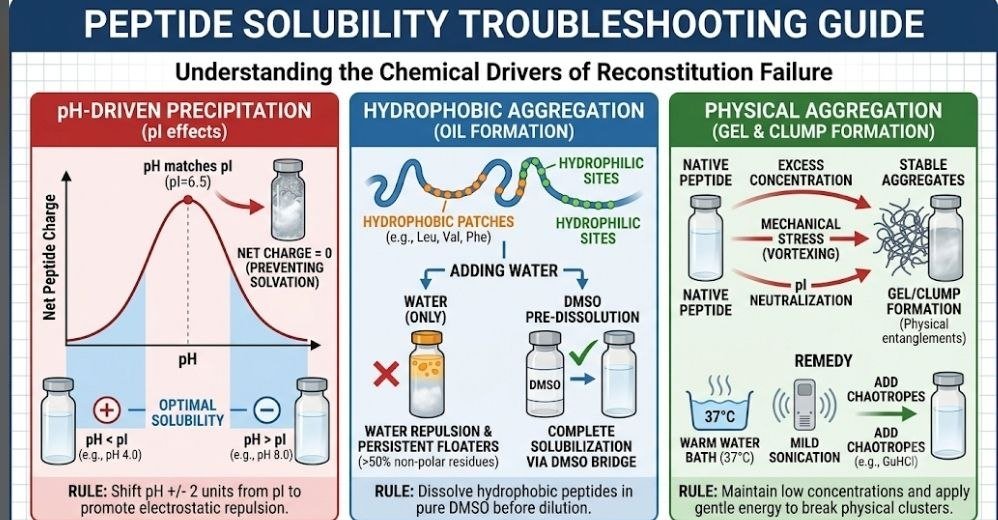
Step 1: Inspect the Lyophilized Material
Before adding solvent, inspect the vial.
Look for:
- Unexpected discoloration
- Excessive moisture
- Unusual cake structure
- Collapsed material
- Glassy appearance
- Material stuck unusually strongly to the vial
- Evidence of damaged packaging
Appearance alone cannot establish quality, but it can provide useful clues.
Step 2: Review Storage History
Ask:
- Was the peptide continuously stored under the recommended conditions?
- Was it repeatedly warmed and cooled?
- Was it exposed to moisture?
- Was the container properly closed?
- Was it exposed unnecessarily to light or air?
Storage history matters because peptide stability is sequence-dependent.
A peptide that has experienced inappropriate storage may behave differently from a properly stored reference material.
Step 3: Examine the Sequence
If you’re asking why won’t my peptide dissolve, sequence information is extremely valuable.
Look at:
- Hydrophobic residues
- Acidic residues
- Basic residues
- Cysteine
- Methionine
- Potential aggregation motifs
- Length
- Terminal modifications
- Salt/counter-ion form
Don’t evaluate one factor in isolation.
The entire sequence matters.
Step 4: Consider the pI
Estimate or obtain the theoretical pI.
Then consider the pH of the intended solvent.
If the solvent is close to the peptide’s pI, precipitation or aggregation may be more likely.
The solution is not automatically to push the pH to an extreme.
Instead, use sequence-specific stability information and appropriate laboratory methodology to determine whether a modest pH shift is compatible with the peptide.
Step 5: Consider Ionic Strength
If the peptide was introduced directly into saline or a concentrated buffer and immediately became cloudy, ionic strength should be investigated.
A lower-ionic-strength initial solubilization strategy may be appropriate for some peptides.
The final experimental buffer can then be introduced under validated conditions if required.
Step 6: Evaluate Concentration
If the peptide remains cloudy, determine whether the concentration is simply too high for the selected solvent system.
Controlled dilution can help distinguish:
intrinsic insolubility
from
concentration-dependent aggregation.
This is an important diagnostic distinction.
Step 7: Apply Gentle Physical Assistance
If the chemistry is appropriate, gentle swirling or inversion can help distribute the material.
Avoid automatically reaching for a vortex mixer.
A peptide that is difficult to dissolve is not necessarily improved by mechanical force.
Excessive agitation can introduce foam and may accelerate undesirable aggregation for sensitive sequences.
Step 8: Investigate Solvent Compatibility
For difficult research materials, solvent selection should be determined from:
- Sequence chemistry
- Hydrophobicity
- pI
- Desired concentration
- Downstream application
- Chemical stability
- Compatibility with analytical methods
Organic co-solvents such as DMSO or DMF can be useful in laboratory solubilization of appropriate hydrophobic research compounds.
But they are not universal solutions.
Their compatibility with the final experiment must always be considered.
For cell-based or biological systems, residual organic solvent can itself affect experimental outcomes.
Case Study 1: AOD-9604 Cloudy Gel
One of the more interesting troubleshooting examples involved a researcher working with AOD-9604.
What happened?
A lyophilized sample was introduced directly to an aqueous diluent.
Instead of becoming clear, the solution developed:
- Cloudiness
- Translucent floaters
- Gel-like material
The researcher initially assumed the material was defective.
What was the likely problem?
The behavior was more consistent with a combination of hydration conditions, charge state, and aggregation than with an immediate conclusion of product failure.
The aqueous environment did not provide favorable conditions for maintaining the peptide as individually solvated molecules.
What changed?
The laboratory investigation focused on modifying the chemical environment rather than mechanically forcing the material into solution.
A controlled pH adjustment and mild thermal assistance were investigated.
Outcome
The previously cloudy material became substantially clearer.
The important lesson was not simply “use acid.”
The lesson was:
The same peptide can behave very differently when its chemical environment changes.
This is why sequence, pI, solvent, and concentration should be considered together.
Case Study 2: SLU-PP-332 and Extreme Hydrophobicity
There is an important terminology point here.
SLU-PP-332 is a small-molecule research compound, not a peptide.
It is nevertheless a useful comparison because it demonstrates how extreme hydrophobicity can overwhelm an aqueous solvent.
What happened?
An aqueous solvent was introduced to a highly lipophilic research compound.
The material remained as a dense suspension instead of dissolving.
Why?
The compound’s non-polar character made water an unfavorable solvent.
No amount of ordinary swirling could fundamentally change that thermodynamic problem.
What was investigated?
A suitable organic co-solvent strategy was evaluated.
The compound was first brought into a compatible organic phase before controlled aqueous dilution.
Lesson
The case demonstrates a principle that also applies to difficult peptide systems:
Solvent compatibility must be determined from molecular chemistry, not from the appearance of the powder.
Case Study 3: Glucagon Precipitation Near Neutral pH
Glucagon provides another useful example of how pH can influence peptide solubility.
What happened?
A glucagon sample was introduced into a near-neutral buffer.
The solution quickly became:
- Milky
- Cloudy
- Particulate
What was suspected?
The peptide’s pI and aggregation behavior were important considerations.
When the environmental pH approaches the region where net molecular charge is low, peptide-peptide interactions can increase.
What was investigated?
Rather than continuing to add mechanical energy, the laboratory investigation focused on changing the chemical environment.
A more favorable pH condition was evaluated.
Lesson
The important takeaway is not that every peptide should be placed in an alkaline solution.
The lesson is:
Know the peptide’s pI and stability profile before selecting the solvent environment.
When Should You Suspect a Bad Peptide?
A difficult-to-dissolve peptide does not automatically mean poor quality.
However, some observations should trigger deeper QC investigation.
Be more concerned when:
- A normally soluble sequence behaves unexpectedly
- Different samples from the same batch behave dramatically differently
- Insoluble material remains under multiple validated conditions
- Analytical purity is substantially below specification
- Mass spectrometry does not match the expected molecular mass
- Chromatography shows significant unexpected peaks
- The sample contains unexplained particulate contamination
- The material shows unusual degradation products
- The lyophilized material has obvious manufacturing abnormalities
The key word is unexpected.
If a highly hydrophobic peptide behaves poorly in water, that may be completely consistent with its chemistry.
If a strongly charged, well-characterized peptide that normally dissolves readily suddenly becomes permanently insoluble, the situation deserves more investigation.
HPLC and Mass Spectrometry for Peptide QC
When the question is why won’t my peptide dissolve, analytical testing can be far more informative than visual inspection.
HPLC
Reverse-phase HPLC can help evaluate chemical purity.
Researchers can look for:
- Main peak percentage
- Secondary peaks
- Degradation products
- Truncation sequences
- Unexpected impurities
- Peak broadening
- Multiple major components
A high main peak percentage does not guarantee perfect behavior, but it provides valuable information.
Mass Spectrometry
Mass spectrometry addresses a different question:
Is the molecular mass consistent with the expected peptide?
Techniques such as ESI-MS or MALDI-TOF can help investigate:
- Molecular identity
- Unexpected mass shifts
- Oxidation
- Modification
- Incorrect synthesis
- Deletion products
- Certain residual protecting-group-related problems
HPLC and MS are therefore complementary.
One primarily evaluates chromatographic composition.
The other provides molecular-mass information.
Together, they provide substantially more evidence than dissolution behavior alone.
Aggregation Analysis
When aggregation is suspected, additional analytical methods may be useful.
Depending on the peptide and research objective, laboratories may consider:
- SEC-HPLC
- Analytical ultracentrifugation
- Dynamic light scattering
- Appropriate electrophoretic techniques
- Microscopy
- Spectroscopic approaches
The purpose is to determine whether the material is:
chemically dissolved but aggregated
rather than simply remaining as undissolved powder.
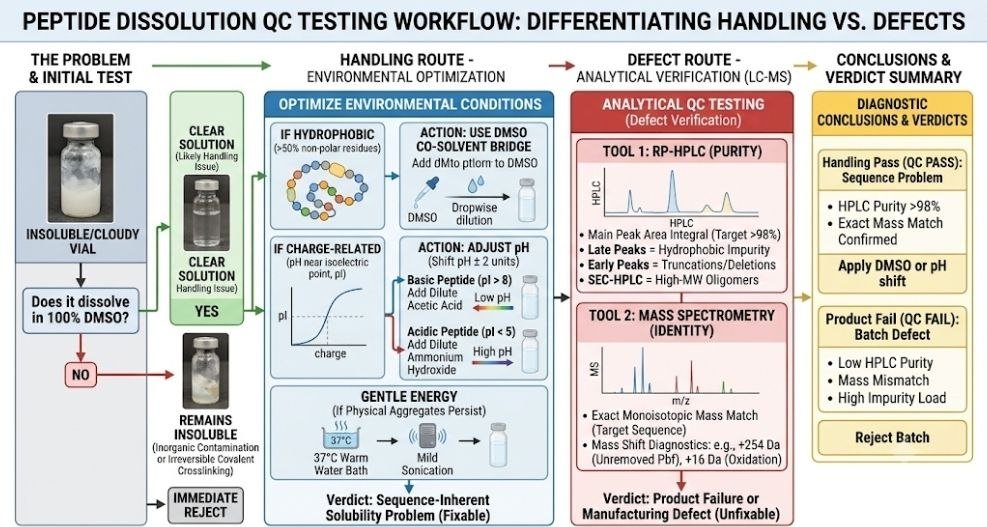
Common Reconstitution Mistakes
If you’re still wondering why won’t my peptide dissolve, check whether any of these mistakes occurred.
Mistake 1: Using the Final Buffer as the Initial Solvent
The buffer required for an experiment may not be the best environment for initial peptide solubilization.
Mistake 2: Adding Liquid Too Quickly
Rapid addition can create extremely high local concentrations around the dry cake.
That can encourage aggregation before the peptide has properly hydrated.
Mistake 3: Vortexing Aggressively
More agitation does not necessarily mean better dissolution.
Foam, shear, and air-liquid interfaces can complicate sensitive peptide systems.
Mistake 4: Ignoring pI
A peptide may be placed directly into a pH environment where its net charge is unfavorable for solubility.
Mistake 5: Ignoring Hydrophobicity
Water is not automatically the correct solvent for every peptide.
Mistake 6: Working With Extremely Cold Solvent
Low temperature can slow dissolution kinetics.
Mistake 7: Assuming More Solvent Always Fixes the Problem
Increasing volume can reduce concentration, but it cannot necessarily overcome an unfavorable solvent-peptide interaction.
Mistake 8: Judging Quality by Appearance Alone
A clear solution does not prove identity or purity.
A cloudy solution does not automatically prove a bad peptide.
Analytical evidence matters.
What Different Visual Signs Can Tell You
Visual observations can provide useful diagnostic clues.
| Appearance | Possible Explanation |
|---|---|
| Floating particles | Hydrophobicity, incomplete hydration, aggregation |
| Milky cloudiness | pI-related aggregation, precipitation |
| Fine sediment | Poor solubility, salt effects, aggregation |
| Gel-like strands | Strong self-association or cross-linking |
| Foam | Excessive agitation or surfactant-like behavior |
| Material stuck to vial | Poor wetting or hydrophobic interactions |
| Rapid precipitation | pH, ionic strength, concentration, or solvent mismatch |
| Persistent insoluble material | Severe aggregation, contamination, cross-linking, or inappropriate solvent |
These are diagnostic clues—not definitive diagnoses.
The same appearance can have multiple underlying causes.
Why Won’t My Peptide Dissolve? A Practical Decision Tree
When researchers ask me why won’t my peptide dissolve, I recommend thinking through the problem in this order:
Question 1: Is the material stored correctly?
If not, investigate stability before assuming a simple solubility issue.
Question 2: What is the sequence?
Look at hydrophobicity, charge, cysteine, methionine, and aggregation-prone regions.
Question 3: What is the pI?
Determine whether the chosen pH is close to the peptide’s isoelectric region.
Question 4: What solvent was used?
Determine whether the solvent is chemically compatible with the sequence.
Question 5: Was salt introduced too early?
High ionic strength can dramatically change behavior.
Question 6: Is the concentration too high?
Try a controlled concentration assessment where appropriate.
Question 7: Was excessive mechanical force applied?
If yes, consider whether agitation contributed to foaming or aggregation.
Question 8: Does the behavior make chemical sense?
Compare the observed behavior with the expected sequence properties.
Question 9: Does analytical data support the expected identity and purity?
If not, investigate the material as a potential QC problem.
How OasBioScience Approaches Peptide Quality
At OasBioScience, the philosophy should be straightforward:
Don’t judge peptide quality from one visual observation.
A peptide is a chemical material.
Its identity, purity, molecular characteristics, storage history, and analytical profile all matter.
That is why researchers evaluating difficult peptide samples should consider supporting documentation such as:
- Certificate of Analysis
- HPLC chromatogram
- Mass spectrometry results
- Reported purity
- Molecular weight
- Batch information
- Testing laboratory information
- Relevant analytical methods
A COA should not simply be treated as a decorative PDF.
Researchers should understand what the analytical results actually demonstrate.
For example, HPLC can help answer:
“How chemically pure is this material?”
Mass spectrometry can help answer:
“Does the observed molecular mass correspond to the expected molecule?”
Dissolution testing answers a different question:
“How does this material behave under this particular solvent and environmental condition?”
Those are not the same question.
That distinction is central to responsible peptide research.
If you are evaluating peptide materials for laboratory work, you can visit OasBioScience at oasbioscience.com to learn more about the company’s research-oriented peptide materials and quality-control approach.
A Better Way to Think About Peptide Solubility
The biggest mistake is thinking:
“If it doesn’t dissolve, the peptide is bad.”
A better framework is:
Solubility = Molecular Chemistry + Environment + Handling + Concentration + Quality
The molecule contributes its own characteristics.
The environment determines how those characteristics interact with the solvent.
Handling determines whether the material is given an opportunity to hydrate properly.
Concentration determines how strongly molecules interact with one another.
Quality determines whether the material actually corresponds to what the label says.
This framework makes troubleshooting much more logical
The Most Important Lesson: Don’t Force Solubility
After years of working with peptide materials, one principle continues to be particularly useful:
When a peptide refuses to dissolve, don’t immediately respond with more mechanical force. Investigate the chemical environment first.
A vortex mixer cannot change a peptide’s hydrophobicity.
Aggressive shaking cannot change its pI.
More agitation cannot automatically overcome an unfavorable solvent.
And a clear solution cannot prove chemical identity.
The better strategy is to ask:
What is preventing this molecule from remaining solvated?
Is it:
- Hydrophobicity?
- pI?
- Ionic strength?
- Concentration?
- Aggregation?
- Temperature?
- Disulfide chemistry?
- Solvent compatibility?
- Or potentially a quality problem?
Once the underlying mechanism is understood, troubleshooting becomes much more rational.
Frequently Asked Questions
1. Why won’t my peptide dissolve in water?
The most common explanations include high hydrophobicity, unfavorable pH, proximity to the peptide’s isoelectric point, aggregation, excessive concentration, or unsuitable solvent conditions.
Water is an excellent solvent for many peptides, but it is not universally appropriate for every sequence.
If your peptide is highly hydrophobic or aggregation-prone, a different laboratory solubilization strategy may be required.
2. Why won’t my peptide dissolve even after waiting?
Time alone cannot overcome an unfavorable chemical environment.
If the peptide remains insoluble after adequate hydration time, investigate the sequence, pI, solvent, concentration, temperature, and aggregation behavior.
If the material remains persistently insoluble under appropriate, validated conditions, analytical QC testing may be warranted.
3. Why does my peptide become cloudy after reconstitution?
Cloudiness often indicates aggregation or precipitation.
Possible causes include:
- pH near the peptide’s pI
- High ionic strength
- Excessive concentration
- Hydrophobic interactions
- Temperature effects
- Sequence-specific aggregation
Cloudiness is a warning sign, but it does not identify the exact cause by itself.
4. Why won’t my peptide dissolve in saline or PBS?
Some peptides do not tolerate immediate exposure to higher ionic strength.
Salts can alter charge interactions and promote aggregation or precipitation.
For difficult peptides, the initial solubilization environment may need to be different from the final experimental buffer.
Always follow a validated sequence-specific laboratory protocol.
5. Can DMSO help a peptide that won’t dissolve?
DMSO can be useful for certain hydrophobic research peptides and compounds, but it is not a universal solution.
Its suitability depends on the molecule, concentration, chemical stability, and downstream experiment.
Residual DMSO can also interfere with some biological experiments.
Therefore, DMSO should be selected based on the specific research application rather than simply because water failed.
6. Should I vortex a peptide that won’t dissolve?
Not automatically.
Aggressive vortexing can create foam, air-liquid interfaces, and additional mechanical stress.
For many peptide systems, gentle mixing and appropriate solvent conditions are preferable.
If a peptide remains insoluble, investigate the chemistry rather than assuming that more agitation will solve the problem.
7. Does peptide purity affect solubility?
Yes, potentially.
Impurities, truncation sequences, unexpected modifications, residual synthesis components, aggregation, and improper lyophilization can all influence apparent solubility.
However, poor solubility does not automatically prove poor purity.
HPLC, mass spectrometry, and other appropriate analytical techniques provide stronger evidence.
8. Does temperature affect peptide dissolution?
Yes.
Temperature influences dissolution kinetics and molecular interactions.
Cold conditions can slow hydration, while excessive heat can accelerate degradation.
The ideal temperature therefore depends on the peptide and its stability profile.
Controlled temperature management is preferable to simply applying more heat.
9. How can I tell whether a peptide is defective or simply difficult to dissolve?
Compare the observed behavior with the expected chemistry of the peptide.
Then examine analytical evidence.
A useful investigation may include:
- Sequence review
- pI assessment
- Solvent compatibility
- Concentration assessment
- HPLC
- Mass spectrometry
- Aggregation analysis where appropriate
A peptide’s dissolution behavior should be considered one piece of evidence rather than the entire QC assessment.
10. What is the most important thing to remember when a peptide won’t dissolve?
Don’t immediately assume the peptide is defective.
Treat incomplete dissolution as a diagnostic signal.
Investigate the molecular chemistry, solvent, pH, ionic strength, concentration, temperature, handling technique, and analytical quality data.
The goal isn’t to force the peptide into solution.
The goal is to understand why it is refusing to dissolve.
Continue Learning: If you found this guide helpful, you may also want to read our previous peptide education articles covering the following topics
• Does adding more diluent make peptides weaker?
• Peptide vendor documents explained
• Explore 9 evidence-based facts about BPC-157
• How long should a weight loss cycle last?
• Can GLP-1 muscle loss be prevented?
• Discover the best peptide for obesity research.
• Which peptide suppresses appetite the most?
• Discover 9 powerful fixes for peptide foaming
• Learn how to read peptide Certificates of Analysis step by step.
• How Should Peptides Be Stored?
• Learn the correct peptide reconstitution process 2026
- Does adding more diluent make peptides weaker?
- Learn 7 powerful reasons why, how HPLC methods affect results
- Peptides warmed in transit are not automatically ruined
- How long can peptides stay unrefrigerated during shipping?
- Learn the complete peptide synthesis and manufacturing process
- HPLC vs Mass Spectrometry explained
- Can I use sterile water instead of bacteriostatic water?
- A 99% HPLC result can look impressive—but what does it really tell you?
Scientific Reference: For additional peer-reviewed information on peptide stability, sterile preparation, and pharmaceutical reconstitution practices, visit
European Medicines Agency (EMA)
National Center for Biotechnology Information (NCBI)
Final Takeaway: Why Won’t My Peptide Dissolve?
So, why won’t my peptide dissolve?
There is rarely one universal answer.
The most common explanations involve:
- High hydrophobicity
- Unfavorable pH or proximity to the pI
- Premature exposure to saline or high ionic strength
- Peptide aggregation
- Cysteine/disulfide chemistry
- Temperature and dissolution kinetics
- Excessive concentration
- Poor reconstitution technique
- Potential quality-control problems
The most important distinction is between inherent chemical behavior and material quality.
A highly hydrophobic peptide may simply require a different solubilization environment.
A peptide near its pI may precipitate because its molecular charge is unfavorable.
A concentrated solution may aggregate because the molecules are interacting too strongly.
And a genuinely problematic batch may show unexpected analytical results that cannot be explained by ordinary sequence chemistry.
That is why the best troubleshooting approach is analytical rather than emotional.
Don’t immediately blame the peptide.
Don’t immediately blame the solvent.
And don’t immediately reach for a vortex mixer.
Understand the molecule. Understand the environment. Understand the analytical data.
At OasBioScience, our educational approach is built around helping researchers understand that distinction: solubility is not the same thing as purity, and dissolution behavior alone is not a substitute for proper analytical QC.
When you understand the chemistry behind why won’t my peptide dissolve, an apparently difficult vial becomes a solvability problem rather than a mystery.
Diagnose first. Adjust the chemical environment intelligently. Verify the material analytically.
