


No products in the cart.
Does Adding More Diluent Make Peptides Weaker? 9 Powerful Facts Researchers Need to Know
Table of Contents
- Does Adding More Diluent Make Peptides Weaker?
- The Short Answer
- Peptide Potency vs. Peptide Concentration
- What Actually Changes When You Add More Diluent?
- A Simple 5 mg Peptide Example
- Does Adding More Diluent Make Peptides Weaker? The Mathematics
- Case Study: The 1 mL vs. 3 mL Reconstitution Error
- Why Researchers Sometimes Think a Peptide Has Become “Weak”
- How Dilution Affects Measurement Accuracy
- Can Too Much Diluent Affect Peptide Stability?
- Solubility, pH, Adsorption and Other Variables
- Common Peptide Reconstitution Mistakes
- How to Troubleshoot a Peptide That Seems Ineffective
- How to Read a COA Before Blaming Dilution
- Practical Dilution Checklist
- Peptide Examples: BPC-157, TB-500, CJC-1295, Ipamorelin, Semaglutide, Tirzepatide and GHK-Cu
- OasBioScience: Researcher Education and Quality
- Frequently Asked Questions
- Final Takeaway
Does Adding More Diluent Make Peptides Weaker?
https://pubchem.ncbi.nlm.nih.gov
Does adding more diluent make peptides weaker? No—not simply because you added more liquid.
This is one of the most persistent misunderstandings I have encountered during my years working with peptides.
Since 2003, I have worked with peptides as a supplier and educator, helping researchers understand peptide handling, product quality, concentration calculations, storage considerations, and the practical mistakes that can occur during reconstitution.
One question repeatedly appears:
“I added more diluent than usual. Did I make my peptide weaker?”
The answer requires an important distinction.
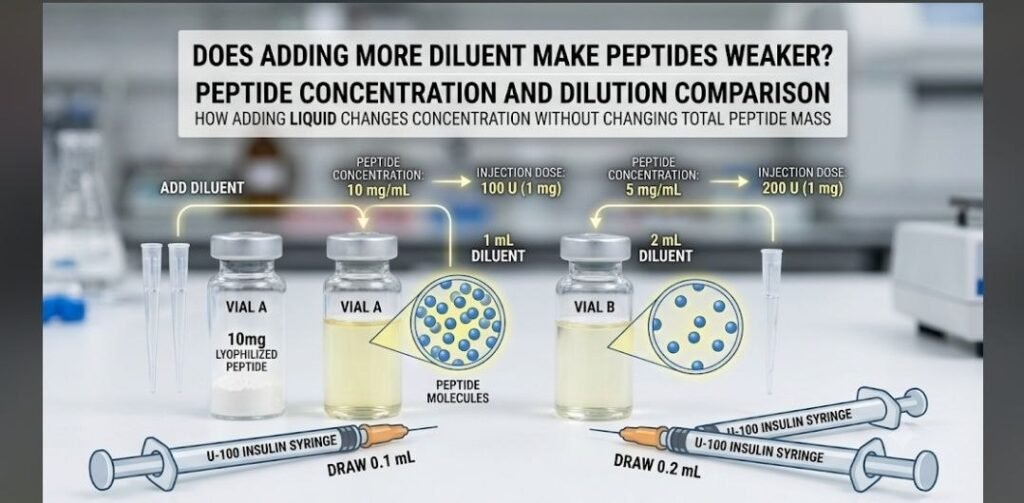
Adding more diluent lowers the peptide’s concentration per unit of liquid. It does not automatically reduce the total amount of peptide originally present in the vial.
For example, if a vial contains 5 mg of peptide before reconstitution, adding 1 mL of diluent does not create a different amount of peptide than adding 3 mL.
The vial still contains the same nominal 5 mg of peptide.
What changes is the concentration.
That difference between amount, concentration, and delivered volume explains many of the “weak peptide” complaints researchers encounter.
The Short Answer: Does Adding More Diluent Make Peptides Weaker?
No.
Does adding more diluent make peptides weaker? Not in the simple mathematical sense.
Adding diluent changes the concentration of the peptide solution.
It does not magically remove peptide molecules from the vial.
Think about it like this:
Imagine you have 5 grams of sugar.
You dissolve those 5 grams in one glass of water.
Then imagine dissolving the same 5 grams in three glasses of water.
You have not destroyed the sugar.
You have simply distributed the same amount of sugar through a larger volume.
The same basic concentration principle applies to a reconstituted peptide.
The fundamental rule
More diluent = lower concentration per mL.
Less diluent = higher concentration per mL.
Same peptide mass = same nominal amount of peptide in the vial.
The critical step is therefore recalculating the concentration after changing the reconstitution volume.
Peptide Potency vs. Peptide Concentration
This is where much of the confusion begins.
The words potency and concentration are often used interchangeably in casual conversation, but they describe different concepts.
What is peptide amount?
Peptide amount refers to the quantity of material in the vial.
For example:
5 mg = 5,000 micrograms
If the vial contains 5 mg before reconstitution, changing the amount of diluent does not turn those 5 mg into 2.5 mg.
The peptide mass remains 5 mg, assuming there has been no actual loss or degradation.
What is peptide concentration?
Concentration describes how much peptide is present in a particular volume.
The basic equation is:
Concentration = peptide amount ÷ total solution volume
For example:
5 mg ÷ 1 mL = 5 mg/mL
But:
5 mg ÷ 2 mL = 2.5 mg/mL
And:
5 mg ÷ 3 mL = 1.67 mg/mL
The peptide amount has not changed.
The concentration has.
What Actually Changes When You Add More Diluent?
When more diluent is added, several practical characteristics can change.
1. Concentration changes
This is the primary mathematical change.
The same peptide mass is distributed through a larger volume.
2. Volume required for a particular amount changes
A lower concentration means a larger volume is needed to obtain the same calculated amount of peptide.
3. Measurement characteristics change
A more dilute solution may make very small quantities easier to measure using an appropriate calibrated measurement system.
This is one reason concentration should be considered when developing a laboratory handling protocol.
4. Storage and stability conditions can become relevant
Dilution itself is not automatically degradation.
However, once a peptide is reconstituted, factors such as temperature, pH, formulation, storage duration, repeated access, adsorption, contamination risk, and the intrinsic characteristics of the peptide become important.
5. Solubility behavior may change
Changing the solvent environment can affect the ability of some peptides to remain dissolved.
This is why there is no universal “one dilution volume works for every peptide” rule.
A Simple 5 mg Peptide Example
Let’s make the concept extremely simple.
Suppose two identical research vials each contain:
5 mg peptide
Vial A
5 mg + 1 mL diluent
Concentration:
5 mg/mL
Vial B
5 mg + 2.5 mL diluent
Concentration:
2 mg/mL
Vial B is more dilute.
But it did not suddenly contain less than 5 mg simply because more liquid was added.
This is the distinction researchers need to remember:
Changing the liquid volume changes concentration. It does not automatically change the original peptide mass.
Does Adding More Diluent Make Peptides Weaker? The Mathematics
Let’s look at a simplified example using a U-100 syringe purely to demonstrate concentration mathematics.
A U-100 syringe is conventionally calibrated so that:
100 units = 1 mL
Therefore:
1 unit = 0.01 mL
Consider a 5 mg vial.
Example 1: 1 mL Reconstitution
5 mg ÷ 1 mL = 5 mg/mL
That equals:
5,000 mcg/mL
Since 1 mL contains 100 syringe units:
5,000 mcg ÷ 100 = 50 mcg per unit
Example 2: 2.5 mL Reconstitution
5 mg ÷ 2.5 mL = 2 mg/mL
That equals:
2,000 mcg/mL
With 250 syringe units representing 2.5 mL:
2,000 mcg ÷ 100 = 20 mcg per unit
The peptide amount remains 5 mg.
But each syringe unit now represents a smaller quantity of peptide.
That is the entire issue.
Case Study: The 1 mL vs. 3 mL Reconstitution Error
One of the clearest ways to understand does adding more diluent make peptides weaker is to examine a common calculation error.
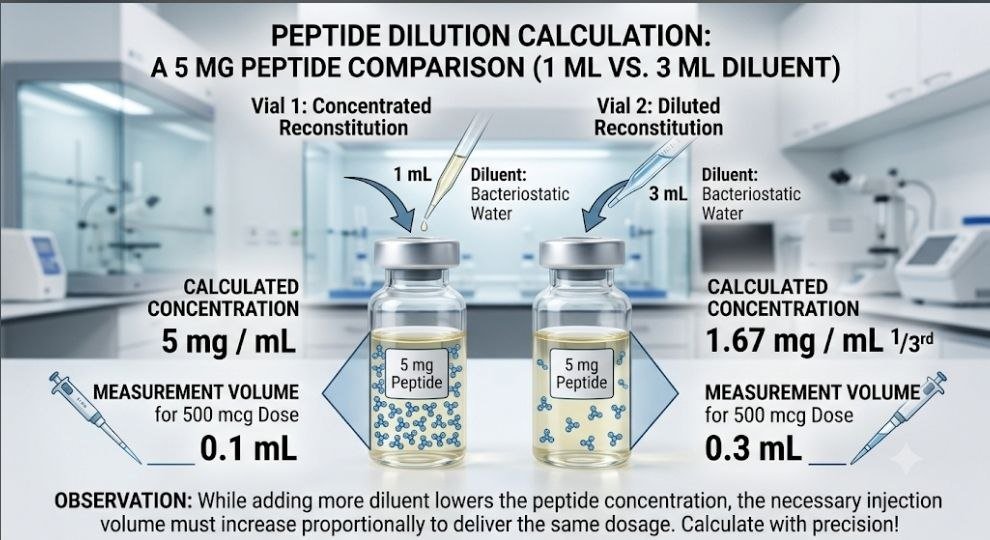
Imagine two identical 5 mg research peptide vials from the same synthesis batch.
For illustration, a researcher is calculating a target amount of 250 mcg.
Vial A: 1 mL
| Variable | Vial A |
|---|---|
| Peptide | 5 mg |
| Diluent | 1 mL |
| Concentration | 5 mg/mL |
| Concentration per U-100 unit | 50 mcg |
| Calculated volume for 250 mcg | 5 units |
Vial B: 3 mL
| Variable | Vial B |
| Peptide | 5 mg |
| Diluent | 3 mL |
| Concentration | 1.67 mg/mL |
| Concentration per U-100 unit | ~16.67 mcg |
| Calculated volume for 250 mcg | 15 units |
Notice what happened.
The peptide mass stayed at:
5 mg
The concentration changed.
The measurement volume changed.
The mistake
Suppose the researcher is accustomed to the 1 mL preparation.
They draw 5 units from Vial A.
That corresponds to approximately 250 mcg in this mathematical example.
Now they prepare Vial B using 3 mL of diluent.
But they continue drawing 5 units because they remember the previous number.
They have not received the same calculated amount.
They have received approximately:
5 × 16.67 mcg = 83.35 mcg
That is roughly one-third of the previous calculated amount.
The researcher may then conclude:
“The second peptide is weaker.”
But the dilution did not necessarily make the peptide weaker.
The concentration changed, but the measurement was not recalculated.
This is one of the most important troubleshooting lessons I have learned from working with peptides.
Why Researchers Sometimes Think a Peptide Has Become “Weak”
When someone says a peptide “feels weaker” after reconstitution, I would not immediately blame the additional diluent.
I would investigate the entire chain of events.
Problem 1: The concentration changed
This is the first thing to calculate.
Ask:
- How much peptide was originally in the vial?
- How much diluent was added?
- What is the resulting concentration?
- What volume corresponds to the intended experimental amount?
A simple calculation can often reveal the problem.
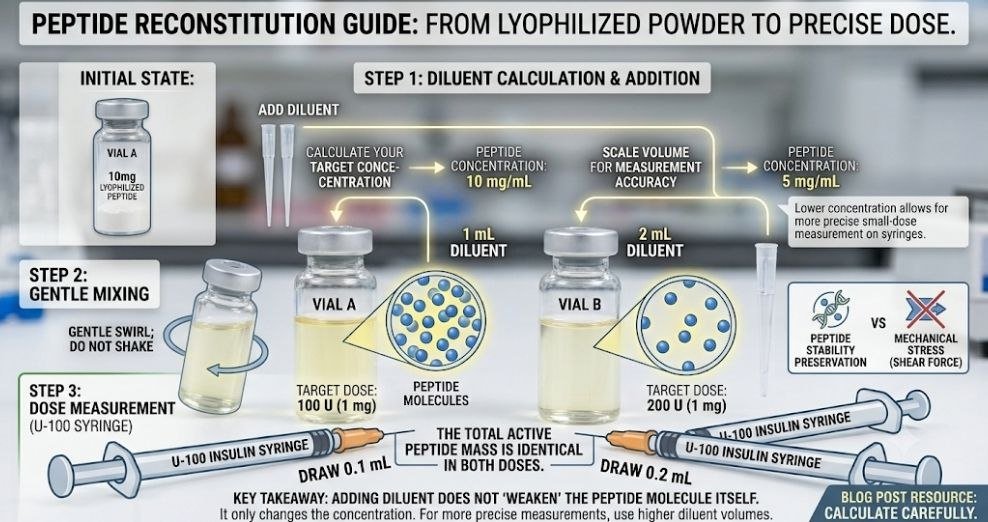
Problem 2: The researcher continued using the old measurement
This is extremely common.
Changing from 1 mL to 2 mL does not mean the same number of syringe units contains the same amount of peptide.
The concentration has changed.
Therefore, the measurement must be recalculated.
Problem 3: The peptide was not fully dissolved
A concentration calculation assumes the peptide is appropriately dissolved and distributed throughout the solution.
If material remains undissolved or has precipitated, the calculated concentration may not accurately represent the solution being sampled.
Solubility therefore matters.
Problem 4: Poor handling
The dilution calculation may be correct while the handling procedure is poor.
Potential variables include:
- Excessive agitation
- Foaming
- Repeated temperature fluctuations
- Prolonged exposure to unsuitable conditions
- Repeated vial access
- Improper storage
- Contamination
- Inappropriate solvent or pH conditions
How Dilution Affects Measurement Accuracy
This is an area that deserves more attention.
Researchers sometimes assume that less diluent is always better because it produces a more concentrated solution.
That is not necessarily true from a measurement perspective.
If the target quantity is very small, a highly concentrated solution can require an extremely small measurement volume.
That can increase volumetric uncertainty.
For example, imagine that a calculated amount requires only a tiny fraction of a measurement device’s smallest graduation.
Even a small measurement error can represent a substantial percentage of the intended quantity.
A somewhat lower concentration can sometimes provide a larger measurement volume and therefore make the calculation easier to implement consistently.
The important point is:
Reconstitution volume is not simply about making a peptide “strong” or “weak.” It is also about creating an appropriate concentration for accurate laboratory measurement and handling.
Can Too Much Diluent Affect Peptide Stability?
Here we need to make an important distinction.
Does adding more diluent make peptides weaker?
Not automatically.
But changing the formulation environment can influence stability in some circumstances.
Peptides are chemically diverse.
There is no universal stability rule that applies equally to BPC-157, TB-500, CJC-1295, Ipamorelin, GHK-Cu, semaglutide, tirzepatide, and every other peptide.
Different molecules can have different sensitivities.
Relevant factors can include:
pH
Some peptides are more stable within particular pH ranges.
Changing the solvent system can alter the chemical environment around the peptide.
Temperature
Temperature is one of the most important variables in peptide storage.
A correctly calculated concentration cannot compensate for poor temperature control.
Time
A freshly reconstituted peptide and the same peptide after prolonged storage should not automatically be assumed to have identical stability.
Repeated access
Every time a multi-use vial is opened or accessed, additional handling and contamination considerations arise.
Adsorption
Some peptide molecules can interact with container surfaces.
This can become particularly relevant when working with very low concentrations.
Aggregation
Certain peptides and proteins may be susceptible to aggregation under unfavorable conditions.
This is why aggressive shaking is generally not an appropriate universal strategy for peptide reconstitution.
Solubility: The Often-Ignored Part of Dilution
A peptide can have a mathematically correct concentration and still present a practical problem if it does not dissolve appropriately.
Solubility can depend on:
- Peptide sequence
- Charge characteristics
- Hydrophobicity
- pH
- Ionic strength
- Solvent composition
- Temperature
- Concentration
- Formulation conditions
This is particularly important when working with peptides that have challenging physicochemical properties.
Therefore, researchers should not assume that simply adding more water will solve every solubility problem.
Likewise, they should not assume that adding less liquid automatically produces a better preparation.
Common Peptide Reconstitution Mistakes
Mistake #1: Treating concentration as potency
A higher mg/mL concentration does not automatically mean the peptide molecule itself has greater intrinsic biological activity.
Concentration tells you how much material is present per volume.
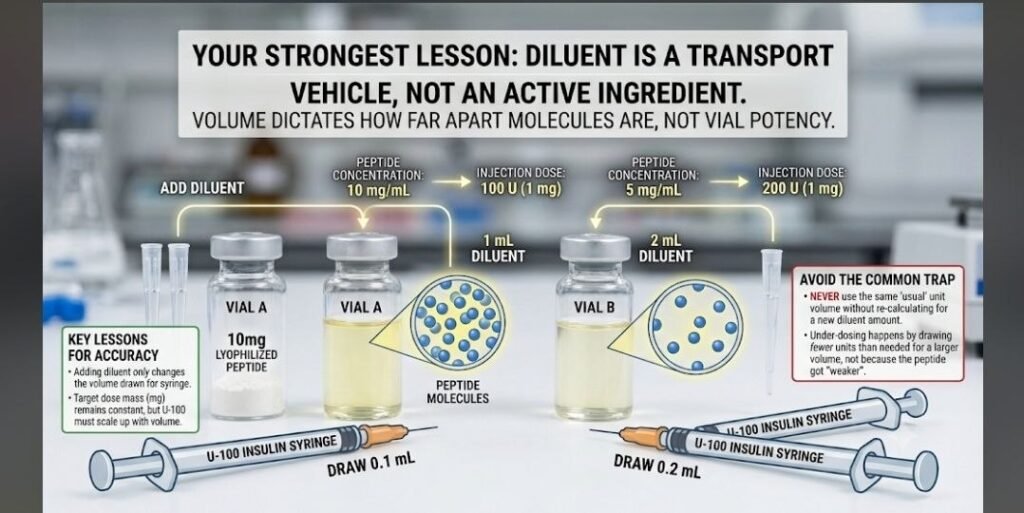
Mistake #2: Using the same syringe volume after changing dilution
This is perhaps the easiest mistake to make.
If the reconstitution volume changes, recalculate.
Never assume that yesterday’s measurement remains correct after changing the concentration.
Mistake #3: Assuming more diluent destroys peptide
Additional liquid is not inherently destructive.
The question is what solvent is being used, what conditions the peptide requires, and how the preparation is handled afterward.
Mistake #4: Shaking aggressively
Researchers sometimes shake a vial because they want to dissolve the material faster.
That is not an ideal universal approach.
Foaming and excessive agitation can create unnecessary stress for susceptible peptide formulations.
Gentle handling is generally preferable unless a validated product-specific protocol says otherwise.
Mistake #5: Ignoring storage
Researchers sometimes spend considerable time calculating concentration while overlooking temperature and storage conditions.
Both matter.
Mistake #6: Blaming the peptide before checking the calculation
Before declaring a batch ineffective, verify the basics.
Check:
Peptide mass → dilution volume → concentration → measurement → storage → handling → analytical evidence.
How to Troubleshoot a Peptide That Seems Ineffective
If a researcher believes a peptide has become weaker after adding more diluent, I recommend working through the problem systematically.
Step 1: Confirm the original peptide amount
Look at the product documentation.
Was it supposed to contain 5 mg?
10 mg?
Another quantity?
Do not begin with assumptions.
Step 2: Record the actual diluent volume
Write down exactly how much liquid was added.
Do not rely on memory.
Step 3: Calculate concentration
Use:
Concentration = peptide amount ÷ solution volume
Step 4: Recalculate the measurement
If the concentration changed, the volume required to obtain a particular amount also changed.
Step 5: Examine solubility
Is the preparation completely dissolved?
Is there precipitation?
Is the solution visibly different from the expected appearance?
Visual inspection is not a substitute for analytical testing, but unusual physical characteristics can be a useful troubleshooting signal.
Step 6: Review storage
Check:
- Temperature
- Freeze/thaw history
- Light exposure where relevant
- Storage duration
- Repeated handling
Step 7: Review reconstitution technique
Consider whether the material was exposed to unnecessary agitation, foaming, heat, or unsuitable solvent conditions.
Step 8: Check analytical documentation
If the problem remains unresolved, examine the available COA, HPLC data, mass spectrometry data, and other relevant quality-control information.
How to Read a COA Before Blaming Dilution
A Certificate of Analysis can provide valuable information about the material itself.
When investigating a suspected quality problem, look beyond a single percentage number.
HPLC
HPLC can provide information about chromatographic purity and related components.
Mass spectrometry
MS can help verify whether the measured molecular mass corresponds with the expected peptide.
Identity
A purity percentage alone does not answer every quality question.
Identity matters.
Batch information
Compare the batch number on the product documentation with the material being investigated.
Testing laboratory
Consider who performed the analysis and what analytical methods were used.
Documentation quality
A professional COA should contain enough information to allow the researcher to understand what was actually tested.
This is why third-party testing and transparent documentation are important components of peptide quality evaluation.
Does Adding More Diluent Make Peptides Weaker? A Better Way to Think About It
Instead of thinking:
“More water means weaker peptide.”
Think:
“More diluent means lower concentration.”
Then ask:
“What concentration do I now have, and what measurement volume corresponds to the amount I need?”
That mental shift eliminates a tremendous amount of confusion.
The peptide amount and solution concentration are different concepts.
Peptide Examples: BPC-157, TB-500, CJC-1295, Ipamorelin, Semaglutide, Tirzepatide and GHK-Cu
The concentration principle applies broadly.
However, these peptides should not be treated as chemically identical.
BPC-157
BPC-157 is frequently discussed in research settings where concentration calculations and reconstitution questions arise.
The key principle remains the same: changing liquid volume changes concentration.
TB-500
TB-500 presents the same basic mathematical issue.
A change in diluent volume requires a corresponding recalculation of concentration.
CJC-1295 and Ipamorelin
These peptides are commonly discussed together, but their individual physicochemical characteristics still need to be considered.
Do not assume that one peptide’s solubility or stability behavior automatically applies to another.
Semaglutide and Tirzepatide
These molecules deserve particular caution because formulation, handling, storage, and analytical considerations can be more complicated than simply calculating mg/mL.
Researchers should distinguish mathematical concentration from validated formulation stability.
GHK-Cu
Copper-containing peptides can introduce additional formulation considerations.
Again, concentration mathematics is only one part of the picture.
The lesson is universal, but the formulation requirements are not.
The Measurement Rule Researchers Should Remember
Here is the simplest way to remember the entire article:
Same peptide mass + more diluent = lower concentration
Same peptide mass + less diluent = higher concentration
Changing concentration = changing the measurement volume required
That is the relationship.
It is not:
More diluent = destroyed peptide.
Practical Peptide Dilution Checklist
Before considering a peptide preparation complete, researchers should verify:
- Original peptide amount is confirmed.
- Actual diluent volume is recorded.
- Final concentration is calculated.
- Measurement calculations are updated after changing concentration.
- Solubility is appropriate for the peptide and formulation.
- Unnecessary agitation and foaming are avoided.
- Storage conditions are appropriate for the specific material.
- Repeated handling is minimized where appropriate.
- COA documentation is available.
- HPLC/analytical information is reviewed when quality is questioned.
- Mass spectrometry or identity data are considered when appropriate.
- Unexpected changes are investigated rather than automatically attributed to dilution.
Why This Matters to Peptide Researchers
The reason this topic matters is not simply academic.
A misunderstanding of concentration can create a chain reaction.
A researcher adds more diluent.
The concentration decreases.
The researcher continues using an old measurement.
The amount measured changes.
The observed result changes.
The researcher concludes:
“The peptide is weak.”
Then the wrong problem gets blamed.
The real problem may have been a simple concentration calculation.
This is why peptide education matters.
OasBioScience: A Research-Focused Approach to Peptide Quality
At OasBioScience, our approach is centered on helping researchers understand the material they are working with rather than treating peptide purchasing as simply a transaction.
My experience working with peptides since 2003 has reinforced one principle repeatedly:
Researchers need reliable information just as much as they need quality research materials.
That means understanding:
- Peptide identity
- Purity
- Analytical testing
- COAs
- HPLC
- Mass spectrometry
- Storage
- Reconstitution considerations
- Concentration mathematics
- Handling variables
- Potential degradation mechanisms
For researchers evaluating peptide materials, reviewing available analytical documentation is an important part of making an informed decision.
You can learn more about OasBioScience and our research-focused peptide offerings at OasBioScience.
Continue Learning: If you found this guide helpful, you may also want to read our previous peptide education articles covering the following topics
- What Bacteriostatic Water Should I Use For My Peptide?
- What’s Peptide Reconstitution?
- How Long Do Peptides Last?
- How Should Peptides Be Stored?
- Peptide vendor documents explained
- Explore 9 evidence-based facts about BPC-157, tendon repair research,
- How long should a weight loss cycle last?
- Can GLP-1 muscle loss be prevented?
- How Are Peptides Made?
Frequently Asked Questions
1. Does adding more diluent make peptides weaker?
No, not simply because additional diluent was added. Adding diluent lowers the concentration of peptide per unit volume while leaving the original peptide mass unchanged, assuming no peptide has been lost or degraded.
2. Does adding more bacteriostatic water reduce peptide potency?
Adding more diluent changes concentration. It does not automatically destroy or chemically weaken the peptide.
However, peptide stability can depend on formulation, pH, temperature, storage duration, handling, and other factors.
3. Why does my peptide seem weaker after adding more diluent?
One common explanation is a concentration calculation error.
If you increase the reconstitution volume but continue measuring the same volume of solution, you are no longer obtaining the same calculated amount of peptide.
Other possibilities include storage problems, degradation, solubility issues, handling problems, or product-quality concerns.
4. Does more diluent mean I need a larger volume to obtain the same amount of peptide?
Mathematically, yes.
When concentration decreases, a larger solution volume is required to contain the same calculated amount of peptide.
That is why measurement calculations must be updated whenever the final concentration changes.
5. Is a more concentrated peptide always better?
No.
Higher concentration is not automatically synonymous with higher peptide quality.
The appropriate concentration depends on the research application, solubility characteristics, measurement requirements, formulation, and stability considerations.
6. Can dilution affect peptide stability?
It can, depending on the peptide and formulation.
Dilution changes the chemical environment, and factors such as pH, ionic strength, solvent composition, adsorption, temperature, storage duration, and concentration can influence stability.
Therefore, dilution should not be considered completely irrelevant to stability—but neither should it automatically be blamed for degradation.
7. Why should I recalculate concentration after changing the diluent volume?
Because the concentration changes.
A vial containing 5 mg in 1 mL has a different concentration from a vial containing 5 mg in 3 mL.
Using the same measurement volume in both preparations will therefore not provide the same calculated quantity of peptide.
8. Can I determine peptide quality just by looking at the solution?
No.
Appearance can sometimes reveal obvious issues such as unexpected precipitation or unusual physical changes, but appearance alone cannot establish peptide identity, purity, potency, or structural integrity.
Analytical methods such as HPLC and mass spectrometry provide much more meaningful information.
9. What should I check if a peptide appears ineffective?
Start with the fundamentals:
peptide amount → dilution volume → concentration → measurement calculation → solubility → storage → handling → analytical documentation.
This systematic approach is much more useful than immediately assuming that additional diluent destroyed the peptide.
10. What is the biggest mistake researchers make with peptide dilution?
The biggest misconception is treating concentration as though it were the same thing as total peptide amount.
Adding more liquid does not automatically remove peptide from the vial.
It changes how much peptide is present in each unit of solution.
Final Takeaway: Diluent Is Not the Enemy
So, does adding more diluent make peptides weaker?
The simple answer is no.
Adding more diluent lowers the concentration of the peptide solution.
It does not automatically reduce the total peptide mass in the vial.
The distinction is fundamental:
Peptide amount = how much peptide you have.
Concentration = how much peptide exists per unit volume.
Measurement volume = how much solution must be measured to obtain a particular calculated amount.
Once researchers understand those three concepts, many apparent “weak peptide” problems become much easier to troubleshoot.
After more than two decades working with peptides since 2003, I have found that some of the most frustrating peptide-handling problems are not caused by the peptide itself.
They are caused by misunderstandings about concentration, measurement, storage, handling, and analytical quality.
The most important lesson to remember is simple:
Changing the amount of diluent changes the concentration—not the original amount of peptide in the vial.
If you change the dilution volume, recalculate the concentration and measurement requirements rather than assuming the peptide has become weaker.
And when the problem cannot be explained mathematically, investigate the other variables: solubility, pH, storage, handling, degradation, COA information, HPLC, mass spectrometry, and batch quality.
That is the difference between guessing that a peptide is “weak” and actually troubleshooting the preparation scientifically.
Research Use Only. Not for human consumption or clinical use.
Scientific Reference: For additional peer-reviewed information on peptide stability, sterile preparation, and pharmaceutical reconstitution practices, visit
National Center for Biotechnology Information (NCBI)
United States Pharmacopeia (USP) Official Website
United States Pharmacopeia (USP) – USP <797> Sterile Compounding

