


No products in the cart.
How Should Peptides Be Stored? 15 Powerful Ways to Prevent Costly Peptide Degradation
How Should Peptides Be Stored? It is one of the most important questions researchers should answer before opening, reconstituting, or experimenting with a peptide.
A peptide can be highly pure when it leaves the laboratory and still lose quality if it is exposed to inappropriate temperature, moisture, oxygen, light, repeated freeze-thaw cycles, or unnecessary handling.
This is particularly important for sensitive research peptides, including GLP-1-related peptides such as semaglutide and tirzepatide, healing-research peptides such as BPC-157 and TB-500, growth-hormone-related peptides such as CJC-1295 and ipamorelin, and many cosmetic or specialized peptide sequences.
The important point is that peptide storage is not simply a matter of putting a vial into a refrigerator or freezer.
The physical form of the peptide matters.
The amino-acid sequence matters.
The formulation matters.
The diluent matters.
The container matters.
The amount of moisture and oxygen reaching the material matters.
And, once a peptide has been reconstituted, the storage requirements can become considerably more demanding.
After more than two decades working around peptide research and education, one of the most common lessons I have seen is simple:
«A good peptide can only remain a good research material if it is handled correctly after it arrives.»
This guide explains how should peptides be stored, from the moment a lyophilized vial arrives to long-term freezer storage, reconstitution, refrigeration, aliquoting, transportation, and troubleshooting.
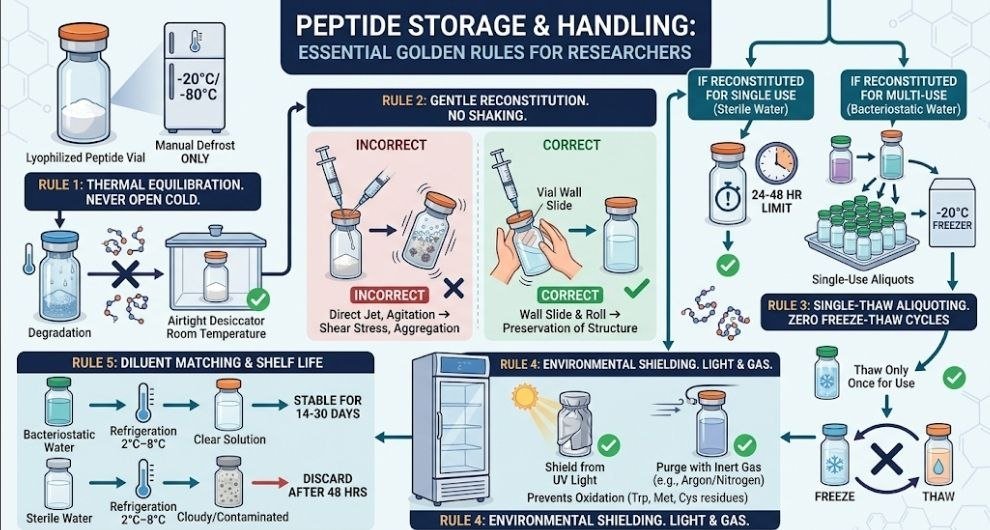
Table of Contents
1. “How Should Peptides Be Stored? The Short Answer” (#short-answer)
2. “Why Peptide Storage Matters” (#why-storage-matters)
3. “Lyophilized vs. Reconstituted Peptides” (#lyophilized-vs-reconstituted)
4. “How Should Lyophilized Peptides Be Stored?” (#lyophilized-storage)
5. “The Best Temperature for Peptide Storage” (#temperature)
6. “Is Room Temperature Safe for Peptides?” (#room-temperature)
7. “Should Peptides Be Stored at 2–8°C?” (#refrigerator)
8. “Why −20°C Is Commonly Used for Long-Term Storage” (#minus20)
9. “When Does −80°C Make Sense?” (#minus80)
10. “Manual-Defrost vs. Frost-Free Freezers” (#freezer-comparison)
11. “How Light Affects Peptide Stability” (#light)
12. “How Moisture Damages Peptides” (#moisture)
13. “Oxygen, Oxidation and Peptide Storage” (#oxygen)
14. “Repeated Freeze-Thaw Cycles” (#freeze-thaw)
15. “How Should Peptides Be Stored After Reconstitution?” (#reconstituted-storage)
16. “Choosing the Right Diluent” (#diluent)
17. “How to Handle a Peptide During Reconstitution” (#reconstitution)
18. “Aliquoting Peptides for Long-Term Storage” (#aliquoting)
19. “Peptide Storage in Hot and Humid Climates” (#hot-climates)
20. “Peptide Shipping and Receiving” (#shipping)
21. “How to Tell Whether a Peptide May Have Degraded” (#degradation)
22. “HPLC and Mass Spectrometry for Peptide Quality” (#hplc-ms)
23. “Real-World Storage Failure Case Study” (#case-study)
24. “The 15 Most Important Peptide Storage Rules” (#15-rules)
25. “Common Peptide Storage Mistakes” (#mistakes)
26. “Peptide Storage Quick-Reference Table” (#quick-reference)
27. “Peptide Storage FAQ” (#faq)
28. “Final Peptide Storage Checklist” (#checklist)
29. “Final Thoughts” (#conclusion)
How Should Peptides Be Stored? The Short Answer
https://pubmed.ncbi.nlm.nih.gov/
If you are asking how should peptides be stored, the first distinction you need to make is whether the peptide is lyophilized or reconstituted.
For lyophilized peptides
For many synthetic research peptides, a common long-term storage starting point is:
• −20°C: commonly used for long-term storage
• −80°C: useful for selected highly sensitive or valuable materials when the manufacturer’s stability information supports it
– 2–8°C: can be appropriate for short-term storage for some peptides, but it is not universally equivalent to −20°C
• Room temperature: generally not the preferred long-term condition unless the specific manufacturer’s documentation says otherwise
• Light: minimize intense or prolonged exposure
• Moisture: keep the vial tightly closed and dry
• Oxygen: minimize exposure for oxidation-sensitive sequences
• Freeze-thaw: avoid unnecessary cycles
GenScript’s published peptide-storage guidance, for example, recommends −20°C for long-term storage of lyophilized peptides and emphasizes protection from bright light, moisture and repeated freeze-thaw exposure. It also notes that sequence-specific residues can affect stability.
For reconstituted peptides
The situation changes significantly.
A peptide in solution is generally more vulnerable to chemical degradation and contamination than the same material in a properly stored lyophilized state.
For that reason:
• Follow the manufacturer’s product-specific instructions first.
• Use only a diluent compatible with the specific research application and peptide.
• Minimize exposure to room temperature.
• Protect sensitive solutions from unnecessary light.
• Avoid repeated freeze-thaw cycles.
• Use sterile technique where applicable.
• Consider aliquoting if the validated storage protocol permits it.
• Do not assume that one peptide’s solution stability applies to another peptide.
There is no scientifically responsible universal statement that every reconstituted peptide remains stable for exactly 14, 21, or 28 days.
Published product-specific examples show why. Some research proteins are documented as stable for only about a week at 2–8°C, while other formulations have different validated conditions.
The correct answer to “how should peptides be stored?” is therefore: according to their physical form, sequence, formulation, intended research use, and validated storage information.
Why Peptide Storage Matters
Peptides are not chemically identical commodities.
Two peptides can both be supplied as white lyophilized powders and still behave very differently during storage.
One sequence may be relatively robust.
Another may contain residues or structural features that make it particularly sensitive to oxidation, moisture, hydrolysis, aggregation, light or temperature.
This is why experienced researchers do not treat peptide storage as an afterthought.
What can go wrong?
Poor storage can contribute to:
• Oxidation
• Hydrolysis
• Deamidation
• Aggregation
• Precipitation
• Moisture uptake
• Loss of solubility
• Changes in chromatographic profile
• Changes in apparent purity
• Reduced experimental reproducibility
• Microbial contamination in improperly handled solutions
Importantly, not every degradation event is visible.
A vial can remain visually clear while chemical changes are already occurring.
That is why visual inspection should be considered one screening tool, not a complete analytical stability test.
For research-grade material, analytical techniques such as HPLC and mass spectrometry can provide substantially more information about chemical identity and purity.
Lyophilized vs. Reconstituted Peptides: Why Storage Is Different
Understanding the difference between these two forms is fundamental to understanding how should peptides be stored.
Lyophilized Peptides
Lyophilization, commonly called freeze-drying, removes most of the water from a formulated peptide preparation.
The resulting dry material is generally much easier to store than a peptide solution.
For many research peptides, the dry state can provide considerably better stability than the corresponding solution.
That does not mean the dry material is indestructible.
Moisture, oxygen, temperature fluctuations, and light can still affect susceptible sequences.
GenScript specifically notes that lyophilized peptide stability depends on sequence and that peptides containing residues such as cysteine, methionine or tryptophan can be more susceptible to oxidation.
Reconstituted Peptides
Once a peptide is dissolved, the chemical environment changes.
The peptide is now surrounded by solvent molecules and may become more susceptible to:
• Hydrolysis
• Oxidation
• Aggregation
• Adsorption to surfaces
• pH-related instability
• Temperature-dependent degradation
• Microbial contamination
This is why researchers should not automatically assume that a peptide with a long dry-state storage life will have the same stability after reconstitution.
The practical rule
Store the peptide in its most stable validated form for as long as practical, and only prepare the amount needed for the planned research work.
This principle reduces unnecessary exposure and handling.
How Should Lyophilized Peptides Be Stored?
For many synthetic research peptides, −20°C in a tightly closed, dry container protected from intense light is a practical starting point for long-term storage, unless the product documentation specifies otherwise.
GenScript’s peptide-storage guidance similarly recommends −20°C for long-term storage and emphasizes keeping peptides dry, tightly capped and protected from bright light.
A good lyophilized storage environment should provide:
1. Stable temperature
2. Low moisture exposure
3. Minimal light exposure
4. Minimal oxygen exposure where appropriate
5. Minimal vial opening
6. Protection from repeated thermal cycling
7. Appropriate labeling and inventory control
Keep the original vial closed
Repeatedly opening a peptide vial can expose the material to atmospheric moisture.
This matters because some sequences are more hygroscopic than others.
A peptide that absorbs moisture may become more difficult to handle and may experience accelerated chemical changes.
The simplest solution is often the best:
Do not open the vial unless you need to.
The Best Temperature for Peptide Storage
Temperature is one of the most important variables in peptide storage, but there is no single temperature that is automatically correct for every peptide.
The appropriate temperature depends on:
• Sequence
• Formulation
• Purity
• Physical state
• Container
• Intended storage duration
• Validated stability data
A useful general framework is:
| Storage condition | Typical role | Important consideration |
| Room temperature | Temporary handling only unless specified | Heat and humidity can accelerate degradation |
| 2–8°C | Short-term refrigeration for suitable materials | Not automatically equivalent to frozen storage |
| −20°C | Common long-term condition for many lyophilized peptides | Avoid unnecessary temperature cycling |
| −80°C | Specialized long-term storage | Requires careful temperature management and appropriate equipment |
These are general research-storage categories, not universal expiration rules.
Always prioritize the manufacturer’s COA, product specification, or validated stability data.
Is Room Temperature Safe for Peptides?
This is one of the most misunderstood questions in peptide storage.
The answer is:
Sometimes for limited periods, but room temperature should not automatically be treated as a long-term storage condition.
Some dry peptides may tolerate shipping or temporary ambient exposure without an obvious problem.
That does not mean indefinite room-temperature storage is ideal.
Temperature becomes particularly important in warm environments.
A vial exposed to 20°C for a limited period is experiencing a very different environment from one sitting for days in a vehicle at 35–50°C.
Temperature is not the only issue
Humidity also matters.
A cold vial taken into a warm, humid environment can experience condensation if opened before equilibrating.
That introduces a second problem:
moisture.
For that reason, temperature control and moisture control should be considered together.
Should Peptides Be Stored at 2–8°C?
For some peptides and research preparations, refrigeration at 2–8°C can be appropriate, particularly for shorter-term storage.
However, refrigeration is not automatically the best long-term condition for every lyophilized peptide.
Published peptide and protein documentation demonstrates substantial variation between products. Some research materials are specifically documented for 2–8°C storage, while others recommend −20°C or lower for long-term stability.
If using a laboratory refrigerator
Avoid placing sensitive materials:
• In the refrigerator door
• Near areas with large temperature fluctuations
• Against cooling elements where freezing may occur
• In areas with frequent handling
A stable internal location is generally preferable.
A calibrated temperature-monitoring device is also much more useful than relying only on the refrigerator’s built-in dial.
Why −20°C Is Commonly Used for Long-Term Peptide Storage
For many lyophilized research peptides, −20°C is a practical long-term storage condition.
It provides a balance between:
• Low temperature
• Accessibility
• Equipment cost
• Energy consumption
• Long-term stability
A number of peptide suppliers and research-resource providers recommend −20°C for long-term storage of lyophilized peptides.
Why consistency matters
A freezer is not useful simply because its display says −20°C.
What matters is the actual temperature profile over time.
Frequent warming and cooling can increase stress on sensitive materials.
This is one reason why minimizing unnecessary door opening is important.
Label everything
Every stored research vial should ideally have enough information to identify:
• Peptide name
• Lot number
• Concentration, if applicable
• Date received
• Reconstitution date, if applicable
• Storage condition
• Relevant expiration or retest information
Good labeling prevents unnecessary handling and helps researchers maintain reproducibility.
When Does −80°C Make Sense?
An ultra-low-temperature freezer can be useful for selected research materials requiring very long-term or highly controlled storage.
However, −80°C is not automatically better simply because it is colder.
The appropriate storage temperature depends on validated stability information.
Some research peptide guidance specifically recommends aliquoting reconstituted material and storing it at −80°C, while other products have different validated conditions.
Advantages of −80°C
• Very low storage temperature
• Useful for selected highly sensitive research materials
• Suitable for long-term archival applications where validated
• Can reduce certain temperature-dependent degradation processes
Disadvantages
• Higher operating cost
• Greater dependence on reliable electricity
• More difficult emergency recovery
• Potential condensation and thermal-shock concerns during removal
•- More demanding equipment requirements
The key lesson is:
Do not choose −80°C merely because it sounds more protective. Choose it when the peptide and research protocol justify it.
Manual-Defrost vs. Frost-Free Freezers for Peptide Storage
This is an area where researchers frequently overlook temperature cycling.
Manual-defrost freezer
A manual-defrost freezer does not repeatedly run the same automatic warming cycle used by many frost-free household freezers.
For long-term peptide storage, a stable manual-defrost freezer can therefore, be an attractive option.
Frost-free freezer
Automatic-defrost systems periodically warm components of the appliance to remove frost.
The exact temperature behavior depends on the appliance design.
The important point is not that every frost-free freezer will automatically destroy peptides.
The point is that repeated temperature fluctuations are undesirable when stability depends on maintaining a consistently cold environment.
Practical comparison
| Freezer type | Stability potential | Best application |
| Manual-defrost laboratory −20°C | Excellent | Long-term storage of many lyophilized peptides |
| −80°C laboratory freezer| Excellent | Excellent | Selected sensitive or archival research materials |
| Manual-defrost household freezer | Moderate | Budget-conscious storage where validated conditions permit |
| Frost-free household freezer | Less desirable | Avoid for, sensitive long-term inventory when better options exist |
How Light Affects Peptide Stability
Light is another frequently ignored storage variable.
Certain peptide sequences can be sensitive to photo-oxidative processes.
This is particularly relevant when a sequence contains oxidation-sensitive residues.
Research-storage guidance specifically identifies cysteine, methionine, and tryptophan as residues that can contribute to oxidation sensitivity in some peptides.
Practical protection
Store sensitive materials:
• Away from direct sunlight
• Away from strong laboratory lighting where practical
• In opaque secondary packaging when appropriate
• In appropriately colored or protective containers where specified
An amber vial can provide useful protection for some light-sensitive preparations.
But remember:
Amber glass does not replace correct temperature control.
It is one layer of protection.
How Moisture Damages Peptides
Moisture is one of the biggest enemies of poorly handled lyophilized peptides.
The dry powder is designed to remain dry.
Opening a vial in a humid environment introduces atmospheric water.
Some sequences are especially prone to moisture uptake.
GenScript notes that peptides containing residues such as Asp, Glu, Lys, Arg and His can be more prone to moisture absorption and recommends dry storage in a tightly capped vial for susceptible materials.
Why moisture matters
Water can facilitate chemical reactions including:
• Hydrolysis
• Deamidation
• Other degradation pathways
It can also change the physical properties of the powder.
Desiccants
A suitable desiccant can help maintain a dry secondary storage environment.
However, the desiccant should not be placed directly in contact with the peptide.
The goal is to reduce environmental humidity, not contaminate the research material.
The humidity problem in tropical climates
In a hot and humid laboratory, opening a frozen vial can be especially problematic.
The colder surface can attract condensation from humid air.
This is why controlled equilibration before opening is an important handling consideration.
Oxygen, Oxidation and Peptide Storage
Oxygen can be another important factor.
Some amino-acid residues are more susceptible to oxidation than others.
Methionine, cysteine and tryptophan are commonly recognized as residues that may contribute to oxidation sensitivity.
Oxidation can affect research quality
Depending on the sequence and application, oxidation may produce:
• Additional chromatographic peaks
• Mass changes
• Reduced purity
• Altered biological activity
• Reduced reproducibility
Inert-gas protection
For particularly oxidation-sensitive research materials, laboratories may use controlled inert-gas environments such as nitrogen or argon.
GenScript’s peptide-storage guidance also discusses limiting air exposure and using argon or nitrogen for susceptible sequences.
This is an advanced handling measure.
It should not be interpreted as a requirement for every peptide.
Why Repeated Freeze-Thaw Cycles Can Damage Peptides
Repeated freezing and thawing is one of the most common storage mistakes.
The problem becomes especially important when a peptide is stored in solution.
Each cycle can expose the material to:
• Temperature changes
• Concentration changes
• Ice formation
• Surface interactions
• pH shifts
• Aggregation
• Container adsorption
Research-protein guidance from Thermo Fisher notes that repeated freeze-thaw cycles can affect protein stability and can contribute to changes such as denaturation and loss through adsorption to container surfaces.
GenScript likewise advises avoiding repeated freeze-thaw cycles for peptides.
The better strategy
If the research protocol allows frozen solution storage, divide the material into appropriately sized aliquots.
Then:
Freeze once → thaw once → use.
Do not repeatedly thaw an entire stock vial simply to remove a small amount.
How Should Peptides Be Stored After Reconstitution?
This is where many storage guides become overly simplistic.
The moment a lyophilized peptide becomes a solution, the storage question changes.
The correct answer depends on:
• Peptide sequence
• Concentration
• Buffer
• pH
• Diluent
• Preservative system
• Container
• Sterility
• Intended research application
• Validated stability data
Refrigeration
For research solutions that are validated for refrigerated storage, 2–8°C is a commonly encountered range.
However, this does not mean every peptide solution is stable for the same number of days.
Product-specific examples demonstrate substantial variation. Some research proteins are documented for approximately one week at 2–8°C, while others have different stability specifications.
Do not confuse chemical stability with sterility
This distinction is extremely important.
A peptide solution might remain chemically intact while simultaneously becoming microbiologically unsuitable.
Conversely, a sterile solution can still undergo chemical degradation.
These are two separate questions:
Is the peptide chemically stable?
and
Is the solution microbiologically controlled?
Both matter.
Choosing the Right Diluent
There is no universal “best water” for every peptide.
The correct diluent depends on the peptide and the research protocol.
The manufacturer’s instructions, COA, technical documentation or validated laboratory method should take priority.
Bacteriostatic water
Bacteriostatic water contains a preservative intended to inhibit microbial growth after opening.
That does not mean it makes every peptide solution stable for a guaranteed period.
The preservative addresses a microbiological consideration.
It does not automatically prevent:
• Oxidation
• Hydrolysis
• Aggregation
• Deamidation
• Other chemical degradation
Sterile water
Preservative-free sterile water may be appropriate for specific research preparations, particularly where the protocol calls for it.
However, once opened and repeatedly accessed, the absence of preservative creates a different microbiological management requirement.
Saline and buffered systems
Some peptides require specific buffer systems.
The correct choice depends on:
• Peptide charge
• Solubility
• pH sensitivity
• Experimental application
• Compatibility with downstream assays
Never assume that a diluent that worked for one peptide is automatically appropriate for another.
How to Handle a Peptide During Reconstitution
Correct reconstitution is part of peptide storage.
Storage begins before the powder becomes a solution.
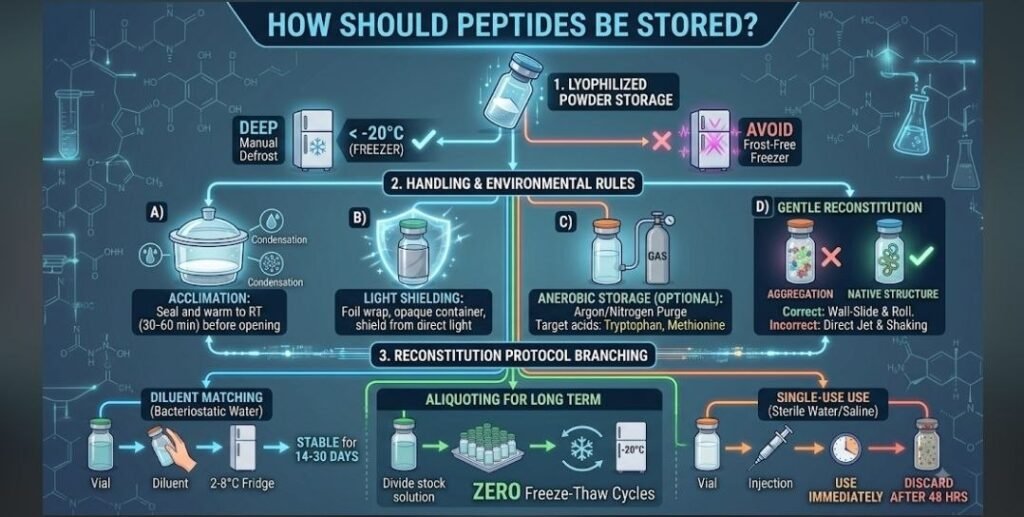
1. Allow the vial to equilibrate appropriately
A very cold vial brought directly into warm, humid air can develop condensation.
For a laboratory environment, controlled equilibration before opening can reduce this risk.
In particularly humid environments, a sealed secondary container can provide additional protection while the vial equilibrates.
2. Avoid unnecessary agitation
A common mistake is vigorously shaking a vial to accelerate dissolution.
For sensitive peptide or protein preparations, unnecessary mechanical agitation can encourage foaming and aggregation.
Gentle mixing is generally preferable when compatible with the product instructions.
3. Introduce liquid carefully
Where the product protocol permits, directing the diluent carefully along the vial wall can reduce the force directly applied to the powder.
The objective is controlled wetting rather than violent agitation.
4. Allow dissolution to occur
Do not assume that faster dissolution is always better dissolution.
Give the material appropriate time to hydrate and dissolve according to the validated protocol.
5. Return to the appropriate storage condition
Once prepared, follow the validated storage condition immediately.
Do not leave a prepared research solution sitting unnecessarily on a laboratory bench.
Aliquoting Peptides for Long-Term Storage
Aliquoting is one of the most effective ways to reduce unnecessary freeze-thaw exposure.
Suppose a researcher has a stock solution that will be needed over several weeks.
If the entire stock is repeatedly removed from the freezer, thawed, opened, and refrozen, the whole batch experiences repeated stress.
Instead, the material can be divided into appropriately sized research aliquots when the validated protocol permits.
Advantages of aliquoting
• Reduces freeze-thaw cycles
• Limits repeated vial opening
• Reduces contamination opportunities
• Makes inventory easier
• Improves experimental consistency
• Limits exposure of the entire batch when one aliquot is being used
Choose appropriate containers
Low-binding polypropylene tubes may be useful for some low-concentration peptide or protein solutions because adsorption to container surfaces can reduce recovery.
The correct container depends on the research application and formulation.
How Should Peptides Be Stored in Hot and Humid Climates?
This question is particularly important for researchers working in tropical and high-temperature regions.
A storage room reaching 30°C or higher creates a very different environment from a climate-controlled laboratory.
The biggest risks are:
• Heat
• Humidity
• Power interruptions
• Refrigerator/freezer cycling
• Poor transportation conditions
• Condensation
• Prolonged room-temperature exposure
Use temperature monitoring
Do not rely exclusively on the number displayed on the refrigerator or freezer.
A separate calibrated temperature-monitoring device provides much better information.
For critical inventory, laboratories may use alarms or data logging.
Prepare for power interruptions
In areas with unreliable electricity, consider an appropriate backup strategy for critical laboratory refrigeration or freezer equipment.
Depending on the laboratory environment, this may involve:
• UPS systems
• Backup generators
• Temperature alarms
• Emergency transfer plans
• Thermal buffering
The purpose is to prevent a short power interruption from becoming a major storage event.
Reduce humidity exposure
In hot, humid climates, opening a cold vial directly into humid air can produce condensation.
A controlled equilibration procedure is therefore particularly valuable.
Peptide Shipping and Receiving: Storage Starts Before the Vial Reaches You
Researchers sometimes focus entirely on what happens after delivery.
But temperature exposure during transportation can also matter.
A peptide can spend hours inside:
• A delivery truck
• A warehouse
• A mailbox
• An airport facility
• A hot vehicle
When the shipment arrives
Inspect the package.
Check:
• Vial integrity
• Labeling
• Physical condition
• Documentation
• Storage instructions
• Any signs of unusual exposure
If a product-specific temperature requirement exists, follow it.
Do not automatically discard a dry peptide simply because it arrived at room temperature unless the product’s specifications say that temperature exposure invalidates it.
Likewise, do not automatically assume that a shipment is unaffected merely because the powder looks normal.
Visual appearance is not a complete stability test
This distinction is extremely important.
A peptide may look normal while experiencing chemical changes that require analytical testing to detect.
How to Tell Whether a Peptide May Have Degraded
One of the most common questions researchers ask is:
“My peptide looks different. Is it still good?”
Appearance can provide useful clues, but it cannot establish chemical purity by itself.
Warning signs include:
• Unexpected cloudiness
• Visible particles
• Flakes
• Unexpected precipitation
• Unusual color change
• Changes in dissolution behavior
• Unexpected changes in assay performance
However, each observation needs interpretation.
For example, precipitation could reflect:
• Aggregation
• Poor solubility
• pH incompatibility
• Salt formation
• Concentration effects
Cloudiness
Persistent cloudiness in a solution can indicate aggregation, precipitation or contamination.
It should not simply be ignored.
Color change
A color change may indicate degradation or oxidation, but color alone cannot identify the specific chemical pathway.
The most important rule
Never use appearance alone to claim that a peptide has a specific percentage of purity.
That requires analytical testing.
HPLC and Mass Spectrometry: How Professionals Evaluate Peptide Quality
For researchers concerned about whether storage affected peptide quality, analytical testing can provide much stronger evidence than visual inspection.
HPLC
Reverse-phase HPLC can help evaluate the chromatographic profile of a peptide.
Researchers may compare:
• Main peak area
• Retention time
• Additional peaks
• Peak shape
• Relative purity
A previously sharp main peak that develops additional peaks may indicate the appearance of related substances or degradation products.
But chromatographic interpretation must be performed by someone qualified to interpret the specific method.
Mass spectrometry
Mass spectrometry can provide molecular-mass information.
This can help identify changes consistent with processes such as:
• Oxidation
• Cleavage
• Modification
• Other chemical changes
Again, interpretation depends on the peptide sequence and analytical method.
pH
For peptide solutions, pH can also be an important stability variable.
A change in pH can influence:
• Solubility
• Charge
• Aggregation
• Chemical reaction rates
• Assay behavior
The professional approach
When stability is important:
Do not guess. Test.
A Certificate of Analysis provides information about the material at the time and under the conditions covered by that analysis.
It does not automatically guarantee that a vial stored improperly months later has exactly the same analytical profile.
Real-World Peptide Storage Failure Case Study
A Representative Semaglutide/Tirzepatide Handling Failure
The following example illustrates how multiple handling errors can compound one another.
It should be understood as a representative storage-failure scenario, not as a claim that a particular named customer experienced these exact analytical results.
What happened?
A sensitive peptide preparation was subjected to several preventable handling errors:
1. A cold vial was handled without controlled equilibration.
2. Room-temperature diluent was introduced immediately.
3. The vial was vigorously shaken.
4. The prepared solution was left at room temperature.
5. The solution was exposed to light.
6. Refrigeration was delayed for several days.
7. The material was subsequently submitted for analytical evaluation.
Why is this problematic?
The individual problems can compound one another.
Temperature stress can affect stability.
Mechanical agitation can promote aggregation in susceptible preparations.
Light can contribute to photo-oxidative processes.
Extended room-temperature exposure can accelerate temperature-dependent degradation.
A conceptual pathway
Poor temperature control
↓
Mechanical agitation
↓
Solution stress
↓
Extended ambient exposure
↓
Potential aggregation / oxidation / degradation
↓
Possible changes in HPLC and MS profile
What might a researcher observe?
Depending on the peptide and formulation:
• Cloudiness
• Precipitation
• Particles
• Changed dissolution behavior
• Additional HPLC peaks
• Changes in peak shape
• Oxidation-related mass changes
What should not be claimed?
It would be scientifically inappropriate to say that every poorly stored peptide will automatically drop from >98% purity to below 80%.
That outcome cannot be predicted without testing.
Likewise, visible fibrils do not automatically prove a particular molecular degradation pathway.
The responsible approach is:
Observe → document → isolate the storage history → test analytically.
The most important lesson
A Certificate of Analysis represents analytical results for a particular sample at a particular point in the material’s lifecycle.
If the storage history changes, the analytical state can change too.
That is why proper storage is part of quality assurance.
The 15 Most Important Peptide Storage Rules
Rule 1: Keep lyophilized peptides dry
Moisture exposure can accelerate degradation for susceptible sequences.
Rule 2: Use the manufacturer’s storage specification first
Generic recommendations are useful starting points.
Product-specific documentation is better.
Rule 3: Use −20°C for many lyophilized peptides when appropriate
This is a common long-term research-storage condition, but not a universal requirement.
Rule 4: Consider −80°C only when justified
Colder is not automatically better.
Rule 5: Avoid unnecessary freeze-thaw cycles
Repeated cycling can compromise peptide and protein stability.
Rule 6: Protect sensitive peptides from intense light
Use suitable opaque secondary packaging or light-protective containers where appropriate.
Rule 7: Minimize oxygen exposure for oxidation-sensitive sequences
Argon or nitrogen protection may be appropriate for selected materials.
Rule 8: Keep vials tightly closed
Every unnecessary opening introduces another opportunity for moisture and environmental exposure.
Rule 9: Do not leave reconstituted solutions on the bench unnecessarily
Prepared solutions generally require more careful storage than dry material.
Rule 10: Do not assume every reconstituted peptide lasts 28 days
Stability must be established for the specific preparation.
Rule 11: Do not confuse sterility with chemical stability
A preservative can address microbial growth but does not prevent every chemical degradation pathway.
Rule 12: Use appropriate aliquots
Aliquoting can minimize repeated freezing and thawing.
Rule 13: Monitor storage temperatures
A calibrated independent monitoring system is preferable to guessing.
Rule 14: Treat hot climates differently
Heat, humidity and power interruptions require additional planning.
Rule 15: When quality matters, verify analytically
HPLC and mass spectrometry provide much stronger evidence than appearance alone.
10 Common Peptide Storage Mistakes Researchers Make
1. Storing every peptide at the same temperature
Different peptides have different stability profiles.
2. Assuming −80°C is always superior
The correct temperature depends on the product and validated conditions.
3. Using a frost-free freezer for everything
Repeated temperature cycling may be undesirable for sensitive long-term inventory.
4. Repeatedly opening the same vial
This exposes the material to environmental moisture and oxygen.
5. Repeatedly freezing and thawing solution
This can accelerate loss of stability.
6. Assuming a clear solution is automatically pure
Chemical degradation can occur without visible changes.
7. Assuming cloudiness identifies the exact problem
Cloudiness can have multiple causes.
8. Ignoring humidity
Humidity can be particularly problematic for lyophilized powders.
9. Leaving prepared solutions at room temperature
Temperature exposure can shorten stability depending on the preparation.
10. Ignoring the COA and product documentation
The storage specification supplied for the particular product should take precedence over generic internet advice.
Peptide Storage Quick-Reference Table
| Question | Practical answer |
| How should lyophilized peptides be stored? | Generally tightly closed, dry, protected from intense light, and commonly at −20°C for long-term storage when specified |
| Is 2–8°C acceptable? | For some peptides and shorter-term storage, yes; check product documentation |
| Is −20°C a common long-term condition?| | Yes, for many lyophilized research peptides |
| Is −80°C always better? | No |
| Should peptides be exposed to sunlight? | Avoid unnecessary intense light |
| Should repeated freeze-thaw cycles be avoided? | Yes |
| Should cold vials be opened immediately in humid air? | Prefer controlled equilibration first |
| Should reconstituted peptides automatically be stored for 28 days? | No; stability is preparation-specific |
| Is bacteriostatic water automatically a stability solution? | No; preservative and chemical stability are separate issues |
| Can appearance prove peptide purity? | No |
| What tests can evaluate degradation? | Depending on the material: HPLC, MS, and other validated analytical methods |
| Is a manual-defrost freezer useful? | It can be a practical option for stable long-term temperature control |
| Are hot climates more challenging? | Yes, because heat, humidity, and power interruptions increase storage risks |
Peptide Storage FAQ
How should peptides be stored long-term?
For many lyophilized research peptides, −20°C is a commonly recommended long-term storage condition. The vial should remain tightly closed, dry and protected from intense light. However, the specific manufacturer’s instructions should always take priority.
How should peptides be stored after reconstitution?
Follow the specific product and research protocol. Many peptide and protein preparations require refrigeration at 2–8°C for short-term use or aliquoting and freezing for longer-term research storage. There is no universal stability period for every reconstituted peptide.
Can peptides be stored in a refrigerator?
Some can.
2–8°C may be appropriate for short-term storage of certain lyophilized or reconstituted research materials.
But refrigeration is not automatically the correct long-term condition for every peptide.
Is −20°C good for peptide storage?
For many lyophilized research peptides, yes.
−20°C is a widely used long-term storage condition.
Is −80°C better than −20°C?
Not necessarily.
−80°C is useful for selected research materials, but the correct condition depends on validated stability information.
Can peptides be stored at room temperature?
Temporary room-temperature exposure may be tolerated by some dry peptides, depending on the product and conditions.
However, room temperature should not automatically be considered a long-term storage condition.
High temperatures are particularly undesirable.
Does light damage peptides?
Some peptides are more sensitive to light and oxidation than others.
Protecting sensitive materials from intense light is a sensible storage practice.
Does moisture damage peptides?
Yes, moisture can be a significant concern for lyophilized peptides.
Keeping the vial tightly closed and storing it in a dry environment helps reduce exposure.
Should peptide vials be frozen immediately after delivery?
Follow the product-specific storage instructions.
Some peptides have shipping conditions that permit temporary ambient transport, while long-term storage may require refrigeration or freezing.
Should peptides be aliquoted?
Aliquoting can be very useful when it prevents repeated freeze-thaw cycles and repeated opening of the same stock.
Can I repeatedly freeze and thaw a peptide?
Repeated freeze-thaw cycles should generally be avoided, particularly for solutions.
Does bacteriostatic water guarantee peptide stability?
No.
Bacteriostatic water contains a preservative intended to inhibit microbial growth, but it does not guarantee chemical stability of every peptide.
How long does a reconstituted peptide last in the refrigerator?
There is no universal answer.
The stability period depends on the peptide, formulation, concentration, diluent, pH, container, sterility conditions and validated stability data.
Some research preparations have published refrigerated stability periods of approximately one week, while others differ substantially.
How do I know whether a peptide has degraded?
Look for changes such as unexpected precipitation, particles, cloudiness or color changes, but do not rely on appearance alone.
For definitive evaluation, appropriate analytical testing such as HPLC and mass spectrometry may be necessary.
Can a peptide look normal but still be degraded?
Yes.
Visual appearance cannot establish chemical purity.
Does freezing destroy peptides?
Not automatically.
Many peptides are intentionally stored frozen.
The concern is uncontrolled temperature exposure, unsuitable formulations and repeated freeze-thaw cycling.
What is the biggest peptide storage mistake?
There is no single universal mistake, but repeated freeze-thaw exposure, moisture exposure, inappropriate temperature, prolonged heat exposure and poor handling of reconstituted solutions are among the most important problems.
Final Peptide Storage Checklist
Before putting a peptide into storage, ask these questions:
For lyophilized peptides
☐ Do I know the manufacturer’s recommended storage temperature?
☐ Is the vial tightly sealed?
☐ Is the storage environment dry?
☐ Is the peptide protected from intense light?
☐ Is the freezer temperature stable?
☐ Am I minimizing unnecessary vial openings?
☐ Is the peptide protected from repeated freeze-thaw exposure?
☐ Does the sequence contain oxidation-sensitive residues?
☐ Would a desiccant or inert-gas environment be appropriate?
☐ Is the vial correctly labeled?
For reconstituted peptides
☐ Is the diluent appropriate for this specific preparation?
☐ Is the storage temperature validated?
☐ Is the solution protected from unnecessary light?
☐ Is the container appropriate?
☐ Am I minimizing room-temperature exposure?
☐ Have I recorded the preparation date?
☐ Is the solution being accessed using appropriate sterile technique?
☐ Can I avoid repeated freeze-thaw cycles?
☐ Do I have an appropriate aliquoting strategy if long-term frozen storage is required?
☐ Do I understand the difference between chemical stability and microbiological control?
For hot climates
☐ Is the laboratory temperature controlled?
☐ Is humidity being managed?
☐ Is freezer temperature independently monitored?
☐ Is there a plan for power interruptions?
☐ Is critical inventory protected during transportation?
☐ Are cold vials equilibrated appropriately before opening?
A Simple Peptide Storage SOP
For researchers who want a simple operational framework, the following workflow is useful.
Step 1: Identify the peptide
Record:
• Name
• Sequence or product identifier
• Lot
• Form
• Supplier
• COA
• Storage specification
Step 2: Determine the physical state
Is it:
Lyophilized?
or
Reconstituted?
This determines the starting storage strategy.
Step 3: Check the manufacturer’s instructions
Do not replace product-specific documentation with a generic internet recommendation.
Step 4: Store dry material correctly
For many lyophilized research peptides, this means:
Tightly sealed → dry environment → light protection → −20°C long-term storage when specified.
Step 5: Minimize exposure
Avoid repeatedly opening the vial.
Avoid unnecessary movement.
Avoid unnecessary temperature changes.
Step 6: Reconstitute only what the research protocol requires
Once dissolved, the peptide may become substantially more sensitive to environmental conditions.
Step 7: Use the correct diluent
Follow the product-specific protocol.
Do not assume water, saline or bacteriostatic water is interchangeable for every sequence.
Step 8: Store the resulting solution according to validated conditions
For many research preparations this may involve controlled refrigeration or frozen aliquots, but the actual condition should be established for that preparation.
Step 9: Monitor
Record:
• Storage temperature
• Preparation date
• Handling events
• Any unusual appearance
• Any deviations from the intended protocol
Step 10: Investigate deviations
If a vial experiences unexpected heat, prolonged room-temperature exposure, freezer failure or repeated freeze-thaw cycles, document the event rather than assuming the material is unaffected.
For critical experiments, analytical verification may be appropriate.
The Five Golden Rules of Peptide Storage
After years of working around peptide research, I have found that complicated storage systems can often be reduced to five memorable principles.
1. The Thermal Equilibration Rule
Never open a cold vial directly into a warm, humid environment if condensation is likely.
Controlled equilibration can reduce moisture exposure.
2. The Gentle-Handling Rule
Do not treat a peptide vial like a bottle that needs vigorous shaking.
Use the gentlest mixing method compatible with the specific product protocol.
3. The Single-Thaw Rule
Avoid unnecessary freeze-thaw cycles.
Aliquoting can make this much easier.
4. The Environmental Shield Rule
Protect sensitive peptides from heat, moisture, oxygen and intense light.
Not every peptide requires every advanced protection method, but susceptible sequences benefit from appropriate environmental control.
5. The Documentation Rule
Storage without documentation is difficult to reproduce.
Record what happened to the material.
Know where it was stored.
Know when it was reconstituted.
Know whether the temperature was maintained.
Know what diluent was used.
This information can become invaluable when troubleshooting an unexpected research result.
How PeptideAmino Nation Approaches Peptide Education and Storage
Researchers should not have to rely on vague advice such as “keep it cold.”
Good peptide education should explain why storage conditions matter.
How OasBioScience Approaches Peptide Education and Storage
Researchers should not have to rely on vague advice such as “keep it cold.”
Good peptide education should explain why storage conditions matter.
At OasBioScience, our educational approach is built around helping researchers understand the practical factors that influence peptide handling rather than simply giving them a temperature number.
Our experience in peptide research education and supply has shown us that many storage problems are preventable.
Researchers often do not need a more complicated protocol.
They need a clearer protocol.
That means understanding the difference between:
– Dry and liquid peptide storage
– Short-term and long-term storage
– Chemical stability and sterility
– Temperature and temperature cycling
– Moisture and condensation
– Visual appearance and analytical purity
– Generic guidance and product-specific stability data
For additional peptide information, research resources and product-related information, visit OasBioScience at oasbioscience.com.
Why the COA Still Matters After Storage
A Certificate of Analysis is an important quality-control document.
It can provide information about the material when tested, including relevant analytical measurements such as HPLC purity and mass spectrometry.
But researchers should understand an important limitation:
A COA is not a permanent guarantee that the material will remain unchanged regardless of storage conditions.
Imagine a vial is tested when it is manufactured.
The analysis confirms its expected characteristics.
Months later, the vial has been repeatedly exposed to:
• Humidity
• Room temperature
• Light
• Multiple freeze-thaw cycles
The original COA does not erase those storage events.
If there is a serious question about the material’s current condition, the appropriate answer is analytical verification.
This is one reason professional research workflows treat storage as part of quality assurance rather than as an afterthought.
Peptide Storage Is About Stability, Not Just Temperature
One of the biggest mistakes in online peptide education is reducing the entire subject to:
“Store peptides at −20°C.”
That is incomplete.
Temperature is only one variable.
A better way to think about storage is:
Temperature + moisture + oxygen + light + formulation + time + handling.
If one of these variables changes, the stability picture can change.
For example:
A peptide stored at −20°C but repeatedly exposed to humid air may not be handled correctly.
A peptide stored at 2–8°C under an appropriate validated condition may be perfectly acceptable.
A peptide stored at −80°C may still experience problems if it is repeatedly removed, warmed and refrozen.
A reconstituted solution can be refrigerated and still require careful microbiological control.
The best storage protocol, therefore, considers the entire lifecycle of the material.
The Researcher’s Storage Mindset
The most reliable researchers approach peptide storage proactively.
They do not wait for the peptide to change color before thinking about stability.
They ask questions before opening the vial:
What does the manufacturer recommend?
How long will I need the material?
Will I be using it as a dry powder or solution?
How many times will I need to access it?
Can I reduce temperature cycling?
Is the sequence oxidation-sensitive?
Is humidity a concern?
What happens if the freezer loses power?
How will I know if something went wrong?
This mindset can prevent many avoidable storage failures.
Conclusion: How Should Peptides Be Stored?
So, how should peptides be stored?
The most accurate answer is not simply “freeze them.”
For many lyophilized research peptides, −20°C, dry, tightly sealed and protected from intense light is a strong general long-term storage framework when supported by the product documentation.
Some materials may have different validated requirements.
Some sensitive preparations may justify −80°C storage.
Some products may tolerate 2–8°C for shorter periods.
Once a peptide is reconstituted, the situation becomes more complicated because solution stability, temperature, pH, formulation, container interactions and microbiological control all become relevant.
The most important principles are consistent:
Keep peptides dry.
Control temperature.
Protect sensitive materials from light and oxygen.
Avoid unnecessary vial openings.
Avoid repeated freeze-thaw cycles.
Use the appropriate diluent.
Handle solutions carefully.
Use aliquots when appropriate.
Monitor temperature.
Do not confuse appearance with analytical purity.
And perhaps most importantly:
«Always start with the storage instructions for the specific peptide and formulation you are working with.»
Generic peptide-storage guidance is useful for building good habits, but peptide stability is ultimately sequence- and formulation-dependent.
When the material is important enough to justify a high-quality research experiment, it is important enough to store correctly.
A carefully stored peptide gives researchers something extremely valuable:
confidence that changes observed in the experiment are more likely to come from the experiment itself—not from preventable deterioration of the research material.
For additional peptide education and research-related information, visit “OasBioScience” (https://oasbioscience.com).
Continue Learning: If you found this guide helpful, you may also want to read our previous peptide education articles covering
- Which Peptides Are Beginners Using?
- Discover the most in demand peptides today in 2026
- What Bacteriostatic Water Should I Use For My Peptide?
- What’s Peptide Reconstitution?
- How Long Do Peptides Last? Learn
Scientific Reference: For additional peer-reviewed information on peptide stability, sterile preparation, and pharmaceutical reconstitution practices, visit PubMed:

