


No products in the cart.
How Long Do Peptides Last? The Complete Researcher’s Shelf-Life Guide
How Long Do Peptides Last? This is one of the most important questions both beginner researchers and experienced peptide professionals ask when working with research peptides.
The short answer is:
• Lyophilized (freeze-dried) peptides can often remain stable for years when stored correctly.
• Reconstituted peptides usually remain stable for days or weeks, not months or years.
The problem is that many researchers assume freezing makes peptides immortal. In reality, improper freezing, repeated freeze-thaw cycles, moisture exposure, and poor storage practices can destroy peptide integrity much faster than expected.
In this comprehensive pillar guide, you’ll learn:
• How long peptides last in lyophilized vs. liquid form
• The difference between Bacteriostatic Water and Sterile Water
• Why frost-free freezers can quietly damage peptides
• Real laboratory case studies
• HPLC and Mass Spectrometry signs of degradation
• The 5 storage mistakes that ruin peptides fastest
• Practical protocols for shipping, refrigeration, freezing, and aliquoting
Whether you’re a new peptide researcher or an experienced laboratory professional, this guide will help you maximize peptide stability, reduce wasted material, and improve experimental reproducibility.

Table of Contents
1. How Long Do Peptides Last? (Quick Answer)
2. The Biggest Shelf-Life Myth
3. Why Lyophilized Peptides Last Much Longer
4. Real Peptide Shelf-Life Table
5. How Long Do Reconstituted Peptides Last?
6. BAC Water vs. Sterile Water
7. The Freeze-Thaw Trap
8. Real Laboratory Case Study: The “Expired” AOD-9604 Vial
9. Which Peptides Have the Shortest Practical Lifespan?
10. HPLC & Mass Spectrometry Signs of Degradation
11. The 5 Storage Mistakes That Destroy Peptides Fastest
12. Shipping & Hot-Weather Cold-Chain Protection
13. Regional Laboratory Best Practices
14. Frequently Asked Questions
15. The One Rule Every Researcher Must Remember
16. Final Expert Conclusion
How Long Do Peptides Last? (Quick Answer)
https://pubmed.ncbi.nlm.nih.gov/
How Long Do Peptides Last? The practical answer depends on whether the peptide is dry or dissolved.
| Peptide Form | Storage Condition | Practical Research Shelf Life |
| Lyophilized powde | Room temperature (20–25°C) | 2–4 weeks |
| Lyophilized powder | 2–8°C | 6–12 months |
| Lyophilized powder | -20°C | 1–2+ years |
| Lyophilized powder | -80°C | 3–5+ years |
| Reconstituted (BAC water | 2–8°C | Up to ~28 days |
| Reconstituted (Sterile Water) | 2–8°C | 24–48 hours |
| Frozen single-use aliquots | -20°C / -80°C | 1–3 months (sequence dependent) |
This table answers the question How Long Do Peptides Last in a practical research context, but the real story is more complicated.
The Biggest Shelf-Life Myth
The most common misconception is:
«“It’s frozen, so it lasts forever.”»
This is false.
Freezing dramatically slows chemical degradation, but it does not stop all physical and chemical processes.
Two hidden problems are especially important:
Auto-Defrost Freezer Cycles
Most household and many laboratory freezers are frost-free. They periodically warm internal coils to remove ice buildup.
These tiny temperature fluctuations can cause:
• Micro-thawing
• Refreezing
• Aggregation
• Structural stress
• Loss of biological activity
Repeated Freeze-Thaw Cycles
Every time a liquid peptide is thawed and refrozen, it experiences:
• Ice-crystal formation
• Freeze-concentration effects
• Local pH shifts
• Increased aggregation risk
The Real Rule
A freezer preserves peptides effectively only when:
• it is a manual-defrost laboratory freezer,
• temperatures remain stable at -20°C or -80°C,
• and freeze-thaw cycles are minimized.
Why Lyophilized Peptides Last Much Longer
Understanding How Long Do Peptides Last requires understanding water.
Lyophilization Removes Water
Freeze-drying removes nearly all water from the peptide, dramatically slowing:
• Hydrolysis
• Oxidation
• Microbial growth
• Chemical side reactions
This is why dry peptides are far more stable than liquid peptides.
Example
A properly stored BPC-157 lyophilized vial may remain highly stable for 1–2 years at -20°C, while the same peptide dissolved in water may begin losing stability within weeks.
How Long Do Reconstituted Peptides Last?
This is where many researchers make costly mistakes.
The Clock Starts When You Add Liquid
Water is essential for peptide use, but it also enables hydrolysis, the gradual breakdown of peptide bonds by water molecules.
Important Principle
«Reconstitution starts the stability clock.»
Even if bacterial contamination is prevented, chemical degradation can still occur.
BAC Water vs. Sterile Water
Bacteriostatic Water
Contains
• 0.9% benzyl alcohol
Purpose
• Inhibits bacterial growth in multi-use vials.
Typical Shelf Life
• Up to ~28 days at 2–8°C
Important Clarification
BAC water helps prevent microbial contamination, but it does not stop oxidation, hydrolysis, or aggregation.
Sterile Water for Injection
Contains
• No preservative
Typical Shelf Life After Opening
• 24–48 hours maximum
Without a preservative, bacteria can multiply rapidly once the vial is punctured.
The Freeze-Thaw Trap
Many researchers unknowingly destroy peptides with this workflow:
1. Reconstitute a 5 mg vial.
2. Store it in the freezer.
3. Thaw it to remove a small amount.
4. Return the remaining liquid to the freezer.
5. Repeat this process for several weeks.
This repeated cycling often causes more damage than simple refrigerated storage.
Better Solution: Single-Use Aliquots
Professional Workflow
1. Reconstitute the peptide.
2. Divide it into small sterile aliquots (50–500 µL).
3. Freeze the aliquots individually.
4. Thaw only one aliquot at a time.
5. Discard any unused thawed remainder.
This is the standard approach used in many high-quality peptide research laboratories.
Real Laboratory Case Study: The “Expired” AOD-9604 Vial
A university research team believed a batch of AOD-9604 (HGH Frag 176-191) had expired.
What Happened?
Storage
• Lyophilized vial stored at -20°C for 4 months.
• Well within its expected shelf life.
Reconstitution
• Added 2 mL of Bacteriostatic Water.
Symptoms
• Immediate cloudiness
• Thick gel-like clumps
• Poor syringe recovery
• Apparent “loss of activity”
The researchers concluded the peptide had degraded during storage.
The Investigation
The remaining unopened vials were analyzed using:
• RP-HPLC
• Mass Spectrometry
Results
• Purity >98%
• Correct molecular weight
• No oxidation products
• No peptide fragmentation
The peptide had not expired at all.
The Real Cause
AOD-9604 is a highly hydrophobic peptide.
At near-neutral pH, its net charge approaches zero, allowing molecules to aggregate and form a hydrogel instead of dissolving.
The Fix
The lab added:
• 50–100 µL of 0.6% sterile acetic acid
Within 30 seconds of gentle swirling, the gel dissolved completely into a clear, fully active solution.
Key Lesson
«Cloudiness immediately after reconstitution is often a solubility or pH problem, not evidence that the peptide has expired.»
Which Peptides Have the Shortest Practical Lifespan?
Not all peptides behave the same way.
GLP-1 Analogues
These are among the most storage-sensitive peptides:
• Semaglutide
• Tirzepatide
• Retatrutide
• Liraglutide
They are relatively large, structurally complex oligopeptides that can:
• Aggregate
• Form inactive fibrils
• Lose activity after freeze-thaw exposure
Best Practice
• Store refrigerated at 2–8°C
• Avoid freezing after reconstitution unless validated stability data exists.
Growth Hormone Secretagogues
• CJC-1295
• Ipamorelin
These peptides are more sensitive to:
• Hydrolysis
• Oxidation
• Repeated freeze-thaw cycles
Hydrophobic Fragments
• AOD-9604
• HGH Frag 176-191
These sequences are particularly prone to:
• Precipitation
• Gelling
• Solubility changes during storage
HPLC & Mass Spectrometry Signs of Degradation
Experienced laboratories do not rely only on visual inspection.
RP-HPLC Warning Signs
Healthy Peptide
• Sharp, narrow peak
• Symmetrical peak shape
• High purity percentage
Degraded Peptide
• Shoulder peaks
• Peak broadening
• Tailing
• Reduced purity percentage
These changes often indicate:
• Aggregation
• Oxidation
• Deamidation
• Structural heterogeneity
Mass Spectrometry Warning Signs
Look for:
• Additional mass peaks
• Oxidation products
• Deamidation-related mass shifts
• Fragmentation products
These analytical changes provide much stronger evidence of degradation than cloudiness alone.
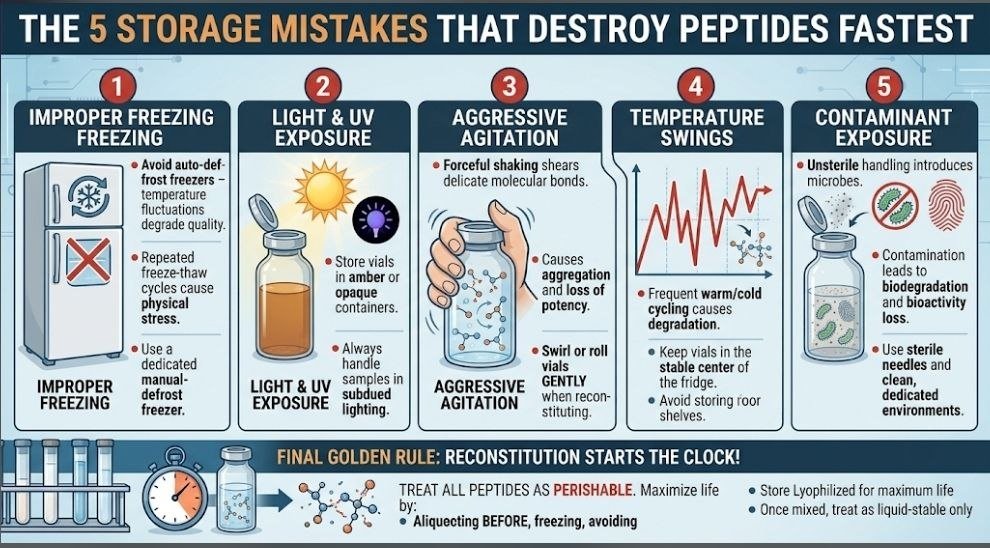
The 5 Storage Mistakes That Destroy Peptides Fastest
1. Opening Cold Lyophilized Vials
Warm humid air condenses inside the vial, introducing moisture before controlled reconstitution begins.
Fix
Allow the sealed vial to reach room temperature for 15–30 minutes before opening.
2. Repeated Freeze-Thaw Cycles
This is probably the most common preventable cause of peptide instability.
Fix
Use single-use aliquots.
3. Storing Peptides in Refrigerator Door Shelves
Door shelves experience constant:
• Temperature fluctuations
• Mechanical vibration
• Light exposure
Fix
Store peptides on a stable back shelf.
4. Exposure to Light
UV and strong visible light can accelerate oxidation of sensitive amino acids such as:
• Methionine
• Tryptophan
• Cysteine
Fix
Store vials in amber containers or their original packaging.
5. Using Standard Polypropylene Tubes for Hydrophobic Peptides
Hydrophobic peptides can adsorb to plastic surfaces, reducing the amount remaining in solution.
Fix
Use low-binding polypropylene tubes or glass mini-vials for sensitive sequences.
Shipping & Hot-Weather Cold-Chain Protection
Lyophilized Peptides
For short transit periods, conditioned gel packs are usually sufficient.
Reconstituted Liquid Peptides
For frozen liquid samples:
• Dry ice is strongly preferred
• Block dry ice lasts longer than pellets
• Use insulated double-box packaging
Include Temperature Loggers
A small electronic temperature data logger can record whether the shipment remained within the safe range throughout transit.
This is especially valuable for international shipments and high-value research materials.
What If the Dry Ice Is Gone on Arrival?
If a shipment arrives with completely sublimated dry ice:
Do Not Panic Immediately
Check:
• Is the peptide still cold?
• Is it still frozen?
• Is it lyophilized or liquid?
For Lyophilized Powder
Short-term warming during transit is often less serious than researchers assume.
For Liquid Peptides
Assume the sample may have experienced a freeze-thaw event and evaluate it more carefully before use.
Regional Laboratory Best Practices
United States
Common approach:
• Bacteriostatic Water
• Multi-use refrigerated stock solutions
• Frequent aseptic withdrawals
Strength
Convenient for high-frequency research.
Risk
Greater exposure to contamination and repeated handling.
Germany & United Kingdom
More common practices include:
• Sterile Water or PBS
• Immediate single-use aliquoting
• Laminar-flow hood preparation
• Minimal preservative exposure
This approach is particularly useful for sensitive analytical assays.
Australia
Australian laboratories often place greater emphasis on:
• Cold-chain verification
• Shipping temperature monitoring
• Immediate intake quality checks
This is partly due to long international shipping routes and hotter transit conditions.
Frequently Asked Questions
How Long Do Peptides Last at Room Temperature?
Lyophilized Powder
• Usually 2–4 weeks maximum.
Reconstituted Peptides
• Generally not recommended for extended room-temperature storage.
How Long Do Peptides Last in the Refrigerator?
With BAC Water
• Often up to ~28 days.
With Sterile Water
• Usually 24–48 hours.
Actual stability depends on the specific peptide sequence.
How Long Do Peptides Last in the Freezer?
Lyophilized Powder
• -20°C: 1–2+ years
• -80°C: 3–5+ years or longer for many sequences
Reconstituted Liquid
• Usually 1–3 months maximum when frozen as single-use aliquots and thawed only once.
Can I Use a Peptide After It Turns Cloudy?
Not automatically.
Determine when the cloudiness appeared:
| Situation | Most Likely Cause |
| Cloudy immediately after mixing | Solubility / pH issue |
| Clear initially, cloudy days later | Aggregation or contamination |
| Clear initially, cloudy days later | Freeze-thaw damage |
The One Rule Every Researcher Must Remember
If you remember only one thing from this entire guide, remember this:
«The clock on peptide stability does not start when you receive the vial—it starts when you add liquid. Keep dry powder frozen for long-term storage, but once reconstituted, treat it like a perishable liquid: keep it cold, handle it gently, and use it within weeks, not months.»
This single principle prevents the majority of peptide storage failures encountered in real laboratories.
Final Expert Conclusion
So, How Long Do Peptides Last?
The evidence-based answer is:
Lyophilized Peptides
• Can remain stable for years when stored properly at -20°C or -80°C.
• Must be protected from moisture, heat, and light.
Reconstituted Peptides
• Usually remain stable for days to weeks, not indefinitely.
• Require careful control of:
- Temperature
• Solvent selection
• Freeze-thaw exposure
• Container material
• Light exposure
• Handling frequency
The biggest mistake researchers make is assuming that cold temperature alone guarantees stability. In reality, peptide longevity depends on sequence chemistry, storage conditions, handling practices, and analytical verification.
By following the protocols in this guide—proper aliquoting, stable refrigeration, low-binding containers, minimal freeze-thaw cycles, and careful solvent selection—both beginner researchers and experienced peptide professionals can dramatically improve peptide shelf life, reduce wasted material, and generate more reliable experimental results.
Understanding How Long Do Peptides Last is not just about extending storage time—it is about protecting peptide potency, research reproducibility, and the integrity of the entire experiment.
Peptide Shelf-Life Red Flags
* Cloudy immediately after mixing: Usually solubility or pH issue
* Clear initially, cloudy after several days: Possible aggregation or contamination
* Flattened HPLC peak or shoulder peak: Potential freeze-thaw degradation
* +1 Da mass shift on MS: Possible deamidation
* Foaming after vigorous shaking: Increased risk of oxidation and aggregation
* Significant peptide loss from dilute solutions: Often caused by adsorption to standard polypropylene tubes
Expand Your Knowledge On Peptide Study, Educate Yourself With The Following Topics
Scientific Reference: For additional peer-reviewed information on peptide stability, sterile preparation, and pharmaceutical reconstitution practices, visit PubMed: https://pubmed.ncbi.nlm.nih.gov/

