

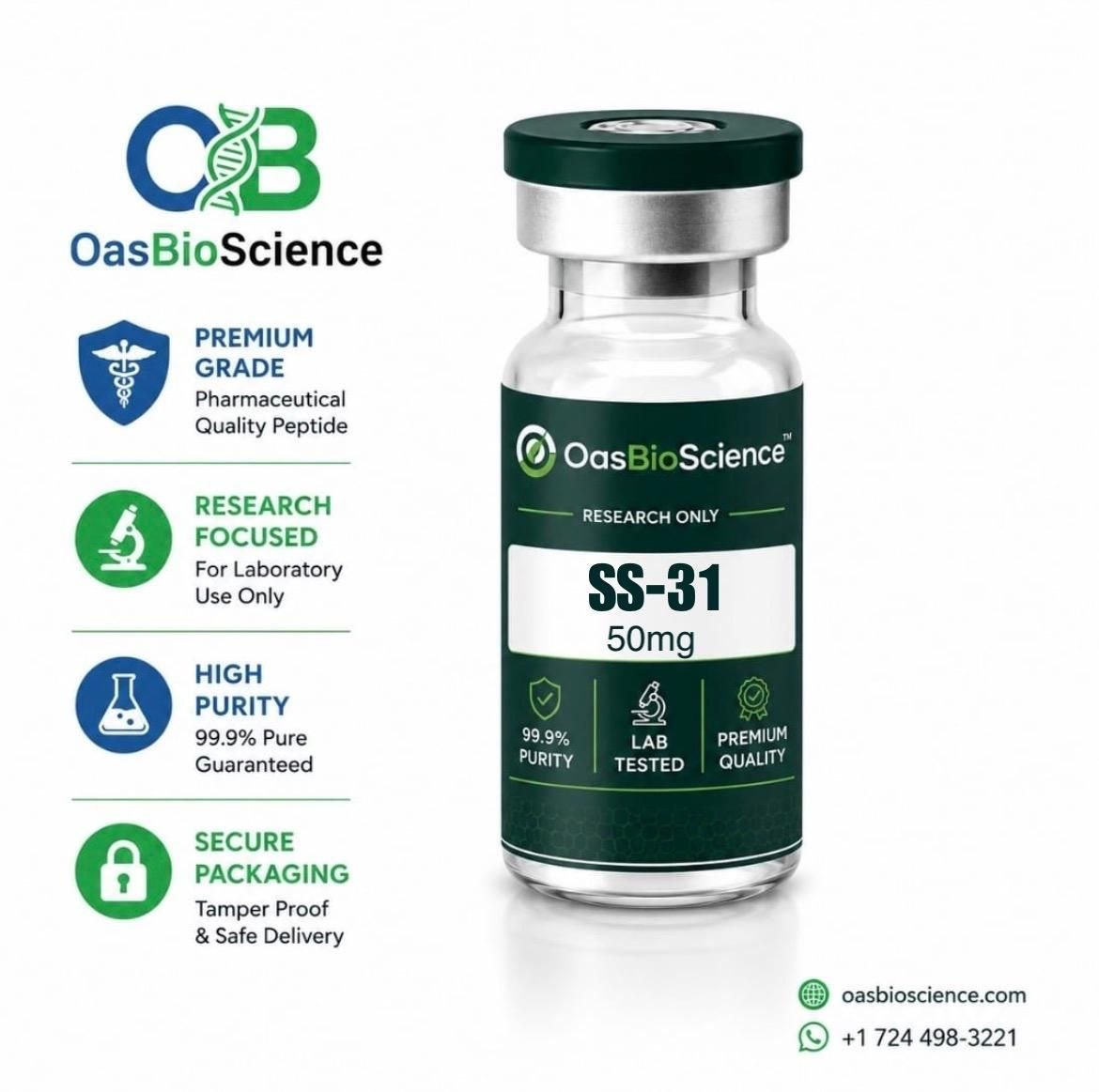
Description
SS-31 Peptide
Unlike many conventional peptides, SS-31 has been designed with physicochemical properties that promote interaction with mitochondrial membranes, particularly the mitochondrial phospholipid cardiolipin.
Because mitochondria play a central role in cellular energy production and oxidative processes, SS-31 has attracted research interest in areas including mitochondrial function, cellular metabolism, oxidative stress, and membrane biology.
Research Use Only: SS-31 Peptide is supplied for laboratory and scientific research purposes only. It is not intended for human or veterinary administration, diagnosis, treatment, cure, or prevention of disease.
What Is SS-31 Peptide?
SS-31 Peptide, commonly referred to as Elamipretide, is a synthetic tetrapeptide designed to interact with mitochondrial membranes.
The peptide belongs to a class of mitochondria-targeted peptides and has been investigated for its interaction with cardiolipin, a distinctive phospholipid found in the inner mitochondrial membrane.
Researchers have studied SS-31 in areas such as:
- Mitochondrial biology
- Cellular energy metabolism
- Oxidative-stress research
- Cardiolipin biology
- Mitochondrial membrane research
- Peptide chemistry
- Cellular signaling
- Preclinical research models
Its research interest comes largely from the relationship between mitochondrial membrane structure, cardiolipin, and mitochondrial function.
Importantly, research findings from laboratory or preclinical models should not automatically be interpreted as evidence of an approved clinical application.
Molecular Formula, Molecular Weight & Sequence
Commonly reported specifications for SS-31 / Elamipretide include:
| Property | Specification |
|---|---|
| Product name | SS-31 Peptide |
| Alternative names | Elamipretide, MTP-131, Bendavia |
| Peptide length | 4 amino acids |
| Sequence | D-Arg-Dmt-Lys-Phe-NH₂ |
| Molecular formula | C₃₂H₄₉N₉O₄ |
| Molecular weight | Approximately 640.78 g/mol |
| CAS number | 736992-21-5 |
Understanding the sequence
The sequence contains several important structural features:
- D-Arg: D-arginine
- Dmt: 2′,6′-dimethyl-L-tyrosine
- Lys: lysine
- Phe-NH₂: C-terminal amidated phenylalanine
These structural characteristics contribute to the peptide’s distinctive physicochemical properties.
For professional research, the calculated molecular weight should be compared with the observed mass from mass spectrometry where available.
Purity
A suitable research-grade specification for SS-31 may be:
Purity: ≥98% by HPLC
The actual purity should always be confirmed through the batch-specific Certificate of Analysis (COA).
A professional analytical package may include:
- HPLC purity percentage
- HPLC chromatogram
- Mass spectrometry
- Calculated molecular weight
- Observed molecular weight
- Lot/batch number
- Testing date
- Net peptide quantity
Researchers should evaluate the analytical results for the specific lot rather than relying solely on a general product-page purity claim.
Appearance
Appearance: White to off-white lyophilized powder.
SS-31 may be supplied as a dry, lyophilized research material.
Minor differences in powder appearance or texture can occur because of manufacturing and drying conditions.
Visual inspection alone cannot confirm peptide identity or purity. Appropriate analytical testing such as HPLC and mass spectrometry should be used when verification is required.
Available Vial Sizes
SS-31 Peptide can be supplied in different quantities depending on laboratory requirements.
Common research vial sizes include:
- 5 mg
- 10 mg
- 20 mg
- 50 mg
- 100 mg
For smaller research projects, 10 mg and 20 mg formats may provide practical quantities for laboratory investigations.
Larger quantities may be suitable for laboratories conducting repeated experiments or analytical studies.
Only list vial sizes that correspond to the actual product you stock and can document.
Storage Recommendations
Proper storage helps maintain the quality of lyophilized SS-31.
General considerations include:
- Keep the vial tightly sealed.
- Protect the material from moisture.
- Minimize exposure to excessive heat.
- Protect from unnecessary direct light.
- Avoid repeated temperature cycling.
- Follow the manufacturer’s documented storage requirements.
- Allow refrigerated or frozen material to equilibrate appropriately before opening to reduce condensation.
For long-term storage, researchers should follow the validated stability information supplied for the specific batch.
Important: Storage requirements can vary depending on formulation, packaging, and stability data. The manufacturer’s batch-specific documentation should take priority over generic recommendations.
Reconstitution Information
SS-31 is supplied as a lyophilized research peptide.
Reconstitution should be performed according to the laboratory’s intended application and validated protocol.
General considerations include:
- Allow the sealed vial to equilibrate appropriately before opening.
- Select a compatible laboratory-grade solvent.
- Add the solvent carefully.
- Avoid unnecessarily vigorous agitation.
- Allow sufficient time for the material to dissolve.
- Minimize excessive foaming.
- Record the solvent, concentration, and preparation date.
- Consider aliquoting where appropriate to minimize repeated freeze–thaw exposure.
There is no universal reconstitution volume suitable for every SS-31 experiment.
Researchers should establish preparation conditions according to their experimental design, concentration requirements, solvent compatibility, and validated laboratory procedures.
Intended Use — Research Only
SS-31 Peptide is intended for laboratory and scientific research.
Potential research applications include:
- Mitochondrial biology
- Cardiolipin research
- Cellular metabolism
- Oxidative-stress studies
- Mitochondrial membrane research
- Peptide chemistry
- Cellular signaling
- Preclinical laboratory studies
SS-31 should not be marketed as:
- An injectable research treatment
- A prescription medicine
- A supplement
- A guaranteed treatment for mitochondrial disorders
- A treatment for cardiovascular, neurological, or metabolic disease
Research Use Only. Not for Human or Veterinary Administration.
Researchers are responsible for complying with applicable laws, institutional requirements, and laboratory safety procedures.
Packaging & Shipping Information
SS-31 Peptide should be packaged appropriately to protect the lyophilized material during transportation.
Professional research packaging may include:
- Securely sealed vial
- Product identification label
- Net peptide quantity
- Lot/batch number
- Research-use statement
- Protective secondary packaging
- Batch-specific COA or analytical documentation
Upon receipt, inspect the vial and packaging for visible damage.
Before placing the material into laboratory inventory, verify:
Product name + quantity + lot number + chemical form + COA
Shipping conditions should follow the applicable stability requirements and relevant transportation regulations.
Frequently Asked Questions About SS-31 Peptide
What is SS-31 Peptide?
SS-31 is a synthetic mitochondria-targeted tetrapeptide commonly known as Elamipretide.
What are other names for SS-31?
SS-31 is also known as:
- Elamipretide
- MTP-131
- Bendavia
What is the sequence of SS-31?
The commonly reported sequence is:
D-Arg-Dmt-Lys-Phe-NH₂
How many amino acids are in SS-31?
SS-31 is a tetrapeptide, meaning it contains four amino-acid residues.
What is the molecular formula?
The commonly reported molecular formula is:
C₃₂H₄₉N₉O₄
What is the molecular weight?
The reported molecular weight is approximately:
640.78 g/mol
What is SS-31 researched for?
SS-31 is primarily studied in mitochondrial biology, cardiolipin research, cellular metabolism, oxidative-stress research, and mitochondrial membrane studies.
What purity should researchers look for?
A research-grade product may specify ≥98% purity by HPLC. The actual purity should be verified using the batch-specific COA.
What does SS-31 Peptide look like?
It is generally supplied as a white to off-white lyophilized powder.
Should SS-31 come with a COA?
For professional research supply, batch-specific analytical documentation is highly valuable. Researchers should look for HPLC purity, mass spectrometry, molecular-weight information, lot number, and testing date where available.
How should SS-31 be stored?
Follow the storage conditions supplied with the specific batch. Protect the lyophilized peptide from moisture, excessive heat, unnecessary light exposure, and repeated temperature cycling.
How is SS-31 reconstituted?
Preparation depends on the intended research application, solvent compatibility, concentration, and laboratory protocol. There is no universal reconstitution volume appropriate for every experiment.
Is SS-31 the same as Elamipretide?
Yes. Elamipretide is the commonly used name for SS-31.
Is SS-31 approved as a general treatment?
SS-31/Elamipretide has been investigated clinically, but a research-grade product should not be represented on a product page as an approved treatment or as a substitute for regulated medical products.
Is SS-31 intended for injection?
A research-grade SS-31 product should not be presented as an injectable product. It is supplied for laboratory research.
Key Takeaway
SS-31 Peptide, also known as Elamipretide, is a synthetic mitochondria-targeted tetrapeptide that has attracted substantial research interest because of its interaction with mitochondrial membranes and cardiolipin.
Key commonly reported specifications include:
- Sequence: D-Arg-Dmt-Lys-Phe-NH₂
- Molecular formula: C₃₂H₄₉N₉O₄
- Molecular weight: approximately 640.78 g/mol
- Purity: ≥98% by HPLC as a potential research-grade specification
- Appearance: White to off-white lyophilized powder
For professional research purchasing, always verify the exact material using the batch-specific COA, including purity and identity testing.
A high-quality SS-31 product page should provide accurate chemical specifications, transparent analytical documentation, appropriate storage information, and a clear research-use-only statement.
Research Use Only. Not for Human or Veterinary Administration.
Continue Learning: If you found this guide helpful, you may also want to read our previous peptide education articles covering the following topics
- What Bacteriostatic Water Should I Use For My Peptide?
- What’s Peptide Reconstitution?
- How Long Do Peptides Last?
- How Should Peptides Be Stored?
- Peptide Bubbles after reconstitution?
- Which peptide suppresses appetite the most?
Scientific Reference: For additional peer-reviewed information on peptide stability, sterile preparation, and pharmaceutical reconstitution practices, visit
National Center for Biotechnology Information (NCBI)
PubMed – Peer-Reviewed Biomedical Literature

Reviews
There are no reviews yet.