
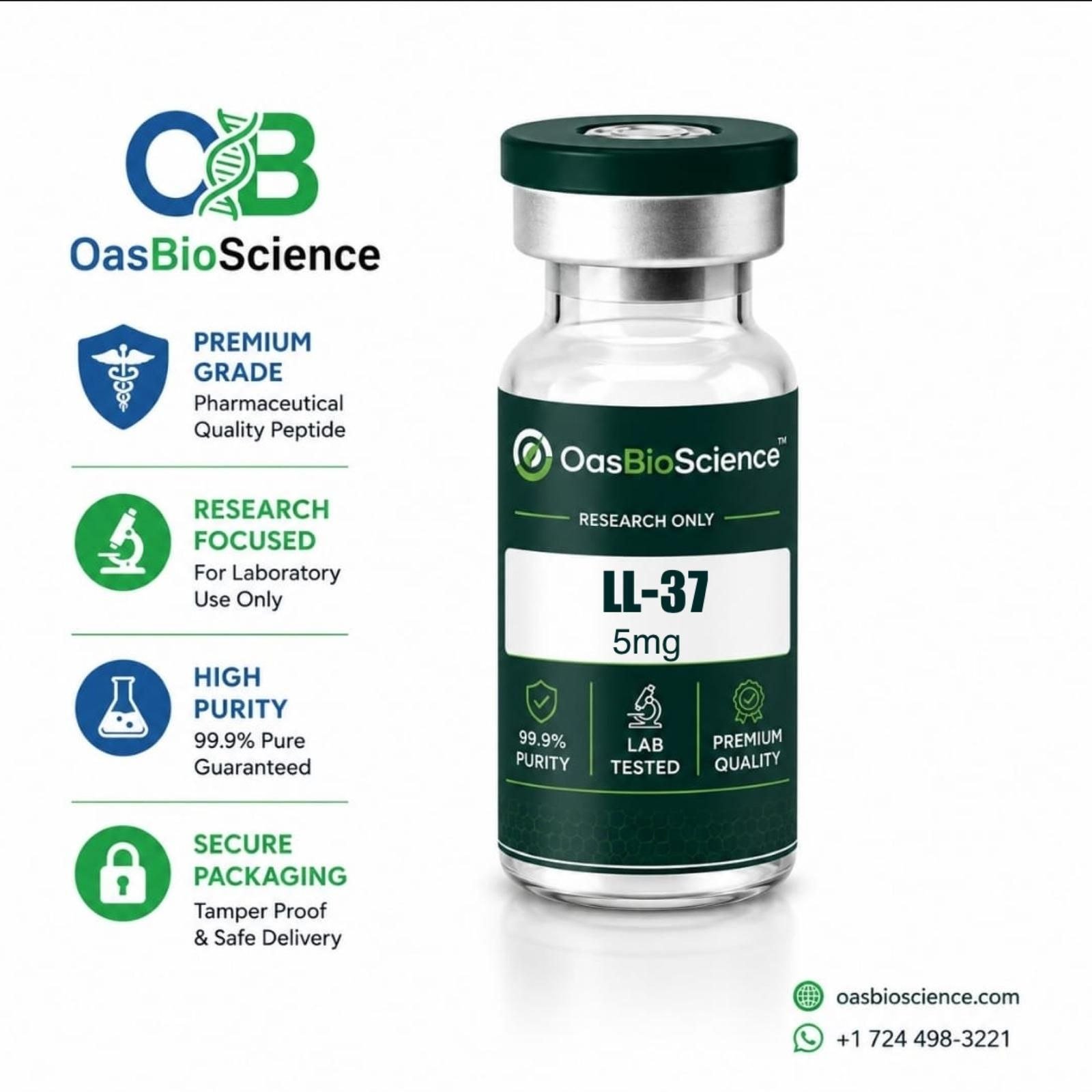
Description
LL-37 Peptide Overview
LL-37 Peptide is a synthetic 37-amino-acid peptide derived from the human cathelicidin precursor hCAP18 (CAMP). It is one of the best-characterized human antimicrobial peptides and has been widely investigated in laboratory research involving innate immunity, host defense, membrane interactions, inflammation-related signaling, and cellular biology.
LL-37 is particularly interesting to researchers because of its amphipathic structure and interaction with biological membranes. Laboratory studies have examined its interactions with microorganisms, lipids, nucleic acids, and several cellular signaling pathways.
Research Use Only: LL-37 Peptide is supplied for laboratory and scientific research purposes only. It is not intended for human or veterinary use, diagnosis, treatment, cure, or prevention of disease.
What Is LL-37 Peptide?
LL-37 is a naturally occurring human antimicrobial peptide derived from the C-terminal region of the 18-kDa cationic antimicrobial protein (hCAP18).
The peptide contains 37 amino acids and forms part of the body’s innate immune defense system.
LL-37 has attracted significant research interest because of its broad biological activity in laboratory models. Researchers have investigated its interactions with membranes, microbial components, immune-related signaling pathways, and cellular processes.
Common research areas include:
- Antimicrobial peptide research
- Innate immune system studies
- Membrane interaction studies
- Host-defense mechanisms
- Inflammation-related research
- Cell signaling
- Peptide structure and function
- Lipid–peptide interactions
- Peptide stability and characterization
The biological effects observed in laboratory studies depend on experimental conditions, concentration, peptide preparation, and model system. Preclinical findings should not automatically be interpreted as evidence of clinical effectiveness.
Molecular Formula, Molecular Weight & Sequence
Commonly reported specifications for the mature human LL-37 peptide are:
| Property | Specification |
|---|---|
| Product name | LL-37 Peptide |
| Peptide type | Synthetic antimicrobial peptide |
| Length | 37 amino acids |
| Sequence | LLGDFFRKSKEKIGKEFKRIVQRIKDFLRNLVPRTES |
| Molecular formula | C₂₀₅H₃₄₀N₆₀O₅₃ |
| Molecular weight | Approximately 4493.4 g/mol |
| Gene precursor | CAMP / hCAP18 |
The sequence is commonly written using the one-letter amino-acid code:
LLGDFFRKSKEKIGKEFKRIVQRIKDFLRNLVPRTES
Important specification note
Molecular weight can differ depending on the precise chemical form, terminal modifications, counterions, or formulation.
For this reason, researchers should compare:
Sequence → chemical form → calculated molecular weight → observed MS mass → COA
when verifying a specific batch.
This is especially important for research peptides because a small change in terminal chemistry can alter the molecular mass reported by analytical instruments.
Purity
A suitable research-grade specification for LL-37 Peptide may be:
Purity: ≥98% by HPLC
The actual purity should always be confirmed using the batch-specific Certificate of Analysis (COA).
Professional analytical documentation may include:
- HPLC purity percentage
- HPLC chromatogram
- Mass spectrometry
- Calculated molecular weight
- Observed molecular weight
- Lot or batch number
- Testing date
- Net peptide quantity
For serious laboratory work, a batch-specific COA is preferable to relying only on a general product-page purity claim.
Appearance
Appearance: White to off-white lyophilized powder.
LL-37 is commonly supplied in lyophilized form for controlled laboratory storage and handling.
Minor variations in powder texture or color may occur due to manufacturing and drying conditions.
However, appearance alone does not establish peptide identity or purity. Analytical techniques such as HPLC and mass spectrometry are more appropriate when verification is required.
Available Vial Sizes
LL-37 Peptide can be offered in multiple research quantities depending on laboratory requirements.
Common vial sizes include:
- 2 mg
- 5 mg
- 10 mg
- 20 mg
- 50 mg
For many laboratory projects, 5 mg and 10 mg formats provide convenient research quantities.
Larger quantities may be suitable for laboratories conducting repeated experiments, assay development, or analytical research.
Always state the net peptide quantity per vial clearly on the product page and product label.
Storage Recommendations
Proper storage is important for maintaining peptide quality.
For lyophilized LL-37:
- Follow the storage temperature specified in the product documentation.
- Keep the vial tightly sealed when not in use.
- Protect the material from moisture.
- Minimize exposure to excessive heat and direct light.
- Avoid unnecessary temperature cycling.
- Allow a cold vial to equilibrate appropriately before opening to minimize condensation.
Controlled frozen storage may be appropriate for long-term preservation when supported by applicable stability information.
Important: Exact storage requirements can depend on peptide formulation, packaging, and stability data. The instructions supplied with the specific batch should take priority.
Reconstitution Information
LL-37 Peptide is supplied as a lyophilized research material. When reconstitution is required, researchers should select a solvent and concentration compatible with their validated experimental protocol.
LL-37 is a cationic, amphipathic peptide, so its solubility can depend on solvent composition, pH, ionic strength, and concentration.
General laboratory considerations include:
- Allow the sealed vial to reach an appropriate temperature before opening.
- Select a solvent compatible with the intended experiment.
- Introduce the solvent carefully.
- Avoid unnecessarily vigorous agitation.
- Allow adequate time for dissolution.
- Minimize excessive foaming.
- Consider aliquoting where appropriate to reduce repeated freeze–thaw exposure.
- Record the solvent, concentration, preparation date, and storage conditions.
There is no single reconstitution volume appropriate for every LL-37 experiment.
Researchers should establish the required working concentration according to their specific laboratory protocol.
Intended Use — Research Use Only
LL-37 Peptide is intended exclusively for laboratory research.
It should not be represented as:
- A dietary supplement
- An approved antimicrobial medicine
- A treatment for infection
- A general wellness product
- A product for self-administration
This material is not intended for human or veterinary administration.
Researchers are responsible for complying with applicable institutional procedures, laboratory safety requirements, and regulations.
Research Use Only. Not for Human or Veterinary Use.
Packaging & Shipping Information
LL-37 Peptide should be packaged appropriately to protect the lyophilized material during normal transportation.
Professional research packaging may include:
- Securely sealed peptide vial
- Product identification label
- Net peptide quantity
- Lot/batch number
- Research-use-only statement
- Protective secondary packaging
- Batch-specific COA or analytical documentation, where applicable
Upon receipt, researchers should inspect the vial and packaging for visible damage.
Before placing the material into laboratory inventory, verify:
Product name + quantity + lot number + chemical form + COA
Shipping conditions should follow the applicable stability requirements and relevant transportation regulations.
Frequently Asked Questions About LL-37 Peptide
What is LL-37 Peptide?
LL-37 is a naturally occurring human antimicrobial peptide derived from the hCAP18/CAMP precursor and is widely studied in innate immunity and peptide biology research.
How many amino acids are in LL-37?
LL-37 contains 37 amino-acid residues.
What is the sequence of LL-37?
The commonly reported mature human LL-37 sequence is:
LLGDFFRKSKEKIGKEFKRIVQRIKDFLRNLVPRTES
What is the molecular weight of LL-37?
The commonly reported molecular weight of the mature peptide is approximately 4.49 kDa, although the exact observed mass can depend on chemical form and analytical conditions.
What is LL-37 derived from?
LL-37 is derived from the C-terminal region of the human hCAP18/CAMP precursor protein.
What does LL-37 research focus on?
Research has investigated LL-37 in areas including innate immunity, antimicrobial peptide biology, membrane interactions, inflammation-related signaling, and cellular responses.
What purity should researchers look for?
A research-grade product may specify ≥98% purity by HPLC. Researchers should confirm the actual batch result using the product’s COA.
What does LL-37 Peptide look like?
Research-grade LL-37 is generally supplied as a white to off-white lyophilized powder.
Should LL-37 come with a COA?
For professional research supply, batch-specific analytical documentation is highly valuable. Researchers should look for HPLC purity, mass spectrometry, molecular-weight information, lot number, and testing date where available.
How should LL-37 be stored?
Follow the storage conditions supplied with the specific batch. Protect the lyophilized peptide from moisture, excessive heat, direct light, and unnecessary temperature cycling.
How is LL-37 reconstituted?
Reconstitution depends on the experimental protocol, solvent compatibility, desired concentration, and peptide formulation. There is no universal reconstitution volume suitable for every research application.
Is LL-37 an approved human medicine?
The presence of LL-37 in human biology does not mean that a commercially supplied LL-37 research peptide is an approved medicine. This product should be presented as research use only.
Why is the COA important?
The COA allows researchers to connect the product they receive with analytical results for that specific batch, including purity and identity information.
11. Key Takeaway
LL-37 Peptide is a 37-amino-acid human cathelicidin peptide that has become an important research model for studying antimicrobial peptide biology, innate immunity, membrane interactions, and cellular signaling.
The commonly reported mature LL-37 sequence is:
LLGDFFRKSKEKIGKEFKRIVQRIKDFLRNLVPRTES
with a molecular weight of approximately 4493.4 g/mol for the mature peptide.
For professional research purchasing, researchers should verify the exact:
- Amino-acid sequence
- Chemical form
- Molecular weight
- HPLC purity
- Mass-spectrometry result
- Lot number
- Batch-specific COA
- Storage requirements
A high-quality LL-37 product page should focus on accurate specifications, transparent analytical documentation, appropriate handling information, and clear research-use labeling, rather than unsupported therapeutic claims.
Research Use Only. Not for Human or Veterinary Use.
Continue Learning: If you found this guide helpful, you may also want to read our previous peptide education articles covering the below topics
- Which peptide suppresses appetite the most?
- Peptide Bubbles after reconstitution?
- Are peptides legal?
- Are peptides safe?
- How Are Peptides Made?
- Peptide Purity explained in depth
- How Should Peptides Be Stored?
Scientific Reference: For additional peer-reviewed information on peptide stability, sterile preparation, and pharmaceutical reconstitution practices, visit PubMed


Reviews
There are no reviews yet.