


No products in the cart.
Are Peptides Safe? 11 Powerful Safety Checks Every Researcher Should Know
Before asking “Are peptides safe?”, researchers need to understand that peptide safety is not determined by a single purity percentage or a supplier’s label. In this guide, we examine the real factors that influence peptide safety, including purity, identity, contamination, COA verification, storage, degradation, analytical testing, reconstitution errors, and regulatory status. Drawing from more than two decades of experience supplying and educating researchers, we also examine real-world troubleshooting cases that show how mathematical errors, poor storage, and inadequate quality control can create problems that may initially appear to be peptide toxicity. By the end, you’ll have a practical framework for evaluating peptide quality and making more informed research decisions.
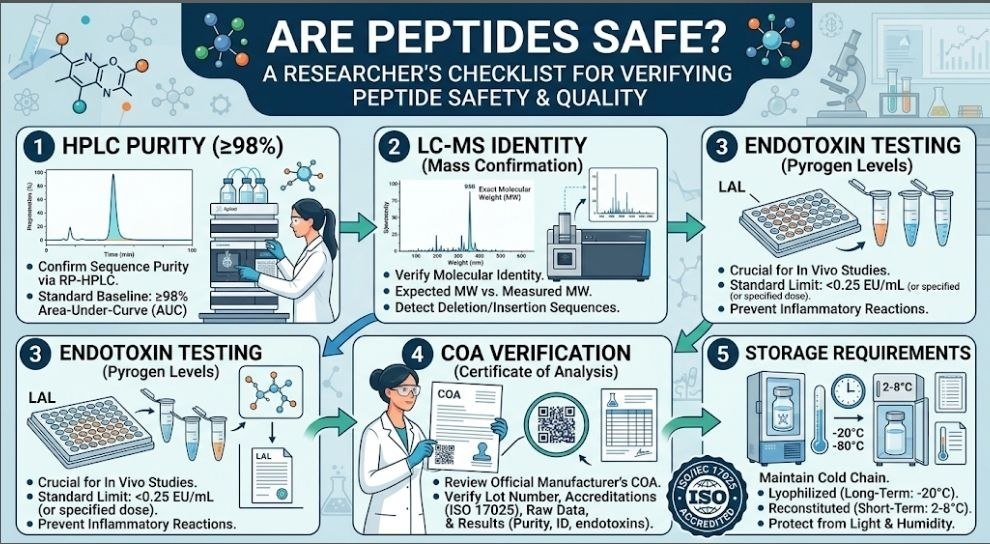
Table of Contents
1. “Are Peptides Safe? The Short Answer” (#are-peptides-safe-the-short-answer)
2. “Why Asking “Are Peptides Safe?” Is the Wrong First Question” (#why-asking-are-peptides-safe-is-the-wrong-first-question)
3. “What Actually Determines Peptide Safety?” (#what-actually-determines-peptide-safety)
4. “Are Peptides Safe When Purity Is 98% or Higher?” (#are-peptides-safe-when-purity-is-98-or-higher)
5. “Why HPLC Purity Alone Does Not Prove Safety” (#why-hplc-purity-alone-does-not-prove-safety)
6. “The 6 Major Peptide Safety Risks Researchers Should Understand” (#the-6-major-peptide-safety-risks-researchers-should-understand)
7. “Three Real-World Peptide Safety Case Studies” (#three-real-world-peptide-safety-case-studies)
8. “How Analytical Testing Protects Peptide Quality” (#how-analytical-testing-protects-peptide-quality)
9. “How to Read a Peptide COA for Safety” (#how-to-read-a-peptide-coa-for-safety)
10. “Are Peptides Safe After Reconstitution?” (#are-peptides-safe-after-reconstitution)
11. “Are Peptides Safe When Stored Incorrectly?” (#are-peptides-safe-when-stored-incorrectly)
12. “Are Peptides Safe for Human Use? Research Peptides vs Approved Medicines” (#are-peptides-safe-for-human-use-research-peptides-vs-approved-medicines)
13. “FDA, Europe, and International Regulatory Considerations” (#fda-europe-and-international-regulatory-considerations)
14. “Common Myths About Peptide Safety” (#common-myths-about-peptide-safety)
15. “Peptide Safety Checklist” (#peptide-safety-checklist)
16. “When You Should Not Use a Peptide Sample” (#when-you-should-not-use-a-peptide-sample)
17. “How OasBioScience Approaches Peptide Education” (#how-oasbioscience-approaches-peptide-education)
18. “Frequently Asked Questions” (#frequently-asked-questions)
19. “Final Answer: Are Peptides Safe?” (#final-answer-are-peptides-safe)
Are Peptides Safe? The Short Answer
Are peptides safe? There is no scientifically responsible yes-or-no answer that applies to every peptide.
Peptides are a broad class of molecules. Some are naturally occurring biological molecules. Others are synthetic research compounds. Some peptide medicines have undergone extensive pharmaceutical development, clinical trials, regulatory review, manufacturing controls, and post-market monitoring.
Other peptides have limited human safety information or may be intended strictly for laboratory research.
Therefore, asking “Are peptides safe?” should lead to a second question:
Safe for what purpose, in which peptide, at what exposure, under what quality standards, and under which regulatory framework?
That distinction is critical.
After more than two decades of working with research peptides—including supplying research materials, consulting with researchers, troubleshooting peptide stability problems, reviewing Certificates of Analysis (COAs), and educating customers—I have repeatedly seen the same mistake:
A problem occurs, and the peptide itself immediately gets blamed.
But peptide-related problems can originate from many different sources:
• Incorrect concentration calculations
• Misidentified compounds
• Counterfeit or substituted materials
• Contamination
• Poor manufacturing practices
• Residual solvents
• Endotoxins
• Heavy metals
• Improper storage
• Repeated freeze-thaw exposure
• Peptide aggregation
• Incorrect reconstitution
• Poor documentation
• Inadequate analytical testing
This is why “are peptides safe” is ultimately a quality-control question as much as it is a chemistry question.
Why Asking “Are Peptides Safe?” Is the Wrong First Question
When researchers ask are peptides safe, they often mean one of several different things.
They may actually be asking:
«“How do I know whether the material I received is what the label says it is?”»
Or:
«“How do I know whether my peptide has degraded?”»
Or:
«“Does 99% purity mean the material is safe?”»
Or:
«“Can I trust this COA?”»
Or:
«“Could contamination explain the unexpected result?”»
These are much better questions.
A peptide can be chemically consistent with its intended structure while still presenting quality concerns because purity, identity, residual solvents, endotoxin burden, elemental impurities, sterility, aggregation, and stability are different analytical questions.
The European Medicines Agency’s current guideline on synthetic peptides addresses manufacturing, characterization, specifications, analytical controls, impurity profiles, immunogenicity, sterilization, and related quality considerations.
The FDA likewise recognizes that peptide drug development involves considerations including pharmacokinetics, drug-drug interactions, QTc effects, and immunogenicity.
So when asking are peptides safe, researchers should think in terms of a complete quality system rather than one laboratory number.
What Actually Determines Peptide Safety?
There are several layers to peptide quality.
1. Identity
First, is the compound actually the molecule it claims to be?
Mass spectrometry can help establish molecular identity by comparing the observed molecular mass with the expected molecular mass.
A material can have an impressive-looking HPLC purity percentage while still requiring independent identity confirmation.
2. Purity
Purity asks how much of the analytical signal corresponds to the desired peptide relative to detected impurities under the specific analytical method.
For high-grade research distribution, 98% RP-HPLC is a useful baseline, but the appropriate specification can vary significantly according to:
• Peptide class
• Sequence length
• Chemical structure
• Intended experimental application
• Known degradation pathways
• Required analytical sensitivity
A longer or chemically complicated peptide may require a different analytical strategy from a short peptide.
3. Impurity Profile
The impurities themselves matter.
Potential impurities can include:
• Truncated sequences
• Deletion sequences
• Oxidized species
• Deamidated species
• Aggregates
• Counterions
• Residual solvents
• Water
• Inorganic residues
• Process-related contaminants
4. Biological Contamination
For materials intended for applications where biological contamination matters, additional testing may be necessary.
Examples include:
• Endotoxin testing
• Sterility testing
• Microbial testing
These are separate questions from HPLC purity.
5. Stability
A peptide can meet specifications when manufactured and later change because of environmental exposure.
Temperature, moisture, light, oxygen, pH, solvent composition, concentration, and repeated handling can all influence peptide stability.
6. Documentation
A credible material should have traceable documentation.
Batch numbers, analytical reports, testing dates, methods, laboratory information, and verification mechanisms matter.
This is why are peptides safe cannot be answered from a vial label alone.
Are Peptides Safe When Purity Is 98% or Higher?
A common misconception is:
«“If a peptide is 98% pure, it must be safe.”»
Not necessarily.
A 98% HPLC purity result is not equivalent to a comprehensive safety assessment.
It tells you something important about chromatographically detected peptide-related material, but it does not automatically answer questions about every possible contaminant.
For example, HPLC purity may not independently establish:
• Endotoxin levels
• Heavy-metal concentrations
• Residual solvent levels
• Sterility
• Exact peptide identity
• Aggregation behavior under all conditions
• Long-term stability
• Biological safety in humans
USP’s work on synthetic peptide reference standards illustrates why peptide characterization can involve more than simply reporting an HPLC peak. Their mass-balance approach considers peptide-related impurities, counterions, water, residual solvents, and non-combustible residues when assigning purity values to reference materials.
Therefore, when someone asks are peptides safe because the COA says 99%, the professional answer is:
Purity is important, but purity alone is not the same thing as safety.
Why HPLC Purity Alone Does Not Prove Safety
Imagine two samples:
Sample A
• 99% reported HPLC purity
• No verified identity
• No endotoxin data
• No residual-solvent data
• No elemental impurity testing
• No independent COA verification
Sample B
• 98% RP-HPLC purity
• Confirmed molecular identity by MS
• Traceable batch number
• Independent laboratory verification
• Appropriate impurity characterization
• Additional testing relevant to the intended research application
Which is automatically the safer research material?
The answer cannot be determined by the HPLC percentage alone.
This is one of the most important lessons for anyone researching are peptides safe.
The 6 Major Peptide Safety Risks Researchers Should Understand
1. Incorrect Concentration and Calculation Errors
Mathematical mistakes can produce results that look like compound toxicity.
This is especially important when researchers work with small volumes and highly concentrated stock solutions.
A concentration should always be independently checked before a research protocol begins.
A simple second-person calculation review can prevent an avoidable error.
Important: This article is educational and does not provide human dosing instructions for research-use-only peptides.
2. Contamination
Contamination is one of the most serious peptide quality concerns.
Potential contaminants include:
• Bacterial endotoxins
• Microorganisms
• Residual solvents
• Heavy metals
• Manufacturing by-products
• Cross-contamination from other compounds
FDA notes that poor-quality compounded drugs can contain contaminants or incorrect amounts of active ingredients and that such problems can result in serious injury or death.
That is why are peptides safe must always include the question:
What testing has been performed beyond purity?
3. Counterfeit or Misidentified Peptides
A label is not analytical evidence.
A vial marked with a peptide name does not independently establish that the contents are that compound.
Researchers should look for:
• Batch identification
• Analytical documentation
• Independent verification
• Molecular identity testing
• Traceability
FDA enforcement actions have repeatedly highlighted concerns surrounding products marketed as research-use-only despite evidence that they were being marketed for human use.
This demonstrates an important distinction:
A research-use label does not automatically make a product a legitimate research material or make it legally appropriate for human use.
4. Peptide Degradation
Peptides can undergo chemical changes.
Depending on the sequence and environment, degradation pathways can include:
• Oxidation
• Deamidation
• Hydrolysis
• Disulfide-related changes
• Fragmentation
• Aggregation
A degraded peptide may produce different analytical and biological behavior from freshly characterized material.
That is why storage is part of peptide quality—not an afterthought.
5. Aggregation and Immunogenicity
Aggregation deserves special attention.
The FDA has specifically identified potential immunogenicity concerns associated with aggregation and peptide-related impurities for certain compounded peptide substances, while also noting that safety information can be limited for some compounds and routes of administration.
This is particularly important when discussing whether are peptides safe can be answered simply from a purity percentage.
It cannot.
The biological consequences of a peptide depend on its structure, formulation, route, exposure, impurities, aggregation behavior, and the quality of the available safety evidence.
6. Incorrect Storage and Handling
Even a properly manufactured peptide can be compromised after leaving the laboratory.
Common problems include:
• Repeated freeze-thaw cycles
• Excessive heat
• Prolonged exposure to light
• Moisture exposure
• Incorrect solvent
• Excessive agitation
• Improper reconstitution
• Long storage after reconstitution
• Opening cold vials before they equilibrate
Researchers should therefore treat the storage history as part of the sample’s history.
Three Real-World Peptide Safety Case Studies
The following anonymized examples come from peptide troubleshooting experience. They illustrate an important principle:
An unexpected reaction does not automatically prove that the peptide molecule itself was inherently toxic.
They are presented for educational purposes and should not be interpreted as clinical evidence or instructions for human administration.
Case Study 1: The “10× Math Mistake”
Apparent Problem
A research protocol produced severe systemic effects, including rapid heart rate and significant nausea.
The immediate assumption was that the peptide itself had caused an unusually severe reaction.
Investigation
The first step was to examine the concentration calculation.
The vial contained 5 mg of material reconstituted with 1 mL of diluent.
That means the stock concentration was:
5,000 micrograms ÷ 1 mL = 5,000 micrograms/mL.
On a U-100 syringe, 1 mL corresponds to 100 units, meaning the concentration represented 50 micrograms per syringe unit.
The research protocol called for a much smaller amount, but the operator confused syringe units and the intended amount.
The resulting volume represented approximately ten times the intended amount.
Resolution
Analytical testing subsequently supported the expected peptide identity and purity.
The investigation therefore shifted away from assuming inherent peptide toxicity and toward the concentration calculation and administration process.
Lesson
One of the most overlooked answers to are peptides safe is:
Can the researcher demonstrate that the material was prepared and measured correctly?
A concentration calculation should be independently checked before an experiment begins.
Case Study 2: The “Room Temperature” Stability Failure
Apparent Problem
A peptide research protocol initially produced expected results.
Later, the same vial showed reduced biological activity and localized problems.
The immediate suspicion was that the peptide had suddenly become intrinsically unsafe.
Investigation
The reconstituted material had remained at approximately room temperature for an extended period rather than being handled according to an appropriately validated stability protocol.
The sample had also been exposed to ambient laboratory light.
Analytical Investigation
Mass spectrometric analysis of the remaining sample indicated substantial loss of intact material alongside evidence consistent with degradation.
The important point was not simply that the peptide had “gone bad.”
The research team needed to understand why.
Environmental exposure can accelerate chemical changes in susceptible peptide sequences.
Resolution
A freshly prepared and appropriately stored research sample produced substantially different analytical and experimental behavior.
Lesson
When asking are peptides safe, researchers should also ask:
Has the sample remained chemically stable throughout its entire storage history?
Case Study 3: The Residual-Solvent Trap
Apparent Problem
A research material produced unexpected irritation-like observations despite apparently correct handling.
The supplier’s documentation reported high HPLC purity.
Investigation
The key question became:
What does the reported purity actually measure?
The manufacturing history involved peptide synthesis and processing chemicals.
HPLC showed a strong principal peptide peak, but that result alone could not establish the absence of every non-peptide process contaminant.
Additional analytical investigation was therefore necessary.
Lesson
This case demonstrates why are peptides safe cannot be answered with:
«“The COA says 98%.”»
A more useful question is:
«“What analytical methods were used, what did they actually measure, and can the results be independently verified?”»
How Analytical Testing Protects Peptide Quality
Analytical QC acts as a series of gates.
No single test answers every safety question.
HPLC
HPLC can help characterize chromatographic purity and impurity profiles.
It is valuable—but it should not be treated as a universal safety certificate.
LC-MS
Mass spectrometry can help verify molecular identity and identify mass differences consistent with certain impurities or modifications.
Endotoxin Testing
LAL or recombinant Factor C (rFC) methods can be used to assess bacterial endotoxin contamination.
This is particularly important when biological contamination is relevant to the intended research application.
ICP-MS
Inductively Coupled Plasma Mass Spectrometry can detect and quantify elemental impurities, including metals.
Residual Solvent Testing
Chromatographic methods can help investigate residual processing solvents.
Sterility Testing
Where sterility is an applicable requirement, validated sterility testing can investigate viable microbial contamination.
The appropriate analytical panel should be determined by the material, application, regulatory framework, and quality requirements.
How to Read a Peptide COA for Safety
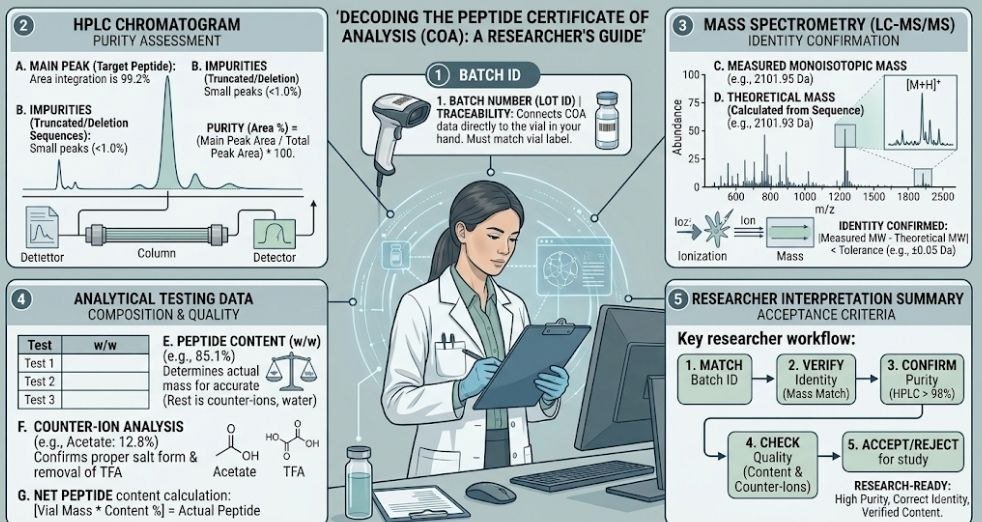
If you are researching are peptides safe, learning how to read a COA is one of the most useful skills you can develop.
1. Verify the Laboratory
Ask:
• Who performed the test?
• Is the laboratory independent?
• Is it appropriately accredited?
• Can the report be verified directly?
• Does the report contain a unique report number?
ISO/IEC 17025 accreditation is an important indicator of a laboratory’s competence for testing and calibration activities.
However, accreditation should still be checked directly rather than assumed from a logo.
2. Verify the Batch Number
The COA should correspond to the actual batch.
A generic COA covering multiple unrelated batches deserves additional scrutiny.
Look for:
• Batch number
• Sample identification
• Testing date
• Product identification
• Laboratory report number
3. Look for the Raw Chromatogram
A typed statement saying:
«“Purity: 99.2%”»
provides much less information than a complete chromatogram.
Look for:
• Chromatographic trace
• Retention time
• Main peak
• Secondary peaks
• Integration information
• Analytical conditions where appropriate
4. Look for Mass-Spectrum Evidence
HPLC answers a purity-related question.
Mass spectrometry can address identity.
These are complementary analytical tools.
5. Look for Relevant Additional Testing
Depending on the intended application, a comprehensive quality assessment may include:
• Endotoxin
• Residual solvents
• Elemental impurities
• Sterility
• Water content
• Counterion analysis
• Peptide content
• Stability data
Not every peptide requires every possible test in every context.
The correct panel should be risk-based.
Are Peptides Safe After Reconstitution?
This is another common question.
Are peptides safe after reconstitution?
The answer depends on the compound, formulation, diluent, concentration, container, storage conditions, microbiological controls, and validated stability data.
Reconstitution changes the chemical environment.
The peptide is no longer simply a dry lyophilized material.
Factors that can become important include:
• pH
• Ionic strength
• Solvent compatibility
• Temperature
• Light exposure
• Oxygen exposure
• Concentration
• Container surface interactions
• Microbial contamination
Researchers should therefore avoid assuming that a peptide’s dry-powder stability automatically predicts its stability after reconstitution.
A Critical Principle
Never assume a universal post-reconstitution shelf life applies to every peptide.
Published or manufacturer-supported stability information should be considered for the specific material and formulation.
Are Peptides Safe When Stored Incorrectly?
Are peptides safe after improper storage?
That is impossible to determine simply by looking at the vial.
A sample may remain visually clear while undergoing chemical changes.
That is why appearance is not a substitute for analytical testing.
Common storage mistakes include:
Repeated Freeze-Thaw Cycles
Repeated temperature cycling can stress sensitive peptide formulations and may contribute to aggregation or degradation.
Opening Cold Vials
Allowing a cold vial to equilibrate before opening can help reduce moisture condensation on or inside the container.
Excessive Heat
Elevated temperature can accelerate chemical degradation.
Light Exposure
Some peptide sequences or formulations may be sensitive to light.
Improper Solvent
Solvent compatibility should be considered according to the specific peptide and research application.
Prolonged Storage After Reconstitution
A researcher should not assume that a reconstituted peptide remains stable indefinitely.
Are Peptides Safe for Human Use? Research Peptides vs Approved Medicines
This distinction is essential.
Are peptides safe for laboratory research?
That is different from asking:
Are peptides safe for administration to humans?
A research-use-only peptide is not automatically a medicine.
FDA-approved peptide drugs have undergone regulatory review based on evidence supporting quality, safety, effectiveness, manufacturing, labeling, and other requirements.
By contrast, a research peptide may have limited or no human safety data.
The FDA specifically warns that compounded drugs are not FDA-approved and are not reviewed by FDA before marketing for safety, effectiveness, or quality in the same way approved drugs are.
The FDA has also issued recent warning letters involving peptide companies whose products were labeled “research use only” while their websites contained evidence of intended human use.
This is an important regulatory lesson:
“Research use only” is not a magic legal phrase that makes a product appropriate for human administration.
Intended use, labeling, marketing claims, distribution practices, and applicable law all matter.
FDA, Europe, and International Regulatory Considerations
United States
In the United States, researchers should distinguish between:
• FDA-approved medicines
• Lawfully compounded medicines
• Investigational products used under applicable research frameworks
• Research materials intended solely for laboratory research
FDA has stated that certain biological specimens used only for basic scientific research and not intended to diagnose, treat, prevent, or cure disease may fall outside certain FDA approval requirements. However, regulatory treatment depends on the specific product, use, and circumstances.
Do not assume that a product is lawful for human use merely because it is sold online.
European Union
European peptide development and manufacturing is also subject to detailed quality expectations.
The EMA’s current synthetic-peptide guideline addresses manufacturing, characterization, specifications, analytical controls, impurities, immunogenicity, sterilization, and other development considerations.
Researchers and buyers in Europe should verify the specific national and EU rules applicable to the material and intended use.
Other Countries
Regulatory frameworks differ between countries.
Depending on location, relevant authorities may include national medicines agencies, customs authorities, health ministries, research-ethics bodies, and controlled-substance regulators.
Before importing, purchasing, possessing, or using a peptide, verify the laws that apply in your jurisdiction.
For international research, documentation and import requirements can also be important.
Common Myths About Peptide Safety
Myth 1: “Natural Means Safe”
False.
Many biologically active molecules occur naturally but can still have powerful biological effects.
Natural origin does not equal universal safety.
Myth 2: “99% Purity Guarantees Safety”
False.
Purity is important, but a purity percentage does not automatically establish:
• Identity
• Sterility
• Endotoxin status
• Residual solvent levels
• Heavy metals
• Stability
• Human safety
This is perhaps the most important misconception when researching are peptides safe.
Myth 3: “All Peptides Have the Same Risk Profile”
False.
Different peptides can have dramatically different:
• Structures
• Targets
• Potencies
• Stability characteristics
• Metabolic pathways
• Immunogenicity risks
• Human safety evidence
A short cosmetic peptide and a biologically active therapeutic peptide should not automatically be evaluated using identical assumptions.
Myth 4: “Side Effects Only Happen at High Doses”
False.
Biological responses are not determined solely by quantity.
Other factors can include:
• Individual susceptibility
• Route of administration
• Peptide identity
• Formulation
• Impurities
• Interactions
• Underlying conditions
• Experimental conditions
For unapproved research compounds, human safety may be poorly characterized.
Peptide Safety Checklist
Before accepting a research peptide into a laboratory workflow, ask:
• □ Is the supplier identifiable and traceable?
• □ Does the batch have a unique identification number?
• □ Is the COA batch-specific?
• □ Can the COA be independently verified?
• □ Is there a raw HPLC chromatogram?
• □ Is molecular identity supported by MS?
• □ Is the stated purity appropriate for the application?
• □ Are relevant impurities characterized?
• □ Has endotoxin testing been considered where applicable?
• □ Has residual solvent testing been considered?
• □ Have elemental impurities been considered?
• □ Is the storage history documented?
• □ Is the packaging appropriate?
• □ Are handling instructions scientifically justified?
• □ Is the intended use clearly defined?
• □ Have applicable laws and regulations been checked?
If several answers are “no,” do not assume that a high HPLC number compensates for the missing information.
When You Should Not Use a Peptide Sample
Researchers should stop and investigate when documentation contains obvious red flags.
Red Flag #1: No Raw Chromatogram
A COA that only reports a purity number provides limited evidence.
Red Flag #2: Impossible Purity Claims
Be skeptical of claims suggesting essentially perfect purity without explaining the analytical method.
Red Flag #3: Missing Batch Numbers
Without batch traceability, connecting the COA to the actual material becomes difficult.
Red Flag #4: No Identity Confirmation
A purity result without identity evidence leaves a major analytical question unanswered.
Red Flag #5: No Information About Relevant Contaminants
Depending on the application, missing endotoxin, residual solvent, elemental impurity, or sterility information may be significant.
Red Flag #6: No Cold-Chain or Storage Information
A high-quality peptide can become a poor-quality sample if its storage conditions are inappropriate.
How OasBioScience Approaches Peptide Education
At OasBioScience, our goal is to make peptide research more understandable by focusing on education, analytical quality, documentation, and responsible research practices.
“Visit OasBioScience“
Our educational approach is built around a simple principle:
Researchers should understand what they are buying, what the analytical documentation actually means, and what limitations exist around the available safety evidence.
That means learning how to evaluate:
• Peptide identity
• HPLC purity
• Mass spectrometry
• COA authenticity
• Batch traceability
• Storage conditions
• Stability considerations
• Testing laboratories
• Research-use limitations
Rather than asking only:
“Are peptides safe?”
we encourage researchers to ask:
“What evidence do I have that this particular research material is properly characterized and suitable for my intended laboratory application?”
That is a much stronger scientific question.
Frequently Asked Questions
1. Are peptides safe?
Are peptides safe? Some peptide medicines have established safety profiles based on extensive regulatory and clinical evaluation, while other peptides have limited safety data. Research-use-only peptides should not be assumed to be safe for human administration simply because they are chemically pure or commercially available.
2. Are peptides safe if they are 99% pure?
Not necessarily.
A 99% HPLC purity result can be useful, but it does not automatically prove identity, sterility, low endotoxin burden, absence of heavy metals, absence of residual solvents, or human safety.
The complete analytical picture matters.
3. Are research peptides safe for human use?
A research-use-only designation should not be interpreted as approval for human use.
Human administration involves medical, regulatory, manufacturing, and safety considerations that are distinct from laboratory research.
FDA enforcement actions have specifically addressed peptide products marketed as research-use-only where evidence indicated intended human use.
4. Are peptides safe if they have a COA?
A COA is useful, but its value depends on its authenticity, scope, methodology, and laboratory credibility.
A strong COA should be traceable to the relevant batch and should provide meaningful analytical evidence rather than simply a typed purity percentage.
5. Are peptides safe after reconstitution?
Not automatically.
Reconstitution changes the peptide’s chemical environment and can influence stability and contamination risk.
The appropriate storage and stability conditions depend on the specific peptide, formulation, solvent, container, concentration, and validated data.
6. Are peptides safe after being frozen and thawed multiple times?
Repeated freeze-thaw exposure can increase the risk of degradation or aggregation for susceptible peptide preparations.
The effect depends on the specific peptide and formulation.
Avoid assuming that every peptide responds identically to temperature cycling.
7. Are peptides safe if the solution looks clear?
Visual appearance is not sufficient to establish peptide quality.
A clear solution can still contain chemical impurities, degraded peptide, endotoxin, or other contaminants.
Analytical testing is more informative than appearance alone.
8. Are peptides safe if they come from a reputable supplier?
Supplier reputation is useful but should not replace batch-level evidence.
A responsible quality assessment should consider the supplier, manufacturing controls, independent testing, COA verification, batch traceability, storage history, and intended application.
9. What is the most important peptide safety test?
There is no single test that answers every peptide safety question.
HPLC, LC-MS, endotoxin testing, ICP-MS, residual-solvent analysis, sterility testing, and other methods answer different questions.
The appropriate testing panel should be based on the peptide and its intended research application.
10. How can I tell if a peptide COA is legitimate?
Look for a verifiable laboratory report number, matching batch number, raw chromatogram, identity data, testing dates, laboratory information, and appropriate analytical methods.
Where possible, verify the report directly with the testing laboratory rather than relying solely on a PDF supplied by a seller.
Final Answer: Are Peptides Safe?
So, are peptides safe?
The most scientifically honest answer is:
It depends on the specific peptide, its intended use, its quality, its characterization, its formulation, its handling, the available safety evidence, and the regulatory framework governing its use.
Peptides should not be treated as one uniform category.
Some peptide medicines have undergone extensive pharmaceutical development and regulatory evaluation.
Other research peptides may have limited human safety information.
And even a well-characterized research material can be compromised by poor storage, contamination, incorrect calculations, inappropriate handling, or inadequate documentation.
After years of working with researchers and troubleshooting peptide-quality problems, one lesson repeatedly stands out:
When something goes wrong, investigate the entire system before blaming the molecule.
Check the identity.
Check the purity.
Check the COA.
Check the batch.
Check the storage history.
Check the analytical method.
Check for relevant contaminants.
Check the reconstitution process.
Check the calculations.
And most importantly, distinguish research characterization from evidence of safety for human use.
That is the responsible way to approach the question:
Are peptides safe?
For researchers who want to improve their understanding of peptide quality, COA interpretation, analytical testing, and responsible research practices, OasBioScience provides educational resources designed to help make these technical questions easier to understand.
“Explore OasBioScience“
Important Research and Regulatory Disclaimer
This article is provided for general scientific and educational purposes only. It is not medical advice, a diagnosis, treatment recommendation, prescribing instruction, or a substitute for consultation with a qualified healthcare professional, pharmacist, regulatory specialist, institutional biosafety officer, or research-ethics authority.
Research-use-only peptides are not automatically approved, authorized, or established as safe for administration to humans or animals. Availability, labeling, importation, possession, distribution, research use, compounding, and administration of peptide substances may be subject to different laws and regulatory requirements depending on the country, jurisdiction, compound, and intended use.
Nothing in this article should be interpreted as recommending human administration of an unapproved peptide or as establishing that any particular peptide is safe for human use.
Researchers are responsible for complying with applicable institutional, national, and international requirements and for determining whether a particular material is appropriate for their authorized research application.
Regulatory requirements can change. Readers should verify current requirements with the relevant regulatory authority before purchasing, importing, handling, distributing, or using peptide materials.
For U.S. regulatory information, consult the U.S. Food and Drug Administration (FDA). For European medicinal-product requirements, consult the European Medicines Agency (EMA) and the appropriate national competent authority.
Sources for Further Reading
• “FDA — Clinical Pharmacology Considerations for Peptide Drug Products
• “FDA — Risks of Compounded Drugs”
• “FDA — Human Drug Compounding”
• “EMA — Development and Manufacture of Synthetic Peptides”
• “USP — Reference Standards to Support Quality of Synthetic Peptide Therapeutics”
Read Related Articles Below To Boost Your Knowledge On Peptides

