
How Much Weight Can You Lose on Tirzepatide? 7 Powerful Facts, Realistic Results & Case Studies

How Much Weight Can You Lose on Tirzepatide?
How Much Weight Can You Lose on Tirzepatide? It is one of the most important questions people ask before considering tirzepatide for weight management.
The short answer is that clinical trials have shown substantial average weight loss, but there is no single amount that everyone will lose.
In the landmark 72-week SURMOUNT-1 trial, adults with obesity or overweight and at least one weight-related condition, but without diabetes, experienced average body-weight reductions of approximately 15.0% with 5 mg, 19.5% with 10 mg, and 20.9% with 15 mg of tirzepatide. The trial included a dose-escalation period and lifestyle intervention.
That means someone beginning at 230 lb (104 kg) could use these percentages as a simple illustration:
| Percentage of weight lost | Approximate loss from 230 lb / 104 kg | Approximate remaining weight |
|---|---|---|
| 5% | 11.5 lb / 5.2 kg | 218.5 lb / 99 kg |
| 10% | 23 lb / 10.4 kg | 207 lb / 93.6 kg |
| 15% | 34.5 lb / 15.6 kg | 195.5 lb / 88.7 kg |
| 18% | 41.4 lb / 18.8 kg | 188.6 lb / 85.6 kg |
| 20% | 46 lb / 20.8 kg | 184 lb / 83.5 kg |
| 21% | 48.3 lb / 21.9 kg | 181.7 lb / 82.4 kg |
These are mathematical examples, not promises.
Your actual response can be considerably different depending on starting weight, metabolic health, diabetes status, treatment duration, tolerability, adherence, lifestyle, and individual biology.
This article explains what the evidence really tells us—and what people considering tirzepatide should realistically expect.
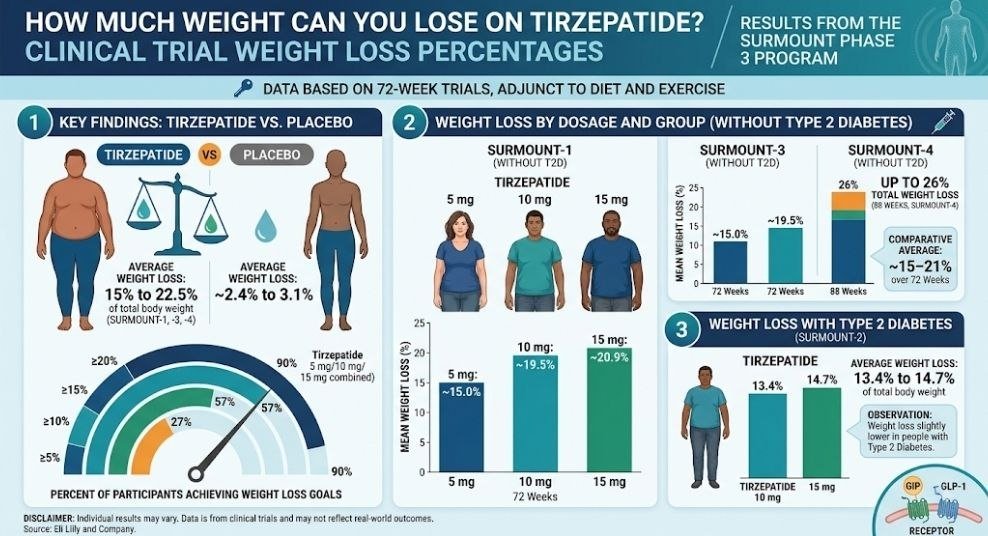
Table of Content
- How Much Weight Can You Lose on Tirzepatide in Clinical Trials?
- What Does 15%, 20%, or 21% Weight Loss Actually Mean?
- How Much Weight Can You Lose on Tirzepatide in the First Month?
- How Much Weight Can You Lose on Tirzepatide in 6 Months?
- How Much Weight Can You Lose on Tirzepatide in One Year?
- Why Some People Lose More Weight Than Others
- Tirzepatide Dose and Weight Loss
- Real-World Tirzepatide Weight Loss
- Illustrative Case Studies
- Why Weight Loss Can Plateau
- Protein, Exercise and Muscle During Weight Loss
- Diet, Calories, Sleep and Adherence
- Tirzepatide for People With Type 2 Diabetes
- Tirzepatide Safety and Side Effects
- Pregnancy and Tirzepatide
- FDA, UK, Canada, Germany and France Regulatory Differences
- Research-Use Tirzepatide vs Approved Medicines
- What Researchers and Consumers Should Look For
- Frequently Asked Questions
- Final Takeaway
How Much Weight Can You Lose on Tirzepatide in Clinical Trials?
The strongest answer to how much weight can you lose on tirzepatide comes from randomized controlled trials.
SURMOUNT-1 enrolled 2,539 adults with obesity or overweight and a weight-related complication, excluding people with diabetes. Participants received tirzepatide at 5 mg, 10 mg, or 15 mg weekly, or placebo, for 72 weeks. The treatment period included up to 20 weeks of dose escalation.
At week 72, the average weight changes were:
- 5 mg: approximately 15.0%
- 10 mg: approximately 19.5%
- 15 mg: approximately 20.9%
- Placebo: approximately 3.1%
These figures are averages across groups.
They do not mean that every person receiving 15 mg will lose exactly 20.9%.
The distribution of individual responses is much wider.
Some participants lost considerably less than the group average, while others lost substantially more.
The trial also found that 50% of participants receiving 10 mg and 57% receiving 15 mg achieved at least 20% weight reduction.
That is an important distinction.
A clinical-trial average tells you what happened to a population. It does not tell you exactly what will happen to one individual.
What Does 15%, 20%, or 21% Weight Loss Actually Mean?
Percentages can sound abstract.
For someone starting at 230 lb, however, the numbers become much easier to understand.
15% weight loss
230 × 0.15 = 34.5 lb
That would bring the person from approximately:
230 lb → 195.5 lb
In kilograms:
104 kg → approximately 88.4 kg
20% weight loss
230 × 0.20 = 46 lb
That would bring the person from:
230 lb → 184 lb
or approximately:
104 kg → 83.2 kg
21% weight loss
230 × 0.21 = 48.3 lb
That would bring the person from:
230 lb → 181.7 lb
or approximately:
104 kg → 82.4 kg
This is why answering how much weight can you lose on tirzepatide using percentages is useful—but converting those percentages into pounds or kilograms makes the information much more practical.
How Much Weight Can You Lose on Tirzepatide in the First Month?
This is where online expectations can become misleading.
Many people expect dramatic weight loss immediately after their first injection.
That is not necessarily what happens.
The approved starting dose of Zepbound is 2.5 mg once weekly for four weeks, and the FDA describes this as a starting dose rather than a maintenance dose. Dose escalation is designed to help patients reach maintenance doses while managing tolerability.
Consequently, the first month can look very different from person to person.
One person may experience noticeable appetite changes and weight reduction.
Another may experience relatively little scale movement.
A third may lose several pounds quickly, particularly because early changes in food intake, glycogen, fluid balance and gastrointestinal contents can affect the scale.
Therefore, not losing a dramatic amount during the first four weeks does not automatically mean tirzepatide has failed.
The first month should generally be viewed in the context of the complete treatment timeline rather than as a final verdict.
How Much Weight Can You Lose on Tirzepatide in 6 Months?
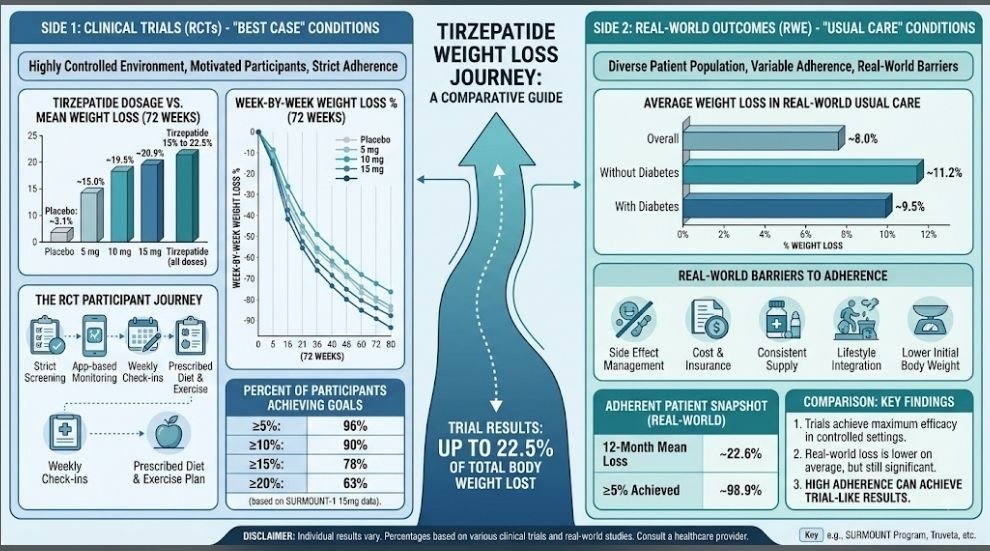
Six-month results are particularly interesting because real-world outcomes can differ from controlled clinical-trial outcomes.
A 2025 real-world analysis of 20,998 people without type 2 diabetes found an average weight reduction of approximately 11.9% at six months in its effectiveness cohort. It also found that dose escalation in routine care was slower than in clinical trials, with many individuals remaining below 10 mg.
For a 230-lb person, 11.9% would be approximately:
27.4 lb
That would correspond to approximately:
230 lb → 202.6 lb
Again, this is an illustrative calculation rather than a prediction.
Real-world results can be affected by medication access, missed doses, insurance coverage, side effects, treatment discontinuation, titration speed and many other variables.
How Much Weight Can You Lose on Tirzepatide in One Year?
There is no universal one-year number.
Clinical trials and observational studies produce different results because they study different populations under different conditions.
A 2026 prospective real-world study following 164 adults for one year reported an average body-weight reduction of approximately 8.66 kg, with reductions in fat mass and waist circumference also observed.
Another 2026 real-world analysis of more than 44,000 patients found that people receiving tirzepatide had approximately 9.1% total weight loss at one year in its intention-to-treat analysis and approximately 11.7% among those with one year of continuous GLP-1 therapy.
These studies demonstrate why it is dangerous to take the highest clinical-trial number and advertise it as the amount everyone can expect.
The better question is:
“What range of weight loss is realistic for someone with my starting weight, health profile, treatment duration and ability to stay on therapy?”
That question is much more useful
Why Some People Lose More Weight on Tirzepatide Than Others
Two people can take the same medication and experience very different outcomes.
Several factors can contribute.
Starting body weight
Someone beginning at 300 lb has more absolute weight available to lose than someone beginning at 170 lb.
That means the same percentage can translate into very different numbers of pounds.
Metabolic health
People with type 2 diabetes may experience different weight-loss trajectories compared with people without diabetes.
Clinical trials therefore need to be interpreted according to the population studied.
Treatment duration
Six weeks, six months and 18 months are not equivalent treatment periods.
Weight loss is usually a process rather than a single event.
Dose and tolerability
Higher studied doses have produced greater average weight reduction in some trials, but higher does not automatically mean better for every individual.
Tolerability matters.
Adherence
A medication cannot produce its expected effect if treatment is repeatedly interrupted.
Real-world studies show that discontinuation and persistence can substantially influence outcomes.
Lifestyle
Tirzepatide is not a replacement for adequate nutrition, physical activity or healthy behaviors.
The FDA-approved weight-management indication for Zepbound is specifically used alongside a reduced-calorie diet and increased physical activity.
Tirzepatide Dose and Weight Loss: Does a Higher Dose Always Mean More?
The clinical-trial evidence shows a dose-response relationship at the population level.
In SURMOUNT-1, average weight reduction at 72 weeks was approximately:
| Tirzepatide dose | Average weight reduction |
| 5 mg | 15.0% |
| 10 mg | 19.5% |
| 15 mg | 20.9% |
However, this should not be interpreted as:
“Everyone should reach 15 mg as quickly as possible.”
That is not an appropriate conclusion.
Dose selection and escalation should be individualized by a qualified healthcare professional based on the approved product information, treatment response and tolerability.
The FDA-approved Zepbound schedule starts at 2.5 mg once weekly, with increases made at intervals of at least four weeks when appropriate; recommended maintenance doses for weight management are 5 mg, 10 mg and 15 mg, with 15 mg being the maximum.
The goal is not simply to reach the highest possible number.
The goal is an appropriate treatment plan that balances effectiveness and tolerability.
Real-World Tirzepatide Weight Loss: Why It Can Be Different From Clinical Trials
This is one of the most overlooked parts of the answer to how much weight can you lose on tirzepatide.
Clinical trials are highly structured.
Participants receive regular follow-up, defined treatment protocols, lifestyle support and systematic data collection.
Real life is different.
People may experience:
- Insurance interruptions
- Medication affordability problems
- Missed injections
- Side effects
- Treatment discontinuation
- Slower dose escalation
- Different dietary habits
- Different activity levels
- Other medications
- Comorbid conditions
- Work and family pressures
The 2025 Optum analysis illustrates this difference. Among people without type 2 diabetes using tirzepatide in routine care, persistence was not universal, and the majority of patients in the utilization cohort were still receiving less than 10 mg by the sixth prescription fill.
This does not mean real-world tirzepatide is ineffective.
It means real-world treatment is real life.
Tirzepatide Weight-Loss Case Studies: Four Illustrative Profiles
The following profiles are based on the representative information supplied for this article.
Important: These should be understood as anonymized/illustrative clinical profiles synthesized from real-world patterns, rather than claims that OasBioScience directly treated or medically supervised these individuals. Individual outcomes vary, and these examples should not be interpreted as treatment guarantees.
Case Study 1: High Responder
A 42-year-old woman began at approximately 228 lb (103.4 kg) with a BMI of 36.8.
After approximately 12 months, her reported weight reduction was approximately 51 lb, representing about 22.4% of starting body weight.
Her treatment included progressive dose escalation and structured lifestyle support.
She also prioritized approximately 110 g of protein daily and performed resistance training three times per week.
She experienced moderate nausea during one escalation period, which resolved after dietary adjustments.
Lesson: A highly responsive patient can exceed the average clinical-trial result, but this does not make that outcome typical or guaranteed.
Case Study 2: Previous Semaglutide User
A 51-year-old man began at approximately 245 lb (111.1 kg).
He had previously used semaglutide and experienced a prolonged plateau.
After switching to tirzepatide, he lost approximately 34 lb, or 13.9%, over nine months.
His lifestyle program included regular walking and dietary monitoring.
Lesson: Previous treatment history matters. A person switching from another incretin-based therapy should not automatically expect the same trajectory as someone who has never used one.
Case Study 3: Type 2 Diabetes Context
A 58-year-old man began at approximately 262 lb (118.8 kg) and had an HbA1c of 8.4%.
Over approximately 10 months, he lost around 32 lb, representing approximately 12.2% of starting weight.
His treatment was combined with a Mediterranean-style, lower-glycemic dietary pattern.
His HbA1c reportedly fell to approximately 5.9%.
Lesson: Weight reduction is only one potential outcome being monitored in people with type 2 diabetes. Glycemic control and broader metabolic health are also important.
Case Study 4: Lower-Dose Maintenance
A 36-year-old woman began at approximately 195 lb (88.4 kg) with a BMI of 31.5.
She remained at 5 mg during the reported period and lost approximately 24 lb, or 12.3%, over six months.
She preferred not to escalate further because of cost and mild constipation.
Weight reduction subsequently stabilized around week 20.
Lesson: Individual treatment plans can differ. The highest dose is not automatically required for every person to experience meaningful weight reduction.
Why Does Weight Loss Plateau on Tirzepatide?
A plateau does not automatically mean tirzepatide has stopped working.
As body weight decreases, energy requirements can decrease as well.
A person who previously lost weight while consuming a particular amount of food may eventually find that the same intake produces much slower weight loss.
This is normal physiology.
The scale can also hide body-composition changes
Someone beginning resistance training may gain or preserve lean tissue while losing fat.
The scale may therefore move more slowly even while waist circumference and body composition improve.
That is why someone using tirzepatide should consider monitoring more than body weight.
Useful measurements can include:
- Waist circumference
- Body weight trend
- Strength
- Physical activity
- Dietary consistency
- Relevant laboratory markers
- Body-composition measurements when appropriately available
A plateau should be discussed with a healthcare professional rather than automatically interpreted as a reason to change medication.
Protein, Resistance Training and Muscle During Tirzepatide Weight Loss
One of the biggest mistakes in aggressive weight loss is focusing exclusively on the scale.
The objective should not simply be:
“Lose as many pounds as possible.”
A better objective is:
“Reduce excess fat while supporting healthy body composition.”
Adequate protein intake can help support maintenance of lean tissue during an energy deficit.
Resistance training is also valuable because mechanical loading provides an important stimulus for maintaining strength and muscle.
This does not mean everyone needs the same protein target or exercise program.
Nutrition should be individualized, particularly for people with kidney disease or other medical conditions.
The same principle applies to exercise.
People with significant joint limitations, cardiovascular conditions or other medical concerns should obtain appropriate professional guidance before beginning a new training program.
Diet, Calories, Sleep and Adherence: What Really Influences Tirzepatide Results?
Tirzepatide can reduce appetite and food intake, but weight management remains a multifactorial process.
Calorie intake
If appetite falls, many people naturally consume fewer calories.
However, food quality still matters.
A diet consisting largely of highly processed foods may provide fewer nutrients and less protein even if total calories decline.
Protein
Protein-rich foods can support satiety and help preserve lean mass during weight reduction.
Individual protein requirements vary.
Physical activity
Walking and resistance training can complement weight management.
The objective is consistency rather than attempting to compensate for poor nutrition with extreme exercise.
Sleep
Poor sleep can affect appetite, food choices, energy and adherence.
Sleep should therefore be considered part of the overall weight-management strategy.
Adherence
Consistency matters.
Real-world evidence demonstrates that discontinuation can be associated with substantially different weight outcomes compared with continued treatment.
This is one reason a sustainable treatment plan can be more valuable than an aggressive short-term approach.
How Much Weight Can You Lose on Tirzepatide If You Have Type 2 Diabetes?
The answer can differ from the results of obesity trials conducted in people without diabetes.
For example, SURMOUNT-1 specifically excluded people with diabetes.
Other tirzepatide studies have examined people with type 2 diabetes.
This distinction is important when reading online claims.
If an article takes the 20.9% SURMOUNT-1 result and tells every person with obesity and diabetes that they should expect exactly 20.9%, it is oversimplifying the evidence.
Type 2 diabetes, other medications, baseline metabolic status and individual treatment response can all influence outcomes.
For someone with diabetes, weight management should also be coordinated with glucose management.
Tirzepatide Safety: Side Effects and Important Warnings
Tirzepatide is a prescription medicine, and significant medical considerations exist.
The most commonly reported adverse effects include gastrointestinal symptoms such as:
- Nausea
- Diarrhea
- Vomiting
- Constipation
- Abdominal discomfort
In SURMOUNT-1, gastrointestinal adverse events were the most common and were generally mild to moderate, particularly during dose escalation.
The FDA-approved Zepbound labeling also contains warnings concerning serious gastrointestinal reactions, acute kidney injury related to volume depletion, gallbladder disease, pancreatitis and hypersensitivity reactions, among others.
When should someone seek medical attention?
Anyone experiencing severe or persistent symptoms should seek medical advice.
Urgent evaluation can be appropriate for symptoms such as severe abdominal pain, persistent vomiting, signs of significant dehydration, serious allergic reactions, or other concerning symptoms.
Do not attempt to diagnose a serious adverse event from an internet article.
Thyroid C-cell tumor warning
The FDA labeling carries a boxed warning regarding thyroid C-cell tumors based on findings in rats.
The human relevance of this finding has not been established.
Zepbound is contraindicated in people with a personal or family history of medullary thyroid carcinoma or in patients with Multiple Endocrine Neoplasia syndrome type 2.
This is one of the reasons medical screening matters before treatment.
Tirzepatide and Pregnancy
Weight loss is generally not an appropriate treatment goal during pregnancy.
People who are pregnant, planning pregnancy or potentially becoming pregnant should discuss tirzepatide with their healthcare professional.
The prescribing information includes pregnancy-related considerations, and tirzepatide may also affect the absorption of some oral medications because of its effects on gastric emptying.
Anyone considering tirzepatide should therefore disclose pregnancy plans and all medications to the prescribing clinician.
Tirzepatide Regulations in the USA, UK, Canada, Germany and France
Tirzepatide’s regulatory status is not identical in every country.
United States
In the United States, the FDA approved Zepbound (tirzepatide) for chronic weight management in adults with obesity, or overweight with at least one weight-related condition, alongside a reduced-calorie diet and increased physical activity.
Tirzepatide is also marketed as Mounjaro for type 2 diabetes.
United Kingdom
The UK’s MHRA authorized Mounjaro (tirzepatide) for weight management and weight loss in adults in November 2023, including adults with obesity or overweight accompanied by specified weight-related health problems.
Canada
Health Canada’s product database identifies Mounjaro and Zepbound as prescription tirzepatide products. Health Canada records Zepbound as marketed in Canada, with current product information available through its drug database.
Germany and France
Germany and France operate within the European Union regulatory framework for centrally authorized medicines.
The European Medicines Agency’s Mounjaro information states that tirzepatide is authorized for weight management in adults with obesity, or overweight accompanied by specified weight-related health problems, alongside reduced-calorie diet and increased physical activity.
The key lesson is simple:
Do not assume that rules applying to tirzepatide in the United States automatically apply in the UK, Canada, Germany, France or another country.
Patients should rely on their country’s medicines regulator and a qualified healthcare professional for current requirements.
Approved Tirzepatide Medicines vs Compounded and Research-Use Products
This distinction is extremely important.
FDA-approved medicines are evaluated for their approved indications, quality standards, manufacturing controls, labeling and safety/efficacy evidence.
Research-use materials are different.
A material sold for laboratory research should not automatically be interpreted as an approved medicine, and a research-use product should not be represented as suitable for human administration unless it has the appropriate regulatory authorization.
For a laboratory/research supplier such as OasBioScience, this distinction should remain clear.
Researchers evaluating peptide materials should focus on analytical documentation rather than marketing claims.
What Researchers Should Look For When Evaluating Tirzepatide Peptide Quality
For research materials, documentation matters.
Researchers can consider requesting or reviewing appropriate analytical documentation, including:
HPLC analysis
High-performance liquid chromatography can provide information about chromatographic purity.
Mass spectrometry
Mass spectrometry can help assess whether the observed molecular mass is consistent with the expected analyte.
Batch identification
A credible certificate of analysis should identify the relevant batch or lot.
Testing laboratory
Researchers should be able to determine who performed the testing and understand the laboratory’s analytical capabilities.
Traceability
The relationship between the product, batch number and analytical report should be clear.
This is particularly important when comparing suppliers.
At OasBioScience, our focus as a laboratory/research supplier is on providing researchers with clear product information and supporting analytical documentation rather than presenting research materials as substitutes for approved prescription medicines.
The Biggest Mistakes People Make When Asking “How Much Weight Can You Lose on Tirzepatide?”
Mistake 1: Treating 20.9% as a guarantee
The 20.9% figure is a group average from a specific clinical trial population and treatment period.
It is not a personal guarantee.
Mistake 2: Judging treatment after four weeks
Early treatment is not the same as the full treatment course.
Mistake 3: Believing everyone needs 15 mg
Higher doses produced greater average weight loss in SURMOUNT-1, but dose selection should be individualized.
Mistake 4: Ignoring muscle
The number on the scale is only one measurement.
Mistake 5: Comparing yourself with social-media transformations
Online before-and-after stories often lack important information about starting weight, treatment duration, diet, exercise, adherence and medical history.
Mistake 6: Ignoring discontinuation
Real-world persistence can be substantially lower than people assume, and discontinuation can influence outcomes.
Mistake 7: Using research products as if they were prescription medicines
Research materials and approved pharmaceutical products are not interchangeable categories.
Frequently Asked Questions About How Much Weight Can You Lose on Tirzepatide
1. How much weight can you lose on tirzepatide in one month?
There is no reliable universal amount.
Some people lose several pounds during the first month, while others lose very little. The initial 2.5 mg dose is intended as a starting dose, and early response should not be used alone to judge long-term effectiveness.
2. How much weight can you lose on tirzepatide in 6 months?
Real-world evidence suggests that substantial weight reduction can occur within six months. One large real-world analysis reported an average reduction of approximately 11.9% at six months among its effectiveness cohort of people without type 2 diabetes.
Individual results can be lower or higher.
3. How much weight can you lose on tirzepatide in one year?
There is no single guaranteed one-year number.
Clinical trials can produce larger average reductions under structured conditions, while real-world studies frequently report lower averages. A 2026 real-world analysis found approximately 9.1% total weight loss at one year among tirzepatide users in its intention-to-treat analysis and approximately 11.7% among people with one year of continuous GLP-1 therapy.
4. Can you lose 20% of your body weight on tirzepatide?
Yes, some people can.
In SURMOUNT-1, approximately 20% or more weight reduction was achieved by 50% of participants in the 10-mg group and 57% in the 15-mg group at 72 weeks.
However, 20% should not be treated as a guaranteed personal outcome.
5. How much weight can you lose on tirzepatide if you start at 230 pounds?
The answer depends on your individual response.
For illustration:
- 10% = approximately 23 lb
- 15% = approximately 34.5 lb
- 20% = approximately 46 lb
- 21% = approximately 48.3 lb
These are calculations, not predictions.
6. Does a higher tirzepatide dose mean more weight loss?
Clinical-trial averages show greater weight reduction at higher studied doses. In SURMOUNT-1, the average reduction was 15.0% with 5 mg, 19.5% with 10 mg and 20.9% with 15 mg at week 72.
However, dosing decisions should be made with a qualified healthcare professional.
7. Why am I not losing weight quickly on tirzepatide?
Several explanations are possible.
You may still be early in treatment, your dose may still be at a starting or lower maintenance level, adherence may be inconsistent, your calorie intake may have changed less than expected, or your individual response may simply be slower.
Persistent concerns should be discussed with your clinician rather than automatically increasing medication.
8. Can tirzepatide cause a weight-loss plateau?
Yes, weight loss can slow or plateau.
As body weight decreases, energy requirements change. Changes in activity, dietary intake, body composition and treatment adherence can also affect the rate of weight reduction.
A plateau does not automatically mean that the medication has stopped working.
9. Is tirzepatide better than diet and exercise alone?
This is not a simple either/or question.
Approved weight-management use of tirzepatide is alongside a reduced-calorie diet and increased physical activity.
Medication and lifestyle intervention can therefore be complementary rather than competing strategies.
10. Is tirzepatide safe for everyone?
No.
Tirzepatide has contraindications, warnings and potential adverse effects. The FDA labeling includes important warnings involving thyroid C-cell tumors, gastrointestinal reactions, pancreatitis, gallbladder disease, kidney injury and hypersensitivity, among other considerations.
A healthcare professional should determine whether treatment is appropriate for an individual.
11. Can you use tirzepatide during pregnancy?
Weight-loss treatment should not be approached casually during pregnancy.
Anyone who is pregnant, planning pregnancy or who may become pregnant should discuss tirzepatide with their healthcare professional and review the current prescribing information.
12. Is research-use tirzepatide the same as Zepbound or Mounjaro?
No.
Approved pharmaceutical products and research-use materials have different regulatory statuses and intended uses.
Research-use material should not be represented as an approved treatment for human weight loss.
Final Answer: How Much Weight Can You Lose on Tirzepatide?
So, how much weight can you lose on tirzepatide?
The most evidence-based answer is:
A substantial amount is possible, but your result cannot be predicted from a single headline percentage.
In the SURMOUNT-1 trial, average weight loss at 72 weeks was approximately 15.0% with 5 mg, 19.5% with 10 mg and 20.9% with 15 mg among adults with obesity or overweight and a weight-related complication without diabetes.
For a person starting at 230 lb, 20% represents approximately 46 lb.
But real-world outcomes can be lower.
Recent observational evidence demonstrates why: treatment persistence, dose escalation, access, tolerability and everyday lifestyle factors can substantially change the outcome.
The most useful way to think about tirzepatide is therefore not:
“How many pounds will tirzepatide make me lose?”
Instead, ask:
“What level of weight reduction is realistic for my starting weight, health profile, treatment duration, adherence, nutrition, activity level and response to therapy?”
That is the question that leads to better expectations.
And for researchers, the same principle applies to peptide materials: quality, identity, analytical documentation and regulatory status matter as much as the name printed on the label.
OasBioScience provides laboratory/research-oriented peptide information and resources for researchers who want to make more informed decisions about peptide materials and analytical documentation.
Important Medical Disclaimer
This article is intended for educational and informational purposes only. It is not medical advice, a diagnosis, or a recommendation to start, stop, increase or decrease any medication.
Tirzepatide is a prescription medicine with important contraindications, warnings, drug interactions and potential adverse effects. Treatment decisions should be made with a qualified healthcare professional who understands the individual’s medical history.
Research-use peptide materials are not presented as approved medicines or as products intended for human administration. Always consult the applicable medicines regulator and current official prescribing information for your jurisdiction.
Sources and Further Reading
- U.S. Food and Drug Administration — Zepbound approval and chronic weight-management information.
- PubMed
- FDA — Zepbound Prescribing Information and safety warnings.
Continue Learning: If you found this guide helpful, you may also want to read our previous peptide education articles covering the following topics below
- What Bacteriostatic Water Should I Use For My Peptide?
- What’s Peptide Reconstitution?
- How Long Do Peptides Last?
- How Should Peptides Be Stored?
- How do I read a COA?
- What Does HPLC Testing Mean?
- Peptide Purity explained in depth
- How Are Peptides Made?
- Peptide Bubbles after reconstitution?
- Which peptide suppresses appetite the most?
- Are peptides legal?
