
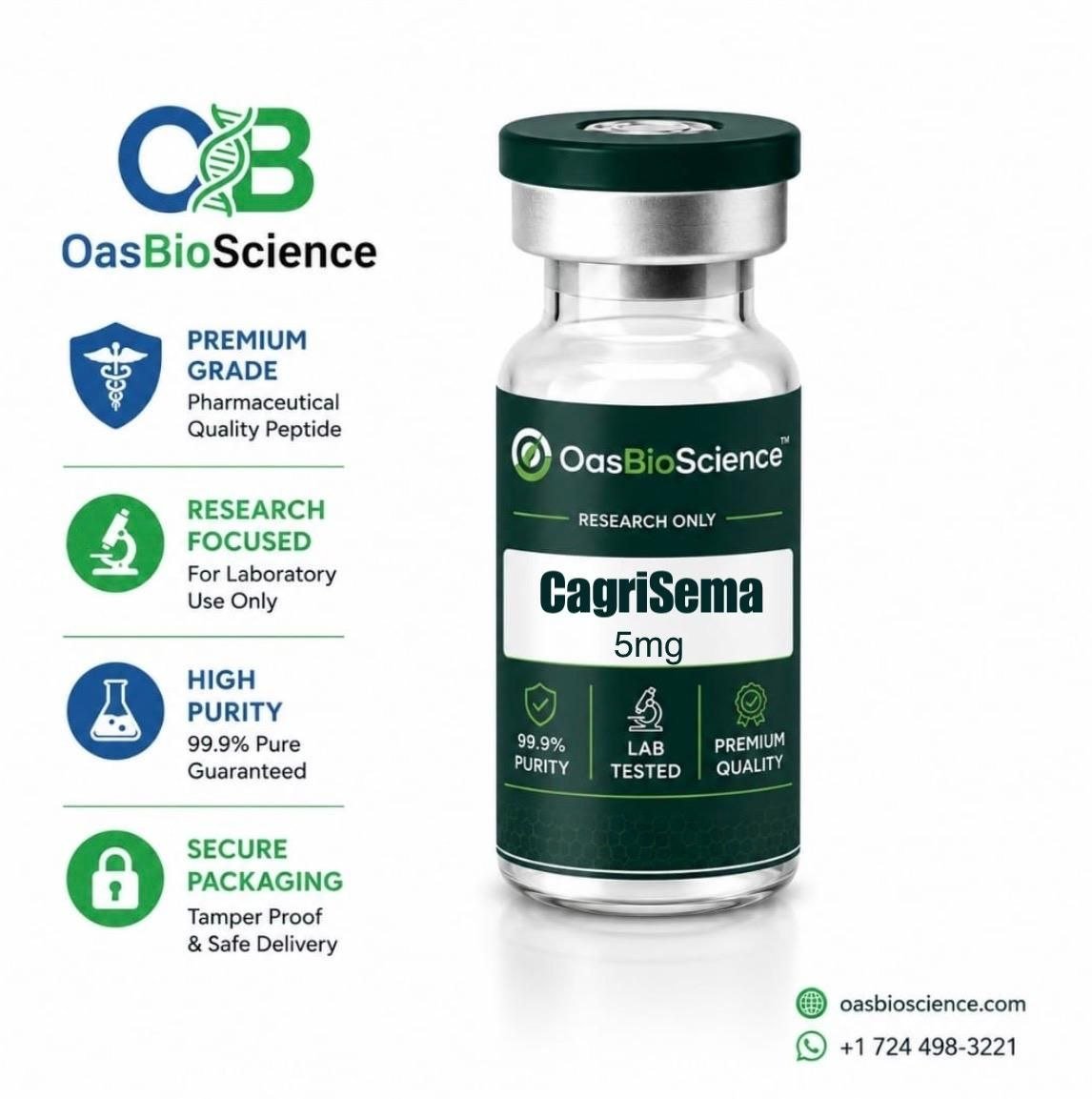
Description
CagriSema Peptide Overview
CagriSema is the name used for a fixed combination of cagrilintide, a long-acting amylin analogue, and semaglutide, a GLP-1 receptor agonist. The combination has been investigated in clinical research for metabolic and weight-management applications.
For laboratory researchers, CagriSema provides an interesting research system for studying the combined pharmacology of amylin-pathway and GLP-1-pathway signaling.
Because CagriSema Peptide consists of two chemically distinct peptides, professional product documentation should clearly identify:
- Cagrilintide
- Semaglutide
- The amount of each component
- The formulation or salt form
- Batch-specific analytical results
Research Use Only: This product description is written for laboratory and scientific research. A research-grade material should not be represented as an approved medicine or supplied for human or veterinary administration.
What Is CagriSema Peptide?
CagriSema Peptide combines two peptide-based active ingredients:
Cagrilintide
Cagrilintide is a long-acting amylin analogue that has been investigated for its activity at amylin and calcitonin receptors.
Semaglutide
Semaglutide is a GLP-1 receptor agonist and a 31-amino-acid peptide analogue.
The scientific interest in CagriSema comes from studying these two complementary peptide pathways together.
Research involving the combination may examine:
- Metabolic signaling
- Appetite and energy-balance pathways
- Amylin receptor biology
- GLP-1 receptor biology
- Peptide pharmacology
- Receptor interactions
- Pharmacokinetics
- Formulation science
The results of laboratory and clinical research should not be interpreted as proof that a research product is suitable for treating people.
Molecular Formula, Molecular Weight & Sequence
Because CagriSema contains two different peptides, there is no single molecular formula or molecular weight for the combination.
Cagrilintide
| Property | Specification |
|---|---|
| Component | Cagrilintide |
| Type | Long-acting amylin analogue |
| Sequence | XKCNTATCATQRLAEFLRHSSNNFGPILPPTNVGSNTP |
| Molecular formula | C₁₉₄H₃₁₂N₅₄O₅₉S₂ |
| Molecular weight | Approximately 4,409 g/mol |
| CAS | 1415456-99-3 |
PubChem reports the cagrilintide sequence, formula, and approximately 4,409 g/mol molecular weight.
The published structural description includes a lipid modification and a disulfide bond, so the exact chemical form should be verified against the product’s analytical documentation.
Semaglutide
| Property | Specification |
|---|---|
| Component | Semaglutide |
| Type | GLP-1 receptor agonist |
| Peptide length | 31 amino acids |
| Molecular formula | C₁₈₇H₂₉₁N₄₅O₅₉ |
| Molecular weight | Approximately 4,114 g/mol |
| CAS | 910463-68-2 |
PubChem reports semaglutide as a 31-amino-acid polypeptide with a molecular formula of C₁₈₇H₂₉₁N₄₅O₅₉ and molecular weight of approximately 4,114 g/mol.
Why the distinction matters
Do not list one combined molecular formula or one combined molecular weight for CagriSema.
A professional COA should identify the two components individually, including their quantities and analytical identity.
Purity
For a research-grade CagriSema product, avoid claiming “≥98% HPLC” for the entire combination unless the actual batch testing specifically supports that claim.
A better product-page specification is:
Purity: Batch-specific; component identity and purity confirmed by analytical documentation.
Where available, analytical testing may include:
- HPLC/UPLC purity
- Mass spectrometry
- Component identity
- Cagrilintide content
- Semaglutide content
- Molecular-weight confirmation
- Lot number
- Testing date
If each component has separately documented ≥98% HPLC purity, that information can be displayed individually rather than implying that CagriSema is one purified molecule.
Appearance
Typical appearance: White to off-white lyophilized material.
The exact appearance can depend on:
- Formulation
- Ratio of the two components
- Salt/counterion form
- Manufacturing process
- Lyophilization conditions
Visual appearance alone cannot establish identity, purity, or the correct cagrilintide-to-semaglutide composition.
For professional research, analytical documentation should be used to verify the material.
Available Vial Sizes
Available research quantities depend on the actual formulation you manufacture or stock.
Common research-packaging options can include:
- 5 mg
- 10 mg
- 20 mg
- 30 mg
- 50 mg
However, with CagriSema, total vial mass alone is not enough information.
Your product label should clearly identify:
Total quantity + cagrilintide amount + semaglutide amount + formulation
For example, if your formulation contains two components in a particular ratio, the ratio should be stated on the COA and label rather than leaving researchers to infer it.
Storage Recommendations
CagriSema contains peptide components that can be sensitive to environmental conditions.
General storage principles include:
- Keep the product tightly sealed.
- Protect from excessive heat.
- Minimize unnecessary light exposure.
- Protect lyophilized material from moisture.
- Avoid unnecessary temperature cycling.
- Follow the specific manufacturer’s stability data.
- Check the batch documentation for the recommended storage range.
For a professional research product, batch-specific stability information should take priority over generic peptide-storage advice.
After reconstitution, storage requirements may differ substantially from those of the original lyophilized material.
Reconstitution Information
CagriSema should be prepared according to the specific formulation and validated laboratory protocol.
Because the product contains two different peptide components, researchers should consider:
- Solubility of each component
- Final concentration
- pH
- Ionic strength
- Formulation compatibility
- Stability after preparation
General laboratory handling includes:
- Allow the sealed vial to equilibrate appropriately before opening.
- Use a solvent compatible with the specific research formulation.
- Introduce the solvent carefully.
- Avoid unnecessarily vigorous agitation.
- Allow adequate time for dissolution.
- Record the solvent and final concentration.
- Minimize repeated freeze–thaw cycles where appropriate.
- Follow the validated post-reconstitution stability protocol.
There is no universal reconstitution volume or protocol suitable for every CagriSema formulation.
Intended Use — Research Only
CagriSema Peptide is intended for laboratory and scientific research.
Potential research areas include:
- GLP-1 receptor research
- Amylin receptor research
- Metabolic signaling
- Energy-balance research
- Peptide pharmacology
- Receptor biology
- Pharmacokinetic research
- Peptide formulation development
CagriSema should not be presented as:
- A research-use injection protocol
- A prescription recommendation
- A weight-loss treatment recommendation
- A substitute for approved medicines
- A treatment for diabetes or obesity
Research Use Only. Not for Human or Veterinary Administration.
9. Packaging & Shipping Information
Professional CagriSema research packaging should clearly identify the combination and its components.
Packaging may include:
- Securely sealed vial
- Product identification label
- Net quantity
- Cagrilintide quantity
- Semaglutide quantity
- Lot/batch number
- Research-use statement
- Protective secondary packaging
- Batch-specific COA
Upon receipt, researchers should inspect the vial and packaging for visible damage.
Before laboratory storage, verify:
Product name + component quantities + lot number + formulation + COA
Shipping should follow applicable stability requirements and relevant transportation regulations.
Important scientific note: CagriSema is a combination of two distinct peptide medicines—cagrilintide and semaglutide—not one single peptide molecule. Therefore, it does not have one unique molecular formula, molecular weight, or single amino-acid sequence. The specifications below list the two components separately. Cagrilintide’s reported molecular weight is about 4,409 Da, while semaglutide’s is about 4,114 Da.
Frequently Asked Questions About CagriSema
What is CagriSema?
CagriSema is a combination of cagrilintide and semaglutide, two distinct peptide-based active ingredients.
Is CagriSema one peptide?
No. It is a combination of two different peptides.
What are the two components?
The two components are:
Cagrilintide + Semaglutide
Does CagriSema Peptide have one molecular weight?
No. Each component has its own molecular weight.
Cagrilintide is approximately 4,409 Da, while semaglutide is approximately 4,114 Da.
Does CagriSema have one amino-acid sequence?
No. Cagrilintide and semaglutide have different sequences.
What is the cagrilintide sequence?
A commonly reported sequence is:
XKCNTATCATQRLAEFLRHSSNNFGPILPPTNVGSNTP
What is semaglutide?
Semaglutide is a 31-amino-acid GLP-1 receptor agonist.
What purity should I look for?
Look for batch-specific analytical testing for each component. If ≥98% HPLC is claimed, the COA should substantiate the claim.
What does CagriSema Peptide look like?
A lyophilized research preparation may appear white to off-white, but appearance depends on the specific formulation.
How should CagriSema be stored?
Follow the storage conditions provided for the exact formulation and batch. Protect the lyophilized material from moisture, excessive heat, light, and unnecessary temperature cycling.
How is CagriSema Peptide reconstituted?
Preparation depends on the exact formulation and experimental application. There is no single universal reconstitution protocol appropriate for every CagriSema research product.
Should the COA list both peptides?
Yes. A professional COA should clearly identify cagrilintide and semaglutide and provide relevant analytical results for the specific batch.
Is CagriSema intended for human use?
A research-grade product should be clearly labeled Research Use Only and should not be marketed as a product for human or veterinary administration.
11. Key Takeaway
CagriSema Peptide is best understood as a combination of cagrilintide and semaglutide, rather than a single peptide molecule.
The two components have different structures, sequences, and molecular weights:
- Cagrilintide: approximately 4,409 Da; sequence reported by PubChem as XKCNTATCATQRLAEFLRHSSNNFGPILPPTNVGSNTP.
- Semaglutide: approximately 4,114 Da; a 31-amino-acid GLP-1 analogue.
For a professional product page, do not invent a combined molecular formula, combined sequence, or generic purity value. Instead, clearly document each component and provide a batch-specific COA.
This approach makes your product page more scientifically accurate, transparent, and useful to researchers.
Research Use Only. Not for Human or Veterinary Administration.
Continue Learning: If you found this guide helpful, you may also want to read our previous peptide education articles covering the following topics
- Why am I not losing weight on semaglutide?
- Which peptide suppresses appetite the most?
- Peptide Bubbles after reconstitution?
- Are peptides legal?
- Peptide Purity explained in depth
- What Does HPLC Testing Mean?
- How Should Peptides Be Stored?
- What’s Peptide Reconstitution?
Scientific Reference: For additional peer-reviewed information on peptide stability, sterile preparation, and pharmaceutical reconstitution practices, visit


Reviews
There are no reviews yet.