
Best Peptide for Obesity: 6 Powerful Candidates Ranked for Weight Loss and Metabolic Research

Table of Contents
- What Is the Best Peptide for Obesity?
- How I Rank the Best Peptide for Obesity Candidates
- Best Peptide for Obesity: The 6 Leading Candidates
- 1. Retatrutide
- 2. CagriSema
- 3. Tirzepatide
- 4. Cagrilintide
- 5. Semaglutide
- 6. Liraglutide
- Best Peptide for Obesity: Retatrutide vs. Tirzepatide vs. Semaglutide
- Why Obesity Peptides Stop Producing the Same Scale Results
- Why Muscle Preservation Matters
- How to Evaluate Peptide Quality
- Approved Obesity Medicines vs. Investigational Peptides
- Three Representative Obesity Research Profiles
- What I Have Learned as a Peptide Supplier and Educator Since 2003
- Common Mistakes When Evaluating Obesity Peptides
- Frequently Asked Questions
- Final Verdict
What Is the Best Peptide for Obesity?
https://pubchem.ncbi.nlm.nih.gov
The best peptide for obesity depends on what you mean by “best.”
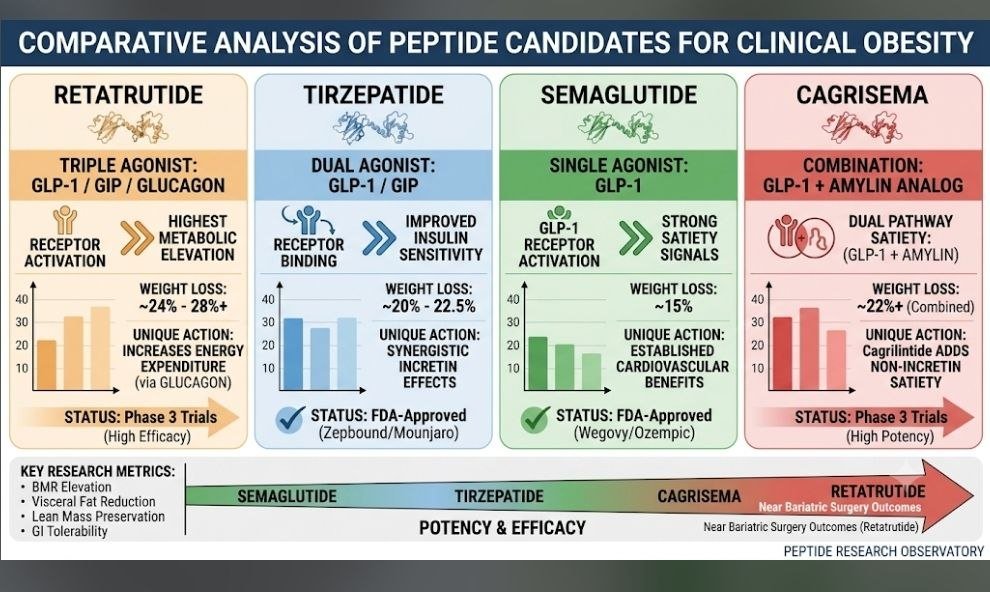
If the objective is maximum weight-loss potential in current clinical research, retatrutide is one of the most compelling candidates to watch.
If the objective is an established, highly effective obesity treatment with substantial clinical evidence, tirzepatide is one of the leading choices among currently approved therapies.
If the objective is an established GLP-1 benchmark with extensive clinical experience, semaglutide remains extremely important.
And if the research question involves combining complementary appetite-regulating pathways, CagriSema represents another important development in metabolic research.
That distinction matters.
There is no scientifically responsible way to say that one molecule is universally the best peptide for obesity for every person, research model, or therapeutic objective.
Obesity is biologically complex. Appetite, energy expenditure, insulin sensitivity, gastric emptying, satiety signaling, adipose tissue metabolism, physical activity, sleep, genetics and body composition can all influence outcomes.
The field has therefore moved beyond asking:
“Which peptide suppresses appetite the most?”
The more sophisticated question is:
Which metabolic strategy produces meaningful and sustainable fat loss while supporting metabolic health and preserving as much lean tissue as possible?
That is the framework I use when evaluating the best peptide for obesity candidates.
How I Rank the Best Peptide for Obesity Candidates
https://pubchem.ncbi.nlm.nih.gov
I have worked with peptides as a supplier and educator since 2003.
Over that time, I have watched peptide research move from relatively simple single-target approaches toward increasingly sophisticated multi-receptor strategies.
Today, I believe obesity research should be evaluated using several dimensions rather than weight loss alone.
1. Total body-weight reduction
The percentage of body weight lost remains an important endpoint.
However, it should never be viewed in isolation.
2. Body composition
Researchers increasingly need to ask:
How much of the weight lost is fat, and how much is lean tissue?
Two interventions producing identical scale weight changes can have very different physiological consequences if their effects on lean mass differ.
3. Cardiometabolic outcomes
Important research endpoints can include:
- Waist circumference
- Blood pressure
- Glycemic control
- Insulin sensitivity
- Lipid parameters
- Liver fat
- Inflammatory markers
- Cardiovascular risk
4. Tolerability
A theoretically powerful peptide is not automatically the best peptide for obesity if its tolerability prevents subjects from remaining on treatment.
Gastrointestinal adverse events are particularly important across incretin-based therapies.
5. Evidence quality
There is a huge difference between:
- Laboratory research
- Animal research
- Phase 1 studies
- Phase 2 trials
- Phase 3 trials
- Regulatory approval
- Real-world clinical experience
These evidence levels should never be treated as interchangeable.
Important: This article is for educational and research-information purposes. It does not provide medical advice, dosing instructions, treatment recommendations, or instructions for self-administration. Approved obesity medicines should be used only under the supervision of a qualified healthcare professional. Investigational compounds such as retatrutide should not be represented as approved treatments.
Best Peptide for Obesity: The 6 Leading Candidates
Here is my current research-oriented ranking.
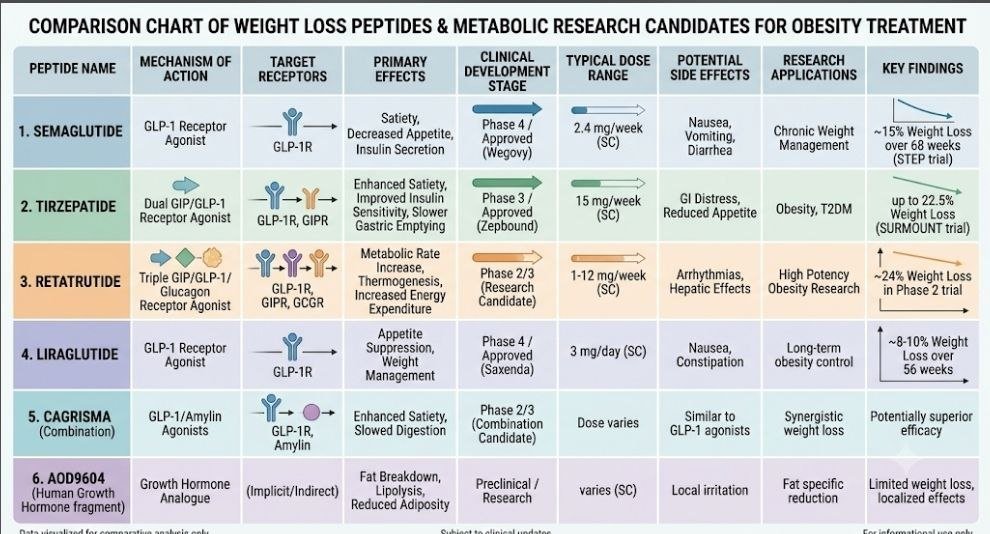
| Rank | Candidate | Main Mechanism | Research Position | Primary Research Interest |
|---|---|---|---|---|
| 1 | Retatrutide | GLP-1 + GIP + glucagon | Investigational | Maximum weight-loss potential and multi-receptor metabolism |
| 2 | CagriSema | Semaglutide + cagrilintide | Investigational/regulatory review | GLP-1 + amylin combination |
| 3 | Tirzepatide | GLP-1 + GIP | Approved obesity medicine | High efficacy and extensive clinical evidence |
| 4 | Cagrilintide | Amylin analogue | Investigational | Independent satiety pathway |
| 5 | Semaglutide | GLP-1 | Approved obesity medicine | Established GLP-1 benchmark |
| 6 | Liraglutide | GLP-1 | Approved obesity medicine | Earlier-generation GLP-1 reference |
The ranking does not mean that #1 is medically appropriate for every person.
It means that, from a metabolic research perspective, these candidates have different strengths and evidence profiles.
1. Retatrutide
Why Retatrutide Is Currently One of the Most Exciting Answers to “What Is the Best Peptide for Obesity?”
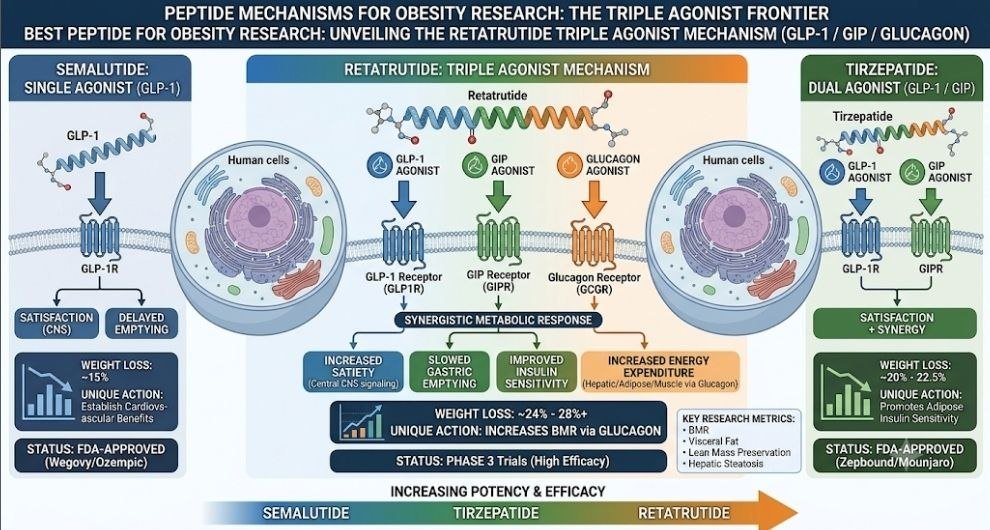
Retatrutide has changed the conversation around obesity research because it targets three hormone receptors simultaneously: GLP-1, GIP and glucagon.
That is substantially different from conventional single-receptor GLP-1 therapy.
The conceptual attraction is straightforward:
- GLP-1 signaling can reduce appetite and food intake.
- GIP contributes to metabolic and insulin-related signaling.
- Glucagon activation introduces another pathway relevant to energy expenditure and substrate metabolism.
The result is a multi-hormonal metabolic strategy rather than a single-receptor approach.
Early Phase 2 data were already impressive. In the 48-week Phase 2 obesity trial, the 12 mg group had an estimated mean weight reduction of 24.2%, compared with 2.1% with placebo.
The subsequent Phase 3 results have made retatrutide even more interesting.
In the TRIUMPH-1 Phase 3 trial, participants receiving 12 mg retatrutide experienced an average 28.3% weight reduction at 80 weeks, according to Lilly’s 2026 topline results.
Another Phase 3 trial, TRIUMPH-4, reported approximately 28.7% average weight loss at 68 weeks among participants receiving 12 mg.
These results explain why retatrutide currently deserves serious attention when discussing the best peptide for obesity research.
But there is an important distinction
Retatrutide remains investigational.
Lilly states that retatrutide has not been approved by any regulatory agency and warns against using products claiming to contain retatrutide outside Lilly-sponsored clinical trials.
Therefore, it would be misleading to describe retatrutide as an approved obesity medication.
For researchers, however, its mechanism and clinical-trial results make it one of the most important obesity molecules to follow.
2. CagriSema
CagriSema takes another approach to multi-pathway obesity treatment.
It combines:
- Semaglutide, a GLP-1 receptor agonist
- Cagrilintide, a long-acting amylin analogue
Amylin is a hormone involved in satiety and nutrient regulation.
This makes CagriSema scientifically interesting because it does not simply increase GLP-1 activity.
It combines two complementary pathways.
In the Phase 3 REDEFINE 1 trial, Novo Nordisk reported 22.7% weight loss at 68 weeks under the treatment-policy estimand assuming continued treatment, compared with 2.3% for placebo; the observed treatment-policy result was 20.4% versus 3.0%.
More than 40% of participants reached at least 25% weight loss in the on-treatment analysis.
That makes CagriSema a major candidate in the discussion of the best peptide for obesity.
However, its regulatory status must be clearly distinguished from approved treatments.
As of the information available for this article, CagriSema has been submitted for U.S. regulatory review but remains described as an investigational fixed-dose combination.
3. Tirzepatide
If retatrutide represents the future-facing triple-agonist research model, tirzepatide represents one of the strongest established dual-agonist benchmarks.
Tirzepatide activates both:
- GLP-1 receptors
- GIP receptors
The combination produces substantially greater average weight loss than semaglutide in direct comparative evidence.
The Phase 3b SURMOUNT-5 trial randomized 751 adults with obesity but without diabetes to maximum tolerated tirzepatide or semaglutide.
At week 72:
- Tirzepatide: −20.2%
- Semaglutide: −13.7%
Tirzepatide also produced a greater reduction in waist circumference.
That head-to-head result is extremely important.
It moves the conversation beyond indirect comparisons between separate studies.
In the United States, tirzepatide is approved as Zepbound for chronic weight management in adults with obesity or overweight plus at least one weight-related condition, alongside reduced-calorie diet and increased physical activity.
This is why I consider tirzepatide an essential benchmark when evaluating the best peptide for obesity.
4. Cagrilintide
Cagrilintide works through an entirely different primary pathway from GLP-1 agonists.
It is a long-acting amylin analogue.
That makes it particularly interesting from a research standpoint.
The significance of cagrilintide is not necessarily that it should outperform every GLP-1 or GIP-based molecule as a standalone treatment.
Its greater scientific value may come from what happens when amylin biology is combined with incretin biology.
In REDEFINE 1, cagrilintide 2.4 mg produced approximately 11.8% weight loss in the on-treatment analysis, compared with 16.1% for semaglutide and 22.7% for CagriSema under the same estimand.
This illustrates an important principle:
A peptide can be highly valuable scientifically without being the most powerful standalone weight-loss molecule.
Cagrilintide helps researchers investigate whether complementary appetite pathways can produce additional effects when combined appropriately in controlled clinical research.
5. Semaglutide
Semaglutide is one of the most important molecules in the modern history of obesity medicine.
Its mechanism is comparatively simple:
GLP-1 receptor agonism.
Yet its clinical impact has been enormous.
Semaglutide established the modern high-efficacy weekly GLP-1 model for obesity treatment.
The FDA originally approved Wegovy for chronic weight management in 2021. In March 2026, the FDA also approved Wegovy HD, a higher-dose semaglutide formulation, for certain adults with obesity or overweight with a weight-related condition.
Semaglutide also remains an important research benchmark.
When a new obesity peptide is being investigated, researchers often need a well-characterized comparator.
Semaglutide provides that benchmark.
It also has a large body of clinical evidence covering weight reduction, cardiovascular outcomes and metabolic effects.
So although newer molecules may produce greater average weight reduction in certain trials, semaglutide should not be dismissed as “old technology.”
It remains highly relevant.
6. Liraglutide
Liraglutide is an earlier-generation GLP-1 receptor agonist.
It was approved for chronic weight management before semaglutide and helped establish the therapeutic potential of GLP-1 biology in obesity.
Its major limitation compared with newer candidates is efficacy and dosing convenience.
Liraglutide requires daily administration for its obesity indication, whereas semaglutide and tirzepatide have weekly formulations.
For modern obesity research, liraglutide is therefore better viewed as an important historical and mechanistic reference point rather than the leading high-efficacy candidate.
Best Peptide for Obesity: Retatrutide vs. Tirzepatide vs. Semaglutide
This is one of the most important comparisons readers want to understand.
| Feature | Retatrutide | Tirzepatide | Semaglutide |
| GLP-1 | ✓ | ✓ | ✓ |
| GIP | ✓ | ✓ | — |
| Glucagon | ✓ | — | — |
| Current U.S. obesity approval | No | Yes | Yes |
| Research position | Investigational | Established treatment/benchmark | Established treatment/benchmark |
| Main attraction | Triple-receptor activity | High efficacy dual agonism | Extensive GLP-1 evidence |
| Key limitation | Investigational status | GI tolerability and individual response | Lower average weight loss than tirzepatide in SURMOUNT-5 |
The SURMOUNT-5 trial provides direct evidence that tirzepatide produced greater average weight loss than semaglutide over 72 weeks.
Retatrutide, meanwhile, has produced even larger average weight reductions in Phase 3 topline results, including 28.3% at 80 weeks in TRIUMPH-1.
But comparing those numbers requires caution.
They come from different trials, populations, protocols and study designs.
You should never assume that a 28.3% result from one trial automatically means every individual would lose 28.3%.
Clinical trial averages are not personal predictions.
Why Obesity Peptides Stop Producing the Same Scale Results
One of the most common questions I encounter is:
“Why did the peptide work extremely well at first and then seem to stop working?”
The answer is usually more complicated than receptor tolerance.
A plateau does not necessarily mean that the molecule has stopped functioning.
Several mechanisms can contribute.
1. Reduced energy expenditure
As body weight falls, the body generally requires fewer calories to maintain itself.
A person weighing 220 pounds does not have the same energy requirements as that same person at 180 pounds.
The energy deficit that produced rapid early weight loss may therefore become much smaller later.
2. Reduced non-exercise activity
NEAT stands for non-exercise activity thermogenesis.
It includes activities such as:
- Walking around
- Standing
- Fidgeting
- Household activity
- General movement
When energy intake falls, spontaneous movement can also decline.
The result is lower total daily energy expenditure.
3. Calorie creep
A person does not need to dramatically overeat to erase a small calorie deficit.
Liquid calories, sauces, snacks, high-calorie coffee drinks and increasingly larger portions can gradually close the gap.
This can happen even when appetite remains substantially lower than before treatment.
4. Body-composition changes
A scale plateau does not automatically mean that fat loss has completely stopped.
If resistance training is being performed consistently, someone could experience:
- Reduced fat mass
- Stable body weight
- Increased or preserved lean mass
That is why researchers should look beyond body weight when possible.
DEXA, waist circumference and other validated body-composition measurements can provide additional information.
Why Muscle Preservation Matters
This is one of the areas where obesity research needs greater attention.
The objective should not simply be:
“Make the scale go down.”
The more sophisticated objective is:
“Reduce excess fat while preserving as much functional lean tissue as possible.”
Rapid weight loss can involve both fat mass and lean mass.
The exact proportion varies substantially between individuals, interventions, baseline body composition, diet, physical activity and study methodology.
Therefore, blanket claims such as “all GLP-1 weight loss causes 40% muscle loss” should be treated cautiously.
What can researchers monitor?
Useful measurements can include:
- Lean mass
- Fat mass
- Waist circumference
- Strength
- Physical performance
- Protein intake
- Resistance-training participation
The practical lesson is simple:
Weight loss and body recomposition are not identical objectives.
A 30-pound reduction composed predominantly of fat is biologically different from a 30-pound reduction containing a large loss of skeletal muscle.
How to Evaluate Peptide Quality
For researchers, identifying the best peptide for obesity research is only half the problem.
The other half is determining whether the material being studied is actually what the supplier claims it is.
A product labeled “99% pure” should not be accepted solely because the label says so.
I recommend looking for several independent analytical layers.
1. Identity confirmation
Mass spectrometry can help verify molecular identity.
For complex peptide molecules, LC-MS or LC-MS/MS can provide significantly more information than a simple purity percentage.
The fundamental question is:
Does the measured molecular mass correspond to the expected molecule?
2. HPLC purity
Reverse-phase HPLC is commonly used to assess peptide purity.
A strong analytical report should show:
- Sample identification
- Lot/batch number
- Analytical method
- Chromatogram
- Retention time
- Purity calculation
- Laboratory identification
A single large “99%” number without supporting analytical information is not sufficient for serious research.
3. Endotoxin testing
For biological research, endotoxin can be a critical variable.
Depending on the research application, laboratories may use:
- LAL testing
- Recombinant Factor C methods
- Chromogenic methods
The appropriate acceptance criterion depends on the experimental system and intended use.
It should therefore not be assumed that one universal EU/mg threshold applies to every research model.
4. Heavy metals and residual solvents
For sensitive biological studies, researchers may also want analytical information regarding:
- Heavy metals
- Residual solvents
- Other process-related impurities
Methods can include ICP-MS and GC-MS where appropriate.
5. Third-party COA verification
A Certificate of Analysis should be traceable to the actual batch.
Look for:
- Lot number
- Test date
- Laboratory identity
- Analytical results
- Supporting chromatograms
- Mass-spectrometry data where applicable
- Clear connection between the COA and the physical batch
Third-party testing can provide an additional layer of confidence.
6. Net peptide content
Researchers should also understand the difference between gross vial weight and actual peptide content.
Lyophilized material can contain:
- Peptide
- Counterions
- Residual moisture
- Other formulation components
Therefore, the number printed on a vial should not automatically be interpreted as equivalent to the quantity of pure peptide molecule.
For quantitative research, understanding how content was measured is important.
Approved Obesity Medicines vs. Investigational Peptides
This distinction is essential.
Approved therapies
In the United States, examples include:
- Semaglutide products approved for specific indications
- Tirzepatide for chronic weight management
- Liraglutide for chronic weight management
The FDA lists semaglutide and tirzepatide among approved GLP-1-based obesity therapies.
Tirzepatide’s Zepbound labeling specifies its use alongside reduced-calorie diet and increased physical activity for chronic weight management in eligible adults.
Investigational candidates
Retatrutide remains investigational and has not been approved by a regulatory agency.
CagriSema has also been described as an investigational combination while undergoing the regulatory process.
This distinction is not merely legal terminology.
It tells the reader how much evidence exists, whether regulatory review has occurred and whether a product is an established prescription treatment or an investigational compound.
Three Representative Obesity Research Profiles
The following profiles are presented as anonymized educational examples supplied for this article, not as independently published clinical case reports. They should not be interpreted as proof that switching or using any particular peptide will produce the same outcome.
Case Study 1: Plateau During Semaglutide Research Follow-Up
A 44-year-old female profile began at approximately 228 pounds with a BMI of 36.8.
During the first several months of semaglutide treatment, weight decreased substantially.
The subject eventually reached approximately 201 pounds and experienced an extended plateau.
The important lesson is not that semaglutide “stopped working.”
Rather, the plateau illustrates how multiple factors can converge:
- Lower body mass
- Lower energy expenditure
- Reduced spontaneous activity
- Changes in appetite
- Dietary adaptation
- Body-composition changes
The subject subsequently transitioned to a tirzepatide-based treatment under clinical supervision and experienced further weight reduction.
The key research lesson is:
A plateau should trigger investigation before assuming pharmacological failure.
Case Study 2: Retatrutide and the Importance of Body Composition
A second educational profile involved a male subject beginning around 284 pounds with a BMI of approximately 40.7.
The profile demonstrated substantial weight reduction during a retatrutide research program.
However, body-composition assessment revealed that some of the weight lost was lean tissue.
That changed the research focus.
Instead of asking only:
“How much weight was lost?”
the research team also asked:
“What happened to lean mass?”
This led to greater attention to:
- Protein intake
- Resistance training
- Strength preservation
- Body-composition monitoring
The lesson is highly relevant to the future of obesity research.
The strongest weight-loss number is not necessarily the strongest overall metabolic outcome.
Case Study 3: Weight Regain After Discontinuation
A third educational profile involved a male subject who experienced substantial weight loss during semaglutide treatment.
However, the subject’s diet remained relatively low in protein and highly processed.
Resistance training was not consistently maintained.
After discontinuation, appetite increased and weight was regained.
This illustrates an important principle:
Appetite suppression is not the same thing as metabolic education.
A peptide can influence appetite while the individual still needs sustainable nutrition, physical activity and behavioral strategies.
Obesity is a chronic disease, and long-term weight management cannot necessarily be reduced to the presence or absence of one molecule.
What I Have Learned as a Peptide Supplier and Educator Since 2003
I have been working with peptides since 2003, primarily as a supplier and educator.
One of the biggest changes I have witnessed is the movement from simple peptide discussions toward increasingly sophisticated metabolic research.
The conversation has changed from:
“Which peptide suppresses appetite?”
to:
“Which biological pathways can be targeted simultaneously to improve weight, metabolic health and long-term outcomes?”
That is a major scientific shift.
But there is another shift that matters just as much:
quality control has become increasingly important.
Researchers should not choose a peptide solely because a supplier claims it is “high purity.”
They should investigate:
- Identity
- Purity
- Batch consistency
- Analytical documentation
- Storage
- Traceability
- Third-party verification
At OasBioScience, our educational approach is built around helping researchers understand what they are evaluating rather than simply looking at a product name.
For additional educational resources, laboratory-quality information and peptide research materials, visit OasBioScience.
Common Mistakes When Evaluating Obesity Peptides
Mistake 1: Choosing the peptide with the biggest number
A headline such as “30% weight loss” can be impressive.
But researchers need to ask:
- Which population?
- Which study?
- How long?
- What comparator?
- What endpoint?
- What adverse events?
- What happened to lean mass?
Numbers without context can be misleading.
Mistake 2: Assuming investigational means better
An investigational compound can be scientifically exciting.
That does not mean it is automatically safer, more effective or more appropriate than an approved medicine.
Retatrutide is a perfect example.
Its clinical results are extremely promising, but it remains investigational.
Mistake 3: Confusing appetite suppression with complete obesity treatment
Reducing appetite can help create a calorie deficit.
But obesity involves substantially more than hunger.
Long-term outcomes also involve:
- Energy expenditure
- Diet quality
- Physical activity
- Muscle preservation
- Sleep
- Metabolic health
- Long-term adherence
Mistake 4: Ignoring tolerability
The most powerful molecule on paper may not be the best research candidate for every model.
Gastrointestinal adverse events are common with incretin-based therapies, particularly during dose escalation. The SURMOUNT-5 trial reported gastrointestinal adverse events as the most common adverse events with both tirzepatide and semaglutide.
Mistake 5: Trusting a COA without verification
A COA should be treated as an analytical document, not simply a marketing certificate.
Researchers should verify:
What was tested?
Who tested it?
Which batch was tested?
What analytical methods were used?
Can the results be independently verified?
Frequently Asked Questions
1. What is the best peptide for obesity?
There is no single universally best peptide for obesity.
For current research, retatrutide is one of the most promising high-efficacy investigational candidates because it targets GLP-1, GIP and glucagon receptors. For established obesity treatment, tirzepatide and semaglutide have extensive clinical evidence and regulatory approvals for appropriate populations.
2. Is retatrutide the best peptide for obesity?
Retatrutide is arguably the most exciting investigational candidate for maximum weight-loss research at present.
Phase 3 results have reported average weight reductions approaching 30% in some trial populations. However, retatrutide remains investigational and should not be presented as an approved obesity treatment.
3. Is tirzepatide better than semaglutide for obesity?
In the head-to-head SURMOUNT-5 trial, tirzepatide produced greater average weight loss than semaglutide at 72 weeks: 20.2% versus 13.7%.
That does not mean every individual will respond better to tirzepatide.
Individual response, tolerability, medical history and treatment goals matter.
4. What is the difference between retatrutide and tirzepatide?
Tirzepatide activates GLP-1 and GIP receptors.
Retatrutide activates GLP-1, GIP and glucagon receptors.
The additional glucagon receptor activity is one of the major scientific reasons retatrutide has generated interest in obesity research.
5. Is CagriSema better than semaglutide?
CagriSema combines semaglutide with cagrilintide, creating a GLP-1 plus amylin approach.
In REDEFINE 1, CagriSema produced greater average weight loss than semaglutide alone under the reported trial analyses.
However, regulatory status and individual clinical suitability must be distinguished from trial efficacy.
6. Can a peptide stop working after several months?
A plateau does not necessarily mean that the peptide has stopped working.
Changes in body weight, energy expenditure, spontaneous activity, dietary intake and body composition can all reduce the size of the calorie deficit over time.
A plateau should therefore be investigated rather than automatically attributed to receptor tolerance.
7. Why is muscle preservation important during obesity treatment?
Because the objective should not simply be to reduce total body weight.
Preserving functional lean tissue can be important for:
- Strength
- Physical function
- Metabolic health
- Long-term body composition
For this reason, researchers should consider body-composition measurements rather than relying exclusively on the bathroom scale.
8. How can researchers evaluate peptide quality?
Start with independent analytical verification.
Important documentation can include:
- HPLC purity
- LC-MS or MS/MS identity
- Lot-specific COA
- Endotoxin testing where relevant
- Residual-solvent testing
- Heavy-metal testing
- Net peptide-content information
- Storage and shipping documentation
A strong analytical package is much more informative than a simple “99% pure” claim.
9. Are research peptides the same as approved obesity medications?
No.
An investigational peptide is not equivalent to an approved prescription medicine.
Retatrutide, for example, remains investigational.
Approved medicines have undergone regulatory review for specified indications, manufacturing standards and safety/efficacy requirements.
Researchers and consumers should never assume that a research-grade product has the same regulatory status as an approved pharmaceutical product.
10. Should someone choose an obesity peptide without speaking to a healthcare professional?
No.
Obesity medications can have contraindications, adverse effects and clinically important drug interactions.
For example, the FDA-approved labeling for tirzepatide includes important warnings and contraindications, including a boxed warning concerning thyroid C-cell tumors and contraindications involving personal or family history of medullary thyroid carcinoma or MEN 2.
Anyone considering an approved obesity medication should discuss their individual circumstances with a qualified healthcare professional.
Final Verdict: What Is the Best Peptide for Obesity?
After looking at mechanism, efficacy, evidence and research potential, my answer is more nuanced than simply naming one molecule.
If the question is about the most promising high-efficacy investigational candidate:
Retatrutide deserves the #1 research position.
Its triple GLP-1/GIP/glucagon mechanism and Phase 3 results have pushed obesity research into a new category of multi-receptor pharmacology.
If the question is about an established high-efficacy obesity treatment:
Tirzepatide is one of the strongest current benchmarks.
The direct SURMOUNT-5 comparison demonstrated significantly greater average weight loss than semaglutide over 72 weeks.
If the question is about an established GLP-1 benchmark:
Semaglutide remains one of the most important obesity molecules in modern clinical medicine.
If the question is about combination-pathway research:
CagriSema is particularly important because it combines GLP-1 and amylin biology.
Ultimately, the best peptide for obesity should not be judged solely by the largest number on a clinical-trial chart.
The more useful question is:
Which biological strategy produces meaningful fat loss, supports metabolic health, maintains acceptable tolerability and preserves as much functional lean tissue as possible?
That is where the future of obesity research is heading.
And that is why the next generation of metabolic peptides is so important.
For researchers who want to learn more about peptide quality, analytical documentation and research materials, explore the educational resources available at OasBioScience.
Research carefully. Verify your materials. Understand the evidence. And never confuse an exciting research molecule with an approved medical treatment.
Continue Learning: If you found this guide helpful, you may also want to read our previous peptide education articles covering the following topics
- Best 2026 Peptide Reconstitution Guide
- Learn the difference between BAC water and sterile water
- Discover the foods to avoid on GLP-1 medications
- Tirzepatide Side Effects: 15 Powerful Facts, Warning Signs & Safe Management
- Why am I not losing weight on semaglutide?
- How Much Weight Can You Lose on Tirzepatide?
- Which peptide suppresses appetite the most?
- Peptide Bubbles after reconstitution?
- Peptide Purity explained in depth
- How do I read a COA?
Scientific Reference: For additional peer-reviewed information on peptide stability, sterile preparation, and pharmaceutical reconstitution practices, visit
