
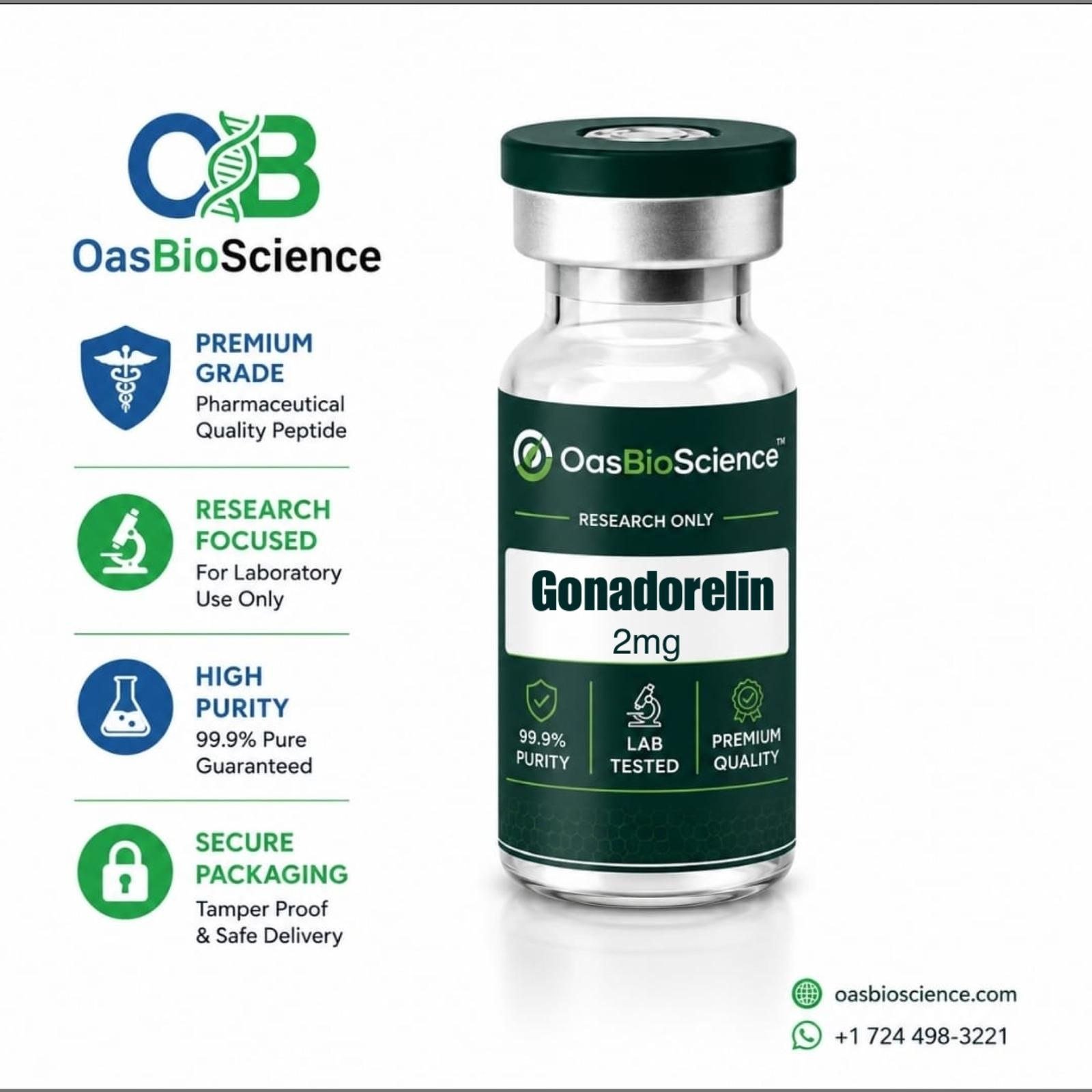
Description
Gonadorelin Peptide Overview
Gonadorelin Peptide is a synthetic form of gonadotropin-releasing hormone (GnRH), a naturally occurring decapeptide involved in the regulation of reproductive endocrine signaling.
Because Gonadorelin is a small and well-characterized peptide, it is widely used as a research tool for studying GnRH receptor biology, pituitary signaling, reproductive endocrinology, and peptide–receptor interactions.
For researchers, Gonadorelin provides a defined molecular system for investigating how GnRH signaling influences downstream endocrine pathways. Experimental findings should be distinguished from clinical applications, and research-grade material should not be marketed as a treatment.
What Is Gonadorelin Peptide?
Gonadorelin is the synthetic form of gonadotropin-releasing hormone (GnRH).
It is a 10-amino-acid peptide, making it a decapeptide.
In biological research, Gonadorelin is important because GnRH signaling plays a central role in the hypothalamic–pituitary–gonadal axis.
Research applications may include:
- GnRH receptor research
- Reproductive endocrinology
- Pituitary signaling studies
- Peptide receptor interactions
- Hormonal signaling research
- Endocrine pharmacology
- Cell-signaling experiments
- Structure–activity relationship studies
Its relatively small molecular size also makes Gonadorelin useful for studying peptide synthesis, characterization, and receptor binding.
Molecular Formula, Molecular Weight & Sequence
Gonadorelin has a defined 10-amino-acid sequence.
| Property | Specification |
|---|---|
| Product name | Gonadorelin Peptide |
| Alternative name | Gonadotropin-releasing hormone (GnRH) |
| Peptide length | 10 amino acids |
| Sequence | pGlu-His-Trp-Ser-Tyr-Gly-Leu-Arg-Pro-Gly-NH₂ |
| One-letter representation | pEHWSYGLRPG-NH₂ |
| Molecular formula | C₅₅H₇₅N₁₇O₁₃ |
| Molecular weight | Approximately 1,182.32 g/mol |
| Peptide class | Synthetic decapeptide |
Understanding the sequence
The sequence begins with pyroglutamic acid (pGlu) and ends with an amidated glycine, features that are characteristic of native GnRH.
The sequence can be represented as:
pGlu-His-Trp-Ser-Tyr-Gly-Leu-Arg-Pro-Gly-NH₂
For analytical work, researchers should verify the molecular mass against the exact product specification and analytical documentation.
Purity
A suitable research-grade specification can be presented as:
Purity: ≥98% by HPLC
However, this specification should only be used when it is supported by the actual batch-specific analytical results.
A professional Certificate of Analysis may include:
- HPLC purity
- HPLC chromatogram
- Mass spectrometry
- Expected molecular weight
- Observed molecular weight
- Lot/batch number
- Testing date
- Peptide content
Researchers should always prioritize the COA for the specific lot over a generic website specification.
Appearance
Typical appearance: White to off-white lyophilized powder.
Gonadorelin Peptide may be supplied as a dry, lyophilized research material to support storage and handling.
The exact appearance may vary slightly depending on:
- Manufacturing process
- Lyophilization conditions
- Formulation
- Packaging conditions
Appearance alone cannot establish purity or molecular identity. HPLC and mass spectrometry provide more meaningful analytical confirmation.
Available Vial Sizes
Common research-packaging options can include:
- 2 mg
- 5 mg
- 10 mg
- 20 mg
- 50 mg
For a research-oriented product catalog, 2 mg, 5 mg, and 10 mg can provide convenient options for laboratories working with small quantities.
Larger quantities can be made available for laboratories requiring repeated analytical work.
Only list quantities that you actually stock and can support with appropriate batch documentation.
Storage Recommendations
Proper storage helps maintain the quality of lyophilized Gonadorelin.
General laboratory considerations include:
- Keep the vial tightly sealed.
- Protect the peptide from moisture.
- Minimize exposure to excessive heat.
- Protect from unnecessary direct light.
- Avoid repeated temperature cycling.
- Follow the storage specifications supplied for the specific batch.
- Allow cold material to equilibrate appropriately before opening to reduce condensation.
For long-term storage, follow the manufacturer’s documented stability information.
After reconstitution, the stability profile can differ from that of the original lyophilized material. Researchers should therefore follow validated laboratory procedures for prepared solutions.
Reconstitution Information
Gonadorelin is typically supplied as a lyophilized research peptide.
Reconstitution should be performed according to the laboratory’s validated protocol and the intended experimental application.
General considerations include:
- Allow the sealed vial to equilibrate appropriately before opening.
- Select a compatible laboratory solvent.
- Add the solvent carefully.
- Avoid unnecessary vigorous agitation.
- Allow adequate time for dissolution.
- Record the solvent and final concentration.
- Minimize unnecessary freeze–thaw cycles.
- Follow the laboratory’s validated stability protocol after preparation.
There is no universal reconstitution volume suitable for every research experiment.
The appropriate preparation conditions depend on the experimental design, desired concentration, solvent compatibility, and laboratory protocol.
Intended Use — Research Only
Gonadorelin Peptide is intended for laboratory and scientific research purposes.
Potential research areas include:
- GnRH receptor biology
- Reproductive endocrinology
- Pituitary signaling
- Endocrine research
- Peptide pharmacology
- Receptor-binding studies
- Hormonal signaling pathways
- Peptide structure–activity research
Research-grade Gonadorelin should not be marketed on the product page as:
- A fertility treatment
- A hormone therapy
- A testosterone treatment
- A prescription medicine
- A treatment for reproductive disorders
Research Use Only. Not for Human or Veterinary Administration.
Researchers are responsible for ensuring their use complies with applicable laws, institutional requirements, and laboratory safety procedures.
Packaging & Shipping Information
Professional packaging helps protect Gonadorelin during transportation while providing researchers with important product information.
Packaging may include:
- Securely sealed vial
- Product identification label
- Net quantity
- Lot/batch number
- Research-use statement
- Protective secondary packaging
- Batch-specific COA
Upon delivery, researchers should inspect the packaging and vial for visible damage.
Before placing the product into laboratory inventory, verify:
Product name + quantity + lot number + formulation + COA
Shipping conditions should follow the documented storage and stability requirements for the product and applicable transportation regulations.
Frequently Asked Questions About Gonadorelin Peptide
What is Gonadorelin Peptide?
Gonadorelin is a synthetic form of gonadotropin-releasing hormone (GnRH) and is a 10-amino-acid peptide.
What is the Gonadorelin sequence?
The sequence is:
pGlu-His-Trp-Ser-Tyr-Gly-Leu-Arg-Pro-Gly-NH₂
How many amino acids does Gonadorelin contain?
Gonadorelin contains 10 amino acids, making it a decapeptide.
What is the molecular formula?
The commonly reported molecular formula is:
C₅₅H₇₅N₁₇O₁₃
What is the molecular weight?
Gonadorelin has a molecular weight of approximately:
1,182.32 g/mol
What purity should researchers look for?
A research-grade Gonadorelin product may specify ≥98% HPLC purity, provided the claim is supported by the batch-specific COA.
What does Gonadorelin look like?
It is typically supplied as a white to off-white lyophilized powder.
What is Gonadorelin researched for?
Gonadorelin is used in research involving GnRH receptor signaling, reproductive endocrinology, pituitary biology, endocrine signaling, and peptide pharmacology.
Should Gonadorelin have a COA?
Yes. A batch-specific COA is strongly recommended for professional research materials. It can document HPLC purity, mass spectrometry, molecular-weight confirmation, lot number, and testing date.
How should Gonadorelin be stored?
Follow the manufacturer’s storage specifications for the exact batch. Protect the lyophilized material from moisture, excessive heat, direct light, and unnecessary temperature fluctuations.
How is Gonadorelin reconstituted?
Reconstitution depends on the laboratory’s experimental requirements and validated protocol. There is no universal preparation volume suitable for every research application.
Is Gonadorelin a fertility treatment?
Gonadorelin has a biological relationship with reproductive endocrine signaling, but a research-grade product should not be marketed as a fertility treatment or human therapeutic.
Is Gonadorelin intended for human use?
A research-grade product should be labeled:
Research Use Only — Not for Human or Veterinary Administration.
Key Takeaway
Gonadorelin Peptide is a well-characterized synthetic decapeptide representing gonadotropin-releasing hormone (GnRH).
Key specifications
- Sequence: pGlu-His-Trp-Ser-Tyr-Gly-Leu-Arg-Pro-Gly-NH₂
- Length: 10 amino acids
- Molecular formula: C₅₅H₇₅N₁₇O₁₃
- Molecular weight: approximately 1,182.32 g/mol
- Purity: ≥98% by HPLC when supported by the relevant COA
- Appearance: White to off-white lyophilized powder
- Format: Research-grade peptide
- Intended use: Laboratory research only
For researchers, quality should be assessed through identity confirmation, HPLC purity, mass spectrometry, accurate labeling, appropriate storage information, and a batch-specific COA.
Research Use Only. Not for Human or Veterinary Administration.
Continue Learning: If you found this guide helpful, you may also want to read our previous peptide education articles covering the following topics
- What Bacteriostatic Water Should I Use For My Peptide?
- What’s Peptide Reconstitution?
- How Long Do Peptides Last?
- How Should Peptides Be Stored?
- How do I read a COA?
- What Does HPLC Testing Mean?
- Peptide Bubbles after reconstitution?
- Which peptide suppresses appetite the most?
Scientific Reference: For additional peer-reviewed information on peptide stability, sterile preparation, and pharmaceutical reconstitution practices, visit

Reviews
There are no reviews yet.