

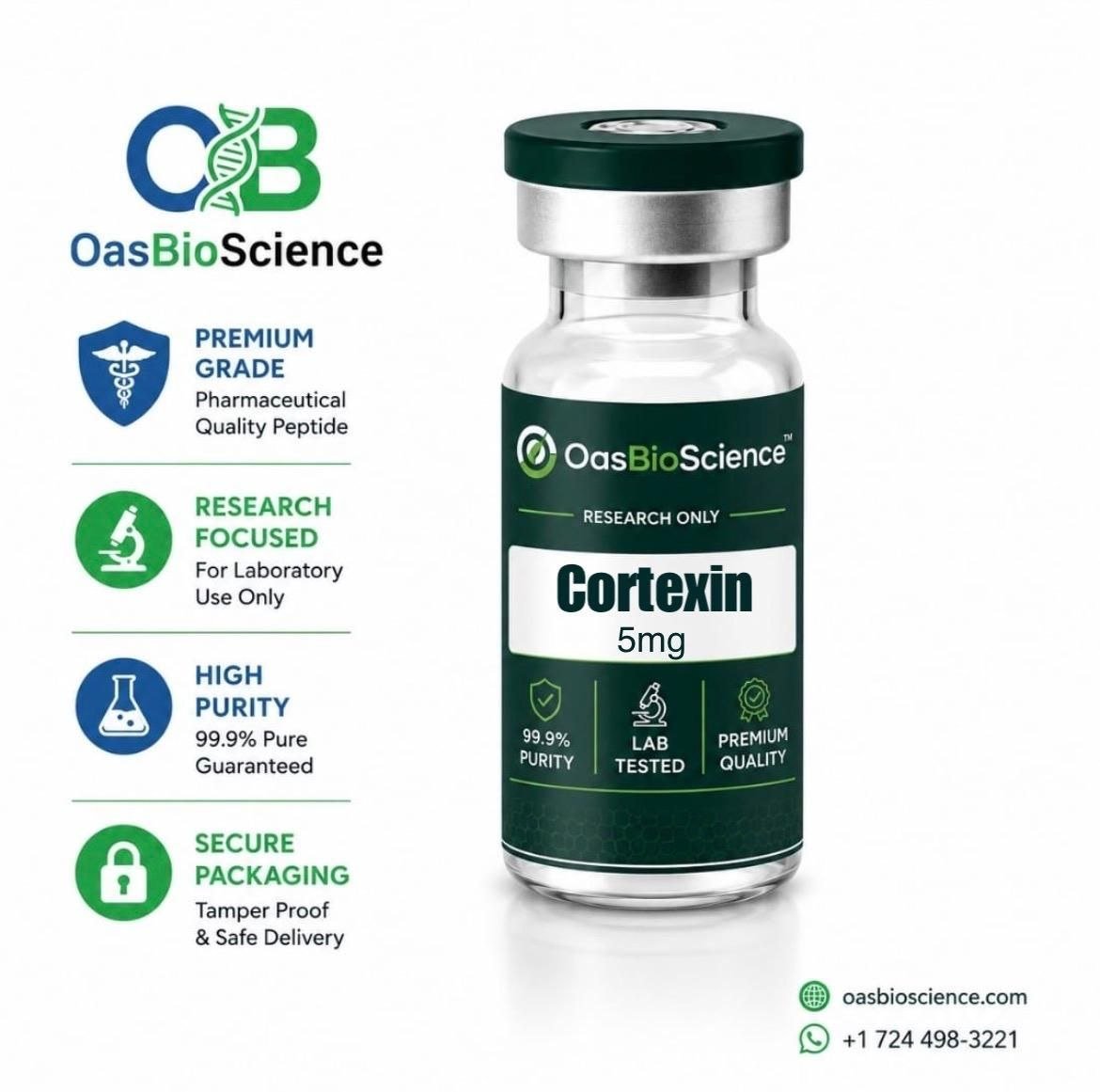
Description
Cortexin Peptide Overview
Cortexin Peptide is a peptide-based biological preparation traditionally described as a complex of low-molecular-weight peptides and other peptide-related components derived from animal cerebral tissue. Unlike a conventional synthetic peptide such as BPC-157 or Selank, Cortexin is not one single defined peptide sequence.
This distinction is extremely important when preparing a professional product page. Cortexin should not be given one molecular formula, molecular weight, or amino-acid sequence as though it were a single purified molecule.
Cortexin has been investigated in neuroscience and biochemical research, including studies of neuronal function, neurotrophic signaling, oxidative processes, and nervous-system biology.
Research Use Only: Cortexin Peptide is supplied for laboratory and scientific research purposes only. It is not intended for human or veterinary administration, diagnosis, treatment, cure, or prevention of disease.
What Is Cortexin Peptide?
Cortexin is generally described as a complex preparation containing low-molecular-weight peptides and peptide-associated biological components.
This makes Cortexin fundamentally different from defined synthetic peptides.
For example:
- Selank has a defined amino-acid sequence.
- BPC-157 has a defined peptide sequence.
- Cortexin is a complex mixture rather than one single molecular entity.
Because of this, researchers interested in Cortexin should focus on composition, characterization, manufacturing specifications, and batch-specific analytical documentation rather than expecting one universal molecular formula.
Cortexin has been investigated in research areas including:
- Neuroscience
- Peptide biochemistry
- Neurobiology
- Cellular signaling
- Oxidative-stress research
- Neuronal function
- Protein and peptide interactions
- Neurotrophic research
Research findings depend heavily on the preparation, experimental model, and analytical methodology used.
Molecular Formula, Molecular Weight & Sequence
Unlike a conventional synthetic peptide, Cortexin does not have one universally applicable molecular formula, molecular weight, or amino-acid sequence.
This is because Cortexin is a peptide complex/mixture containing multiple low-molecular-weight peptide components.
Product specification
| Property | Cortexin Peptide |
|---|---|
| Product name | Cortexin Peptide |
| Material type | Peptide complex |
| Composition | Multiple low-molecular-weight peptide components |
| Single peptide sequence | Not applicable |
| Single molecular formula | Not applicable |
| Single molecular weight | Not applicable |
| Physical form | Typically supplied as a lyophilized preparation |
Why this matters
A professional product page should not invent a single molecular weight or sequence for Cortexin.
Instead, researchers should be provided with the supplier’s:
- Batch-specific composition information
- Analytical documentation
- Manufacturing specifications
- Identity testing
- Purity/quality data
- Certificate of Analysis (COA)
If your particular Cortexin product is a defined synthetic or recombinant preparation rather than the traditional peptide complex, its specifications should be listed according to the manufacturer’s exact documentation.
Purity
Because Cortexin is a complex preparation rather than one defined synthetic peptide, a simple statement such as “≥98% by HPLC” may not adequately describe the material.
For a professional Cortexin product page, it is better to state:
Purity/Quality: Batch-specific analytical specification — see COA.
Where applicable, analytical documentation may include:
- HPLC or chromatographic analysis
- Peptide-profile information
- Molecular characterization
- Protein/peptide content
- Lot number
- Testing date
- Microbiological testing
- Residual moisture
- Other applicable quality-control measurements
If your actual batch has been independently tested and the COA specifically reports ≥98% HPLC purity, that exact value can be displayed. Otherwise, avoid assigning a generic purity percentage.
Appearance
Typical appearance: White to off-white lyophilized powder.
The precise appearance can vary depending on the manufacturing and drying process.
A small variation in color or powder texture does not by itself establish identity or purity.
For professional laboratory work, researchers should verify the material using the available analytical documentation rather than relying only on visual inspection.
Available Vial Sizes
Cortexin-type research materials can be offered in several quantities depending on the supplier’s formulation and packaging.
Common research formats may include:
- 5 mg
- 10 mg
- 20 mg
- 50 mg
- 100 mg
For your store, only list vial sizes that you actually stock and can document.
If your product is based on the traditional Cortexin preparation, the exact amount should be clearly identified as the amount of the preparation, rather than implying that it represents a single purified peptide.
Storage Recommendations
Proper storage is important for maintaining the quality of lyophilized peptide preparations.
General considerations include:
- Keep the vial tightly sealed.
- Protect the material from moisture.
- Minimize exposure to excessive heat.
- Protect from unnecessary direct light.
- Avoid repeated temperature fluctuations.
- Store according to the conditions specified by the manufacturer or batch documentation.
- Allow refrigerated material to equilibrate appropriately before opening to reduce condensation.
For long-term storage, researchers should follow the validated stability information supplied for the specific product.
Important: Because Cortexin is a complex biological preparation, the manufacturer’s stability and storage specifications should take priority over generic peptide-storage recommendations.
Reconstitution Information
Cortexin is generally supplied as a lyophilized preparation.
Reconstitution should be performed according to the specific product’s laboratory protocol and applicable manufacturer documentation.
General laboratory considerations include:
- Allow the sealed vial to equilibrate appropriately before opening.
- Use a compatible laboratory solvent specified for the particular preparation.
- Add the solvent carefully.
- Avoid unnecessarily vigorous agitation.
- Allow sufficient time for the material to dissolve or disperse.
- Record the preparation conditions.
- Use appropriate sterile laboratory techniques when required by the experimental design.
- Follow the documented stability period after preparation.
There is no universal reconstitution volume that should be applied to every Cortexin preparation.
The appropriate preparation conditions depend on the exact composition and intended research application.
Intended Use — Research Only
Cortexin Peptide is intended for laboratory and scientific research.
Potential research areas include:
- Neuroscience research
- Neurobiology
- Peptide-complex characterization
- Cellular signaling studies
- Oxidative-stress research
- Neuronal biology
- Peptide interaction studies
It should not be presented on a product page as:
- An injectable treatment
- A prescription medicine
- A treatment for neurological disorders
- A cognitive-enhancement product
- A treatment for memory problems
- A substitute for approved medical therapy
Research Use Only. Not for Human or Veterinary Administration.
Researchers are responsible for ensuring that their use of the material complies with applicable laws, institutional requirements, and laboratory safety procedures.
Packaging & Shipping Information
Cortexin should be packaged in a manner appropriate for protecting the lyophilized material during transportation.
Professional packaging may include:
- Securely sealed vial
- Product identification label
- Net quantity
- Lot/batch number
- Research-use statement
- Protective secondary packaging
- Batch-specific COA or analytical documentation
Upon delivery, inspect the package and vial for visible damage.
Before adding the material to laboratory inventory, verify:
Product name + quantity + lot number + formulation + COA
Shipping conditions should follow the applicable stability requirements and transportation regulations.
Frequently Asked Questions About Cortexin Peptide
What is Cortexin Peptide?
Cortexin is generally described as a complex preparation containing low-molecular-weight peptides, rather than one single defined peptide.
Does Cortexin have a single amino-acid sequence?
No. Traditional Cortexin preparations contain multiple peptide components, so there is no single sequence representing the entire preparation.
Does Cortexin have one molecular formula?
No. Because it is a complex mixture, it does not have one universal molecular formula.
What is the molecular weight of Cortexin?
Cortexin does not have one single molecular weight. Individual peptide components within the preparation can have different molecular masses.
What does Cortexin look like?
It is typically supplied as a white to off-white lyophilized powder.
Can Cortexin be described as ≥98% HPLC purity?
Only if the specific batch’s analytical documentation supports that claim. Because Cortexin is a complex preparation, a generic ≥98% HPLC claim may be misleading.
What should researchers look for on the COA?
Depending on the product, useful documentation can include composition information, analytical characterization, lot number, testing date, purity/quality measurements, and relevant microbiological or physicochemical tests.
How should Cortexin be stored?
Follow the storage conditions specified by the manufacturer for the exact preparation. Protect the lyophilized material from moisture, excessive heat, light, and unnecessary temperature cycling.
How is Cortexin reconstituted?
Reconstitution depends on the exact formulation and research application. Researchers should follow the applicable product documentation rather than applying a generic peptide-reconstitution protocol.
Is Cortexin the same as Selank?
No. Selank is a defined synthetic peptide with a specific amino-acid sequence, whereas traditional Cortexin is a complex peptide preparation.
Is Cortexin the same as BPC-157?
No. BPC-157 is a defined peptide sequence, while Cortexin is generally described as a mixture of multiple low-molecular-weight peptide components.
Is Cortexin intended for human use?
A research-grade Cortexin product should be clearly labeled Research Use Only and should not be represented as a product for human or veterinary administration.
Key Takeaway
Cortexin Peptide is different from most conventional peptide products because it is generally described as a complex preparation of multiple low-molecular-weight peptides, rather than one purified peptide molecule.
Therefore, a scientifically accurate Cortexin product page should not assign a single molecular formula, molecular weight, or amino-acid sequence unless the exact product is a defined chemical entity supported by appropriate documentation.
For professional research purchasing, the most important quality indicators are:
- Accurate product identity
- Clear composition information
- Batch-specific COA
- Appropriate analytical characterization
- Transparent storage instructions
- Correct labeling
- Research-use-only designation
Research Use Only. Not for Human or Veterinary Administration.
Continue Learning: If you found this guide helpful, you may also want to read our previous peptide education articles covering the following topics
- Why am I not losing weight on semaglutide?
- Which peptide suppresses appetite the most?
- Peptide Bubbles after reconstitution?
- Are peptides legal?
- re peptides safe?
- Peptide Purity explained in depth
- How Should Peptides Be Stored?
Scientific Reference: For additional peer-reviewed information on peptide stability, sterile preparation, and pharmaceutical reconstitution practices, visit PubChem

Reviews
There are no reviews yet.